


Chemical Business Ideas India is entering a decisive growth phase due to rise in industrial expansion, infrastructure development, increased exports and policy-led manufacturing reforms. Under Viksit Bharat @2047 vision, there is a very clear strategic objective: build up domestic manufacturing, make India less dependent on imports, enhance quality standards and create globally competitive, environmentally responsible industries.
The chemical sector is already a contributor to more than ₹15 lakh crore in output and critical industries like agriculture, pharmaceuticals, textiles, automobiles, construction, and consumer goods. For MSMEs and startup founders, the opportunities are not to compete with large players in the commodity chemicals business but to build value-added, downstream chemical manufacturing businesses in line with the long-term industrial road map in India.
This article covers the ideas of high potential chemical business, cluster advantages in strategy, compliance aspects, and practical steps to form a sustainable enterprise.
Table of Contents
ToggleWhy India's Chemical Sector Is A Long Term Opportunity
India is currently the 6th largest producer of chemical globally and one of the fastest growing markets. The growth of the sector is supported by structural drivers:
- Increasing domestic consumption across the manufacturing industries
- Strong push by Indian government for “Make in India” and import substitution
- Actions taken: – Infrastructure and housing expansion
- Increasing environmental and quality compliance requirements
- Growing world market for specialty chemicals
While bulk alkali chemicals dominate in terms of production volume, specialty, organic and application-specific formulations offer better opportunities for MSMEs owing to lower capital intensity and higher margin protection.
The future of chemical manufacturing in India will be determined not by scale alone, but by technical differentiation, quality control, and downstream value creation.(Chemical Business Ideas India)
Strategic Advantage: Chemical Clusters & PCPIR Regions
India established Petroleum, Chemicals and Petrochemicals Investment Regions to boost ecosystem-based manufacturing through its development of Petroleum, Chemicals and Petrochemicals Investment Regions. The clustered system enables new business owners to enter the market because it delivers common facilities and essential material and transportation advantages.
Dahej
Dahej has an excellent port connectivity and a well-established chemical ecosystem. It is ideal for the processing of polymer compounding, specialty chemical processing, and export-oriented units.
Vizag–Kakinada PCPIR
This coastal region offers logistical efficiency and growing petrochemical infrastructure to make it suitable for downstream conversion projects.
Pradeep PCPIR
Pradeep benefits from feedstock availability and increasing downstream chemical opportunities vis-a-vis the refinery.
Cluster Advantages Include:
- Reduced logistics cost
- Effluent treatment facilities commonly used
- Skilled technical manpower availability
- Streamlined regulatory coordination
- Vast vendor and buyer ecosystems
Choosing the right location goes a long way toward improving long-term profitability.(Chemical Business Ideas India)
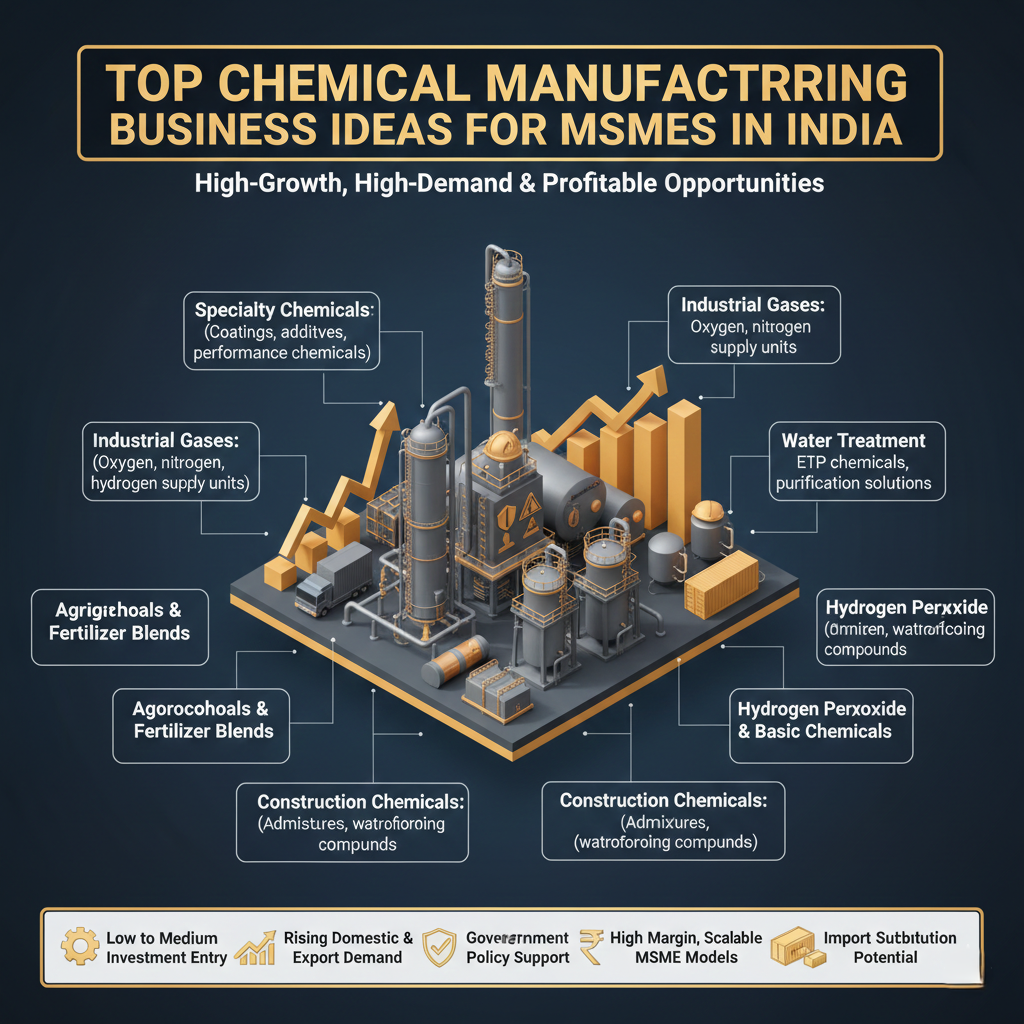
High Growth Chemical Manufacturing Business Ideas for MSMEs
1. Polymer Compounding, Masterbatches
Instead of manufacturing base polymers, MSMEs can alter them in performance-enhanced grades for automotive, packaging, cables and consumer appliances.
Investment Range: ₹1–3 crore
Margin Potential: 12-25% based on customization
Key Success Factor: Formulation know-how and stable quality
This is the segment where there are recurring orders, once product approval is received from the industrial buyers. Import substitution in specialty polymer grades creates additional growth potential.
2. Water Treatment Chemicals
Industrial and municipal expansion leads to more water purification and effluent treatment chemicals. Manufacturing units, CETPs and the municipal bodies also need regular supply.
Product Categories:
- Coagulants and flocculants
- pH control chemicals
- Anti-sealants
- Sludge treatment aids
Investment Range: ₹50 lakh–₹2 crore
Margin Potential: 15–30%
Reliability, concentration stability and regulatory compliance are differentiators in this segment.(Chemical Business Ideas India)
Read More: Modern Technology of Industrial Chemicals
3. Construction Chemicals
With the infrastructure expansion in place under the national development programs, there is a good downstream opportunity in the field of construction chemicals.
Products Include:
- Tile adhesives
- Waterproofing compounds
- Epoxy grouts
- Repair mortars
Investment Range: ₹75 lakh–₹2.5 crore
Margin Potential: 18–35%
This market not only rewards product performance but contractor relationships too, not just on scale.(Chemical Business Ideas India)
Read More: Industrial Chemicals Technology Hand Book
4. Textiles Processing Auxiliaries
The textile industry in India operates its manufacturing processes through chemical auxiliaries which are essential for the complete dyeing and finishing and quality enhancement of textiles.
Product Examples:
- Wetting agents
- Dispersants
- Silicone softeners
- Fixing agents
The textile industry requires improved product formulations because its export-driven growth needs to comply with international standards.(Chemical Business Ideas India)
5. Specialty Surfactant Combinations
Institutional hygiene, food processing, hospitals, manufacturing units to name a few need customized cleaning solutions.
Instead of selling commodity surfactants, MSMEs are able to formulate stable blends intended for special industrial applications.
Key Advantage: The process of creating unique products involves two main activities which include testing product performance and developing specific product formulas.(Chemical Business Ideas India)
6. Agrochemical Formulations
While active ingredient manufacturing is capital intensive, formulation and blending units can be in MSME scale with stringent compliance.
- Critical Success Factors:
- Correct labelling and documentation
- Safe storage and handling
- Adherence to regulatory approvals
This segment needs to be subject to disciplined compliance management.(Chemical Business Ideas India)
7. High-Purity Inorganic Salts
Rather than being forced to compete in the mass markets for chemicals, entrepreneurs have the opportunity to specialize in application-specific grade ceramics, detergents, glass, and metallurgy.
Value is created through:
- Controlled impurity levels
- Uniform particle size distribution
- Moisture control
Industrial buyers pay premiums for consistency.
Lessons from the Industrial Leaders of India
Mukesh Ambani
Expanded Reliance Industries by expanding downstream into higher-value segments instead of sticking to the level of raw materials
Kumar Mangalam Birla
Strengthened Aditya Birla Group by governance, diversification and strategic discipline.
Karsan Bhai Patel
Built Nirma with affordability and operational consistency.
For MSMEs, the lesson is clear: sustainable growth is found in the system, quality control and long-term positioning – not short-term price competition.(Chemical Business Ideas India)
Common Errors Made in Chemical Startups
Many new chemical businesses fail because of preventable mistakes:
- Underestimating the working capital requirements
- Neglecting environmental compliance costs
- Entering oversupplied commodity markets
- Poor quality control systems
- Poor plant location selection
- Inadequate safety measures
A detailed feasibility study, realistic financial modelling, and compliance planning are very important before capital deployment.(Chemical Business Ideas India)
Compliance & Regulatory Requirements
Chemical manufacturing in India entails:
- Factory License
- State Pollution Control Board approval
- Environmental clearance (if any)
- Fire department clearance
- GST registration
- Product specific regulatory permissions
The requirement for compliance exists as a mandatory duty. Organizations that fail to comply will face operational shutdowns and financial penalties and damage to their corporate image.(Chemical Business Ideas India)
Capital Planning and Financial Structure
Typical MSME chemical projects require:
- Land & Infrastructure 25 – 35% of capital
- Plant & Machinery: 30–40%
- Utilities & Effluent Systems: 10–15%
- Working Capital: 20–30%
Working capital management is the biggest challenge in many cases. Industrial buyers usually operate on 45 to 90 day credit cycles.(Chemical Business Ideas India)
Read More: Project Reports & Profiles
Aligning with Viksit Bharat @2047
To build a future-ready chemical enterprise:
- Focus on import substitution segments
- Develop specification-based products
- Invest in quality testing and lab infrastructure
- Choose cluster-based industrial zones
- Implement environmental safeguards from inception
- Plan phased capacity expansion
The Viksit Bharat vision includes three main elements which include sustainable industrial growth and international competitiveness and local value production. The policy framework will assist micro, small and medium enterprises that operate according to these priorities because the market demand will increase and export prospects will expand.(Chemical Business Ideas India)
Conclusion
The chemical sector in India is undergoing permanent growth because it enters a phase of structural expansion. As infrastructure expands, manufacturing scales, and quality standards rise, downstream chemical manufacturing presents powerful opportunities for disciplined entrepreneurs.
The future does not belong to the largest plants alone. It belongs to well-planned, compliance-driven, value-added manufacturing units that serve specific industrial needs with consistency and technical expertise.
The establishment of profitable chemical enterprises requires entrepreneurs to develop their business skills and technical abilities while they follow the strategic requirements of India’s Viksit Bharat @2047 vision. These businesses will help to develop the nation and will generate long-lasting financial value.(Chemical Business Ideas India)
FAQs
Which chemical manufacturing business is best for beginners?
Polymer compounding, water treatment chemicals, and construction chemicals are relatively MSME-friendly because they allow differentiation and manageable capital investment.
How much capital is needed to start a chemical manufacturing unit in India?
Investment depends on product type, but small-scale units typically require ₹50 lakh to ₹3 crore, including compliance infrastructure.
Is chemical manufacturing profitable in India?
Yes, especially in specialty and downstream segments where margins are protected through quality and formulation expertise.
What licenses are required for chemical manufacturing?
Factory license, Pollution Control Board approval, GST registration, fire clearance, and product-specific regulatory approvals.
How important is compliance in chemical manufacturing?
Extremely important. Non-compliance can result in shutdowns, penalties, and loss of customer trust.(Chemical Business Ideas India)


