

• Latest
  • Trending
  • All
fiber intermediates manufacturing India process diagram showing PTA and MEG production

How to Start Fiber Intermediates (PTA & MEG) Manufacturing Unit in India

June 4, 2026
Government-approved ₹10,000 crore Container Manufacturing Scheme 2026 showing shipping container production, factory workers and new manufacturing business opportunities in India.

India’s ₹10,000-Crore Container Manufacturing Scheme: New Business Opportunities

October 31, 2026
food-grade rPET business ideas in India

Food-Grade rPET Business Ideas in India | 40% Recycled Content

October 30, 2026
Project & Profile
PET recycling business in India

PET Recycling Business Ideas: India’s 40% Mandate Opens New Markets

October 29, 2026
PET Recycling Business in India

How to Start a PET Recycling Business in India: Rules, Opportunities & MSME Setup

October 28, 2026
Jambudiya-Paneli Ceramic Park

Jambudiya-Paneli Ceramic Park: What Entrepreneurs Should Know as GIDC Opens Plot Applications

October 21, 2026
Gujarat Medical Device Park

Gujarat Medical Device Park: Rajkot Opens a New Route for Manufacturing Investment

October 21, 2026
Gujarat Bulk Drug Park

Want to Start a Pharma Business? Gujarat to Open Applications for Its 2,015-Acre Bulk Drug Park

October 20, 2026
Entrepreneur India Magazine September 2026 – Manufacturing Business Ideas and Investment Opportunities

Entrepreneur India Magazine September 2026: Manufacturing Business Ideas and Investment Opportunities

October 20, 2026
Scouring pads and sponges manufacturing business ideas with colorful cleaning sponges, scrub pads, packaging, and factory production line.

Scouring Pads and Sponges Manufacturing business ideas

October 3, 2026
High Protein Food Manufacturing in India: 10 Business Ideas

High Protein Food Manufacturing in India: Business Ideas for a Market That Has Finally Woken Up

October 1, 2026
Tripura Business Opportunities: 22 Priority Sectors

Tripura Business Opportunities with Government Benefits: A Complete Guide to 22 Priority Sectors

October 1, 2026
Tall Oil Rosin Production, Processing | Handbook

The Byproduct That Became a Business: Why Tall Oil and Rosin Are Among the Most Versatile Industrial Chemicals You Have Never Heard Of

October 1, 2026
  • About
  • Advertise
  • Privacy & Policy
  • Contact
Tuesday, November 3, 2026
  • Login
Entrepreneur India Blog
  • Home
  • About
  • Books
  • Business Ideas
  • Contact
No Result
View All Result
Entrepreneur India Blog
No Result
View All Result
Home Chemical Industry Business Opportunities

How to Start Fiber Intermediates (PTA & MEG) Manufacturing Unit in India

by Diksha Garg
June 4, 2026
in Chemical Industry Business Opportunities
0
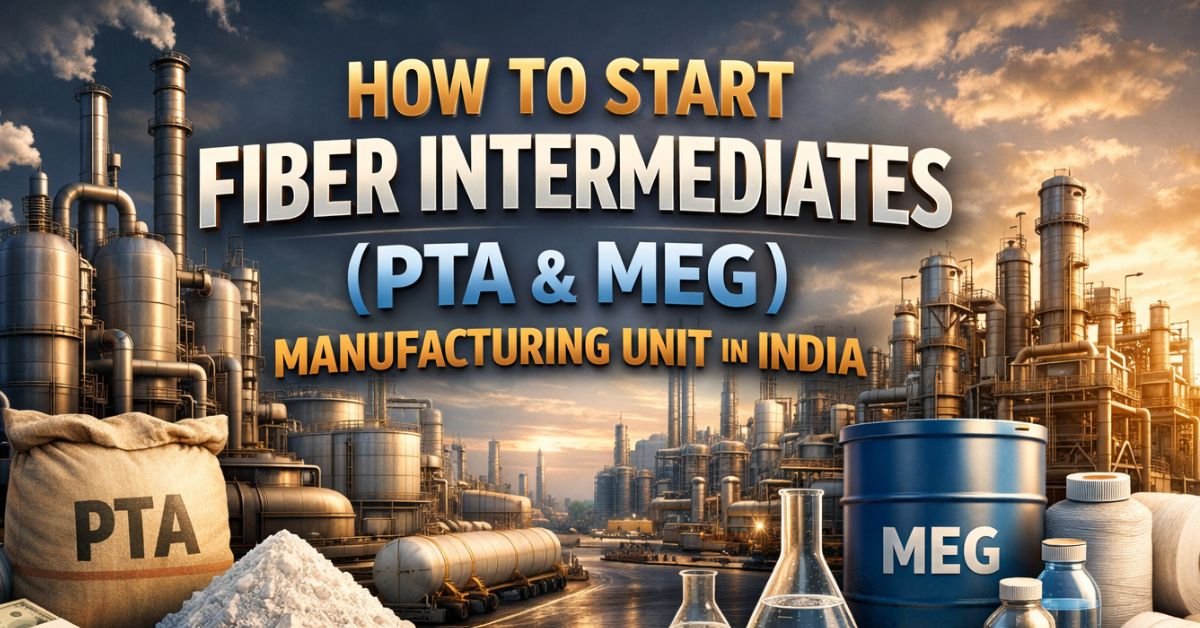
fiber intermediates manufacturing India process diagram showing PTA and MEG production

Process flow of PTA and MEG used in fiber intermediates manufacturing in India.

507
SHARES
1.4k
VIEWS
Share on FacebookShare on Twitter

The petrochemical industry in India has also experienced a very strong growth due to the increased domestic demands, increased exports and government programs that Favor growth of industries. The Fiber Intermediates Manufacturing , especially Purified Terephthalic Acid (PTA), and Mono Ethylene Glycol (MEG) are some of its other segments, but have become a promising niche in which the industry has high potentials and investment opportunities. The Annual Report 202526 by the Ministry of Chemicals Fertilizers has reported a figure of around 12.2 percent of the total production of petrochemicals in India by fiber intermediates, indicating a long-term and increasing production trend.(Fiber Intermediates Manufacturing)

Table of Contents

Toggle
    • Read More: MONO ETHYLENE GLYCOL – Manufacturing Plant, Detailed Project Report, Profile, Business Plan, Industry Trends, Market Research, Survey, Manufacturing Process, Machinery, Raw Materials, Feasibility Study, Investment Opportunities, Cost and Revenue
  • Fiber Intermediates: Understanding.
    • Read More: Indian Chemical Industry in 2025: Opportunities for Entrepreneurs and Startups
  • Large Suppliers of Fiber Intermediates.
    • Read More: Startup Selector
  • PCPIR Clusters Strategic Advantage.
  • Downstream Fiber Intermediates Opportunities in MSME.
    • Read More: PET Preform
  • Financial and Investment Prognosis.
  • Important Facts to be considered when establishing Fiber Intermediates Plant.
    • Read More: Mono Ethylene Glycol – Manufacturing Plant, Detailed Project Report, Profile, Business Plan, Industry Trends, Market Research, Survey, Manufacturing Process, Machinery, Raw Materials, Feasibility Study, Investment Opportunities, Cost and Revenue
  • Benefits of Investment in Fiber Intermediates.
  • Future Growth Outlook
    • Read More: Indian Chemical Industry in 2025: Opportunities for Entrepreneurs and Startups
  • Conclusion
  • Frequently Asked Questions (FAQ)

Read More: MONO ETHYLENE GLYCOL – Manufacturing Plant, Detailed Project Report, Profile, Business Plan, Industry Trends, Market Research, Survey, Manufacturing Process, Machinery, Raw Materials, Feasibility Study, Investment Opportunities, Cost and Revenue

Fiber Intermediates: Understanding.

Fiber intermediates are crucial petrochemical items that serve as raw materials in the establishment of polymers that are utilized in the creation of polyester. These two major intermediates are:

  • Purified Terephthalic Acid (PTA): This is one of the major building blocks of polyester fibres and PET resin.
  • Mono Ethylene Glycol (MEG): It is a reaction with PTA to form polyethylene terephthalate (PET), which is converted to polyester fibres, filament yarn, PET resin, and technical textiles.

PTA and MEG are key in the manufacturing of a polymer, polyester which is the most dominating segment of the Indian synthetic textile market because it is durable, versatile and cost effective.(Fiber Intermediates Manufacturing)

Read More: Indian Chemical Industry in 2025: Opportunities for Entrepreneurs and Startups

Large Suppliers of Fiber Intermediates.

Large integrated companies have already taken control of the Indian fibre intermediates industry and are running large upstream production plants:

  • Reliance Industries Ltd.
  • Indorama Ventures
  • Indian Oil Corporation

Although these players deal with large-scale production of PTA and MEG, downstream production sections of polymer blending, copolymer preparation, and additive formulation can be scaled down to provide an opportunity to MSMEs and new entrants.(Fiber Intermediates Manufacturing)

Read More: Startup Selector

PCPIR Clusters Strategic Advantage.

The Petroleum, Chemical and Petrochemical Investment Regions (PCPIRs) in India are developing the best infrastructure to facilitate the manufacturing of chemicals. Key clusters include:

  • Dahej PCPIR, Gujarat
  • Pradeep PCPIR, Odisha
  • Visakhapatnam Kakinada PCPIR, Andhra Pradesh.

These clusters offer:

  • Ordinary effluent treatment facilities.
  • Shared utilities Steam, power, and cooling, water.
  • Port connectivity on import-export.
  • Environmental compliance support.

Locating manufacturing facilities in the clusters helps decrease the cost of logistics and guarantees the stable supply of textile and packaging industries which have tight production programs.(Fiber Intermediates Manufacturing)

Downstream Fiber Intermediates Opportunities in MSME.

Rather than investing in the capital-intensive production upstream, entrepreneurs may concentrate on modular and scalable downstream processes, such as:

  1. Polyester Feedstock Blending Plants: Blending of both PTA and MEG to produce tailor-made feedstock blends to the textile mills.
  2. PET Copolymer Preparation Units: This is the production of specialty PET resin to be used in the packaging, filament yarn, and industrial processes.
  3. Industrial Yarn-Grade Additive Formulation: Improving fibre properties to become durable, UV resistant and thermal resistant.
  4. Fiber-Grade Stabilizer Production: Enhancing polymer behaviour to enhance high-performance technical fabrication.

The manufacturing process is generally a blend that is controlled, and catalytic and stability modified, as well as quality standardized to the BIS norms. Access to common facilities in chemical properties eases operations and decreases set-up sophistication.(Fiber Intermediates Manufacturing)

Read More: PET Preform
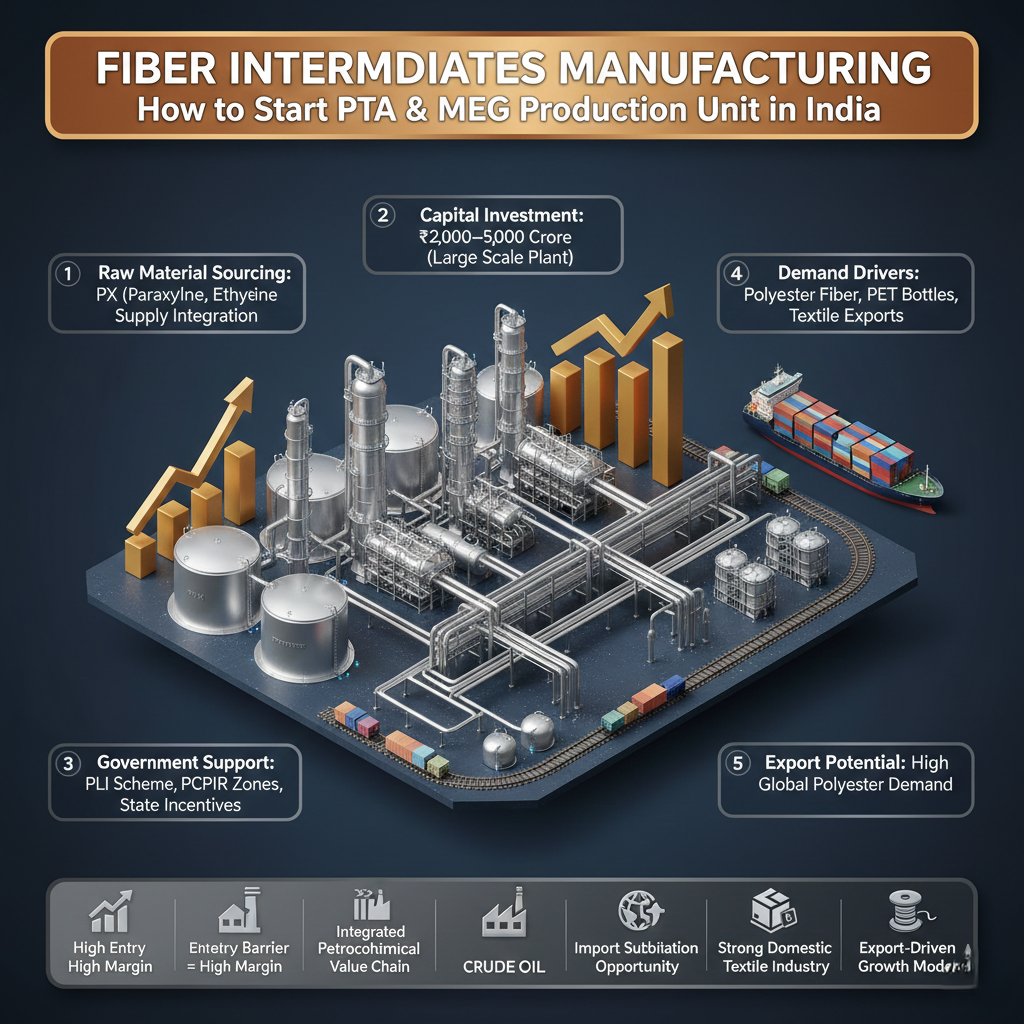
fiber intermediates manufacturing India process diagram showing PTA and MEG production

Financial and Investment Prognosis.

The chemical industry in India has received a lot of foreign direct investment (FDI) in the last ten years, which can be regarded as a confidence of investors. Fiber intermediates offer:

  • Constant industrial demand during the year.
  • Good connection with export-oriented textiles.
  • Increasing domestic use of polyester.
  • Indian refiners are able to provide raw materials.

Government programs like the Technical Textiles Mission and production based incentive schemes are likely to increase the capacity to produce more polyester hence a steady demand in the PTA and MEG derivatives.

Export Potential: Indian manufacturers can provide modified intermediates and specialty blends to the international polyester producers that are ready to source reliable and diversified products with improved infrastructure (ports).

Important Facts to be considered when establishing Fiber Intermediates Plant.

The investors must consider: when planning a downstream fiber intermediates unit.(Fiber Intermediates Manufacturing)

  1. Raw Material Procurement: Obtain PTA and MEG either domestically through the refineries or through imports.
  2. Location Choice: PCPIR clusters give cost and logistic benefits.
  3. Regulatory Compliance: Compliance with the environmental, safety and BIS quality standards.
  4. Machinery & Equipment: Invest in modular blending and stabilization as well as copolymer processing units.
  5. Market Access: forge B2B relationships with textile manufacturers, packaging companies and industrial yarn manufacturers.(Fiber Intermediates Manufacturing)

Read More: Mono Ethylene Glycol – Manufacturing Plant, Detailed Project Report, Profile, Business Plan, Industry Trends, Market Research, Survey, Manufacturing Process, Machinery, Raw Materials, Feasibility Study, Investment Opportunities, Cost and Revenue

Benefits of Investment in Fiber Intermediates.

  • High Demand: In linked with increased textile, packaging, and technical fabric industries.
  • Scalable Investment Downstream units can be expanded gradually with reduced capital investment.
  • Specialty blends: Specialty blends may also be exported to international producers of polyester.
  • Industrial Synergy: Installed in PCPIR clusters to be more easily integrated with the supply of raw materials and utility.
  • Stable Returns: Polyester intermediates are demanded by the industry throughout the year and thus guarantee stable revenues.(Fiber Intermediates Manufacturing)

Future Growth Outlook

The Indian polyester market is expected to experience growth within the next decade which will be promoted by:

  • Increasing local demand of garments and industrial textiles.
  • Diversification of technical fabrics and performance fabrics.
  • More use of PET in packaging of FMCG and pharmaceutical.
  • Policies on government favourability towards manufacturing and export of chemicals.

This structural development provides a long-run demand queue of PTA and MEG, and thus fiber intermediates production is a well-timed investment.(Fiber Intermediates Manufacturing)

Read More: Indian Chemical Industry in 2025: Opportunities for Entrepreneurs and Startups

Conclusion

The production process of fiber intermediates establishes a link between India’s petrochemical industry and its textile industry, which together serve as major forces driving industrial growth. The segment provides long-term investment prospects through its 12.2% market share, which results from its high operational efficiency and increasing polyester demand.(Fiber Intermediates Manufacturing)

Entrepreneurs who operate business ventures in PTA and MEG processing facilities that exist within PCPIR clusters can use the following advantages:

  • Strong infrastructure support
  • Consistent industrial demand
  • Modular and scalable expansion opportunities
  • Access to export markets

The fibre intermediates processing sector offers attractive business opportunities to investors and MSMEs who aim to create manufacturing facilities in India because the petrochemical sector is undergoing strategic development through this process.(Fiber Intermediates Manufacturing)

Frequently Asked Questions (FAQ)

  1. What are fibre intermediates?
    Fiber intermediates are petrochemical products like PTA and MEG, which serve as raw materials for polyester fibres, PET resin, and technical textiles.
  2. Why is this sector growing in India?
    Growth in polyester textiles, technical fabrics, and PET packaging is driving strong demand for PTA and MEG.
  3. Can MSMEs enter this business?
    Yes, particularly in downstream blending, copolymer preparation, and specialty additive formulation.
  4. Where is the best location to set up a plant?
    PCPIR regions such as Dahej, Pradeep, and Visakhapatnam–Kakinada offer infrastructure, port connectivity, and regulatory support.
  5. Does the sector have export potential?
    Yes. Modified polymer blends and specialty fibre-grade intermediates can be supplied to international polyester producers seeking reliable and diversified sourcing.(Fiber Intermediates Manufacturing)
Tags: chemical manufacturing companiesmonoethylene glycol
Share203Tweet127
Previous Post

Top Chemical Manufacturing Business Ideas for MSMEs in India

Next Post

Maize Wet Milling Plant in India: Cost, Profit & Sorbitol Manufacturing Opportunity

Diksha Garg

Diksha Garg

Diksha Garg is Associate Editor at Entrepreneur India, with an MBA in Marketing and over seven years of professional experience in marketing strategy and business communication. She writes for entrepreneurs, startups, and MSMEs, bringing a marketing perspective to the opportunities and decisions involved in starting and growing a business. Her articles cover manufacturing business ideas, emerging market opportunities, marketing strategies, brand building, and business growth. She connects these subjects with the practical questions entrepreneurs face when exploring a venture: understanding customer needs, assessing market demand, identifying a target audience, and communicating a product’s value. Her focus is on helping readers move from a broad business idea towards a clearer understanding of its market potential. Drawing on her background in marketing and strategic storytelling, Diksha explains complex business topics in clear, accessible language. She brings together data-driven insights and practical explanations to help readers understand how market trends relate to their business plans. Whether discussing a manufacturing opportunity or a marketing approach, she keeps the needs of founders and small business owners at the centre of her writing. At Entrepreneur India, her content serves both aspiring entrepreneurs exploring their first venture and established MSMEs looking for opportunities to expand. She writes about the connection between choosing a product, understanding its buyers, building a brand, and developing a strategy for growth. This approach helps readers consider how a business will reach and serve its customers alongside what it plans to offer. Through her articles, Diksha aims to make business information easier to understand and apply. Her writing encourages entrepreneurs to ask relevant questions, examine market opportunities, and make informed decisions as they plan, launch, and grow their ventures.

Next Post
Maize Wet Milling Plant in India

Maize Wet Milling Plant in India: Cost, Profit & Sorbitol Manufacturing Opportunity

Leave a Reply Cancel reply

Your email address will not be published. Required fields are marked *

Contact Us

    Categories

    • Agri Business Opportunities
    • Business Ideas
    • Chemical Industry Business Opportunities
    • Cosmetics and Personal Care Business
    • Eco Friendly Sustainable Business
    • Entrepreneurship Leadership and Startup Growth
    • FMCG Consumer Products Business
    • Food Processing Business Industry
    • Future & Emerging Industries
    • Government Schemes Policies for Business
    • Import Export Business Opportunities
    • Industrial Project Reports Business Guide
    • Investment Funding for Startups
    • Manufacturing Business Ideas for Startups
    • Market Research Trends for Business
    • MSME & Small-Scale Industries
    • Paper Pulp Industry Business
    • Pharmaceutical Industry Business
    • Plastic & Packaging Business
    • Renewable Energy Startups
    • Startup Business Opportunities
    • Startup Business Planning and Strategy
    • Technology & Automation Business
    • Textile Industry Business
    • Uncategorized
    • Waste Management & Recycling Business
    • Water & Environmental Business
    Entrepreneur India Blog

    Copyright © 2026 Entrepreneur India

    Navigate Site

    • About
    • Advertise
    • Privacy & Policy
    • Contact

    Follow Us

    Welcome Back!

    Login to your account below

    Forgotten Password?

    Retrieve your password

    Please enter your username or email address to reset your password.

    Log In
    No Result
    View All Result
    • Home

    Copyright © 2026 Entrepreneur India

    Not enough quota to unlock this post
    Unlock left : 0
    Are you sure want to cancel subscription?