





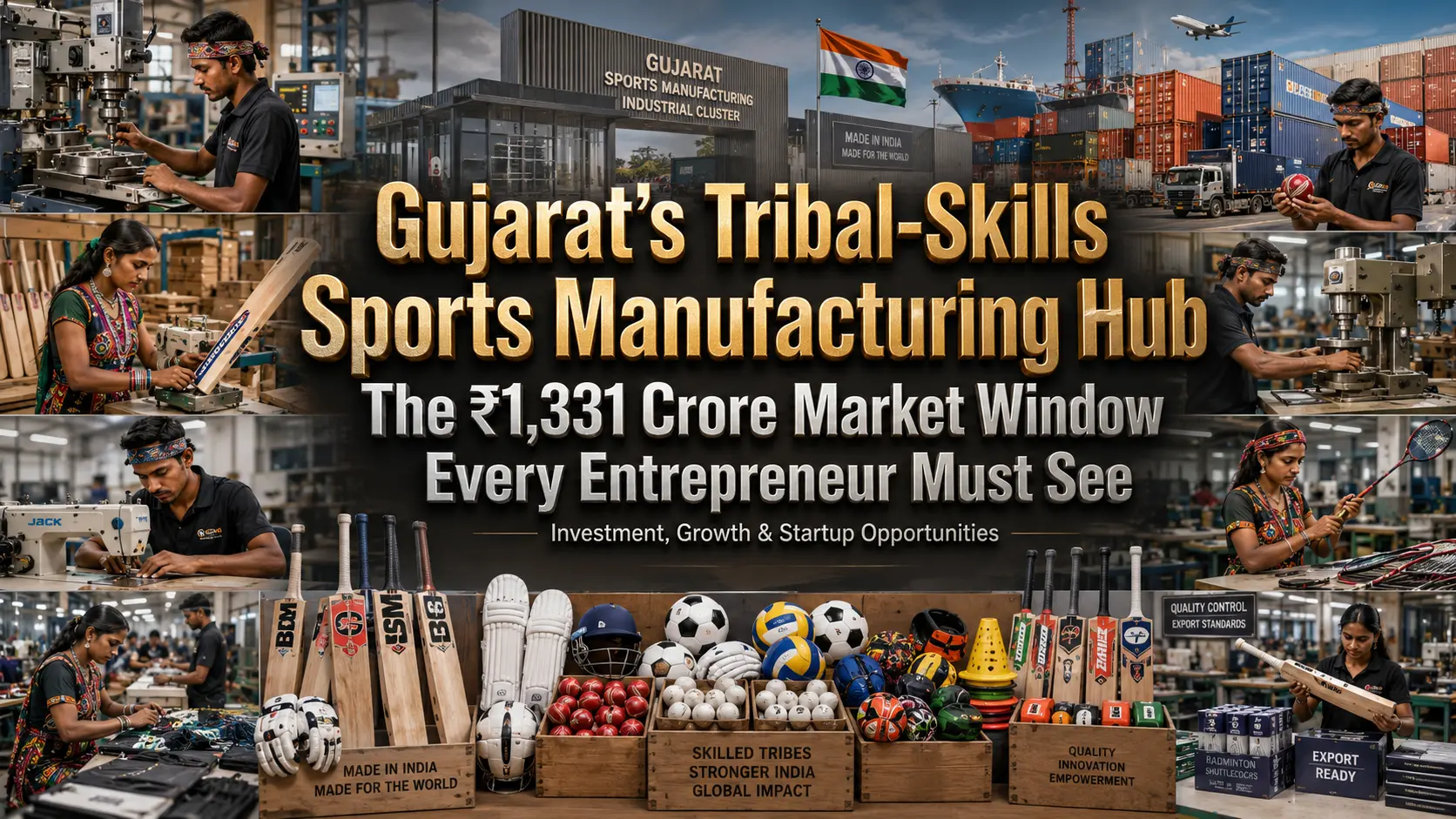
Gujarat Sports Equipment Manufacturing Hub
There is something important going on in the tribal heartland of Gujarat and it is being closely followed by Economic Times. The Economic Times Manufacturing had earlier reported that Chhota Udepur district, where bamboo handicrafts and tribal woodworking skills are prevalent, is being groomed as the next Sports Equipment Manufacturing Hub of India. This isn’t a promise yet to be made in the far-off future. The Gujarat Chief Minister’s Office has officially announced that this cluster will be formally introduced as a major investment avenue at the Vibrant Gujarat Regional Conference (VGRC) to take place at GSFC University, Vadodara, on June 29-30, 2026.
This is exactly the type of opportunity that entrepreneurs, MSMEs and early-stage start-ups are looking for, and that doesn’t come around often. A market signal is formed when a State Government formally adopts the vision of a Manufacturing Cluster and provides it with a financial commitment of ₹ 1331 crores through its Budget allocation for the manufacturing cluster.
There is also solid global data to back the timing. As per a NITI Aayog report, ‘Sports Economy Survey 2026’, the world sports equipment market, which is worth $140 billion, is expected to grow to 283 billion dollars by 2036. Currently, India accounts for only 0.5% of export share. The opportunity for a startup is just where the gap between India’s potential and its current state exists.
Related Article: Top 20 Sports Equipment & Fitness Goods Manufacturing Business Ideas
What Recent Economic Times Reporting Means
The Economic Times Manufacturing report of the Gujarat’s Chhota Udepur initiative raises the curtain on a multi-faceted market transition, more than a story of a single district. Let’s look at what the development really signifies for the Indian startup and MSME ecosystem:
1. A New Manufacturing Geography Is Emerging
The manufacturing of sports equipment’s in India has traditionally been dominated by Meerut (UP) and Jalandhar (Punjab) which contribute 75-80% of total production. Chhota Udepur is an intentional government endeavour to diversify this geography; that is, to integrate tribal regions rich in bamboo into the manufacturing mainstream.
2. Tribal Craftsmanship Is Being Commercially Valorised
The story in the Economic Times emphasizes that Chhota Udepur’s tribal population has extensive knowledge of the crafting of bamboo and traditional woodwork. The state government is now focused on incorporating these skills into today’s product design, quality and world market needs. For startup founders, it translates to a true supply chain, a story, and a culturally diverse source that is an excellent brand asset for export markets that are increasingly looking for sustainable, artisan-made products.
3. The Entire Value Chain Is Being Developed Locally
The Gujarat plan is to develop the whole value chain in Chhota Udepur from bamboo sourcing to product branding. This provides opportunities for businesses to enter at various stages; not only in the making of finished goods, but in raw material processing, manufacturing, quality certification, packaging, branding, and export logistics.
4. Global Investor Attention Is Already Directed Here
Investors will be formally introduced to the district’s bamboo resources and skilled workforce, cluster development potential and opportunities for integration with the global market at the VGRC event on June 29-30. The endorsement from the Gujarat CMO’s office from the economic and reputational aspect essentially makes it an investment ready zone. The early movers will benefit from having an informational and positional advantage over the late movers if they explore partnerships, supply agreements or co-manufacturing models prior to this event.
Your investment deserves the right opportunity
Why This Industry Is Growing
It’s the sports equipment industry that is expanding for structural reasons, not seasonal reasons. Several overlapping factors are driving this to be one of India’s most interesting manufacturing opportunities in 2026 and beyond.
The demand for domestic products is on the rise. The Khel Maha Kumbh sports programme of Gujarat has expanded from 16 lakh participants in 2010 to almost 71 lakh in 2025-26. At present, over 1.21 lakh children are undergoing sports training in 230+ schools in the state. The sports and sports clothing industry directly employs more than 5 lakh people across the country and this figure is expected to mushroom up.
The worldwide market for “green” sporting goods is growing rapidly. There is a strong trend towards sustainable, bamboo and recycled material sports products in the west markets, especially in Europe and North America. In 2025, the global bamboo products market was valued at $82.5 billion and will attain $142.27 billion by 2035, expanding at a 5.6% CAGR. This is the opportunity for the export of bamboo from Chhota Udepur that can be benefited by its tribal skill base and natural resource.
Investment from the government is increasing. With the right sports ecosystem, India’s export of sports equipment will increase by 29x from $275 million today to $8.1 billion by 2036, according to the NITI Aayog report in March 2026. This will involve a coordinated investment of around ₹7,500 crore from 2027-31 for developing manufacturing clusters, shared testing facilities, and export infrastructure.
Government Policies & Incentives
There is a supportive policy environment for entry into this sector. MSMEs and founders need to know the following government systems:
- MSME Cluster Development Programme (CDP): It is an initiative of the Ministry of MSME to create clusters of manufacturing units for infrastructure, common facility centres, and capacity building. The sports hub in Chhota Udepur is organised in a cluster and thus has been eligible to be supported by CDP. Visit msme.gov.in
- Registered startups are granted tax benefits, rebates on patents and preferences on government procurement. Sports equipment manufacturing startups can register via startupindia.gov.in
- Sports Goods is a specific target area under Make in India program, which will give incentives to the manufacturing of sports goods in India and promote exports. Visit makeinindia.com
- Access to Self-Certification, Simplified Compliance and Government Priority procurement are the advantages of the formal recognition by DPIIT for the Manufacturing Startups. Apply via gov.in
- Sports Goods Export Promotion Council (SGEPC): It offers export market intelligence, facilitates participation in international trade fairs and facilitates buyer-seller meets. This Council acts as the guiding body of sports goods exports from India mainly.
- The National Bamboo Mission offers direct support for developing bamboo sports products, including for cultivation, processing units and product development. In several categories, funding will cover up to 50% of project costs.
Business Ideas for Startups & MSMEs (5 Opportunities)
All the business ideas here are directly related to the Chhota Udepur project as mentioned in the Economic Times. All are real, fundable and scalable opportunities based on current market conditions.\
1. Bamboo-Based Sports Equipment Manufacturing Unit
Establish a micro or medium scale manufacturing business in production of bamboo cricket stumps, hockey sticks, yoga blocks, gym balance boards, archery bows and badminton frames. This is the most direct route as Chhota Udepur has a raw bamboo supply base, an existing artisan workforce and a government cluster. Proceed to market in Europe and Japan where the sports goods market is based on bamboo, which fetches a premium price, often 30–40% more than plastic.
Get Detailed Insights from This Book: Bamboo Plantation and Utilization Handbook
2. Tribal Artisan Aggregator & Export Brand
Market your brand as a curator of products made by tribesmen of Chhota Udepur – Sports goods. It is a B2B model with the production from various tribal artisans’ units, common quality checks and international certifications (ISO, FSC for bamboo), and then marketing to international importers. In 2026 the ‘tribal craft meets global sport’ story is an extremely strong export brand story.\
3. Quality Certification & Testing Services Hub
The lack of sharing in the testing and certification system is one of the key challenges identified in the NITI Aayog’s report for 2026 which highlights the hurdles faced by the Indian sports goods exporters. A quality lab and certification facilitation centre, to meet international standards such as ISO 9001, BSCI and industry-specific safety standards, is a facility which serves all manufacturers in the cluster. A very lucrative, B2B service offering that has local need built in, and local need captive.
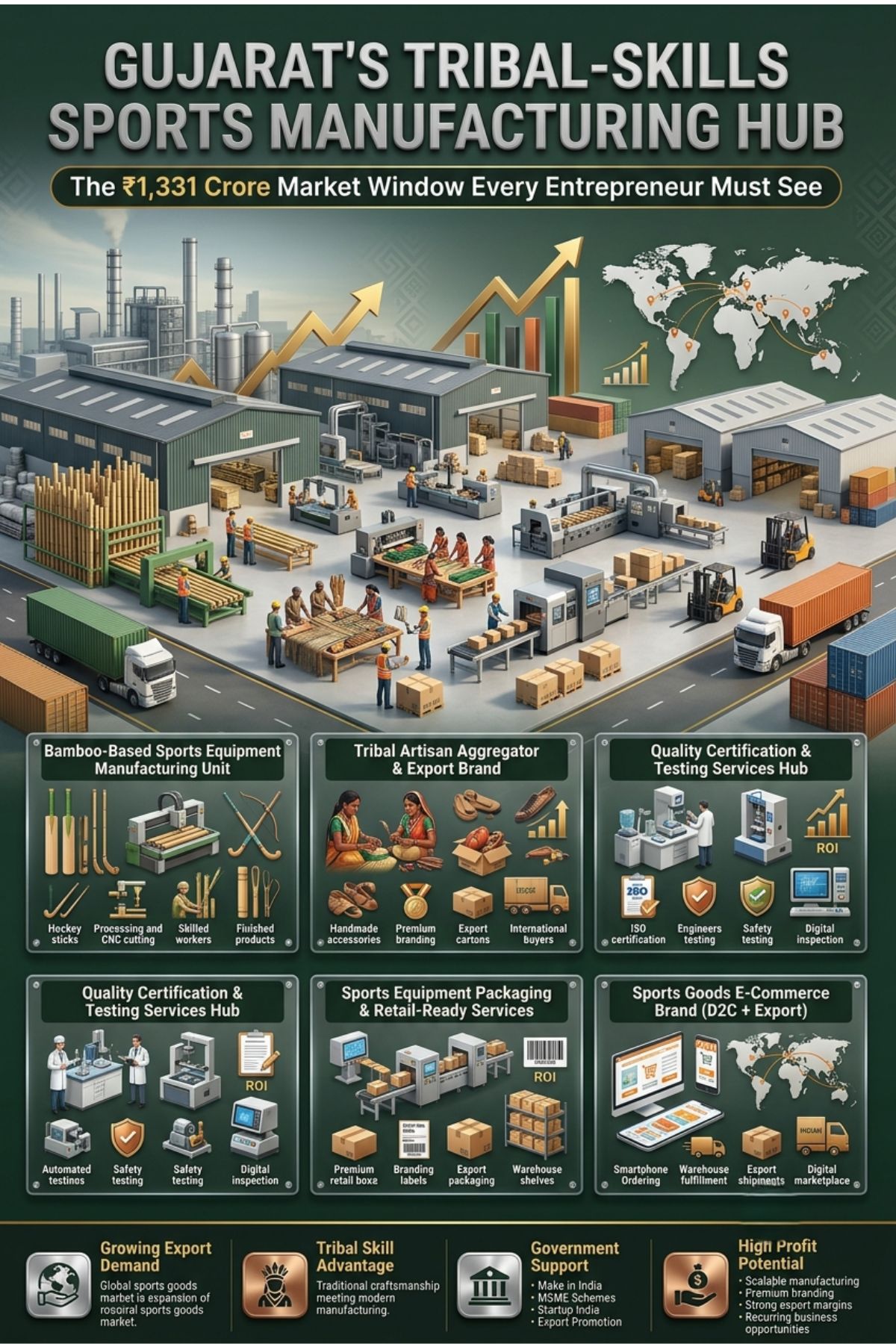
4. Sports Equipment Packaging & Retail-Ready Services
Specific packaging, labelling, integration of barcodes and retail-ready presentation are required for the international retail chains. This packaging capability is limited among most of the manufacturers in the tribal MSME clusters such as Chhota Udepur. A company that provides eco-friendly retail-ready packaging, using recycled paper, jute and bamboo packaging materials, is seizing two trends at once: the sports manufacturing growth and the worldwide sustainability packaging trend.
5. Sports Goods E-Commerce Brand (D2C + Export)
Create a direct-to-consumer brand that sources sports goods that are ecofriendly, made from bamboo in the Chhota Udepur cluster. Drive sales to your own Shopify-based site, Amazon Global Selling or Etsy (for artisanal products) amongst health-conscious, sustainable consumer bases in the USA, UK, Germany, and Australia. The investment demand is low (mainly in the building of the brand, quality procurement, digital marketing). The cluster offers you cost advantage, and you offer him brand & market.
Import–Export Opportunity Analysis
The opportunity in the exports of sports goods in India is yet to be written.
The annual value of Indian sports goods exports is about $275 million, accounting for 0.5% of the world exports. With an investment of ₹7,500 crore and a target of making it $8.1 billion by 2036, which would create 54 lakh jobs, the NITI Aayog has set itself the target. Even if the MSME sector captures a portion of this growth curve, it’s certainly a big business.
Germany, the Netherlands, the UK, the USA and Japan are the main export destinations for bamboo and eco-friendly sports products. The markets are well established with sustainability standards and a strong demand for certified products made from natural materials. Large sporting goods companies are actively seeing regulators in Europe move toward sustainability disclosures and single-use plastics measures, which are encouraging them to diversify their supply chains beyond all-synthetic goods.
Entrepreneurs can approach Sports Goods Export Promotion Council (SGEPC) under the Ministry of Commerce for export guidance, compliance and connecting with buyers, and the SGEPC acts as a support agency for sports goods exporters for market access, sports goods industries participation in the sports goods trade fairs, and buyer matching.
Indian MSME Success Stories in Sports Manufacturing
Cosco India – Meerut’s MSME Giant
The Cosco India started from a small sports goods manufacturing unit in Meerut and has emerged as one of the most recognised sports brands in India with export to 50+ countries. In the Cosco story, the cluster approach to sports manufacturing has proved successful, as the synergy of quality infrastructure, design investment and export orientation has transformed into global brands.
SG Cricket Equipment – Meerut Cluster Success
The Meerut cluster has been the birthplace of SG (Stanford Global) Cricket, which now caters for the Board of Control for Cricket in India (BCCI) to play cricket with official BCCI balls. A good example of how an MSME from a manufacturing cluster can gain institutional credibility and scale.
Chhota Udepur’s Bamboo Craft Tradition – The Untapped Case Study
Although there is no large sporting company to originate from Chhota Udepur yet, the bamboo weavers have already shown their potential of appeal to the international market – their creations are now making it to niche markets in furniture and décor. Infrastructure, skills and raw material base are already available. The last missing piece of the puzzle is organised investment and market connectivity, which the Vibrant Gujarat Regional Conference (29-30 June, 2026) will be able to offer.
About NPCS – Feasibility & Market Intelligence Support
NPCS (Niir Project Consultancy Services) is India’s premier company in the field of industrial feasibility reports and project profiles and Business opportunity analysis. NPCS has a vast repository of more than 5,000 detailed project reports for a range of industries including manufacturing, agro-industries, chemicals and services that will help the entrepreneurs and MSMEs to gain practical intelligence that is required to start, scale or diversify their businesses.
NPCS provides for the sports equipment and manufacturing from bamboo sectors in particular:
- Feasibility & Market Research Reports on sports goods manufacturing clusters (in detail)
- Project profiles aligned with MSME and Startup India funding requirements
- The report will contain the sports goods market intelligence for the country, India. The Report Will Contain Market Intelligence for Sports Goods Sector in India.
- Report on manufacture of bamboo-based products, processing, branding, and strategy of entering the global market.
From being a first-time entrepreneur to an MSME considering pivoting or an investor assessing the Chhota Udepur cluster opportunity, NPCS reports provide the solid data foundation needed to make confident decisions. Visit www.niir.org to read project reports in various sectors.
Get Detailed Project Report (DPR): Best Business Opportunities in Gujarat
Key Market Data at a Glance
| Indicator | Current Figure | Projected (2036) | Source |
| Global sports equipment market | $140 billion | $283 billion | NITI Aayog, 2026 |
| India’s annual sports equipment exports | $275 million (₹2,301 Cr) | $8.1 billion (₹75,516 Cr) | NITI Aayog, 2026 |
| India’s global export share | 0.5% | Target: ~3–4% | NITI Aayog, 2026 |
| Gujarat sports sector budget (FY26-27) | ₹1,331 crore | — | Gujarat CMO |
| India bamboo market (domestic) | — | ₹52,246 Cr by 2033 | IBEF |
| People in India’s sports/apparel sector | 5 lakh+ | 54 lakh+ (jobs target) | Govt. of India |
| Khel Mahakumbh participants | 16 lakh (2010) | 71 lakh (2025-26) | Gujarat CMO |
| Chhota Udepur children in sports training | 1.21 lakh+ | — | Gujarat CMO |
Frequently Asked Questions (FAQs)
Q1. What exactly is the Chhota Udepur Sports Equipment Manufacturing Hub?
Tribal Chhota Udepur District of Gujarat being melded into a Sports Eco-Club Chhota Udepur has long had a high concentration of tribals and abundant bamboo resources and tribal craftsmanship. This has been a long shot to utilize the bamboo wealth of Chhota Udepur district to fashion it as bamboo eco-club and to build on the traditional tribal craftsmanship, to set up a cluster, which aims to focus on producing bamboo sports goods (and sustainable sports goods), for global and Indian Markets, and for a green generation, supported officially by Chief Minister’s Office, Gujarat , is also highlighting itself at the upcoming Vibrant Gujarat Regional Conference, on 29-30 June 2026.
Q2. How much investment does a startup need to enter the bamboo sports equipment sector?
Investment for entry level varies with model picked. A processing & trading business model (buying from artisan units, getting QC & supplying) could range between 10 to 25 lakhs. Small scale manufacturing unit for bamboo sports goods could be anywhere between 25 to 75 lakhs including machinery, working capital and certification. You can leverage government subsidies such as cluster development scheme and MSME support to substantially cut down capital expenditure.
Q3. Which government schemes support sports equipment manufacturing startups?
The main programs are the MSME Cluster Development Programme (CDP) to fund infrastructure development and common facility centers. Other initiatives include the advantages for registration under Startup India, which include tax breaks, fast-tracking regulatory compliance and preference in government purchasing programs, the National Bamboo Mission which aims to boost bamboo processing industry with unit support and PLI-linked manufacturing encouragement incentives. Founders should check the eligible criteria and the application process on msme.gov.in, and startupindia.gov.in.
Q4. What is the export potential for bamboo-based sports goods from India?
Significant. India currently exports just $275 million in sports goods — 0.5% of the global $52 billion export market. NITI Aayog targets $8.1 billion in exports by 2036 with the right ecosystem investment. Bamboo-based sports products specifically command premium pricing in European, US, and Japanese markets, where sustainability-certified natural goods are increasingly preferred over synthetic alternatives.
Q5. Is the Chhota Udepur opportunity available only for Gujarat-based entrepreneurs?
No. The event is geared toward enticing national & international Investors and Entrepreneurs. We do extend co-manufacturing or contract manufacturing opportunities or the engagement of investor to entrepreneur to any stakeholder in the cluster on the strength of our clusters. Founders from all over India are invited to consider business opportunities on the back of brand agreements, supply chain tie-up or any investment interest in the clusters.
Q6. What certifications are required to export sports goods from India?
Certifications may cover anything such as ISO 9001 (quality management), BSCI/SMETA, the required by large European retailers, for social compliance, FSC for wood/bamboo products or even products certified according to standards depending on the destination (eg. CE marking for Europe, ASTM standards for USA). Sports Goods Export Promotion Council (SGEPC) may advise you on certification needs for products of their category.
Conclusion: Act Early on a Cluster That Is Just Opening
The Economic Times coverage of Gujarat’s Chhota Udepur Sports Equipment Manufacturing Hub is not a feature on something that happened years ago. It is a live signal of a cluster ecosystem that is being formally activated right now — with government backing, investor attention, and a formal investment showcase event scheduled for June 29–30, 2026.
The timing matters enormously. Early entrants into cluster-based manufacturing ecosystems — whether as manufacturers, quality service providers, packaging specialists, or export brands — consistently capture the highest margins and the most durable market positions. The Meerut and Jalandhar clusters that now dominate India’s sports goods manufacturing were built by founders who entered before the formal infrastructure arrived.
Chhota Udepur sits at exactly that inflection point today. The bamboo is there. The tribal skills are there. The government budget and policy intent are there. The global market demand for eco-friendly sports goods is growing. What is still early-stage is the organised entrepreneur response.
India’s sports equipment exports need to grow 29x to reach the 2036 NITI Aayog target. That gap represents trillions of rupees in manufacturing value waiting to be captured. The founders who read today’s Economic Times signals carefully, move with informed intent, and anchor themselves in emerging clusters like Chhota Udepur will be the ones writing tomorrow’s success stories.
The window is open. The market signal is live. The time to move is now.
Sources & References: Economic Times Manufacturing | MSME.gov.in | StartupIndia.gov.in | MakeInIndia.com | DPIIT.gov.in


