





Henry Ford failures
When you ask most people about Henry Ford, you will hear three answers: the Model T, the assembly line, and the $5 workday. I never see anyone talk about the fact that Ford had two separate businesses that he brought to bankruptcy before anything else, and that the people who invested in him early on—who know nothing good about him—actually took his name off one of his companies and gave it to someone else.
Henry Ford was not the first to realize the need for a change in the 20th century. It was his third.
Attempt One: The Detroit Automobile Company
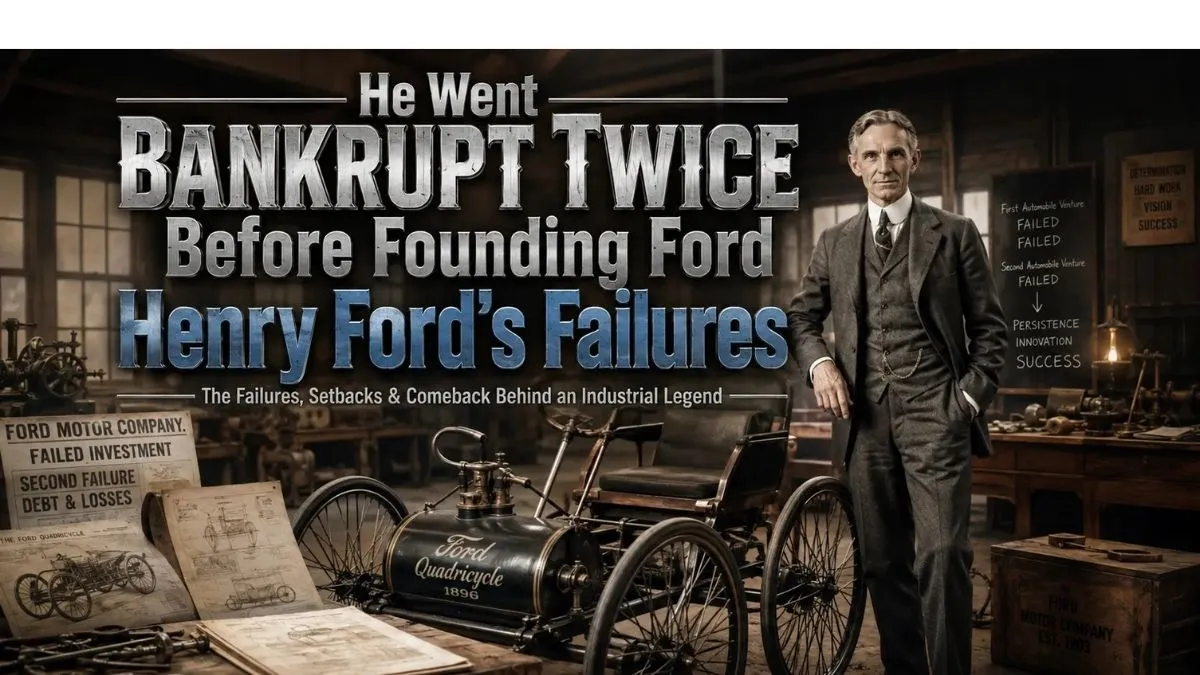
Born on a farm near Dearborn, Mich., Ford left home at age 16 and became a Detroit machinist. After years of learning to make things and mechanics, he was hired as chief engineer at Edison Illuminating Company in just a couple of years. At the side he played with the idea of internal combustion engines and in 1896 constructed his first fully formed machine, which he named the Quadricycle, a stripped down four-wheeled machine. It led him to believe there was a future in the motorcar and at the age of 36 he abandoned his engineering career to pursue it in 1899.
He convinced a group of Detroit investors led by businessman William H. Murphy to back him, and together they formed the Detroit Automobile Company, an early chapter Stuart Lichtman’s writeup on repeated founder failure describes as backed by three prominent local politicians whom Ford would later blame for the venture’s financial collapse. It should have worked. Ford was, by every account, a genuinely gifted engineer. But according to an account published on Bankruptcy Solutions, the company produced only about twenty vehicles in nearly two years of operation, at a staggering cost of roughly $86,000 — the equivalent of over $2.5 million today, or more than $125,000 per car.
It wasn’t that the engineering was flawed. It was Mr. Ford himself. He was a perfectionist who continually reworked and built upon, rather than putting out sellable product, and he was not interested in the commercial and marketing aspects. USLegal’s profile of the bankruptcy notes that this gifted engineer focused so heavily on the mechanics of the car that he all but ignored how it would actually get sold. Investors became impatient, sales remained low and by early 1901 the Detroit Automobile Company went bankrupt.
Check Out This Recommended Book: Best Businesses You Can Start with Low Cost
Attempt Two: They Took His Name
But most people, after witnessing their first company go under, would take stock and regroup quietly. But almost immediately, Ford got Murphy to give him another chance. The same group of investors re-organized around him in November of 1901 and established The Henry Ford Company, the company he was named after.
It failed even quicker when it was tried the first time. Murphy and the other backers, leery from the first failure, engaged an outside manager for help in the management and more detailed supervision of expenditures: Henry M. Leland. By this time Ford was also bitten by the race car bug, constructing and testing his own race car, the Ford 999, and he was at odds with his backers both on pace and priorities. Wikipedia has a history of the company and says that after that dispute, Ford left the company with little more than his name and $900 in cash.
The investors didn’t close down the company; this is the point at which they get hurt. We kept it going without him, called it by his name and Leland came in to lead it. The company took Henry Ford’s name and gained the infrastructure and assets of the company that had just been renamed from Cadillac-Liter Motor Wagon Co. and became Cadillac Automobile Company, one of the most storied luxury car brands in American history.
He was in essence, bankrupt, out of the game, and then, someone else making a success of his misfortunes.
Attempt Three: The One That Worked
Ford again went to the trouble of raising $900 and a few remaining investors willing to gamble on him in 1903. In this instance, he approached the problem differently: he found a business partner in Alexander Malcomson who was a coal dealer and organized the new enterprise (the Ford Motor Company) with the help of those who knew how to commercialize, not engineer. Despite this, several reports, such as one on AP PGECET, mention the company almost exhausted its money again in its initial months before it began to take off.
MyHorizon’s recount of Ford’s bankruptcies sees this as when perseverance finally collided with the proper configuration. It was a change in the product and not the company structure that changed everything. Ford decided instead to make one simple, durable, inexpensive car, and make it in large numbers – as opposed to the typical custom-made car for the wealthy at the time. That car was the Model T which debuted in 1908. Its use in tandem with the moving assembly line which his factories began a few years later enabled Ford to cut production costs and prices at the same time, making automobile ownership accessible to the average American family for the first time.
Get Detailed Project Report (DPR): Detailed Project Report (DPR) Consultants in India
Quick Facts: Henry Ford
| Born | July 30, 1863, Dearborn, Michigan |
| First vehicle built | 1896, the “Quadricycle” |
| First company | Detroit Automobile Company (1899) — bankrupt 1901 |
| Second company | Henry Ford Company (1901) — Ford forced out 1902, became Cadillac |
| Left second company with | His name and $900 |
| Third company | Ford Motor Company, founded 1903 |
| Breakthrough product | Model T, launched 1908 |
| Legacy | Moving assembly line, mass-market car ownership, $5 workday |
Why the Failures Mattered More Than the Success
There’s something important to note here: both of Ford’s companies were sunk by this same misstep. He was a great engineer who wasn’t quite aware that a business is not merely a good product – it is a good product that gets to the right price, and the right customer, consistently and at scale. But this is a straightforward and unambiguous interpretation of the lesson from the two failures that led Ford to develop the strategy that eventually created Ford Motor Company, as described in a retrospective published on LinkedIn.
By the time he launched his third attempt, Ford wasn’t just a better engineer — he was a completely different kind of businessman. He understood pricing, manufacturing efficiency, and mass distribution in ways his earlier failures had forced him to learn the hard way. The Model T didn’t succeed because Ford finally built a better engine. It succeeded because he finally understood the business, he was actually in.
Henry Ford died in 1947 as one of the most influential industrialists in history, remembered for reshaping how the entire world manufactures and buys things. Almost none of that would have happened if two groups of investors hadn’t, at separate points, decided he wasn’t worth backing anymore — and if he hadn’t gotten back up and tried a third time anyway.
Related Article: Best Manufacturing Business Ideas Under ₹50 Lakh in India
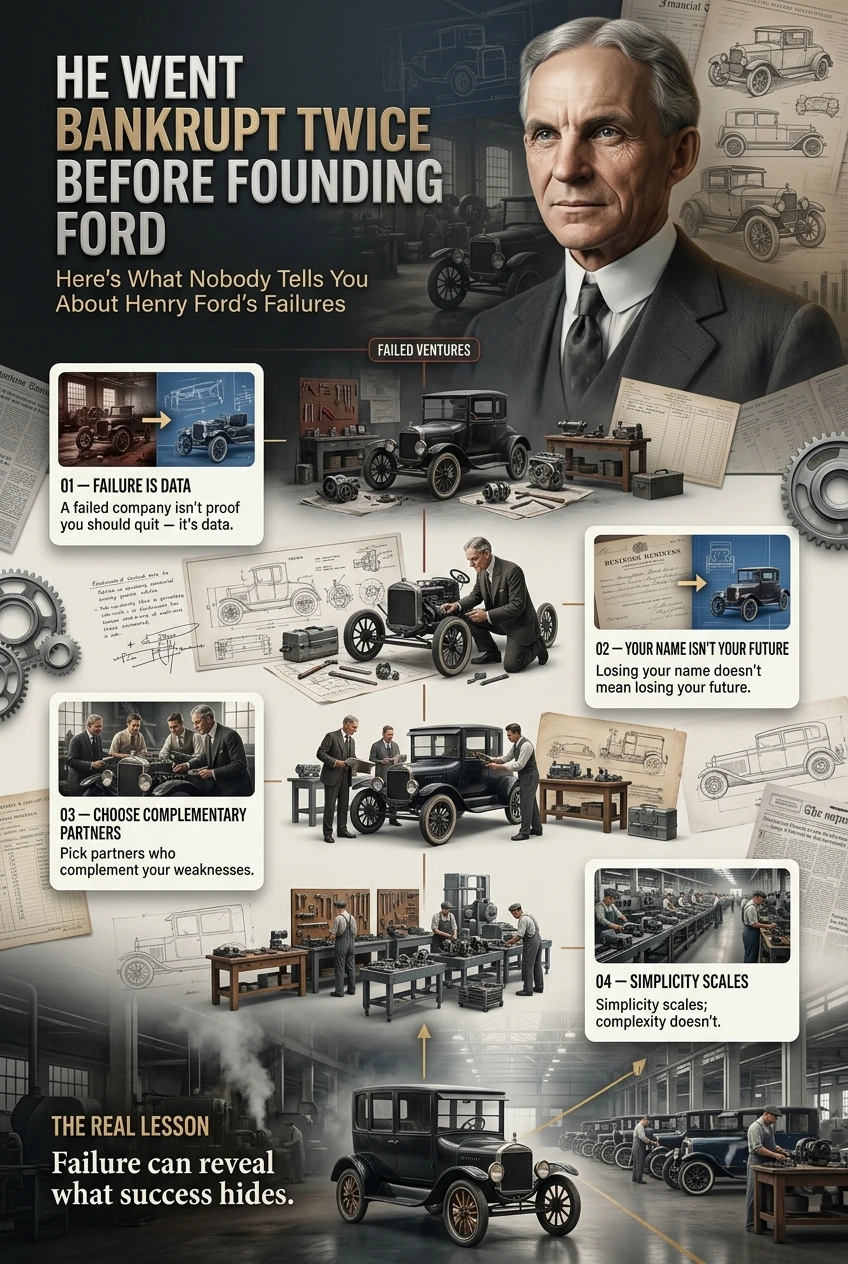
Four Lessons From Ford’s Comeback, for Anyone Rebuilding After Failure
1. A failed company isn’t proof you should quit — it’s data. Ford’s first two failures both traced back to the same root cause: he prioritized engineering perfection over shippable, sellable product. Recognizing that pattern, rather than blaming bad luck or bad investors, is what let him fix it the third time. Quora’s discussion of the bankruptcy myths around Ford’s career is worth a look for how differently this period gets interpreted depending on the source — even the basic facts of “bankruptcy” versus “company dissolution” are disputed among historians.
2. Losing your name doesn’t mean losing your future. His dismissal from the Henry Ford Company and their decision to rename Cadillac after him might have been career suicide. Instead, he closed this book and went right to a third attempt.
3. Pick partners who complement your weaknesses. Ford’s first two efforts found investment from people looking for a return on their investment but not necessarily knowledgeable about manufacturing or engineering. His third effort was quite a mix of Alexander Malcomson, a coal merchant with business acumen, and Ford’s engineering love of practical business sense.
3. Simplicity scales; complexity doesn’t. Ford’s rivals were creating expensive tailor-made vehicles for the wealthy. The one decision that most historians identify as the turning point is his decision to make one simple, reliable car, the Model T, and make it in a never-sleeping barrage of production. Wikipedia’s biography of Henry Ford tells the story of that single strategic decision, combined with the moving assembly line manufactured a few years later, that changed America’s manufacturing industry.
Discover business ideas that actually make money
What Happened to the Company That Took His Name
This is a curious epilogue to the story. On the ruins of Ford’s second unsuccessful venture, the Cadillac Automobile Company became one of the most esteemed luxury car brands of American history, which was eventually bought by General Motors in 1909. Ford’s downfall happened not only to pave the way for his own triumph but, in a manner of speaking, sow the seeds for a competitor that would challenge Ford Motor Company for the next 100 years. The chapter is hardly conspicuous in Ford Motor Company’s own history, and understandably so, because the sanitized take on it goes right to the Model T.
The Takeaway
The lesson in Ford’s story was that the failure was specific, not inspirational. It was not the fault of the market, nor was it a matter of bad luck. Ford had a flaw in his business model that was more easily repeated than it was identified: He was more interested in the product than the customer or the money. And it took him two bankruptcies, and two sets of investors deciding to give up on him, to stop repeating it.
He founded the Ford Motor Company that he later built, which employed hundreds of thousands of workers, paid then-unprecedented $5.00 per day to factory workers and made car ownership accessible to the average American family for the first time in history. It did not go as planned on the first attempt. It was nearly all of it didn’t happen.


