


Haldiram Success Story Business
The Haldiram’s business journey demonstrates how their success grew from their commitment to developing their products through their dedication to steady expansion. The majority of new entrepreneurs believe that successful businesses achieve their results because they have access to large financial resources or because they benefit from random chance. Successful businesses develop through a process that requires ongoing dedication and effective strategic design and complete knowledge of customer preferences.
Hadiram started as a small family enterprise and grew to be one of the most known food brands in India. It has risen proving that even a small business may develop into a national and global brand with proper principles and future perspective.
In the case of Micro, Small, and Medium Enterprises (MSMEs), startups, and first-time entrepreneurs, this story provides an effective guide on how to establish a sustainable and profitable manufacturing business.
Table of Contents
ToggleRead More: Profitable Food Processing and Agriculture Business Ideas Book
Simple Start: The History of a Superior Brand
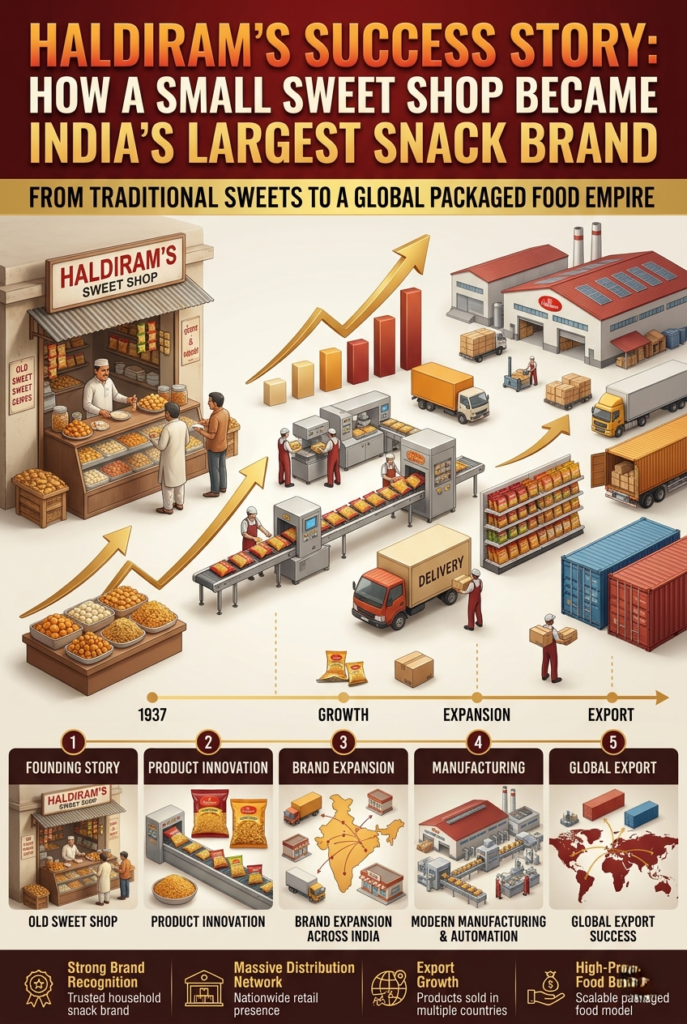
All thriving companies began with a mere thought. A self-motivated businessman started a small store in Bikaner in 1930s, in Rajasthan, and started selling traditional snacks. One of such products, bhujia, a savory, crispy snack, soon gained popularity among the local customers.
Nevertheless, the actual distinction was not the product, but the quality and consistency approach. The founder did not create snacks in a casual manner but paid more attention to the improvement of the recipe, taste, and consistency of the standards of each batch.
This focus on details created a sense of confidence in the customers.
The other significant innovation was on packaging and branding. When the majority of food products were sold as loose items without labels, the business realized that the attractive packaging could enhance hygiene, improve shelf life, and establish brand recognition. This was the first step towards the commercialization of a local snack.
The moral of the story to the entrepreneurs of this day is easy:
Brands are built through loyalty, and quality and consistency bring about customer loyalty.
The Turning Point: Going Beyond Local Markets
The process of starting a small shop and growing into a large company did not occur in a day. The business next generation made a strategic move to venture outside their hometown. They did not enter several markets simultaneously but instead took their time in choosing new locations and developing manufacturing facilities in major cities.
This growth plan was not an aggressive growth process but a well thought out expansion strategy.(Haldiram Success Story Business)
The business also made sure that the capacity of production, supply chain, and distribution systems were robust to meet the demand before penetrating into new markets. Such discipline ensured that it avoided operational failures and kept the quality of products.
At this phase, the company had three key areas of growth in which it concentrated:
- Developing strong manufacturing facilities.
- Normalizing product quality and processes.
- Building solid distribution channels.
These are some of the factors that enabled the brand to become a stable presence in various areas and slowly gain national awareness.
To business people, this step helps to emphasize a key value:
Systems are required to support growth rather than ambition.
Manufacturing: The Keystone of Success in the Long-term
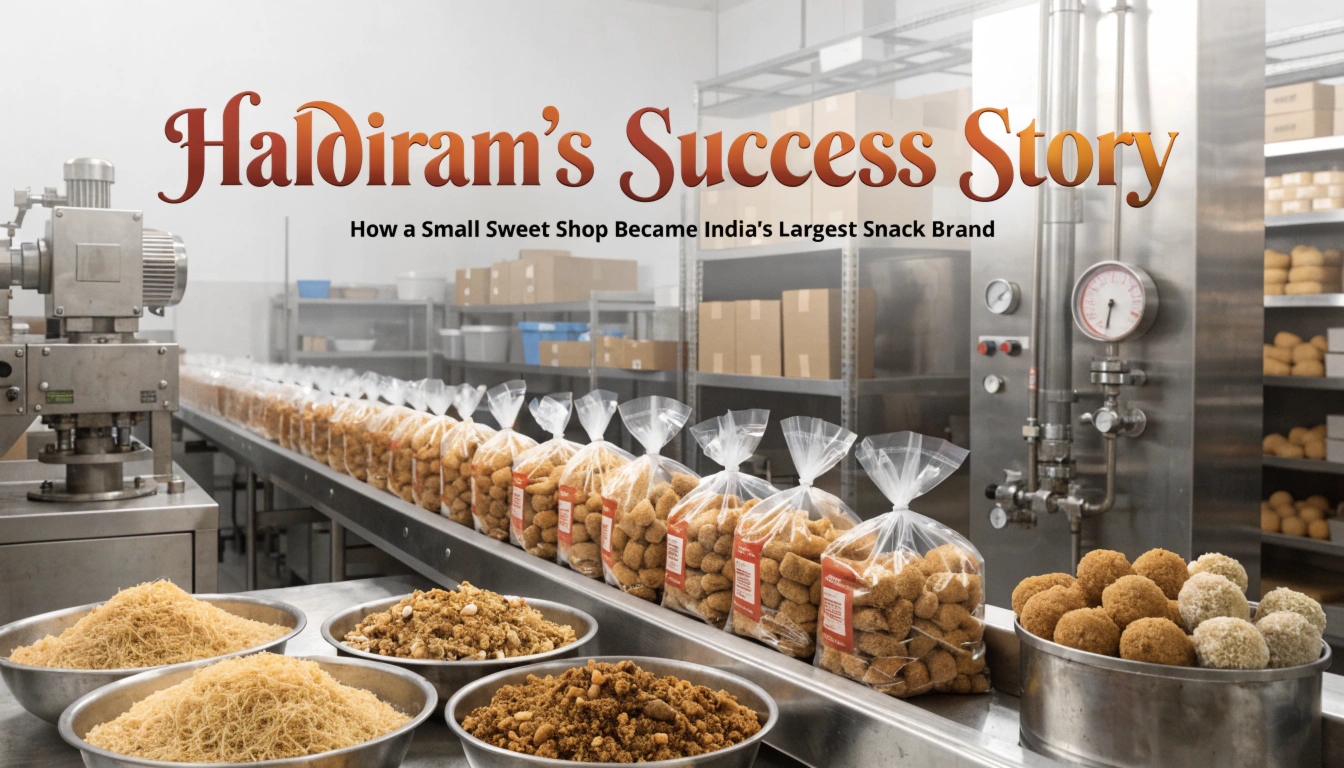
The dedication to its manufacturing excellence was one of the most crucial choices that led to the long-term success of the company. The costly third-party suppliers were avoided and the business invested in their own production plants and quality control mechanisms.
The benefits of controlling a manufacturing operation were:
- Quality Control
Close supervision of production means product consistency and customer satisfaction.
- Cost Efficiency
Production within the company will minimize reliance on suppliers and enhance profit margins.
- Product Innovation
Companies will be able to test new recipes, packaging, and technologies.
- Brand Reliability
Customers have faith in brands that can provide the same quality in the long run.
To the contemporary businesspeople, production is one of the surest means of establishing a sustainable business. Regardless of whether it is the production of snacks or packaged foods or consumer goods, controlling production generates competitive advantage that trading businesses in most cases find it difficult to generate.
The Rapid Growth of India’s Food Processing Industry
There has been a phenomenal growth in the food processing industry within India over the last ten years. Entrepreneurs have been presented with new opportunities by changing lifestyles, rise in incomes, urbanization, and growth in demand of convenience foods.
The consumers today are favouring packaged products that:
- Hygiene and safety
- Comfort and increased shelf life.
- Consistent quality
- Attractive packaging
Consequently, the market of snacks and ready-to-eat food keeps growing dramatically.
Another major growth driver is export demand. The Indian snacks and traditional food are becoming popular in the global markets especially in nations that have a high population of Indians. Small businesses can now access international markets with better logistics and online market places.
The industry has also been enhanced by government programs in terms of financial support and development of infrastructure. Such programs stimulate the investment by entrepreneurs to food production and new technology of processing.
The food processing industry is one of the most consistent and expandable business prospects of the modern economy in the case of startups and MSMEs.
Read More: Project Reports & Profiles
Successful Business Concepts based on the Haldiram model
The popularity of developed snack products has challenged thousands of entrepreneurs to venture into the food manufacturing sector. Competition has been on the rise, however the demand of quality products is ever rising.
There are numerous food enterprises that can be launched on small basis and grown as the market demands rise.
The following are some of the most lucrative food manufacturing opportunities:
- Namkeen and Snack Manufacturing.
Bhujia, mixture and sev are traditional snacks which are in demand all year round. These are cheap products that can be distributed easily and are consumed by all age brackets.
- Frozen Snacks and Ready-to-Cook Products.
Frozen foods are gaining popularity among busy households, restaurants and cloud kitchens. Samosas, cutlets, and parathas are some of the products with good potential in terms of profits.
- Classic Candy in a Contemporary Pack.
Indian sweets are also part and parcel of festivals and celebrations. With hygienic packaging and better shelf life, the businesses can access new markets and make more sales.
- Ready-to-Eat Meal Production
City dwellers are seeking fast and easy to get meals. Ready-to-eat meals like instant curries, rice recipes and snacks are increasing in popularity at an alarming rate.
- Papad and Fryums Manufacturing.
They are products that do not demand a lot of investment and have high demand in both the domestic and export markets.
All these businesses can start small in terms of production and expand over time as they increase their revenue.
The Significance of Planning Before opening a business
Poor planning is one of the major causes of business failure. Most entrepreneurs spend funds on assumptions and not data. Unless researched well, businesses can incur unforeseen expenses, lack of demand or even challenges in operations.
An elaborate feasibility study assists the entrepreneurs to make sound decisions prior to starting a new venture.
The following are the main elements of a professional business plan:
- Market demand analysis
- Raw material availability
- Machinery and equipment requirements.
- Production process design
- Budgets and break even analysis.
- Risk assessment and mitigation strategies.
This systematic strategy will eliminate the unpredictability and increase the likelihood of success in the long term.
When starting as an entrepreneur, professional advice may be particularly beneficial to overcome regulatory challenges, choice of technology and financial planning.
Read More: Startup Selector
Important Takeaways of MSME Entrepreneurs and Startups
The case of successful food brands has a number of practical lessons that can be used in businesses of any scale.
Emphasize on Product Quality.
Consumers will go back to the brands that provide the similar taste and predictability. The most important thing should be quality.
Begin Small and Grow Progressively.
The fast growth without adequate mechanisms may result in a loss of finances and collapse of operation. Stability is guaranteed by controlled growth.
Invest in Branding and Packaging.
Good packaging enhances visibility of the product, the establishment of trust and sales.
Compose of Good Distribution Networks.
Efficient distribution also makes sure that goods are delivered to the customers in a fast and reliable manner.
Maintain Financial Discipline
Budgeting and cost management helps businesses to avoid the unforeseen financial strain.
These values are the basis of a sustainable business development.
The Future of Indian Food Manufacturing
The future of the food processing business is very bright. Entrepreneurs have been given a favorable environment due to technological advancement, better logistics, and friendly government policies.
Some of the critical trends that are influencing the industry are:
- Modern manufacturing machinery and automation.
- Online food delivery sites.
- Organic food and healthy food.
- Export-oriented production
- Sustainable packaging solutions
Companies that adjust to such trends will be at a competitive edge in the market.
The food manufacturing is a promising industry in the long-term to those entrepreneurs who are ready to take time, efforts and plan their strategies.
The support NPCS gives to Entrepreneurs and MSMEs
Niir Project Consultancy Services has also established a good reputation in assisting entrepreneurs in setting new industries over the years. The organization also offers technical advice and practical solutions that are specific to the project.
The NPCS services are also very useful to the first-time entrepreneur who might not be experienced in manufacturing. The consultancy assists businesses to mitigate risks and enhance their likelihood of success through the provision of professional guidance and well-organized planning.
Entrepreneurs select NPCS due to its:
- Experience in the industry in a variety of fields.
- Bank-accepted reliable project reports.
- Assistance on securing government subsidies.
- Advice on the appropriate machinery.
- Help in opening new production plants.
Such an integrated system of support enables companies to emphasize on growth as opposed to operational issues.
Conclusion: How to develop a Successful Business in 7 Steps
The case of Haldiram demonstrates that it does not take a day to create a great business. They are constructed by hard work, proper planning, and diligence to excellence.
The rise of a small store in a town in the country to a world-known company proves that patience and the ability to make right choices are the key.
Entrepreneurship has never been more opportunities than it is today. Even a small startup can become a successful and reputable brand with the right attitude, proper planning, and attention to quality.
Frequently Asked Questions (FAQ)
Q1. What was the secret of the success of Haldiram in snack industry?
The success of Haldiram was based on the quality of its products, good branding and slow growth which was backed by good manufacturing systems.
Q2. Is the food processing business lucrative to new entrepreneurs?
Yes, it is a good growth opportunity in the industry because of the growing demand of packaged food and convenience food.
Q3. What is the amount of investment needed to start a snack manufacturing business?
A mid-unit size business usually costs between 1.5 crore and 4 crore as per capacity and level of automation.
Q4. Are there any small businesses that can export food products in India?
Yes, small businesses are able to export when they get the required licenses and reach the quality standards.
Q5. What is the significance of a feasibility study prior to the commencement of a manufacturing business?
A feasibility study assists an entrepreneur to know the cost, risks and the demand of the market so that they make an informed decision in investing.


