


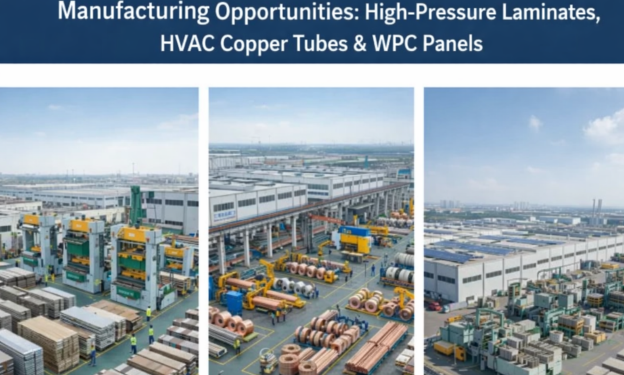
Manufacturing Opportunities High-Pressure Laminates (HPL), which deal with the manufacturing of copper tubes that are used in HVAC systems, Wood Plastic Composite (WPC) panels are terrific opportunities to the entrepreneur seeking new industrial ventures. These are products that are currently up in demand in the construction, interior design and sustainable building sectors. Durable, decorative surfaces (countertops, cabinets, furniture), copper tubes (heating, ventilation and air-conditioning (HVAC) and refrigeration systems), and wood fiber and thermoplastics-based WPC panels (decking, cladding, and environmentally friendly furniture) all use high-pressure laminates.
The world markets of these products are expected to increase in growth steadily as an example HPL is expected to increase form about 8.2 billion (2024) to more than 11.6 billion (2034), copper tubes 24.8billion (2024) to more than 35billion (2030) and WPC panels (exterior/interior) 4.3billion (2024) to 8.0billion (2033). The growth rates (mid-single-digit CAGR of laminates and copper, high-single-digit of WPC) are accelerated by the increase in construction, renovation, energy-saving building trends, and sustainability. Key features and market metrics of each product are not only summarized in the table below:
| Product | Raw Materials | Major Uses | 2024 Market Size | Forecast (Target Year) |
| High-Pressure Laminates (HPL) | Kraft/cotton paper, phenolic/melamine resins | Kitchen countertops, cabinets, furniture, wall panels | ~$8.2 billion | ~$11.6 billion by 2034 (~3–4% CAGR) |
| Copper Tubes (HVAC) | Refined copper (C11000 grade) | Refrigeration/AC lines, plumbing, heat exchangers | ~$24.8 billion | ~$35 billion by 2030 (~5% CAGR) |
| WPC Panels (Wood-Plastic Composite) | Wood fiber (sawdust), HDPE or PVC, additives | Outdoor decking, wall cladding, furniture, interiors | ~$4.3 billion (panels) | ~$8.0 billion by 2033 (~7–8% CAGR) |
High-Pressure Laminates (HPL)
High-Pressure Laminates are ornamental panels that are formed by compressing numerous layers of paper with artificial resins in the presence of enormous heat and pressure. The process of HPL production is usually the saturation of kraft or cotton paper sheets with both phenolic and melamine resin. An overprinted decorative overlay is laid on the top and the stack is bonded in a hydraulic press (flush with the usual pressures of up to 1,000 psi).
The thermosetting resins dry into hard plastic under the heat and the layers amalgamate to make one tough sheet. What comes out is a hard, waterproof, fire and scratch resistant panel which can replicate wood grains, stone, metal finishes or solid colors.
Applications:
HPL is extensively used in interior surfacing, kitchen counter applications, cabinets, wall/door panel applications, tabletops, flooring, and furniture in residential, office, hotel and restaurant settings. In the business environment, HPL is preferred due to its durability and design flexibility. Creative patterns or even anti-bacterial, anti-fingerprint, and UV-resistant surfaces can be created on custom laminates to be used in medical and public spaces.
Market Outlook:
HPL has a moderate demand with new residential and commercial buildings, interior, and expansions contributing to the growth in the hospitality sector. One market forecast HPL to grow in the world market by approximately 3-4 percent CAGR in the coming 10 years. Another frequent example of producing at low costs are the laminate sheets that are produced in places such as India, China and Turkey to meet the local needs. In North America and Europe, the high-end laminates and the specialty laminates are more accepted whereas the Asia-Pacific region is experiencing accelerated growth as a result of urban housing and retail projects.
Business Considerations:
To open an HPL plant, it needs to invest heavily in special equipment ( multi opening presses, calender lines, dryers), and to have a constant flow of raw materials (decorative paper rolls, resin monomers, kraft paper). The control of quality is essential: a high degree of temperature control / pressure control provides equal thickness and adhesion. Modular plant designs which are capable of scaling output are beneficial to entrepreneurs. The main opportunities of HPL manufacturing are a stable demand (laminate is an established product that is used regularly in renovations) and comparatively high margins on superior decorative lines. The challenges are the variability of prices of resin and pulp, and the low-cost substitutes such as melamine boards.
Copper Tubes for HVAC Systems
The mainstay of HVAC and refrigeration systems is copper tubes (seamless or welded). Copper has a high thermal conductivity with solid resistance to corrosion making it a perfect heat exchanger: it is used to move heat fast in refrigeration lines, condensers, evaporators and radiator coils.
Plumbing Water lines and fuel gas lines are also plumbed in with copper tubing because it is durable. Copper tubing is used to distribute refrigerants (like R410A, R32 or R290) and water in HVAC equipment (air conditioners, chillers, heat pumps) and in refrigeration (commercial coolers, automotive air conditioning), which guarantees the efficient operation of the systems and their durability.
Applications and Advantages:
HVAC/refrigeration systems are about 40 percent of copper pipes and tubes market. Air-conditioning refrigerant lines, water coils are standardized using copper alloy C11000 (99.9% pure copper). These tubes are frequently in coils or straight lengths, in different wall thicknesses (Type L or Type K). In addition to HVAC copper tubing is also appreciated by its antimicrobial behavior in chilled water systems, and marine/shipbuilding (seawater cooling pipes) due to its resistance to biofouling. Copper has the ability to survive pressure and thermal cycling longer than other solutions (plastic PEX or aluminum).

Market Outlook:
The world copper tubes and pipes market is a large and expanding market that is increasing with infrastructure and buildings. A recent study estimates a market size of about 25 billion dollars (2024) with a growth of 3543billion by the year 2030. The main sources of growth are the increasing urban air-conditioning need in hot climates, the replacement of old HVAC systems, and the cooling of industries. It is dominated by the Asia-Pacific region (almost 70 80 percent of the demand) because of rapid urbanization in China, India and Southeast Asia. Modernization and efficiency upgrades (smart HVAC) are propelled by North America and Europe, whereas renewable energy applications (solar/wind cooling) are new markets of high conducting tubes.
Manufacturing Process:
The production of copper tubes normally begins with very pure copper billets. These billets are pressed out or pushed through dies into long hollow tubes, and pulled through dies until they attain specific diameters. Restoration of ductility is done by annealing furnaces and cleaning and testing (hydrostatic pressure tests, eddy-current inspections) of tubes. A production line can also consist of a continuous draw bench, annealer, coiler or cut-to-length saws and packing. Recycling scrap copper (offcuts or rejected scraps) is part and parcel as copper is costly.
Business Considerations:
Business: In the case of startups, the most important aspects are to have a stable supply of copper cathode (price fluctuations are also a significant risk) and to invest in quality controllers. The market embraces high-end premium versions in admi (including silver or phosphorus to achieve increased strength), as well as pre-insulated lines. Capital intensity is average-high as entry barriers however well-packed copper tubing is still in use in new HVAC systems and retrofit markets. Most of the OEMs would love to have the local tube suppliers to eliminate any delays caused by importation.
Read Also: HVAC Growth and Copper Demand: Strategic Opportunity for Tube Manufacturers by 2030
Figure: World copper pipes and tubes market in regions (20182030, USD). Asia-Pacific (blue) leads the growth due to booming AC and construction. The growth rate of copper tubing is also expected to be substantial in the next few years with an average growth rate in the mid-single digit.
This graph (based on market analysis extrapolated) shows that the growing construction and manufacturing sector of Asia-Pacific controls the market with North America and Europe stable in demand. Copper in cooling systems is supported by usage of about 40 percent of it by the HVAC sector alone.
Read Business Plan: Click Here
Wood-Plastic Composite (WPC) Panels
Wood-Plastic Composite panels are thermoplastics (usually recycled HDPE, PVC or polypropylene) boards engineered by blending wood fibers (sawdust or wood flour) and thermoplastics with additives. The WPC panels have the appearance and stiffness of wood, as well as the ability to resist moisture and low maintenance of plastic. The wood and plastic granules are melted and combined (usually with UV stabilizers and coupling agents) in manufacturing, and extruded or molded into panel shapes.
A co-extrusion style, in which a thin top-coat of pure polymer is applied to give the wood-plastic core an extra layer of durability, is used in many WPC panels; this type of paneling is the current majority in the panel market.
Applications and Benefits:
WPC panels have applications in the outdoors and indoors. They are commonly used in outdoor decking boards, fencing, railing, and exterior wall cladding; they do not rot, do not have termites or weather problems, and do not need to be painted. WPC wall panels or ceiling planks can be applied indoors in the bathrooms, kitchens and commercial interiors of places that are prone to moisture. These panels are also resistant to impacts and can be manufactured either in wood-like finishes or in personal colors. WPC also makes use of waste wood, and recycled plastic, which is more environmentally friendly and does not require as much virgin lumber as much. WPC is appreciated by homeowners and builders due to low maintenance, in that it does not require either sealing or painting, and lasts very long (up to 20 years).
Market Outlook:
The WPC market is growing at a very high rate. Wood-plastic composites, further expanded into decking boards, furniture parts, and other shapes, will rise to satisfy a market of approximately 15 billion plus by 2030 (CAGR 1012 percentage). The growth rates of WPC panels (exterior/interior wall panels specifically) can be seen as following the same growth line, the market estimations are increasing at an average of 7-8 percent a year. The trends of green buildings, building renovations and substituting tropical hardwood decking with environmentally friendly materials drive growth. It is the fastest-growing geographically in Asia-pacific (huge infrastructure undertakings in China, India, Southeast Asia), North America and Europe are mature markets that emphasize high quality and specialty products (fire-rated panels, composite siding).
Types and Segments:
In the WPC panel industry, exterior (to be used outside) panels (entities to be used outdoors) are concentrating the major share (approximately 85 percent of the panel market), whereas interior panels are increasing as well. The dominance goes to co-extruded panels as they are better appearing and have a moisture barrier. The other 15 percent of so-called solid WPC panels (only one composite material) are less expensive and less weatherproof. Synthetic wood-look interior panel in offices and bathrooms costs manufacturers a niche such as required fine finishes and uniform color.
Manufacturing Process:
A typical WPC panel plant consists of extrusion lines or press molds. Dried wood fiber and plastic pellets are pumped through an extruder where they are mixed with the heat and pressure of the screw to become a molten composite. The extrudate is cast in the form of a sheet, cooled by rollers and cut to size. This process is augmented with a thin layer of PVC or a modified cap which is co-extrusion lines. The quality control is carried out on panel density, moisture content and the uniformity of the surface. Contemporary WPC facilities tend to use automation (laser cut, CNC surface texturing) to increase productivity. At times, a startup may start with a single-screw extruder or a twin-screw extruder and add capacity to meet demand.
Figure: A regional overview of the market of wood-plastic composites (2025–2030, USD). The graph reveals that there is a high growth in all the regions with North America and Asia-Pacific topping the list. The WPC market (panels, decking, etc.) all over the globe is predicted to explode. North America and the Asia-Pacific dominate the market share which is fueled by the building and sustainable building projects.
The market forecasts (shown in the graph) show that there is high growth in the near future, which means that there will be high demand of WPC products. This industry presents an opportunity to the entrepreneurs in this business to explore markets between residential decking and commercial cladding, capitalizing on the green image of composite wood panels.
Key Advantages & Market Drivers
Durability and Aesthetics (HPL):
High-pressure laminates provide an easy-to-clean and strong-looking finish for architects and homeowners. They are available in endless design styles (woodgrain, stone, solid colors) and can be compatible with practically any interior design style. This aesthetic versatility and low maintenance makes this desirable in kitchens, offices, and hospitality facilities with the resultant constant demand.
Thermal Efficiency (Copper):
The thermal conductivity of copper is inherent and this makes systems more energy efficient. The use of copper tubes is improved by new trends in HVAC (e.g., cold-climate heat pumps and high-efficiency chillers). There are also building codes and efficiency standards governing high-performance materials all over the world, which is advantageous to copper line sets.
Sustainability (WPC):
WPC is being promoted as an environmentally friendly substitute of pure wood or vinyl. They enable construction professionals to boast of sustainable sourcing (with the use of recycled material) and save maintenance expenses in the long run. WPC is supported by government subsidies on sustainable building (particularly in Europe and North America).
Infrastructure Growth:
A major factor in each of the three sectors is an increase in construction and infrastructure expenditures. Along with the growth of economies and urbanization, there is an increase in the demand for new housing (laminates, WPC) and better HVAC systems (copper tubes). These markets are further increased by the renovation and retrofitting of the old buildings.
Challenges:
The entrepreneurs should be sensitive to the volatility of raw materials (paper pulp and resin costs of laminates; copper metal costs of tubes; plastic resin costs of WPC). All industries are capital-intensive and the optimization of factory layout and processes is essential to profitability.
Manufacturing Considerations
These industries must be planned properly with regard to facilities and processes to start. Laminate plant requires a production line consisting of impregnating stations, dryers and a high-pressure press; tube manufacturing requires precision extruders, draw benches and annealing ovens and a WPC panel plant requires extruders or presses and finishing lines.
In every instance, the consideration is safety (resin, and metalworking safety, in the latter instance, with copper). There is also a need to have quality labs (strength, coating adhesion, dimensional checks).
A good entrepreneur would take one strategic measure of referring to detailed feasibility studies and project reports. An example of such industries is Niir Project Consultancy Services (NPCS) which prepares Detailed Techno-Economic Feasibility Reports of the Market Survey-cum.
NPCS reports include all details of establishing production such as the minute manufacturing process, raw material needs, the plant layout design, and the entire financial forecasts. With the help of such professional research, a new company will have a superior chance to evaluate the feasibility of taking the gamble of entering the laminates, copper-tube, or WPC panel business and strategize to do so.


