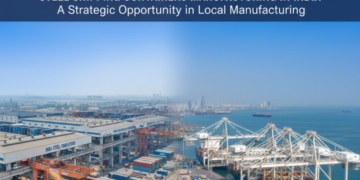




Steel Shipping Containers Manufacturing in India: India’s manufacturing landscape is quietly entering a phase where logistics infrastructure, steel capacity, and export ambition are converging. Few products sit as neatly at this intersection as steel shipping containers standard dry cargo containers, specialized containers, and modular freight units that form the backbone of global trade.
For decades India has remained a net importer of cargo containers despite being one of the world’s largest steel producers and a major trading nation. This anomaly is now being actively corrected through targeted policy intervention, infrastructure spending and MSME focused financial support. For entrepreneurs evaluating capital-intensive but scalable manufacturing opportunities container manufacturing deserves serious attention.
The Strategic Logic Behind Steel Container Manufacturing
From a project evaluation standpoint, steel shipping containers tick several boxes that feasibility consultants look for:
- Non-discretionary demand – containers are required regardless of economic cycles
- Export-linked scalability – global freight growth directly translates into demand
- Steel-backed cost stability – India’s domestic steel ecosystem reduces raw-material volatility
- High entry barrier – protects serious manufacturers from overcrowding
Globally container manufacturing has been dominated by a handful of Asian suppliers leading to pricing concentration and supply chain vulnerability. India’s policy framework now explicitly recognizes containers as a strategic manufacturing segment, aligning them with infrastructure and export competitiveness objectives
Policy Push That Changes the Economics for Entrepreneurs
A defining feature of the current industrial policy environment is the creation of a dedicated container manufacturing ecosystem, backed by multi-year public funding and MSME-friendly instruments. The government’s approach is not cosmetic—it directly addresses the structural disadvantages Indian manufacturers previously faced.
Key interventions include:
- Capital support for setting up container manufacturing lines
- Integration with bonded manufacturing zones and deferred duty mechanisms
- Electronic sealing and digitization of customs clearance of export goods.
- Increase in inland waters and coastal shipping.
Collectively, these measures narrow the historical cost gap with global competitors while improving working capital efficiency—two variables that traditionally made container manufacturing unattractive for first-generation entrepreneurs.
Read Also: PV Cell & Module Demand vs Imports
Why Containers Make Commercial Sense Now
From an investor’s lens, timing matters as much as product selection. Three macro shifts make this sector particularly attractive:
Logistics Infrastructure Is Catching Up
With new freight corridors and operational inland waterways container circulation within India is accelerating. Faster turnaround directly improves container utilization economics.
Export Orientation Is Policy-Aligned
Export cargo clearance from factory premises, risk-based customs systems, and single digital windows significantly reduce friction for container exporters.
MSME Liquidity Constraints Are Being Addressed
Dedicated MSME growth funds, expanded credit guarantees, and mandatory TReDS integration for public sector buyers improve cash-flow predictability—often the weakest link in heavy manufacturing startups.
Read Also: The Future of Cargo Containers in Global Logistics: Landing Page Design
Cost Structure Snapshot: India vs Import Dependence
| Cost Component | Imported Containers | Domestic Manufacturing |
| Steel Input | FX-linked | Domestic steel pricing |
| Freight Cost | High (bulk shipping) | Minimal |
| Lead Time | 8–12 weeks | 3–5 weeks |
| Working Capital Lock-in | High | Moderate |
| Policy Incentives | Nil | Available |
This differential is precisely what policy intervention is designed to exploit—turning logistics inefficiency into a domestic manufacturing advantage.
Business Models Entrepreneurs Can Consider
Standard Dry Cargo Container Manufacturing

This is the volume backbone of the industry. Entrepreneurs entering here benefit from standardized designs and repeat bulk orders from logistics companies and leasing firms.
Specialized Containers (Reefer, Tank, Flat Rack)
Though capital intensive specialized containers offer higher margins and lower price sensitivity. This segment rewards engineering capability and quality compliance.
Modular Containers for Infrastructure & Defence
The next opportunity is repurposed containers to mobile offices, defence logistics, storage units, and emergency infrastructure in solution-based selling and manufacturing.
All models vary in intensity of CAPEX, certification needs, access of the market- however all have the same structural drivers of demand.
Read our project reports: Production of Steel containers (Cargo Containers)
Lessons from Indian Industrial Leaders
The Indian steel and engineering market leaders have always shown that scale is the result of integration and not speculation.
- Tata steel (Promoter: Jamsetji Tata) was able to develop competitiveness through the alignment of downstream applications and raw material security.
- The JSW Group (Promoter: Sajjan Jindal) used proximity of logistics and port integration to manage the cost that was delivered rather than production cost.
- Larsen and Toubro (Promoter: Homi J. Bhabha legacy institution) concentrated on deepening the engineering and executing the engineering projects and not the price of the commodities.
For container manufacturing entrepreneurs, the lesson is clear:
Win on system efficiency, not just factory cost.
Import–Export Opportunity Analysis For Steel Shipping Containers Manufacturing in India
India’s container requirement is not limited to domestic usage. Global trade volatility has exposed the risks of over-dependence on single-country suppliers. This creates space for India-made containers in:
- Africa and Middle East trade lanes
- South Asia coastal shipping
- Inland water transport systems
With policy support for export facilitation and bonded manufacturing, container units can be designed as export-first projects, not domestic afterthoughts.
Risk Awareness: What Entrepreneurs Must Plan For
No feasibility-driven article is complete without risk realism.
Key risks include:
- Certification and international compliance delays
- Initial order concentration risk
- Steel price cyclicality
- Skilled fabrication manpower availability
However, these risks are manageable with correct project sizing, phased capacity expansion, and buyer diversification—principles that experienced consultants apply while structuring DPRs.
Where Professional Feasibility Matters
This is precisely where structured project evaluation becomes critical.
At Niir Project Consultancy Services (NPCS), we work closely with entrepreneurs to translate policy intent into executable industrial projects. Our Market Survey cum Detailed Techno-Economic Feasibility Reports cover:
- Manufacturing process design and layout planning
- Product mix and capacity selection logic
- Machinery and raw-material configuration
- Market demand mapping and buyer profiling
- Complete financials with profitability, IRR, and break-even analysis
The objective is simple- help investors commit capital with clarity not assumptions.
Read our book: Profit-Making Production Business of Metal Marine Containers for Entrepreneur and Startup.
FAQ
Q1. Is container manufacturing suitable for first generation entrepreneurs?
Yes provided the project is professionally structured and aligned with policy incentives rather than oversized from day one.
Q2. What is the typical payback expectation?
Well-planned units targeting export and institutional buyers typically achieve medium-term payback once capacity utilization stabilizes.
Q3. Does this sector require export orientation to succeed?
Export orientation significantly improves scalability, but domestic logistics demand alone can sustain medium-scale units.
Q4. How critical is location selection?
Proximity to ports and freight corridors materially impacts competitiveness.
Q5. Are MSME schemes practically accessible?
Yes especially when compliance and financial structuring are professionally handled.
Final Thought
Steel Shipping Containers Manufacturing in India are not a speculative trend they are infrastructure anchored industrial assets. With policy alignment and MSME centric financial support now in place this sector has shifted from difficult to decisively viable.
For entrepreneurs who think in systems rather than slogans container manufacturing offers something rare in today’s startup landscape- predictable demand and policy backed momentum.


