


New Service Startup Ideas: Tourism has always been described as a “sunrise sector” in India. What is changing now is the character of tourism itself. It is no longer being fuelled by recreational travel or seasonal traffic. A more enduring, reliable service economy is emerging, anchored on healthcare-centered traveling, long-stay care services, skills-based hospitality institutions, and digitally crafted cultural encounters.
Reference context: India’s Union Budget 2026–27 (presented on 1 February 2026)
This change is exhibited in the Union Budget 2026 -27 of India. The Budget brings tourism, healthcare and education as one service value chain; it does not concentrate on them as independent silos, but as a value chain, which is medical value travel, care services, hospitality skilling and experience-driven tourism.
To first-generation entrepreneurs and startups, this provides capital-light opportunities in comparison to manufacturing, but which are scalable, export-facing, and policy-aligned.
The sentimental aspect is not commercially interesting at this moment, but the structure. The Budget supports the development of the service sector by providing specific schemes, rationalisation of taxes, training, and institutional infrastructure, to help establish the environment in which properly designed service startups can grow well, without increasing and decreasing unpredictably.
Read Also: The Incredible Growth of the Tourism and Hospitality Sector in India
The reason why Tourism is becoming a services-led industry.
Conventional tourism relies a great deal on discretionary expenditure and seasonality. Medical travel, care services, and experiential tourism operate on different demand fundamentals. Healthcare is non-cyclical. Ageing demographics create recurring demand for care. Skill shortages generate institutional demand for training. Cultural and digital tourism scale globally without physical footfall limits.
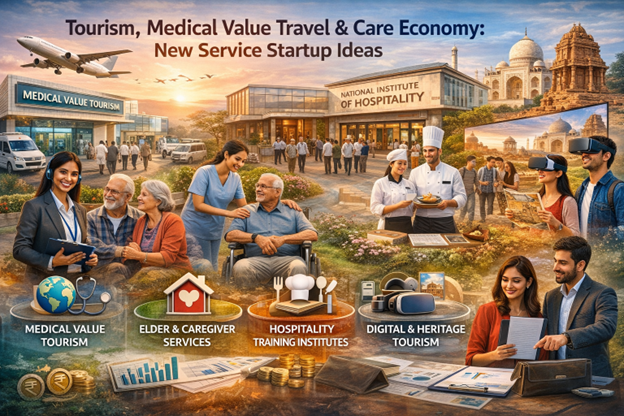
The Budget’s service-sector emphasis reflects this reality. Measures such as schemes to establish medical value tourism hubs, large-scale training of caregivers, creation of a National Institute of Hospitality, development of digital knowledge grids for heritage sites, and focused upskilling of guides at iconic destinations are not tourism promotions—they are capacity-building interventions.
From a feasibility perspective, this matters because capacity-building creates long-term demand for private service providers who can operate at professional standards.
Read our book: Investment Opportunities In Hospitality, Medical, Entertainment, Ware Housing & Real Estate Projects (with 15 Project Profiles)
Table: Budget Signals Shaping Tourism & Care Economy New Service Startup Ideas
| Policy Focus Area | Budget Intervention | Startup Opportunity Created |
| Medical value tourism | State-supported hubs with private partnership | Integrated medical travel service companies |
| Care economy | Training of 1.5 lakh multiskilled caregivers | Caregiver agencies & assisted-living services |
| Hospitality education | National Institute of Hospitality | Private training & certification institutes |
| Experience-based tourism | Digital documentation & site development | Content-led tourism startups |
| Skills & guides | Upskilling of 10,000 guides | Professional tour & experience operators |
1) Medical Value Tourism Hubs: Beyond Hospitals, Toward Integrated Services
The medical value travel proposal by India has been hospital-based historically. Patients came in, were treated and went out. The private-sector-driven initiative towards Budget-supported medical value tourism hubs is an indication that it is moving towards integrated ecosystems instead of individual hospitals.
This leaves room for startups that are between hospitals and patients such as medical travel coordinators, post-treatment recovery facilitators, concierge healthcare services, and international patient management firms. Surgery is the least important, but coordination between the end and the end: visas, accommodation, diagnostics, after-operative care, insurance contact, and follow-up telemedicine.
From a business-selection standpoint, these models are attractive because they are asset-light and relationship-driven. Once a hospital network is onboarded, patient inflows become repeatable through overseas referrals.
Industry Lesson:
The person who established the reputation of healthcare exports in India was Apollo Hospitals Founder, Dr. Prathap C. Reddy, who made sure that the care was standardised and the processes internationalised at the hospital. In the case of startups the same applies but with better effect; credibility and process design have greater importance than advertising.
2) Geriatric & Caregiver Services: The Quiet, Scalable Opportunity
A building of a holistic care ecosystem, where 1.5 lakh multiskilled caregivers are being trained, is one of the underrated Budget announcements. It is not a welfare program per se, it is an acknowledgement of a structural demographic change.
There is an increase in the elderly population at home in India and the number of skilled nurses in care across the globe is on the increase. Start ups can be run in various models; caregiver staffing agencies, home based eldercare services, assisted-living management, and post-hospitalisation care coordination.
The logic of profitability is simple. The services provided by the care are not a single instance of sales but recurring monthly revenues. Client stickiness is very high and differentiation of the service is not done on price wars but on the basis of quality and reliability of training.
There is also a potential of exports, skilled caregivers can be rolled out to other countries and their skills become foreign-exchange-generating services.
Industry lesson:
Jana Urban Services Co-founder Ramesh Ramanathan showed how services based on social infrastructure can be scaled sustainably with professionalism substituting informality. The same is so with care services.
3) Hospitality Training Institutes: Turning Skill Shortages into Business Models
One of the reasons why tourism development usually fails in its implementation is the lack of skilled manpower to match the rate of expansion of infrastructure. This limitation can be attributed to the fact that the decision of the Budget to establish a National Institute of Hospitality to mediate between academia, industry, and government.
In the case of entrepreneurs, the business is not in the matter of operating a hotel, but training the employees that hotels, hospitals, cruise companies and tourism services require. The short term certification centres, private hospitality training institutes, and sector-specific academies can flourish as a result of designing curricula in line with the needs of the industries as opposed to generic diplomas.
The economics are very attractive: training businesses are not very capital intensive, scale through batch replication, and have the advantage of institutional demand. They also have credibility and placement leverage when they are pegged to government skill frameworks.
Read This Business Plan to Boost Tourism and Hospitality Sector
Industry lesson:
Ritu Kumar, the Founder of the Ritu Kumar Group, created fashion education as a part of the brand ecosystem. The lesson can be applied to the present case in which, the lack of skills in an industry makes training a lucrative venture.
4) Experience-Based Tourism & Digital Heritage: Scaling Without Physical Limits
The emphasis of the Budget on transforming archaeological sites to a dynamic learning experience, building a National Destination Digital Knowledge Grid, and hosting international culture occasions is a move towards experience-based tourism.
Startups that are a content-technology-storytelling combination, digital heritage platforms, guided experiences, and AR/VR site interpretation, curated cultural trails, and multilingual content services to global audiences, all have fertile ground here.
These startups are digital, unlike the traditional tour operators. The experience designed with the right sales can be sold again and again without an equal amount of cost growth. The types of revenue models include B2B licensing, consumer subscriptions, and institutional contracts.
Industry lesson:
Nandan Nilekani, Co-founder of Infosys, showed that platforms create exponential scale when built as infrastructure. Digital tourism platforms can follow the same principle—quietly embedding themselves into national tourism systems.
Import–Export Lens: Tourism as a Foreign Exchange Service
Tourism and care services are effectively service exports. Medical travellers bring foreign exchange. Overseas students and trainees do the same. Digital tourism products can be sold globally without physical movement.
The Budget’s service-sector tax rationalisation, safe-harbour frameworks, and extended certainty for IT and service exports improve predictability for such businesses. Entrepreneurs who structure operations with international compliance and transparent accounting gain easier access to global clients.
Where NPCS Fits into Service Startup Decision-Making
Poor structuring is another reason why service businesses fail not due to demand but due to poor pricing models, underestimated manpower costs, and poor planning of scalability.
Niir Project Consultancy Services (NPCS) is a professional consulting firm that will assist in preparing Market Survey cum Detailed Techno-Economic Feasibility Reports (DPRs) to establish new industries or businesses, even those of the service industry. We do market demand analysis, service process design, capacity and manpower planning, pricing logic and full financial projection to enable entrepreneur determine whether to invest or not based on feasibility, profitability and long-term scalability.
FAQ: Founder-Focused Questions
Which service segment stabilises fastest?
Caregiver services and medical travel coordination tend to stabilise quickly due to recurring demand.
Are tourism startups too seasonal?
Experience-based and medical tourism models are far less seasonal than leisure tourism. Most models are asset-light, unlike hotels or hospitals, which rely on systems and collaboration.
Is it possible to have first-generation entrepreneurs in healthcare-related services?
Yes, as long as compliance, training and partnerships are put at the front line at the onset.
What is the biggest hidden risk?
Service quality inconsistency. In services, reputation compounds faster than marketing.
Final Perspective: Tourism Is Becoming a Knowledge and Care Economy
Tourism in India is evolving from sightseeing to service excellence—healthcare, care, skills, and curated experiences. The Budget’s approach makes it clear that future growth will come from entrepreneurs who treat tourism as a professional service industry, not an informal trade.
For startups willing to design structured, quality-driven service models, tourism, medical value travel, and the care economy now offer something rare: policy alignment, recurring demand, and global relevance.
Top 20 Medical Devices Manufacturing Business Ideas


