
• Latest
  • Trending
  • All
Biological Waste Treatment in India: Business Opportunities

India’s Waste Is Worth More Than You Think — Here Is Why Biological Treatment Is the Business Opportunity of the Decade

September 28, 2026
Manufacturing Empire

12वीं फेल से ₹100 करोड़ की फैक्ट्री तक: इस छोटे शहर के Entrepreneur ने कैसे खड़ी की करोड़ों की Manufacturing Empire?

September 28, 2026
Hidden Manufacturing Opportunity

₹10 लाख से शुरू हुआ ये Business आज करोड़ों में: भारत के इस Hidden Manufacturing Opportunity ने बदल दी Entrepreneurs की कमाई

September 28, 2026
Project & Profile
Pine Chemicals and Oleoresin: Market, Business & Processing

Pine Chemicals & Oleoresin: Why This USD 10 Billion Industry Deserves Your Attention Right Now

September 25, 2026
Engineering and Fabrication Business Ideas: 5 Profitable

Engineering and Fabrication Business Ideas: 5 Profitable Units in India

September 25, 2026
Pharmaceutical Business Ideas in India: 5 Manufacturing Unit

Pharmaceutical Business Ideas: 5 Profitable Manufacturing Units in India

September 25, 2026
Agro-based processing business ideas in India with food processing factory, agricultural products, packaging machinery, rice, pulses, oil, spices and farming-based industries

Agro-Based Processing Business Ideas: 5 Profitable Units to Start in India

September 28, 2026
Oracle invokes ‘force majeure’

Oracle invokes ‘force majeure’ over data center project as power delays disrupt plans, source says

September 25, 2026
Canadian business leader warns of a “capital chill”

Canadian business leader warns of a “capital chill” as USMCA talks with the US drag on

September 25, 2026
गांव में Business Ideas और ग्रामीण उद्यमिता के अवसर

गांव में शुरू करें ये 7 Business Ideas और हर महीने कमाएं ₹50,000 — कम निवेश, ज़्यादा मुनाफा

September 24, 2026
Natural Dyes and Pigments: Business Opportunities in India

Natural Dyes and Pigments: A Booming Industry That Entrepreneurs Can No Longer Afford to Ignore

September 23, 2026
Building Materials Business Ideas in India: 5 Manufacturing

Building Materials Business Ideas: 5 Profitable Manufacturing Units in India

September 23, 2026
Home Business Ideas: Low-Cost Ways to Start From Home

Home Business Ideas That Actually Work: Low-Cost Ways to Earn Extra Income

September 23, 2026
  • About
  • Advertise
  • Privacy & Policy
  • Contact
Monday, September 28, 2026
  • Login
Entrepreneur India Blog
  • Home
  • About
  • Books
  • Business Ideas
  • Contact
No Result
View All Result
Entrepreneur India Blog
No Result
View All Result
Home Waste Management & Recycling Business

India’s Waste Is Worth More Than You Think — Here Is Why Biological Treatment Is the Business Opportunity of the Decade

Author: Dr. H. Panda | Publisher: NIIR Project Consultancy Services (NPCS) | Price: ₹1,675 / US$ 150

by Sai Teja
September 28, 2026
in Waste Management & Recycling Business, Eco Friendly Sustainable Business
0
Biological Waste Treatment in India: Business Opportunities

Biological waste treatment converts organic and agricultural waste into useful products such as compost, biogas and bio-based materials.

491
SHARES
1.4k
VIEWS
Share on FacebookShare on Twitter

Biological Waste Treatment in India

Table of Contents

Toggle
  • India Generates Enormous Quantities of Organic Waste — Most of It Goes Nowhere Useful
  • The Science Behind Biological Waste Treatment: What It Is and Why It Works
  • Market Demand and Business Potential: The Case for Investing in Biological Waste Treatment
  • Policy and Regulatory Drivers
  • Commercial Opportunity: Products from Waste
  • Agricultural Waste Utilisation: A Specific MSME Opportunity
  • The Complete Book on Biological Waste Treatment and Their Utilization: What This Handbook Delivers
  • The 38-Chapter Scope: What Is Actually Covered
  • Who Should Read This Book
  • The Practical Value of This Reference
  • Book Details at a Glance
  • Get Your Copy Today
  • Your Investment Deserves the Right Opportunity
    • Frequently Asked Questions

India Generates Enormous Quantities of Organic Waste — Most of It Goes Nowhere Useful

The amount of waste accumulated in the form of organic waste is huge each day across the cities, farms, food processing units, dairy units, poultry units and fisheries in India. Food processing wastes, agricultural crop waste, manure from livestock and poultry, municipal sewage sludge, palm oil mill effluent, cotton jute processing and waste from onion dehydration, fish processing waste and there are so many other wastes and their utilisation is inadequate in most of the cases.

The opportunity is suggested by the scale of the problem. The organic waste produced by the household, food processors, restaurants and institutions on an average per person per day is about 1kg. The biggest contributors to organic food waste are urban centres, but agricultural operations produce large amounts of waste in the form of manure, crop residues and agro-industrial wastes as well.

Many of these wastes are currently being disposed of in landfill, water bodies or are left to decompose uncontrolled in the field, which results in environmental liabilities, greenhouse gas emissions and regulatory risks for the generators. However, organic waste can also be viewed as a raw material that can be economically recovered, just waiting for the proper technology and entrepreneur.

The Science Behind Biological Waste Treatment: What It Is and Why It Works

Biological waste treatment is the use of biological and microbial processes to transform organic waste into useful products or into a safe to dispose of product. Biological treatment is a method that retains and recovers the chemical energy and nutritional content of organic materials that would otherwise be lost when they are incinerated or dumped in landfills.

The main processes are aerobic composting (composting and humus production with microorganisms that need oxygen), anaerobic digestion (digestion without oxygen to biogas and digestate), fermentation (production of ethanol, acids, proteins or specialty chemicals with yeasts and bacteria), and bioremediation (degradation of hazardous organic compounds in soils and water with microorganisms).

All of these are characterized by their respective input materials, operating conditions, equipment requirements and output products. The soil amendment product from a unit for the composting of food waste and agricultural residues has commercial value for farmers. The manure from cattle or food waste is fed into an anaerobic digester or fermenter which generates biogas (mainly methane) which is used to fuel a generator or cooking system, and a digestate rich in nutrients. Fuel ethanol can be produced in a fermentation unit by enzymatic hydrolysis of wheat straw or sunflower stalks. Different products are produced from an organic waste stream using different processing methods.

Market Demand and Business Potential: The Case for Investing in Biological Waste Treatment

Over the last ten years, the business case for biological waste treatment in India has improved manifold and will continue to improve for the following reasons.

Policy and Regulatory Drivers

The Solid Waste Management Rules and the Plastic Waste Management Rules are coming into effect and also the general provisions of the environmental laws are increasingly putting responsibilities on the waste generators including the municipalities, food processors, hotels, markets and large agricultural operations to take care of their organic waste responsibly. It puts a demand on waste processing services and technology companies that are able to provide solutions that comply with the laws.

The National Mission for Sustainable Agriculture (NMSA) and state-level schemes have encouraged measures such as composting, biogas production, and utilization of agro-waste to decrease reliance on chemical fertilizers and enhance soil health. This support helps in building stable demand for farm and cooperative level composting units and biogas plants.
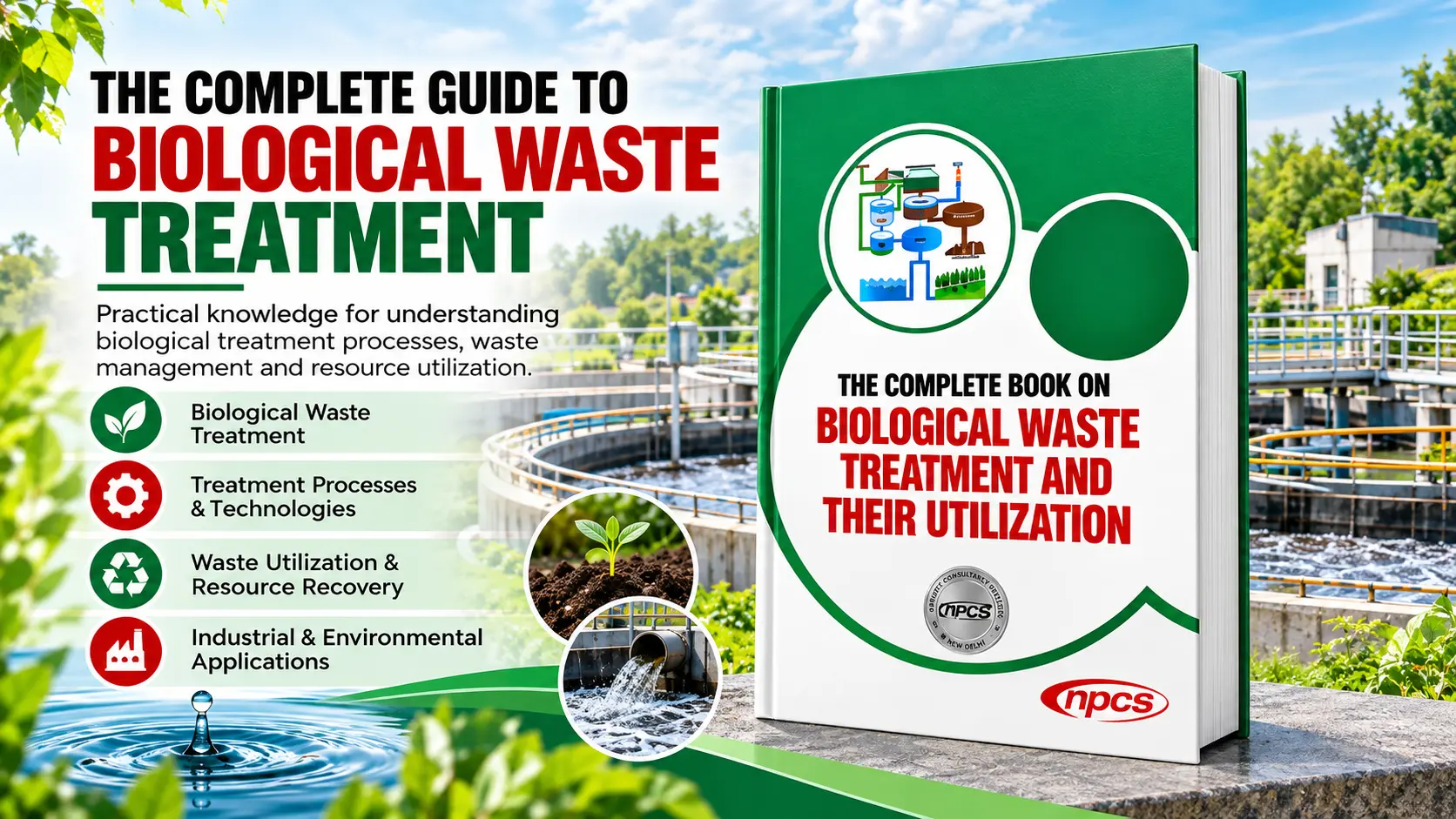
Biological Waste Treatment in India and Organic Waste Recycling
Biological waste treatment converts organic and agricultural waste into useful products such as compost, biogas and bio-based materials.

Commercial Opportunity: Products from Waste

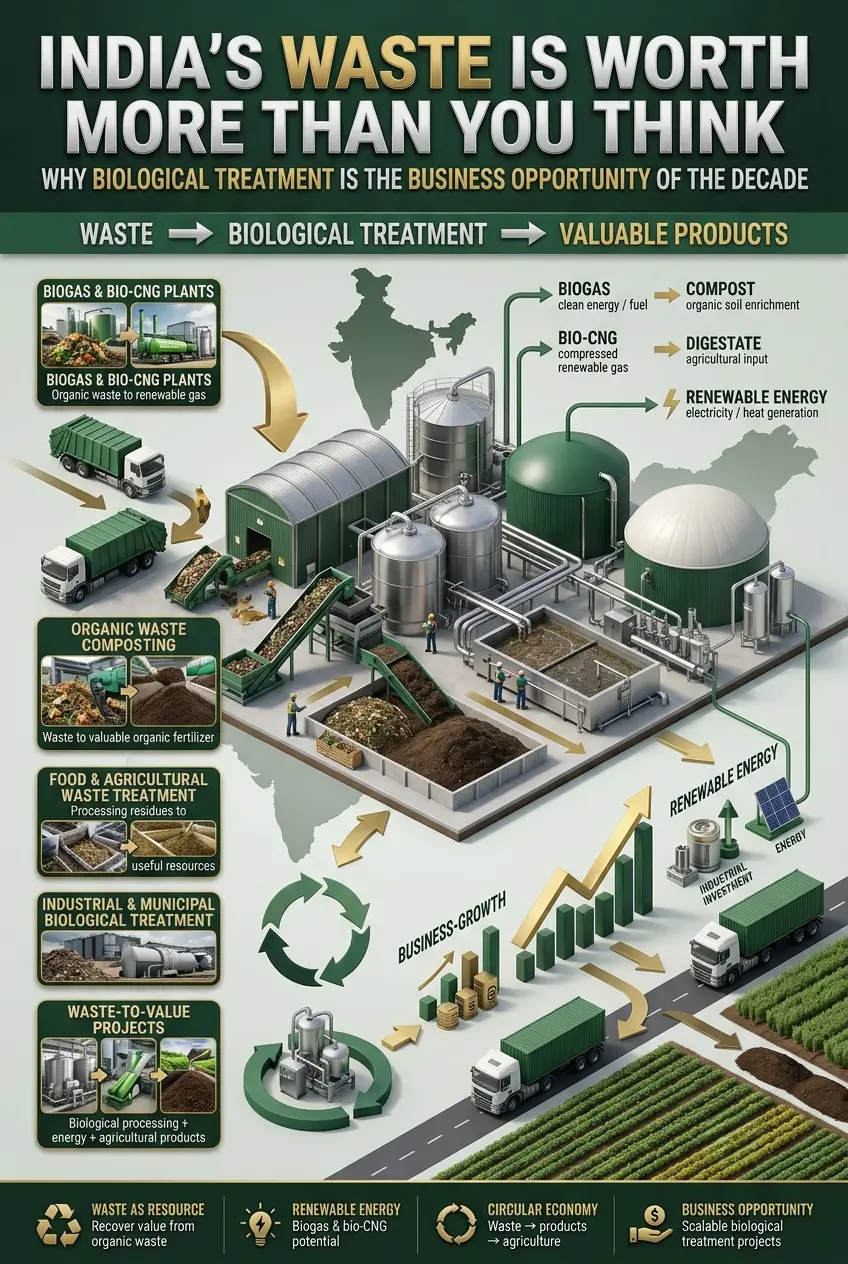
There is a service-oriented model based on the processing of other people’s waste for monetary compensation, as well as a product-oriented model that could have greater margins. Commercial products can be created from specific organic waste streams through biological treatment.

Composted organic materials and humic substances (humic acids and humates derived from composted bark or other biomass) are sold at premium prices for use as soil conditioners for organic farming, horticulture and export markets. Biogas replaces LPG and grid power as a cooking fuel or electricity generation. Ethanol can be produced from wheat straw and sunflower stalks, which can be converted into bioethanol. The by-products from fish waste production are used as protein-rich feed supplements. The onion dehydrated industry wastes can be used as media in the production of fodder yeast. The gas produced by cattle and poultry manure treated under anaerobic conditions has a measurable calorific value.

At the upper end of the value chain, by the fermentation of N-rich organic wastes such as tobacco, specialty products like oxytetracycline (antibiotic produced by Streptomyces rimosus) and oxalic acid can be produced by the processing of jute wastes by the alkali fusion and nitric acid oxidation routes.

Agricultural Waste Utilisation: A Specific MSME Opportunity

Processable organic by-products in the agro-industrial sector in India are enormous: tomato wastes, cotton processing wastes, sorghum stalks, palm oil mill effluent and others. The potential to set up biological waste treatment plants in the vicinity of agricultural processing clusters to convert the locally produced agricultural wastes into compost, biogas, supplements for animal feed or specialty chemicals is real, available and gaining institutional support for MSMEs.

It is necessary to have an understanding of process knowledge, including which waste streams are appropriate for which biological treatment, conversion rates, product yields, equipment requirements, and quality requirements for the products. Historically it is difficult to locate such a knowledge base in a technically sound and consolidated manner.

The Complete Book on Biological Waste Treatment and Their Utilization: What This Handbook Delivers

One of the most complete technical references available on biological treatment of organic wastes from agricultural, food processing, livestock and municipal sources, this handbook is authored by Dr. H. Panda and published by NIIR Project Consultancy Services (NPCS). The book, which addresses the entire range from primary treatment science to the different waste types and conversion paths to commercially relevant output products and covers 38 chapter-level topics, was published in 2013.

The 38-Chapter Scope: What Is Actually Covered

The handbook covers the following waste types and treatment processes across its chapters:

  • Organic waste for biological treatment — physiological basis for hazardous organic compound degradation, anaerobic vs. aerobic transformations, biodegradation by mixed microbial populations
  • Organic waste forms and treatment strategies — in situ bioremediation, bioreactor designs, treatment of liquid wastes, contaminated soils, and gases
  • Transformation of liquid manure into solid — composting methodology, pellet production, pathogen destruction, fertiliser evaluation
  • Tomato wastewater treatment — experimental apparatus, cost analysis, treatment efficiency
  • Oxalic acid from jute stick — alkali fusion and nitric acid oxidation processes, effect of temperature, catalyst, and acid concentration
  • Digestion of cotton processing waste — batch fermentation, bench-scale and pilot plant studies
  • Fermentation of fish waste — inoculum preparation, microbiological examination across five experimental designs
  • Agro-industrial waste processing — results and discussion of various agro-industrial streams
  • Bioconversion of wheat straw and sunflower stalks to ethanol — enzymatic hydrolysis, substrate pretreatment, yeast fermentation
  • Modelling of agricultural waste treatments — chemical reactor theory, microbial kinetics, model implementation
  • Utilisation of dehydrated onion waste — fodder yeast production in laboratory and onion juice media
  • Palm oil mill effluent disposal — land application trials, mulching effects, optimum input rates
  • Beef-cattle manure slurry — rheological properties, temperature and solids effects
  • Manures and sewage sludge for algal growth — waste extract analysis, algal cultivation in waste media
  • Management and treatment of wastes from large piggeries — primary, secondary, and tertiary treatment
  • Poultry waste processing — nutritive value of poultry waste, poultry wastewater as broiler feed
  • Humic substances from composted and decomposing barks — extraction methods, Sephadex gel filtration, organic carbon analysis
  • Production of oxytetracycline — fermentation of Streptomyces rimosus, 1200-litre fermenter process, antimicrobial spectrum
  • Manure in fish farming — pond application, manure as fertiliser for autotrophic production
  • UASB treatment of wastes — semi-technical pilot plant, loading rates, sludge retention, methanogenic activity
  • Methane from cattle waste — fermenter design, methane yield, temperature effects
  • Treatment of milking parlour wastewater — pilot-scale reactor, phase allocation, analytical results
  • Digestion of poultry litter — daily fed and batch digestion, ammonium-N levels, biogas yields

Who Should Read This Book

The handbook serves a broad but specific readership:

  • Entrepreneurs assessing biological waste treatment as a business entry point — for composting, biogas, or specialty chemical production
  • Agro-industrial units seeking to manage waste streams productively rather than disposing of them at a cost
  • Project consultants and environmental engineers preparing feasibility studies for waste treatment facilities
  • Research scholars and students in environmental engineering, agricultural engineering, and biotechnology
  • Farm-level biogas and composting operators looking for technical grounding and process optimisation guidance
  • Pharmaceutical and specialty chemical manufacturers interested in the fermentation-derived product angle
  • Municipal solid waste management planners and urban local body technical staff

The Practical Value of This Reference

38 distinct waste treatment scenarios, from tomato wastewater to beef-cattle manure slurries, from jute stick oxalic acid production to pharmaceutical-grade oxytetracycline fermentation, is an unusual depth of coverage for a single volume. The consistent focus on methods, results, and economic or process evaluation — rather than purely descriptive environmental science — makes this a working reference rather than a library book.

For anyone writing a project feasibility report, planning a pilot plant, or evaluating a biological waste treatment business, having this level of process-specific data across 38 waste treatment scenarios in a single reference significantly reduces research time and improves the credibility of technical sections.

Book Details at a Glance

Book TitleThe Complete Book on Biological Waste Treatment and Their Utilization
AuthorDr. H. Panda
PublisherNIIR Project Consultancy Services (NPCS)
ISBN9789381039236
Pages504
FormatPaperback
Price₹1,675 (India) | US$ 150 (International)

Get Your Copy Today

The Complete Book on Biological Waste Treatment and Their Utilization

If you are working in agro-industrial waste management, evaluating a biological waste treatment project, preparing a feasibility study, or looking for a technically credible reference on organic waste conversion processes, this 504-page handbook will be one of the most useful volumes you can add to your working library.

Dr. H. Panda’s approach across 38 waste treatment topics — consistently grounded in methods, results, and practical evaluation rather than general environmental commentary — makes this a reference that actually helps you make decisions and build projects. At ₹1,675, it is a one-time investment that will repay itself many times over in research time saved and project credibility gained.

Price: ₹1,675 (India) | US$ 150 (International)

Buy from NIIR.orgBuy on Amazon India
https://www.niir.org/books/book/complete-book-on-biological-waste-treatment-their-utilization/isbn-9789381039236/zb,,18b5c,a,0,0,a/index.htmlhttps://www.amazon.in/dp/9381039232

Published by NIIR Project Consultancy Services (NPCS)

106-E Kamla Nagar, New Delhi — niir.org | entrepreneurindia.co | npcsblog.com

30+ Years in Consulting | 150,000+ Projects | 85 Countries | ISO 9001:2015 Certified

Your Investment Deserves the Right Opportunity

Every serious investment begins with choosing the right sector and the right  business model. With hundreds of industrial opportunities available across India’s  manufacturing and clean-energy landscape, making the most informed choice is crucial. Niir’s Startup Selector tool helps entrepreneurs, MSMEs and investors identify the most suitable business opportunities based on their investment capacity, location and interests, ensuring their capital is directed toward the venture with the best fit.

Frequently Asked Questions

What is biological waste treatment and how does it differ from conventional waste disposal? +
Biological waste treatment uses microbial and biological processes — composting, anaerobic digestion, fermentation, bioremediation — to convert organic waste into useful products or render it safe for disposal. Unlike landfilling or incineration, biological treatment captures the chemical energy and nutritional value embedded in organic materials, producing outputs like compost, biogas, ethanol, animal feed, and specialty chemicals rather than simply eliminating the waste.
What types of organic waste are amenable to biological treatment? +
A wide range of organic waste streams can be biologically treated, including food preparation waste, agricultural crop residues (wheat straw, sunflower stalks, sorghum), livestock manure (cattle, pig, poultry, rabbit), fish and meat processing waste, agro-industrial effluents (tomato wastewater, palm oil mill effluent, onion dehydration waste), municipal sewage sludge, dairy parlour wastewater, cotton and jute processing waste, and forest product residues like bark.
What is anaerobic digestion and what products does it produce? +
Anaerobic digestion is a biological process in which microorganisms break down organic material in the absence of oxygen. The main products are biogas (a mixture of methane and carbon dioxide, which can be used as fuel) and digestate (a nutrient-rich liquid and solid residue that can be used as a soil amendment or fertiliser). The process is used to treat livestock manure, food waste, sewage sludge, and various agro-industrial effluents.
What is a UASB reactor and where is it used? +
UASB stands for Upflow Anaerobic Sludge Blanket. It is a type of anaerobic bioreactor where wastewater flows upward through a dense blanket of anaerobic sludge, which breaks down the organic material. UASB reactors are widely used for treating high-strength industrial and agro-industrial wastewater — including from food processing, dairy, and livestock operations — because they are compact, efficient, and produce biogas as a recoverable byproduct.
How can oxalic acid be produced from jute waste? +
Oxalic acid can be extracted from jute sticks (the woody core of the jute plant, a byproduct of fibre extraction) through two main processes: alkali fusion, where the jute stick is fused with sodium hydroxide, and nitric acid oxidation, where the material is oxidised with nitric acid under controlled temperature and catalyst conditions. The book covers both methods including the effect of reaction time, temperature, catalyst concentration, and acid concentration on yield.
What is oxytetracycline and how is it produced from biological waste? +
Oxytetracycline is a broad-spectrum antibiotic produced by the bacterium Streptomyces rimosus through submerged fermentation. While the primary carbon and nitrogen sources in the fermentation medium can include agro-industrial waste components, the production is essentially a fermentation process rather than a direct waste conversion. The handbook covers a 1,200-litre industrial fermenter process for oxytetracycline production, including vegetative and fermentation media, amino acid determination in fermented mash, and antimicrobial spectrum evaluation.
Can agricultural waste be converted to ethanol commercially? +
Yes. Lignocellulosic agricultural residues like wheat straw and sunflower stalks can be converted to ethanol through a process involving pretreatment (to break down the lignocellulose structure), enzymatic hydrolysis (to release fermentable sugars), and yeast fermentation. The handbook covers the pretreatment, hydrolysis, and fermentation stages with experimental data on wheat straw and sunflower stalk conversion, including solids analysis and ethanol yield measurement.
What are humic substances and what is their commercial value? +
Humic substances — humic acids, fulvic acids, and humins — are complex organic compounds formed during the decomposition of plant and animal matter. They are key components of healthy soil and are commercially sold as soil conditioners that improve water retention, nutrient availability, and microbial activity. Humic acid extracts from composted bark and decomposing organic material are used in organic farming, horticulture, and soil restoration applications, commanding premium prices in export markets.
What is the business model for a composting unit in India? +
A composting unit can operate on a service model (accepting organic waste from municipalities, markets, hotels, or farms for a processing fee) or a product model (selling composted output to farmers, nurseries, or soil conditioner manufacturers). Some units combine both. The raw material cost can be zero or negative (if gate fees are charged), making the business model attractive on paper — but operational efficiency, product quality consistency, and buyer relationships are the critical success factors.
How can fish waste be utilised productively? +
Fish processing waste — including offal, heads, skin, and bones — can be converted into fish meal (a high-protein animal feed), fish oil (for aquaculture feeds and nutraceuticals), and fermented fish products. The handbook covers fermentation of fish waste using inoculated microorganism cultures, with detailed experimental design across five fermentation trials examining substrate preparation, fermentation conditions, and microbiological outcomes.
What government or institutional support is available for biological waste treatment projects in India? +
Several central and state government schemes support organic waste treatment and biogas projects, including the National Biogas and Manure Management Programme (NBMMP), schemes under the Ministry of New and Renewable Energy for biogas and biomass, MSME development schemes for agro-processing and waste utilisation units, and state pollution control board incentives for zero liquid discharge and effluent treatment investments. NPCS provides Detailed Project Reports for entrepreneurs seeking bank finance or government scheme benefits for waste treatment projects.
Where can The Complete Book on Biological Waste Treatment and Their Utilization be purchased? +
The handbook is available from NIIR.org (the publisher's website) and Amazon India. Purchase links are provided in the section below. The book ships within five working days from the publisher and is priced at ₹1,675 for India and US$ 150 for international buyers.
Tags: Agricultural Waste ManagementAgricultural Waste UtilisationBiological Waste TreatmentBiological Waste Treatment in IndiaOrganic Waste ManagementOrganic Waste Treatment
Share196Tweet123
Previous Post

12वीं फेल से ₹100 करोड़ की फैक्ट्री तक: इस छोटे शहर के Entrepreneur ने कैसे खड़ी की करोड़ों की Manufacturing Empire?

Sai Teja

Sai Teja

Sai Teja specializes in the technical and regulatory dimensions of industrial project implementation, with particular focus on manufacturing process selection, machinery and equipment evaluation, and compliance requirements. His work bridges the gap between business concept and operational reality, providing entrepreneurs and MSMEs with structured, execution-ready guidance for setting up manufacturing units — from initial technology assessment through to regulatory approvals.

Leave a Reply Cancel reply

Your email address will not be published. Required fields are marked *

Contact Us

    Categories

    • Agri Business Opportunities
    • Business Ideas
    • Chemical Industry Business Opportunities
    • Cosmetics and Personal Care Business
    • Eco Friendly Sustainable Business
    • Entrepreneurship Leadership and Startup Growth
    • FMCG Consumer Products Business
    • Food Processing Business Industry
    • Future & Emerging Industries
    • Government Schemes Policies for Business
    • Import Export Business Opportunities
    • Industrial Project Reports Business Guide
    • Investment Funding for Startups
    • Manufacturing Business Ideas for Startups
    • Market Research Trends for Business
    • MSME & Small-Scale Industries
    • Paper Pulp Industry Business
    • Pharmaceutical Industry Business
    • Plastic & Packaging Business
    • Renewable Energy Startups
    • Startup Business Opportunities
    • Startup Business Planning and Strategy
    • Technology & Automation Business
    • Textile Industry Business
    • Uncategorized
    • Waste Management & Recycling Business
    • Water & Environmental Business
    Entrepreneur India Blog

    Copyright © 2026 Entrepreneur India

    Navigate Site

    • About
    • Advertise
    • Privacy & Policy
    • Contact

    Follow Us

    Welcome Back!

    Login to your account below

    Forgotten Password?

    Retrieve your password

    Please enter your username or email address to reset your password.

    Log In
    No Result
    View All Result
    • Home

    Copyright © 2026 Entrepreneur India

    Not enough quota to unlock this post
    Unlock left : 0
    Are you sure want to cancel subscription?