







Tripura Business Opportunities
Tripura Is Open for Business — Across 22 Sectors
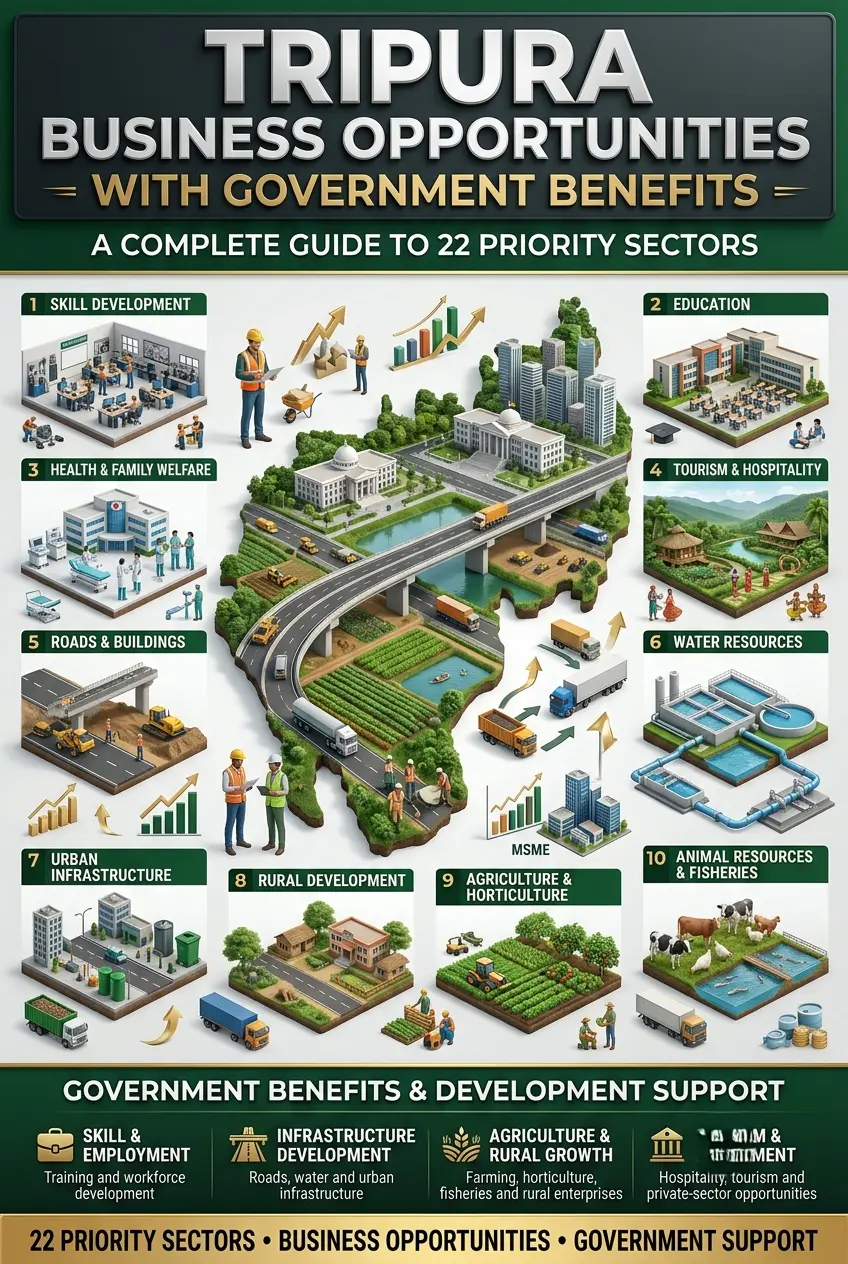
Tripura is not an emerging opportunity anymore; it is already an active one. The state government has identified 22 priority sectors in which entrepreneurs, MSMEs and private investors can unlock real business ideas with direct government backing. These sectors range from manufacturing, services and infrastructure to agriculture and social development. If you are an entrepreneur seeking markets beyond saturated metros, Tripura offers something increasingly rare: a combination of natural resource richness, improving connectivity, structured incentive framework and minimal competition.
What makes Tripura distinct is the sheer breadth of what the government has opened up on. From bamboo product manufacturing and rubber processing to digital governance, health infrastructure and sports facilities the state has mapped a full-spectrum investment canvas. The Tripura State Industrial Corporation Limited (TSICL) has drawn up detailed project opportunities across all 22 sectors backed by the Tripura Industrial Development Corporation (TIDC) which manages over 900 acres of operational industrial land today.
This article covers every one of those 22 sectors, with practical business logic, applicable government schemes and strategic observations. Whether you are a first-generation entrepreneur or an experienced MSME operator looking to diversify, this guide is your starting point.
Why Tripura Is Rising as India’s Next Business Frontier
Tripura’s rise is not accidental. The state borders 856-kilometre with Bangladesh and sits at the junction of South Asia and Southeast Asia. The Agartala-Akhaura rail link with Bangladesh, operational now, has transformed freight economics for exporters based in Tripura. Meanwhile, the Agartala airport expansion and National Highway upgrades have reduced logistics friction across the state’s otherwise difficult terrain.
Industrial infrastructure is another decisive advantage. TIDC manages three major operational industrial complexes – the Bodhjungnagar Industrial Complex covering 535.73 acres, the R.K. Nagar estate spanning 226.16 acres and the Dukli estate across 45.77 acres. Five managed industrial estates at A.D. Nagar, Badharghat, Dhajanagar, Dharmangar and Kumarghat contribute an additional 95.35 acres. Four new Integrated Infrastructure Development Centres (IIDCs) at Dewanpassa, Lalchhari, Sarasima & Belonia and Jalefa & Sabroom are currently under development, each covering 40 to 50 acres.
International institutions have validated this growth story. An Asian Development Bank loan of USD 85.4 million targets industrial infrastructure development in Tripura – a signal of institutional confidence that private entrepreneurs should take seriously.
Tripura is also India’s second-largest rubber producer. Bamboo forests cover significant portions of the state. Pineapple, jackfruit, tea and assorted vegetables grow in abundance. Natural gas availability keeps energy costs low for manufacturers. These structural advantages – natural resources, cheap energy, border trade access and government built industrial infrastructure – combine to make Tripura one of the most genuinely compelling investment destinations in the country right now.
Government Policies and Incentives: The Financial Case for Investing in Tripura
Policy support in Tripura goes well beyond statements of intent. The Tripura Industrial Investment Policy 2024 offers capital subsidies, power tariff concessions, land allotment benefits, single-window clearance for new enterprises. It covers manufacturing, agro-processing, tourism, IT and service sectors all aligned directly with the 22 priority sectors identified for development.
The North East Industrial Development Scheme (NEIDS) is a powerful central government instrument for entrepreneurs in Tripura. Businesses that qualify can access capital investment subsidies, income tax exemptions, GST reimbursements, transport subsidies and employment incentives. Entrepreneurs should review NEIDS eligibility and benefits on the Tripura industries portal before finalising project plans, as the subsidy structure materially improves viability calculations.
The MSME sector gets additional support through the Raising and Accelerating MSME Performance (RAMP) programme. The RAMP State Implementation Plan for Tripura focuses on cluster development, technology upgradation and market access for small enterprises.
Food processing entrepreneurs benefit from the Pradhan Mantri KISAN SAMPADA Yojana. Tripura’s implementation details – including cold chain funding, food processing unit grants and agro-processing cluster support – are available on the PMKSY Tripura page. For micro enterprises, PMEGP offers accessible grant-cum-loan finance. The PMEGP scheme guidelines include higher subsidy percentages for SC, ST, women and NER applicants – all well-represented categories in Tripura.
All 22 Priority Sectors: Business Ideas, Opportunities, and Government Support
The Government of Tripura and TSICL have opened 22 sectors for private participation, covering an enormous range of economic activities. Each sector carries specific business models, government support mechanisms and underlying demand drivers. Here is a comprehensive sector-by-sector breakdown.
1. Skill Development and Vocational Training
Tripura has a large young population that needs job-ready skills. Private training providers, assessment agencies, curriculum developers find consistent demand here. Entrepreneurs can establish vocational training centres aligned to construction trades, electronics repair, hospitality services, healthcare assistance, IT basics. The National Skill Development Corporation (NSDC) and state skill development missions fund training throughput on a per-outcome basis – making training a genuinely scalable, performance-linked business.
The strongest opportunity lies in attaching training centres directly to TIDC industrial zones, where factories need certified workers on an ongoing basis. This placement-linked model commands premium funding rates and builds a recurring revenue stream. As Tripura’s manufacturing and services sectors expand, demand for trained workers will only increase – giving early-mover training providers a structural demand advantage for years.
2. Education — School, Higher and Technical
Education infrastructure gaps across Tripura’s districts create clear business opportunities for private operators. Smart classroom providers, e-learning platform developers, coaching institutes and technical education centres all find strong demand in semi-urban and rural areas. Samagra Shiksha and PM SHRI create school infrastructure contracting opportunities. Private universities and professional institutes – particularly those offering engineering, nursing, pharmacy, agriculture, management – attract students from across the Northeast.
The most commercially sustainable model in Tripura education is pairing technical courses directly with placement in local industries. As TIDC industrial zones absorb more manufacturing capacity, demand for trained engineers, quality technicians and production supervisors will rise steadily. Education businesses that align curriculum to these emerging employment markets will outperform generic institutions.
3. Health and Family Welfare
Healthcare infrastructure across Tripura’s districts remains significantly underdeveloped relative to population demand. Private hospitals, diagnostic centres, dental clinics, ophthalmology centres, telemedicine platforms fill real gaps. Ayushman Bharat PM-JAY scheme empanelment ensures that even lower-income patients can access private healthcare services – giving private hospitals a guaranteed institutional payer base that substantially improves commercial viability.
Pharmaceutical distribution chains, medical device supply, ambulance services represent lower-capital entry points into health sector business, Tripura’s tribal belt populations in remote districts present a specific niche for mobile health units and district-level specialty care. Entrepreneurs entering health in Tripura should pursue government empanelment first – it provides revenue floor certainty while the private-pay patient base builds over time.
4. Tourism, Hospitality and Culture
Tourism is one of Tripura’s most commercially underexploited sectors. The state offers over 50 significant tourist destinations: Ujjayanta Palace, Neermahal – India’s only water palace, Unakoti rock carvings, Jampui Hills hill station and the Sepahijala Wildlife Sanctuary. Boutique hotels, eco-lodges, cultural heritage circuits, specialised travel agencies all find a growing demand base here. The modernisation of Agartala airport opens direct access for domestic and eventually international tourists.
Bangladesh tourism connections add a cross-border dimension that few states can match. Bangladeshi tourists visiting religious sites and heritage locations in Tripura represent a growing inbound market segment. Swadesh Darshan 2.0 scheme funding supports tourism circuit development across the state. Entrepreneurs entering hospitality should focus on Agartala, Sepahijala and the Unakoti circuit as the highest-traffic initial zones, then expand to niche eco-tourism destinations as awareness grows.
5. Public Works — Roads and Buildings
Public works is one of Tripura’s most active procurement markets. Road construction, bridge development, government building construction and maintenance contracts flow continuously through the state PWD, NHIDCL, BRO. Civil contractors with proven track records find a consistent pipeline of government contracts. Material supply businesses – cement block manufacturing, construction aggregate, structural steel fabrication, roofing material benefit from the sustained public infrastructure spending.
The ADB-backed industrial corridor projects add international funded infrastructure contracts to the domestic pipeline. Contractors meeting quality standards required for ADB-financed works access premium contract values and capacity building support. Entrepreneurs in this sector should prioritise registration with CPWD, state PWD and TIDC empanelment panels to maximise contract access.
6. Water Resources and Drinking Water Supply
The Jal Jeevan Mission is reshaping rural Tripura’s water infrastructure landscape. Functional Household Tap Connection (FHTC) targets across the state create sustained procurement demand for pipeline manufacturers, pump suppliers, water meter distributors, civil contractors specialising in water infrastructure. Water testing laboratories accredited for JJM compliance find both government contracts and institutional demand from industries.
Beyond JJM, industrial water treatment and effluent management services represent a growing commercial niche as TIDC industrial estates expand. Entrepreneurs offering turnkey water treatment plant setup, operations and maintenance contracts for municipal water systems, packaged water purification units serve both government and private sector clients. In a state where water access infrastructure is rapidly scaling, this sector rewards early technical specialists who build credibility quickly.
7. Urban Infrastructure and Municipal Services
Agartala holds Smart City Mission status – a government designation that has unlocked a structured pipeline of urban projects. Command-and-control centre operations, intelligent traffic management systems, LED street lighting networks, solid waste management, storm water drainage upgrades are all active procurement areas. Private operators participate through PPP (Public-Private Partnership) contracts in service delivery: waste collection contracts, parking facility management, public infrastructure maintenance.
Urban real estate development, commercial complexes, affordable housing – aligned with PMAY urban targets – represent parallel business ideas for entrepreneurs with real estate and construction capabilities. Secondary cities like Dharmanagar and Udaipur are experiencing rapid urbanisation, creating demand waves that Agartala-centric developers should not ignore. Municipal procurement in Tripura moves faster than comparable contracts in larger states, making project timelines more predictable for operators.
8. Rural Development and Panchayati Raj
MGNREGS, PMGSY, the Rurban Mission generate consistent business activity for rural contractors, material suppliers and service providers across Tripura. Rural road construction, drainage work, community asset development under MGNREGS create regular procurement opportunities for local civil contractors. PMAY Gramin housing targets drive demand for building materials, prefabricated components, skilled construction labour across all districts.
Women’s Self-Help Groups (SHGs) supported under NRLM present a distinct B2B market opportunity. Consumer goods businesses, packaged food producers, handicraft aggregators can build last-mile distribution networks through SHG federations – reaching rural consumers efficiently without building their own distribution infrastructure. Panchayat management software, governance training, accounting services for local bodies represent newer digital service business ideas in this sector.
9. Agriculture and Horticulture
Agriculture and horticulture represent Tripura’s deepest resource base. Rubber, pineapple, jackfruit, bamboo shoots, assorted vegetables, tea are produced in commercially significant volumes. The opportunity is overwhelmingly in value addition – because raw produce margins are thin, but processed product margins are substantial. Pineapple canning facilities, jackfruit processing units, bamboo shoot preservation plants, rubber processing factories represent high-potential business ideas with clear input supply certainty.
The Ministry of Food Processing Industries has documented Tripura’s agricultural output and processing potential comprehensively. Cold storage infrastructure is critically underdeveloped – creating space for entrepreneurs with logistics capabilities to build cold chain assets that serve multiple agricultural commodities simultaneously. Input supply businesses providing quality seeds, bio-fertilizers, farm machinery services also find steady demand from Tripura’s farming community.
10. Animal Resource Development and Fisheries
Tripura’s extensive river systems, beels (wetlands), reservoir networks support significant inland fishery potential. Fish processing units, aquaculture farms, integrated fish seed production centres, ice plant facilities serve both local consumption markets and interstate trade. Poultry processing, dairy development cooperatives, goat rearing enterprises for meat supply are other scalable agri-business models that serve Tripura’s growing urban consumer base.
The protein food demand in Tripura is rising with urbanisation and income growth. Entrepreneurs entering fisheries or poultry should connect early with NABARD credit linkages and state fisheries department extension services, which provide working capital support and technical guidance. Export-oriented fish processing – particularly dried and smoked fish to Bangladesh and other Northeast states – represents a trade opportunity that very few operators have yet systematically developed.
11. Forest, Environment and Climate Change
Tripura’s forest cover supports a range of non-timber forest produce (NTFP) businesses. Wild honey extraction and value addition, medicinal herb collection and processing, lac cultivation, cane furniture manufacturing, resin-based product development all build on the state’s natural forest resource. These are not marginal businesses – globally, NTFP-based products command premium prices in organic, natural and traditional remedy markets.
Newer environmental business models are also gaining traction. Carbon credit project development, afforestation and eco-restoration contracts under CAMPA funding, biodiversity-linked eco-tourism ventures find institutional support and growing commercial demand. Entrepreneurs with environmental consulting capabilities can position themselves for forest department advisory contracts and corporate sustainability service mandates as Tripura’s industrial base grows and compliance requirements increase.
12. Industries, Commerce and MSME
General manufacturing in Tripura operates under a highly supportive framework. Small manufacturing units producing rubber goods, plastic products, metal fabrication, wooden furniture, construction materials have found viable markets within and well beyond the state. The Invest India Tripura investor facilitation page documents the business environment, available infrastructure and sectoral opportunities comprehensively. MSME clusters aligned to rubber, food processing, bamboo, textile sectors receive cluster development assistance under central and state programmes.
Entrepreneurs considering manufacturing entry should engage with TIDC directly for industrial plot allotments. Bodhjungnagar’s 535-acre complex, with its dedicated food processing and export promotional parks, and R.K. Nagar’s bamboo focused industrial area offer plug-and-play infrastructure that dramatically shortens setup timelines. NEIDS benefits combined with Tripura’s low land and energy costs create a project cost structure that most mainland India manufacturing locations cannot match.
13. Handloom, Handicrafts, Sericulture and Bamboo
Tripura’s handloom and handicraft sector combines deep cultural heritage with real commercial potential. Traditional tribal textiles – risa, rignai, and risha – woven by skilled artisans attract premium buyers in domestic boutique markets and through export channels. The differentiation advantage here is authenticity: machine-made substitutes cannot replicate the design heritage. Entrepreneurs who build brand narratives around origin, tribal artisanship, sustainable production command prices that justify premium positioning.
Bamboo products are a global growth category. Furniture, flooring panels, decorative items, musical instruments, composite construction materials, single-use bamboo alternatives to plastic – all face surging demand as sustainability priorities reshape consumer and industrial purchasing. TIDC’s R.K. Nagar Bamboo Park provides shared processing infrastructure for bamboo-based manufacturers. Sericulture offers a fully integrated value chain opportunity – from mulberry farming and silkworm rearing through silk reeling and weaving – for entrepreneurs with adequate land and multi-stage operational capacity.
14. Information Technology and Digital Governance
Tripura’s IT sector has grown with sustained government backing. The Agartala IT Park, National Optical Fibre Network connectivity, a steady flow of e-governance projects create a stable demand base for software development firms, BPO operators, data management services, cybersecurity providers. Operating cost advantages versus Tier 1 cities are substantial – office space, talent, infrastructure costs are all significantly lower, while output quality from Agartala-based teams has been consistently competitive.
Business ideas in this sector extend beyond pure IT services. Digital literacy training centres, e-commerce enablement platforms for local artisans and farmers, GIS-based agricultural mapping services, government data analytics contracts represent emerging opportunity streams. Entrepreneurs who build domain-specific technology products for agriculture, rubber, or handicraft sectors – combining IT capability and Tripura’s sectoral knowledge – can serve both local clients and national markets.
15. Power and Renewable Energy
Energy in Tripura presents a dual opportunity. Natural gas availability keeps electricity costs for manufacturing units lower than most Indian states – an advantage for power-intensive industries like rubber processing and food manufacturing. Simultaneously, national renewable energy targets and state net-metering policies create demand for solar EPC contractors, rooftop solar installers, biogas plant developers.
TIDC industrial estates are well-suited for large-scale rooftop solar deployment – the aggregated demand from clustered manufacturing units creates viable project sizes. PM Surya Ghar scheme support and MNRE capital subsidies improve project economics further. Biogas plants processing agricultural waste, food processing effluents, livestock manure represent another clean energy business idea with strong government backing and growing private sector demand.
16. Transport and Logistics
Logistics is Tripura’s fastest-improving sector – and thus one of its highest-potential business arenas right now. The Bangladesh-Agartala rail and road connections have changed freight economics fundamentally. Warehousing facilities, cold chain logistics networks, trucking fleets serving Bangladesh trade routes, freight forwarding services targeting export cargo represent high-demand business ideas for logistics entrepreneurs.
Multimodal logistics parks aligned to TIDC industrial zones serve as intermediate storage and processing nodes for goods moving between mainland India and Southeast Asian markets. Last-mile delivery businesses serving Tripura’s rapidly growing e-commerce consumer base are a low-capital entry point with expanding demand. As Agartala’s airport capacity grows, air cargo logistics services for high-value perishables – fresh flowers, processed fish, premium handicrafts will become commercially viable at scale.
17. Social Welfare, Tribal Welfare and Minorities
Social welfare in Tripura creates substantial government contracting markets. Eklavya Model Residential Schools for tribal students, community development projects under the tribal welfare mandate, social infrastructure construction generate significant procurement volumes. NGOs and private service providers with proven delivery track records win implementation contracts for welfare scheme components. Beyond contracting, there are consumer-facing business opportunities in affordable nutrition, digital financial services, consumer goods targeting Tripura’s tribal communities – a large population with rising disposable incomes and limited existing branded product access.
18. Labour, Employment and Livelihoods
As Tripura’s industrial base expands, organised labour supply services become structurally more valuable. Staffing agencies, payroll management service providers, compliant contractor firms serve a growing manufacturing and construction ecosystem. Livelihoods programmes under NRLM and DDUGKY create business opportunities for training providers, assessment agencies, placement firms that can demonstrate measurable employment outcomes.
E-Shram worker registration services, labour compliance auditing, and occupational health and safety training represent newer business ideas that serve both government mandates and corporate compliance needs. Entrepreneurs who build reliable skill-to-employment pipelines — connecting trained workers from Tripura’s workforce development ecosystem to factory jobs in TIDC industrial zones — provide genuine value on both ends and can build sustainable service businesses in this space.
19. Food, Civil Supplies and Co-operation
Food supply chain infrastructure has perennial demand in Tripura. Organisations involved in fortified rice production, commodity packaging for PDS, construction of warehouses and recruitment of transporters for civil supplies network are regular buyers of services. Cooperative sector also offers opportunity for entrepreneurs as milk, forest produce marketing and consumer goods cooperatives offer contract management and management services contracts to private agencies.
Manufacturing entrepreneurs engaged in rice milling, oil expending, spice grinding and packing and flour milling also find buyers for their produce. The National Cooperative Development Corporation provides funding support to cooperative societies which in turn open opportunities for entrepreneurs in the sector. Similarly, entrepreneurs engaged in both manufacturing and cooperative distribution find markets for their products.
20. Public Safety, Prisons, Fire and Disaster Management
This sector offers vendors, contractors and technology providers with varied opportunities. Fire safety equipment supply, fire fighting system installation in commercial complexes and industries, disaster rescue equipment manufacturing and emergency communication system installation are areas with demand. With the expansion of industrial infrastructure in Tripura, industries leasing land from TIDC have to adhere to fire safety norms which creates demand for inspection and equipment.
Security training institutes, institutes for training drill instructors and rescue equipment on lease also find a market in the state. Similarly, construction of police stations, fire stations and disaster management depots add to the revenue streams of civil contractors with requisite approvals. Upgradation of police infrastructure in the Northeast is a long term government scheme which offers stability to bidders.
21. Science, Technology and Innovation
The science and technology ecosystem in Tripura is at an inflection point with the state and union governments encouraging testing labs, certification bodies and calibration services. With the expansion of industries in TIDC industrial estates, demand for industrial testing and certification services are on the rise. Similarly, techno parks and incubators focused on agri-tech, bamboo products and renewable energy find demand in the state.
Similarly, drone mapping, input application and crop health monitoring services are innovative services with potential in Tripura’s agriculture focused economy. R&D services focused on rubber products, bamboo composites and spice value addition could be explored by entrepreneurs looking to tie into government research labs and certification agencies. Startups in the innovation space should initially target the TIDC industrial estates as a launchpad as they would have the most viable demand base.
22. Sports, Youth Affairs and Community Facilities
Tripura boasts of its sporting achievements with footballers and chess grandmasters from the state receiving national recognition. Sports academies focused on football, chess, athletics and martial arts are well placed to capitalise on the existing demand. Indoor sports complexes, swimming pools and fitness clubs are in demand in the urban middle class of Agartala and the growing district towns. Such clubs could explore BOOT (build operate transfer) model with municipal authorities who are often looking to divest their community infrastructure assets.
Organisations involved in management of youth events, festivals, sports meets and community gatherings find government and private sector tenders as potential recruitment channels. Similarly, management of community facilities in parks, clubs, amphitheaters and community halls is another avenue for private participation although with relatively lower risk profiles.
Import–Export Opportunity: Tripura’s Gateway to South and Southeast Asia
As India’s easternmost state, Tripura is at the of India’s trade and commerce with South and Southeast Asia. Akhaura integrated check post is the designated trade route between India and Bangladesh. For entrepreneurs, Bangladesh offers a large consumer base of 170 million people with rising aspirational buying power. Producers of rubber, bamboo products, pineapple products, processed fish and handloom products could explore this market as compared to other Indian states, entrepreneurs in Tripura enjoy a logistical advantage over their counterparts in the mainland.
The Export Promotional Industrial Park set up by TIDC at Bodhjungnagar is a testament to the government’s commitment to facilitating export led manufacturing. This park is ideally located to tap into the potential offered by Bangladesh. With the completion of road infrastructure and proposed rail connectivity, entrepreneurs eyeing Myanmar market also stand to benefit. It must be noted that the first entrepreneurs to set up production units in these industrial parks would benefit from the infrastructure advantage.
While the export potential of Tripura is well placed, the import substitution potential of the state is also worth consideration. Entrepreneurs could explore setting up manufacturing units for consumer goods, food products and consumer electronics imported from Bangladesh and China at present.
Indian MSME Leaders Who Built Success on Northeast India Opportunities
1. Tripura Rubber Industry Cooperative Federation (TRICO)
TRICO is a prime example of the benefits of collective action among rubber growers in the state. Small scale rubber growers who earlier struggled to sell their produce individually came together to form this cooperative body. This allowed members to overcome challenges such as low bargaining power and lack of processing infrastructure. Similar opportunities exist for collectives in allied sectors to tap into the demand in Kerala and other natural rubber consuming states.
2. Bamboo Product Entrepreneurs at R.K. Nagar
A group of entrepreneurs who set up their manufacturing units at TIDC’s R.K. Nagar Bamboo Park has carved a niche for themselves in the bamboo products market. These entrepreneurs leverage the availability of raw material at competitive prices and the infrastructure support provided by the park, which includes common processing equipment. In addition to serving bulk buyers in West Bengal and Delhi, some also sell their products online across the country. The main lesson from these entrepreneurs is that an industrial park setup reduces the capital and other requirements for setting up a unit, thus giving a significant business advantage to any potential entrant. Additionally, these entrepreneurs benefit from the incentives available to MSMEs under NEIDS and the bamboo mission.
3. Agartala IT and Digital Services Cluster
The IT and digital services cluster that has emerged in Agartala offers an alternative for companies looking to set up operations in a cost efficient environment. This cluster has demonstrated that the salary expectations of employees in a Tier 3 city can be comparable to those in bigger cities without compromising on the quality of work. This is borne out by the experience of IT entrepreneurs from Bengaluru and Hyderabad who have set up their delivery centers in Agartala and report savings of 40 to 60 percent on salary and other expenses. Potential entrepreneurs could replicate this business model in similar sectors.
About NPCS: Expert Consulting for Your Tripura Business Project
We at Niir Project Consultancy Services (NPCS) provide professional consulting for the preparation of Market Survey cum Detailed Techno-Economic Feasibility Reports (DPRs) for setting up new industries or businesses. Our reports include detailed manufacturing processes, market research and demand analysis, process flow diagrams, product mix and capacity planning, machinery and raw material details, and complete project financials with profitability analysis. Our objective is to help entrepreneurs evaluate feasibility, profitability, and long-term scalability before investing.
NPCS has published a comprehensive profile reference covering the best business opportunities in Tripura — spanning technology, market analysis, investment parameters, and project-specific data. The project profile: Best Business Opportunities in Tripura — Identification and Selection of Right Projects provides a curated overview of viable projects sector by sector.
For a detailed techno-economic Project Report on setting up a specific manufacturing or service business in Tripura — including plant economics, machinery procurement lists, financial projections, applicable NEIDS and state incentive calculations, and regulatory clearance roadmaps — our consulting team prepares customised DPRs for each project individually. Contact NPCS directly through our portal to commission a project-specific feasibility report for your chosen sector.
Tripura 22-Sector Business Opportunity Matrix
| Sector | Primary Business Model | Key Scheme | TIDC Infrastructure Link |
| Skill Development | Training centre, assessment agency | NSDC, PMKVY | Industrial zone placement pipelines |
| Education | Technical institute, e-learning | Samagra Shiksha, PM SHRI | Factory-linked curriculum demand |
| Health & Family Welfare | Hospital, diagnostics, telemedicine | Ayushman Bharat, NHM | District hospital gaps |
| Tourism & Hospitality | Boutique hotel, eco-lodge, travel agency | Swadesh Darshan 2.0 | Airport modernisation |
| Public Works | Civil construction, material supply | NHIDCL, BRO, PWD contracts | ADB industrial corridor |
| Water Resources | Pipeline supply, water treatment | Jal Jeevan Mission | Industrial zone water mgmt |
| Urban Infrastructure | Smart city services, waste management | Smart Cities Mission, AMRUT | Agartala Smart City |
| Rural Development | Rural construction, SHG B2B | MGNREGS, PMGSY, PMAY-G | Rural market access |
| Agriculture & Horticulture | Agro-processing, cold storage | PMKSY, PM-KISAN | Bodhjungnagar Food Park |
| Animal Resources & Fisheries | Fish processing, aquaculture, poultry | NABARD, State Fisheries | Protein export to Bangladesh |
| Forest & Environment | NTFP processing, carbon credits | CAMPA, NTFP Missions | Rich biodiversity base |
| Industries, Commerce, MSME | Manufacturing units, clusters | NEIDS, RAMP, PMEGP | Bodhjungnagar 535 acres |
| Handloom, Handicraft, Bamboo | Textiles, bamboo products, sericulture | DC Handicrafts, KVIC | R.K. Nagar Bamboo Park 226 acres |
| IT & Digital Governance | Software, BPO, e-governance services | MeitY, NeGP, Startup India | Agartala IT Park |
| Power & Renewable Energy | Solar EPC, biogas plant | PM Surya Ghar, MNRE | Industrial zone rooftop solar |
| Transport & Logistics | Warehousing, cold chain, freight | Bharatmala, UDAN | Akhaura ICP, airport expansion |
| Social Welfare & Tribal | EMRS contracting, consumer goods | PM-JANMAN, SHG schemes | Tribal district markets |
| Labour & Employment | Staffing, placement, payroll | NRLM, DDUGKY | Factory workforce supply |
| Food, Civil Supplies | Rice milling, packaging, warehousing | NCDC, NABARD, TRIFED | State PDS procurement |
| Public Safety & Disaster Mgmt | Equipment supply, training, construction | NDMA, state DM schemes | Fire safety compliance market |
| Science, Tech & Innovation | Testing lab, drones, agri-tech | DST, StartupIndia | Industrial zone QC demand |
| Sports, Youth & Community | Sports academy, event mgmt, facility ops | Khelo India, SARFAESI | Urban PPP concessions |
Conclusion: The Time to Enter Tripura Is Now
Tripura’s 22-sector framework is not a wish list — it reflects genuine market gaps and real resource advantages that private entrepreneurs can exploit commercially. Natural resources are abundant. Industrial infrastructure is operational. Government policy is supportive. Connectivity is improving. The subsidy environment under NEIDS and the Tripura Industrial Investment Policy makes the financial case stronger than most entrepreneurs realise before they run the numbers.
The state’s geographical position as India’s gateway to Bangladesh and Southeast Asia adds a trade dimension that will only grow in strategic importance. TIDC’s industrial estates — Bodhjungnagar, R.K. Nagar, Dukli, and the four emerging IIDCs — provide ready sites for manufacturing deployment that eliminate greenfield land acquisition complexity.
Entrepreneurs and MSMEs who act decisively in this growth phase capture both the incentive benefits and the first-mover market advantages that come with early entry. The 22 sectors mapped by the Government of Tripura represent a genuinely comprehensive opportunity landscape — and the businesses that establish themselves now will be the ones writing the state’s next industrial success stories.
Your Investment Deserves the Right Opportunity
Every serious investment begins with choosing the right sector and the right business model. With hundreds of industrial opportunities available across India’s manufacturing and services landscape, making the most informed choice is critical. NPCS Startup Selector tool helps entrepreneurs, MSMEs, and investors identify the most suitable business opportunities based on their investment capacity, location, and interests — so your capital is directed toward a venture with the strongest fit and potential.


