




PET recycling business in India: India’s recycled-content rules are pushing packaging buyers to consider recycled plastics. For a new entrepreneur, however, the opportunity is not simply to collect discarded bottles. The real business starts when those bottles become a reliable material that a factory is ready to buy. Three routes deserve attention: washed PET flakes, industrial PET strapping, and food-grade recycled PET resin. Each serves a different customer, needs different machinery, and carries a different investment risk.
Why This Market Matters to New Manufacturers
A business may pay very little for a mixed load of used bottles but pay substantially more for a clean, consistent material that works on its machines. That difference creates room for processors who can sort, wash, test and deliver to specification. Polyester fibre producers, packaging businesses, strapping users and approved food-contact material buyers do not all need the same grade of recycled PET.
There is also a policy driver. Under India’s plastic-waste management framework, the recycled-content target for Category I rigid plastic packaging is 40% for FY 2026-27, rising to 50% in FY 2027-28 and 60% from FY 2028-29 onward. These are category-level obligations with regulatory conditions and exemptions, not a rule that every PET bottle must contain 40% recycled PET. They support demand, but they don’t guarantee orders or profits for an individual recycling plant.
Why the 40 Per cent Requirement Does Not Guarantee Profit
The 40% recycled-content requirement is a compliance target for Category I rigid plastic packaging, not a guaranteed purchase order for a PET recycler. It covers a packaging category, not every PET product, and regulatory conditions and exemptions can affect how companies comply. Even when a packaging manufacturer wants more recycled material, it can reject material that fails its quality, safety, traceability or delivery requirements.
For a startup, demand and profit are two separate tests. Confirm who will buy the output, which grade they require and at what net price. Then test whether recovered yield, bottle prices, utilities, freight, finance costs and customer payment terms leave a sufficient margin. A policy target may improve the market opportunity, but it cannot replace customer contracts and a sound feasibility study.
Three Manufacturing Ideas With Different Investment Profiles
1 Hot Washed PET Flakes
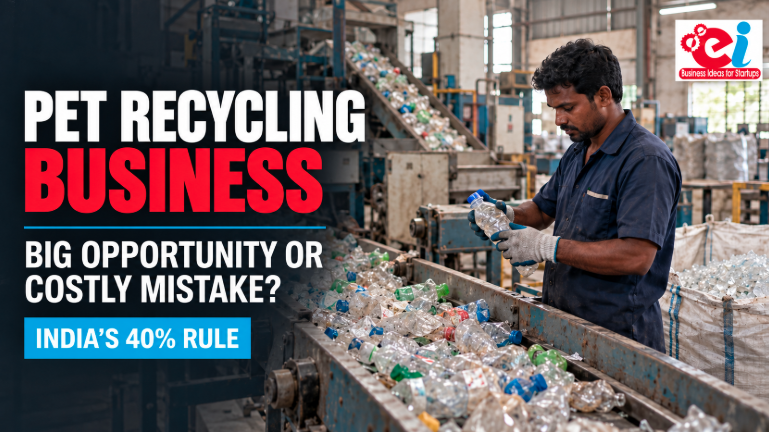
This is often the most practical manufacturing entry point for a first-time recycler. A plant receives sorted PET bottles, removes labels and caps, grinds the bottles, washes the material, and dries it into flakes. Possible buyers include polyester fibre makers, sheet manufacturers and other PET processors.
The attraction is a clear B2B product with a defined process. The difficulty is quality. PVC mixed into the feedstock, coloured bottles, stubborn glue and excess moisture can reduce the price or cause rejection. The founder’s first job is to obtain buyer specifications and test local bottle supplies. A machine rated at one tonne per hour is of little use if the plant cannot consistently buy suitable bottles or sell the resulting flakes.
Investor fit: Entrepreneurs with access to bottle collection networks, industrial utilities, water treatment and one or more dependable B2B buyers.
2 Recycled PET Strapping
PET strapping holds cartons, pallets, and heavy goods during transport. It can give a processor an additional product beyond flakes, with customers in logistics, warehouses and manufacturing plants. Instead of selling only raw material, the business sells a packaging product that customers use every day.
This does not mean every flake can be turned into saleable strapping. Extrusion quality, material drying, strap width, breaking strength, and stable dimensions matter. Large users will test the product on their strapping machines. A sensible startup approach is to qualify one or two strap specifications with local industrial buyers before installing a line designed for many product sizes.
Investor fit: Manufacturers who can manage product testing and industrial sales, or existing recyclers looking to move into value-added products.
3 Food Grade Recycled PET Resin
Food-grade rPET resin can be used in approved food and beverage packaging applications. This is the most demanding of the three routes. FSSAI permits eligible recycled PET for food-contact use under its regulatory framework, but the process must meet the applicable approval and safety requirements. Ordinary hot-washed flakes cannot simply be sold as food-grade bottle resin.
The plant needs suitable input control, validated decontamination technology, testing, traceability and formal customer qualification. The investment and working-capital exposure are substantially greater. A startup should not purchase a high-end line solely because the 40% target appears attractive in a headline. A startup should first have an offtake discussion with a qualified packaging customer and a clear approval roadmap.
Investor fit: Well-capitalised manufacturers with technical partners, consistent high-quality feedstock and the ability to handle a lengthy qualification period.
Which Business Should You Start
The right model depends less on industry excitement and more on what the founder can control. The comparison below is relative. You must develop actual project costs from capacity, machinery quotations, utilities, land, building, and working-capital needs.
Business route | Capital intensity | What must be secured first |
| Bottle sorting and baling | Lower | Collection network and buyers for sorted bales |
| Hot-washed PET flakes | Moderate | Flake buyer standards, feedstock and utility plan |
| PET strapping | Moderate to higher | Industrial product trials and stable feedstock quality |
| Food-grade rPET resin | High | Technology approval path, qualified input and offtake |
Where PET Recycling Profit Really Comes From
Recycling profitability starts with saleable yield, not the weight entering the conveyor. The plant pays for the full bottle load, including caps, labels, dirt, moisture and rejected polymers. Its revenue comes mainly from the quantity of acceptable product after those losses.
A useful first calculation is: sales revenue = saleable product kilograms x realised selling price per kilogram. Then deduct purchased feedstock, labour, power, water, chemicals, packaging, freight, maintenance and other operating costs. Consider loan servicing, depreciation, taxes, and working capital separately when judging the return on investment.
Consider a purely illustrative case: a plant buys 1,000 kg of used bottles and recovers 800 kg of saleable flakes. A ₹1 per kg increase in bottle purchase cost adds ₹1,000 to the batch cost; a ₹1 per kg drop in flake selling price removes ₹800 from sales. Neither figure is a market quotation. The example shows why procurement cost, recovery and realised sale price should be stress-tested together.
An investor should request three financial cases before committing funds: expected operations, lower selling prices and higher bottle procurement costs. Add a slow-ramp case in which the plant runs below capacity while customers test its output. This can reveal a cash shortage that a headline profit margin hides.
A Practical Startup Checklist Before Buying Machinery
· Find the buyer. Get a written product specification, expected monthly volume, sampling procedure and payment terms.
· Map the bottle supply. Check seasonality, colour mix, contamination, transport distance and the cost of buying from aggregators.
· Trial the process. Run representative feedstock samples and measure actual yield, washing performance and rejected output.
· Plan approvals and utilities. Check applicable State Pollution Control Board consents, plastic-waste processor registration through the CPCB EPR system, water, effluent treatment, power and fire requirements. Food-contact resin needs the relevant FSSAI pathway.
· Build a complete project budget. Include land, building, machinery, installation, testing laboratory, utilities, effluent treatment, finance cost and working capital, not machinery alone.
· Secure payment and sales channels. Check customer credit periods and whether alternative buyers exist for lower-grade material.
Where Should the Plant Be Located
Low land prices do not automatically make a good recycling location. The plant should be close enough to bottle suppliers to control freight and close enough to customers to keep delivery economical. It also needs industrial zoning, consistent utilities, and a workable system for wastewater and residues. Compare locations on delivered bottle cost and net product realisation, not only rent or land price.
What an Entrepreneur Can Do in the First 90 Days
In the first month, shortlist the product and speak to buyers about quality and volumes. In the next month, sample local bottle streams, commission product trials, and get preliminary equipment and utility quotes. In the third month, build a location-specific feasibility model and identify every permit and customer-approval step. A serious investment decision should follow that work. The sequence is far cheaper than discovering quality or supply problems after the machinery arrives.
Make an Investment Decision Based on Your Market
PET recycling can be a worthwhile manufacturing opportunity for entrepreneurs, startups, and MSMEs, but the winning model isn’t the one with the biggest machinery brochure. It is the one built around a buyer, a dependable raw-material supply, and an acceptable margin after all costs. A founder who proves those three points has a stronger case for investment and finance.
Niir Project Consultancy Services (NPCS) assists entrepreneurs with market surveys and Detailed Techno-Economic Feasibility Reports for manufacturing projects. A PET recycling study can assess the right product route, capacity, process, machinery, raw-material supply, projected costs, sales assumptions, and financial viability before committing capital.
Official References
Frequently Asked Questions
Is PET recycling suitable for a first time manufacturing entrepreneur
Yes, particularly a well-planned flake unit, but only when feedstock, buyer quality and working capital are understood. A simple-looking process is not automatically a low-risk business.
Does the 40 percent recycled content target guarantee demand for my plant
No. The target relates to a defined plastic-packaging category, with conditions and exemptions. Buyers still select suppliers on price, consistency, compliance and delivery.
Can a startup sell washed PET flakes to food and beverage brands
Not as a substitute for approved food-contact resin. Food-grade applications require compliant technology, validated safety processes and applicable authorisation.
Should I start with flakes or make strapping directly
Start from the buyer. Flakes may be easier to market as a raw material, while strapping requires product performance trials. The choice depends on local offtake and the quality of feedstock.
What should an investment feasibility report show
It should show realistic plant capacity, output recovery, product quality, investment cost, selling price, feedstock cost, operating expenses, working capital, break-even, cash flow and downside scenarios.


