




Starting a PET Recycling Business in India | Setup, Rules & Ideas now depends on much more than simply collecting discarded bottles. Strict new plastic packaging rules have created a structural demand for recycled material, while food safety requirements have significantly raised the quality threshold. For startup founders and MSMEs, the true commercial opportunity lies in supplying consistent, traceable, and regulatory-compliant products.
However, entrepreneurs must note: cheap machinery cannot rescue weak sourcing, poor washing, or a buyer who rejects entire batches.
Why PET Recycling Deserves Your Attention
Beverage packaging, textiles, and industrial strapping offer distinct markets for recycled PET. Therefore, founders should identify their target buyer before selecting processing equipment. Clear flakes, coloured flakes, and food-grade resin serve completely different industrial needs and command different market prices.
Profit margins depend strictly on saleable output after removing labels, caps, dirt, and moisture. Meanwhile, virgin resin prices heavily influence what corporate buyers will pay for recycled alternatives. Always test your project’s profitability against worst-case scenarios: lower selling prices, higher bottle procurement costs, and delayed payments. While export demand adds lucrative options, consistent domestic contracts provide a steadier operating base.
A workable supply contract should clearly define bale composition, weighing methods, and dispute resolution for contamination. Also, track electricity and water usage against saleable output, not incoming waste. This reveals the true operational losses that headline machinery capacity figures often conceal. Before expanding, establish a backup outlet for off-specification material and a lawful disposal route for residues that buyers will not accept. (PET Recycling Business in India)
Government Policies and Practical Support
The Plastic Waste Management (Amendment) Rules, 2022, phase in rigid packaging recycled-content obligations from 30% to 60%. However, category-specific conditions, statutory exemptions, and food-contact carry-forward provisions matter. This is not a blanket requirement for every plastic product.
Recyclers require Central Pollution Control Board (CPCB) processor registration and applicable State Pollution Control Board consents. EPR (Extended Producer Responsibility) certificates require eligible, documented processing; they do not guarantee automatic revenue. Moreover, FSSAI food-contact PET guidelines require specific process authorisation, traceability, and safety controls that go far beyond ordinary washing lines.
The Plastic Park Scheme supports shared infrastructure rather than automatic grants to individual factories. Eligible new manufacturing enterprises can explore the PMEGP (Prime Minister’s Employment Generation Programme), a credit-linked subsidy programme. Separately, CGTMSE support guarantees eligible lender exposure; it is neither direct funding nor loan forgiveness. Check eligibility before assuming benefits, and do not budget a PET-specific PLI (Production Linked Incentive) payout without a qualifying government notification.
Innovative regional models, such as Uttarakhand’s digital bottle deposit refunds along the Kedarnath route, show how public-private partnerships can improve feedstock collection. However, localized success does not assure a startup exclusive supply rights nationwide. (PET Recycling Business in India) (PET Recycling Business in India)
3 Manufacturing Business Ideas for Startups
Hot Washed PET Flakes
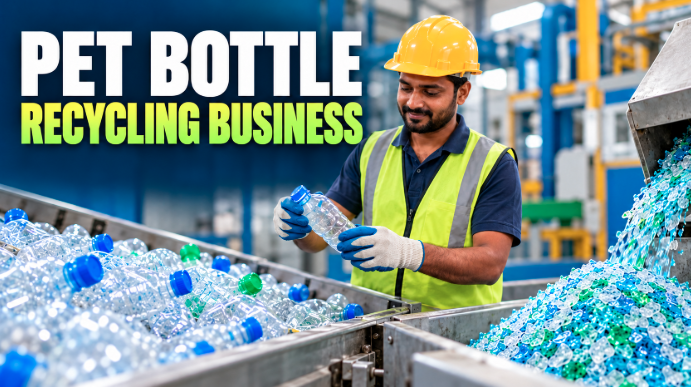
A hot wash flake unit sorts bottles, removes labels, grinds the PET, washes it at high temperatures, and controls moisture. Polyester fibre producers and downstream recyclers buy this material against strict agreed specifications. Secure trial acceptance before choosing your line capacity. PVC contamination, leftover glue, and mixed colours can destroy batch value. Negotiate feedstock quality deductions upfront and measure actual recovery from representative bottle bales. Otherwise, nominal throughput capacities can hide a critically weak operating margin. (PET Recycling Business in India)
Recycled PET Strapping
Strapping serves factories that need to secure heavy cartons, pallets, and industrial goods. This route adds conversion value beyond simply selling flakes. However, industrial buyers judge breaking strength, dimensions, and performance on their automated equipment. Consistent drying and extrusion matter because moisture destroys PET’s tensile strength during processing. Start with defined industrial applications and repeat buyers, then expand sizes after proving quality.
Food-Grade rPET Resin
Bottle-to-bottle recycling targets beverage and food packaging customers with demanding approval procedures. It requires validated decontamination, controlled inputs, and highly documented quality assurance. Consequently, ordinary recycled granules cannot simply carry a “food-grade” label. Entrepreneurs must align technology selection with FSSAI requirements and customer trials before committing to expensive extrusion equipment. The commercial advantage comes from dependable approvals, but the lengthy qualification cycle creates working-capital pressure.
Import and Export Opportunities
Exporters can target flakes, strapping, and qualified resin, depending on the destination country’s rules. Overseas buyers often require testing, traceability, and certification beyond Indian standards. Always compare net realisation after accounting for freight, insurance, rejection risks, and payment delays.
Imports require separate, intense scrutiny. India’s Directorate General of Foreign Trade (DGFT) heavily restricts the import of solid plastic waste, including PET flakes. Therefore, verify exact product classifications and permissions with customs before contracting international suppliers. Do not build a business model around assumed access to cheap imported scrap.
Indian Success Stories and MSME Lessons
Shyam Sunder Sharma, founder of Ganesha Ecosphere, built his empire on textile expertise, expanding the company into recycled fibres and packaging materials. The lesson for MSMEs is to connect recycling with a known, guaranteed end market. Established downstream demand guides product development more reliably than a broad sustainability pitch.
Similarly, Srichakra Polyplast founder Ravindra Paruchuri has heavily emphasised quality, advanced technology, and integration as his business expanded. Its bottle-to-bottle positioning illustrates the high value of meeting stringent global brand requirements. While these are industry benchmarks, their massive scale should not imply that either company currently qualifies as an MSME. For new founders, both examples prove a vital rule: secure customer requirements before buying equipment. (PET Recycling Business in India)
Turning an Opportunity into a Feasible Project
We at Niir Project Consultancy Services (NPCS) prepare comprehensive Market Survey cum Detailed Techno-Economic Feasibility Reports (DPRs). Our reports cover manufacturing processes, market research, demand analysis, process flow diagrams, product mix, capacity planning, machinery, raw materials, and complete project financials with profitability analysis. This helps entrepreneurs assess feasibility and long-term scalability before investing.
For broader technical reading, NPCS offers the printed Recycling Business Handbook Industrial and Agricultural Waste Processing, which includes PET bottle recycling, flakes, processes, and equipment. Pair this reference with current market and regulatory checks.
The NPCS Project Report, Business of PET Recycling & Production of Flakes, supports project evaluation through plant economics, machinery requirements, and financial projections. Confirm applicable incentives within the proposed project’s scope. (PET Recycling Business in India)
Recycled Content Obligations at a Glance (Category I: Rigid Packaging)
The rigid-packaging schedule under MoEFCC rules creates rising structural demand. These are mandatory regulatory phases, not mere market-share estimates.
| Schedule Phase | Financial Year | Recycled Content Mandate |
| Initial Phase | 2025–2026 | 30% |
| Second Phase | 2026–2027 | 40% |
| Third Phase | 2027–2028 | 50% |
| Final Onward | 2028–2029 onwards | 60% |
Conclusion
PET recycling rewards disciplined sourcing and dependable quality. Start with a defined product, verify state and central permissions, and prove buyer acceptance. Expand only when your operating cash flow and evidence support the next step.
Your Investment Deserves the Right Opportunity. Every serious investment begins with choosing the right sector and the right business model. With hundreds of industrial opportunities available across India’s manufacturing landscape, making an informed choice is critical. The NPCS Startup Selector tool helps entrepreneurs, MSMEs, and investors identify the most suitable business opportunities based on their investment capacity, location, and interests—so your capital is directed toward a venture with the strongest potential. (PET Recycling Business in India)


