







There is a silent yet conclusive change in the Indian manufacturing landscape. In addition to the old heavy industries, a new generation of business owners and MSMEs are taking off in niche and value added segments which offer predictable demand in combination with scalability. Of these, Emerging industrial three have been identified to have good commercial rationale and future applicability, including industrial chemicals, agri-based bio-inputs, and alternative alcoholic drinks.
This article analyses Methanol Carbonylation of Acetic Acid, Neem-Based Biopesticides, and Herbal-Flavoured Alcoholic Beer as separate yet equally good manufacturing prospects. Both of them represent a distinct demand driver industrial use, sustainable agriculture and changing consumer preferences but have one similarity in common, good domestic demand and space to organise manufacturing.
Acetic Acid through Methanol Carbonylation
Product Overview and Applications
Acetic acid is a backbone chemical that has applications that range from textiles, plastics, pharmaceuticals, food processing, and coating. In the case of industrial acetic acid, almost 80 percent of the consumption is captive, mainly in the case of vinyl acetate monomer, purified terephthalic acid, and acetate esters. Although the profile is mature, the demand is robust since it supports several value chains of the downstream.
Manufacturing and Production Insights
The methanol carbonylation route is the most common route to produce because it yields better and the process is stable. Simply, methanol is reacted with carbon monoxide with the help of a catalyst to form acetic acid. Modern plants are technology-intensive, but have a predictable cost of operation and prolonged campaign runs.
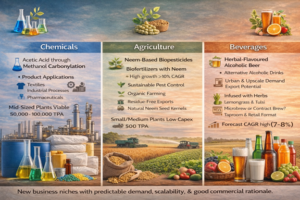
Scale matters here. Smaller units less than 25,000 TPA find it difficult to compete on price, but mid-sized plants of 50,000 to 100,000 TPA are viable, particularly where they are close to refineries or methanol sources.
Raw Materials and Processing Considerations
Project location depends on the availability of methanol and carbon monoxide. Capex factors are important in the management of catalysts and corrosion resistant equipment. Energy-efficient design can cope with utilities steam, power, cooling water, which constitute a significant portion of operating expenses.
Demand Drivers and End-Use Industries
Expansion in packaging, polyester fibres, adhesives and pharmaceuticals will maintain the demand of acetic acid. Substitution of imports is also a viable strategy since India still needs its suppliers abroad to supply some of its needs.
Market Size and Profitability Outlook
The demand of acetic acid in India is increasing at a mid-single-digit rate which agrees with the industrial production. Margins are cyclical but they stabilise over long operating periods.
Indicative Cost Structure
| Cost Head | Share (%) |
| Raw materials | 55 |
| Utilities | 18 |
| Fixed costs | 12 |
| Logistics | 10 |
| EBITDA margin | 15 |
 Neem-Based Biopesticides from Neem Seed
Product Overview and Applications
Bio pesticides made of neem are no longer peripheral products. These formulations are based on neem seed kernels, being antifeedants and growth regulators and not necessarily toxins. They have been embraced by the horticulture, organic farmers and export agri producers.
Manufacturing and Production Insights
The process of production includes the collection of seeds, their drying, separation of kernels, oil extraction and formulation. The process is capital light and relatively easy mechanically in comparison with synthetic pesticides. Nevertheless, regularity in active ingredient concentration requires discipline in the processes.
Small and medium-scale units can be run at 500 or less capacities and this would make this segment very appealing to first-generation manufacturers.
Raw Materials and Processing Considerations
Neem seeds are not in demand at all times, which necessitates inventory planning. The areas of technical focus include extraction efficiency and shelf-life stabilisation. Packaging should be such that it does not degrade active compounds under heat and light.
Demand Drivers and End-Use Industries
Adoption is encouraged by regulatory pressure on chemical pesticide use, residue issues in food export and farmer awareness. Organic farming programs sponsored by the government also enhance demand indicators.
Market Size and Growth Potential
The market of biopesticides in India is growing at a rate of more than 10 percent per year, versus conventional agrochemicals. The products made of neem are taking a large proportion because of their availability locally and familiarity among the farmers.
Demand Comparison Snapshot
| Segment | Growth Trend |
| Chemical pesticides | Moderate |
| Biofertilisers | High |
| Neem biopesticides | Very high |
Alcoholic Beer in Herbal Flavour
Product Overview and Applications
Herbal-flavoured beer is a change in consumer behaviour that is subtle yet strong. Functional and flavour differentiation ingredients such as lemongrass, ginger, coriander, tulsi do not cause radical changes in alcohol content. This segment targets the urban consumers who want something new with an apparent sense of wellness.
Read Project Details: Alcoholic Project
Manufacturing and Production Insights
In terms of production, herbal beer is not very different as compared to the standard brewing. The distinction is in infusion phases and formulation of recipes. The operations of a microbrewery can be quickly tested on the market, whereas with contract brewing, it is possible to grow quickly without massive investment.
Raw Materials and Processing Considerations
Core inputs are barley malt, hops, yeast and water. The herbal additions must be sourced in food grade and regulated on the dosage to ensure uniformity. The state excise laws and regulatory compliance is a very important parameter of planning.
Demand Drivers and End-Use Industries
This segment is motivated by urbanisation, premiumisation and experiential consumption. Primary channels include hospitality, organised retail and taproom format.
Market Size and Profitability Outlook
The beer industry in India is expanding at a rate of 7-8, which is higher than flavoured and craft beer. Excite taxes affect the margins, but brand-led pricing has an advantage.
Growth Outlook Table
| Parameter | Outlook |
| Urban demand | Strong |
| Product differentiation | High |
| Export potential | Moderate |
| Margin scalability | High |
Read Also: The Rise of Herbal Beverages: Crafting Traditional Indian Liquors
Learning from Indian Industrial Success Models
A number of Indian MSME leaders have shown how scale is created by being focused. Examples of disciplined chemical production include companies such as Aarti Industries which were led by promoters who believed in backward integration and long term contracts. Multi-plex Group, under the leadership of Dr. Y. L. Nene, has developed a reliable reputation in agro-inputs by educating farmers and maintaining a high level of quality instead of using aggressive pricing as a strategy to gain market share.
In drinks, Radico Khaitan, which is marketed by Abhishek Khaitan, demonstrates that portfolio diversification and compliance with regulations may work together. The general moral is obvious: to be successful, one has to grasp the demand and not live up to the trends.
Role of Institutional Support and Policy Environment
Policy frameworks that favor manufacturing by the ministry of micro, small and medium enterprises are an added advantage to the entrepreneurs since they are covered with credit-linked programs, cluster development, and technology upgrades. Being sensitive and in line with such institutional ecosystems tends to mitigate the friction at the initial stages.
How Niir Project Consultancy Services (NPCS) Supports New Manufacturing Ventures
To entrepreneurs looking into these opportunities, there is a lot to be said about structuring the plan to the extent that it would be viable or not. Niir Project Consultancy Services (NPCS) has a pragmatic role to play in this process. NPCS makes Market Survey cum Detailed Techno-Economic Feasibility Reports which help the promoters to know the demand dynamics prior to investing capital. Their reports normally include manufacturing processes, sourcing of raw materials, planning of plant layout and a detailed financial projection. The NPCS can help an entrepreneur to evaluate the feasibility of a given industry or product line to take a venture in India by breaking down the technical complexity into business practicality and relevance.
Frequently Asked Questions
Can first time entrepreneurs engage in chemical manufacturing?
Yes, assuming scale, location, and the presence of feedstock are planned well. Joint ventures and incremental capacity help in mitigating risk.
Neem-based products – are they seasonal businesses?
Raw materials are seasonal, whereas the demand of finished products is on an annual basis. Seasonality is alleviated by inventory planning.
What is the riskiness of the alcoholic beverage industry?
The biggest challenge is regulatory complexity. Nevertheless, demand stability and brand loyalty provides long term rewards.
What is the quickest break even?
Neem biopesticides are generally able to break even earlier since they have low capex and they have more rapid entry into the market.
Conclusion: Business lessons to Be learned as an entrepreneur.
The three opportunities discussed work in a different risk-reward band. It is the Scale of Acetic Acid Rewards
and Operational Discipline. Demand of biopesticides that are based on neem favors agility and demand built on sustainability. Herbal-flavoured beer is a brand-based, consumer-driven beer.
What makes them similar is not newness, but timeliness. The few entrepreneurs who match the technical feasibility with real market demand and take the time to organize their planning are in a position to construct robust manufacturing firms in the dynamic industrial economy in India.


