





Starting a manufacturing business is an exciting time – but it is not without its hidden challenges. Most first-time founders quickly realize that a product idea is not sufficient. The real battle is infrastructure – land, utilities, compliance, supply chain and logistics. These “invisible costs” can be the subtle difference between a unit surviving beyond its 3rd year or not.
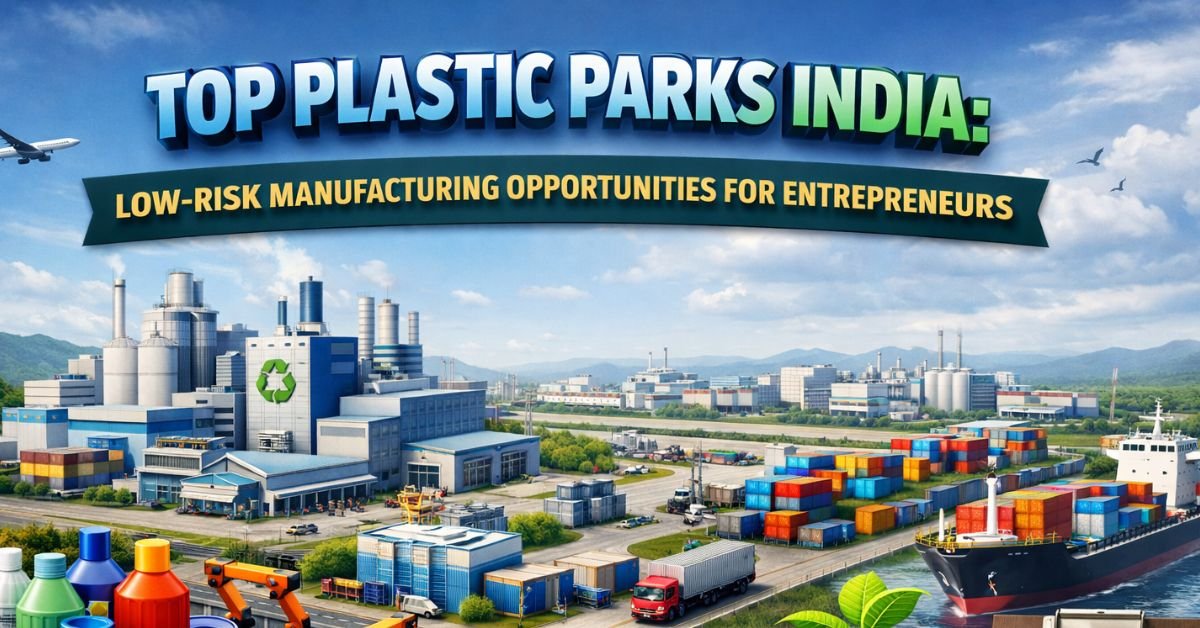
This is where Government Backed Plastic Parks India comes in as a game-changer. These parks enable entrepreneurs to get into the plastics production business with less risk, shared infrastructure, and quicker time-to-market.
Table of Contents
ToggleRead More: Polymer Processing Unit in Plastic Park: Cost, Subsidy & 50% Government Grant in India
Why Plastic Parks Are the Best First Manufacturing Step
Plastic Parks are intended to eliminate the process of plastic processing downstream and puts it in cluster-based common-facility parks. Rather than needing to develop everything from the ground up, small and medium enterprises (SMEs) can focus on production, quality and customers and the park can handle the roads, utilities, effluent treatment and compliance.
This is in line with India’s overall strategy to develop high domestic chemical and petrochemical industries, decrease dependence on imports and to develop skilled manpower. According to the Ministry of Chemicals & Petrochemicals, the sector is huge and plays a pivotal role in industries like agriculture, textiles, automobiles and healthcare and provides huge downstream opportunities for SMEs.(Plastic Parks India)
How Plastic Parks Address the "First Factory" Problem
New manufacturers often lose money because of structural disadvantages:
- High logistics costs
- Unreliable utilities
- Delayed approvals
- Lack of shared testing/tool room resources
Plastic Parks address these problems with:
- Shared infrastructure: Water, power, and roads sustained by the park
- Common facilities: Testing labs, tool rooms, storage spaces
- Vendor ecosystems (service providers, repair shops, raw material suppliers nearby)
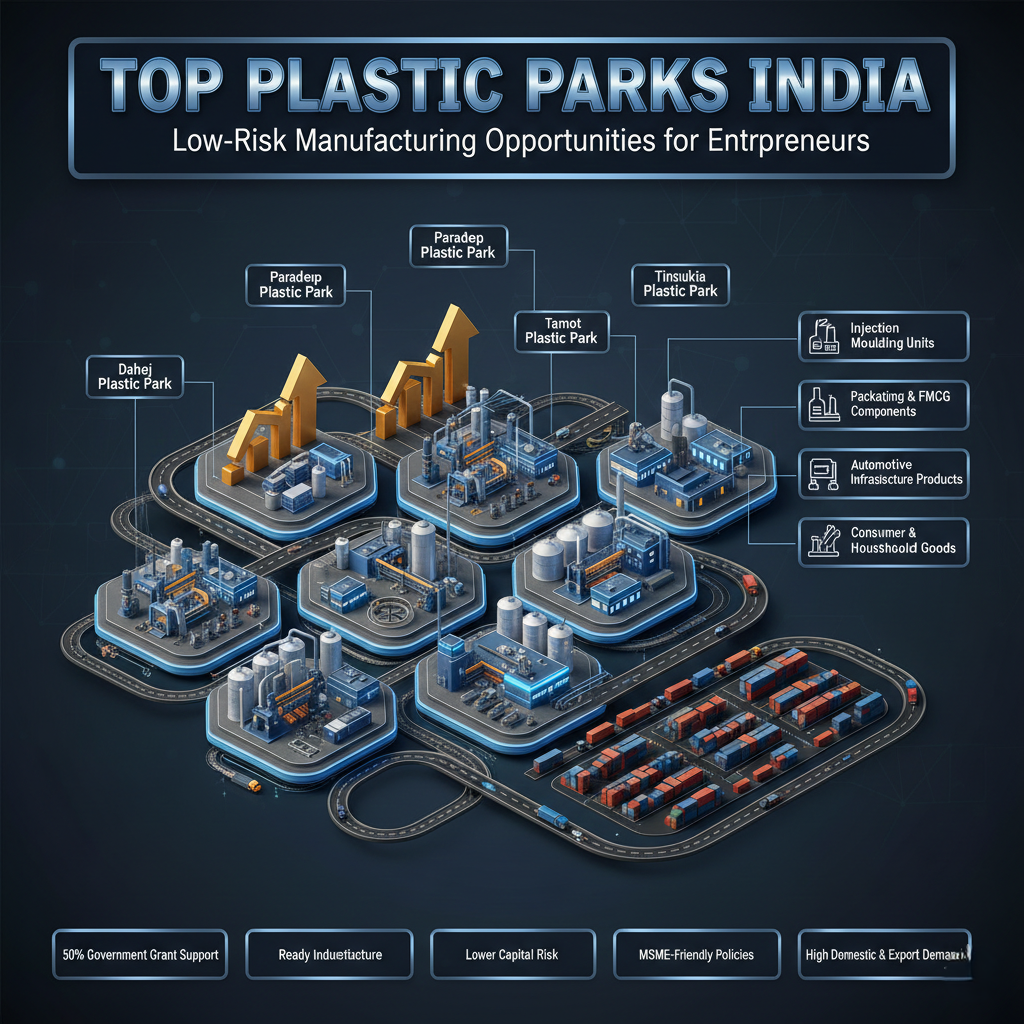
Policy-wise, the government supports grant up to 50% of project cost up to the ceiling of Rs. 40 crores per park. This lowers the barrier to entry to new entrepreneurs even if they have limited own capital.
The key benefit: speed. Manufacturing returns are extremely sensitive to time-to-market. Parks minimize delays, making a much safer investment.(Plastic Parks India)
Approved Plastic Park data: What it means to entrepreneurs
Looking at approved parks gives some idea of the scale and seriousness of this initiative:
Location | Land Area (Acre) | Total Plots | Total Project Cost (₹ Crore) | Approved Grant (₹ Crore) |
Tamo, MP | 122 | 172 | 108 | 40 |
Jagatsinghpur, Odisha | 120 | 81 | 106.78 | 40 |
Tiruvallur, Tamil Nadu | 240 | 65 | 216.92 | 40 |
Tinsukia, Assam | 173 | 104 | 93.65 | 40 |
Deoghar, Jharkhand | 93 | 102 | 67.33 | 33.67 |
Portfolio Overview:
- Total Land: 1,120 acres
- Total Plots: 918
- Total Project Cost: ₹903.58 crore
- Total Approved Grant: ₹349.14 crore
- The average grant was approximately 38.6% of project cost.
Founder takeaway: These parks are industrial platforms on a large scale, very suitable for MSMEs to grow, because it is not an accidental ecosystem.(Plastic Parks India)
Read More: Business Plans / Project Profiles
Selecting the Right Business Inside a Plastic Park
The most successful founders begin not with product ideas, but with margin strategy. Four successful profitable models work repetitive in Plastic Parks:
1. Conversion Businesses: Steady Demand, Predictable Margins
Turn base polymers to finish or semi-finished goods like:
- Rigid packaging
- Caps & closure
- Crates & industrial bins
- Household injection moulded objects
Park advantage: operational stability, repair services in the area, faster acquisition of goods, reliable utilities.(Plastic Parks India)
2. Value-Added Compounding & Masterbatch: Increased Margin
Masterbatch and compounding units are successful if:
- Dispersion quality is uniform
- Colour matching is precise
The cluster ecosystem has the advantage of close customers, such as film lines, injection moulders and extruders. Discipline is key, but parks make operational problems easier.
3. Packaging for Fast Growing Industries
Packaging: it remains a very high demand sector in:
- FMCG
- Personal care
- Pharmaceuticals
- E-commerce logistics
Start with jars, bottles, trays and closures; later scale to multi-layer or barrier packaging solutions. Repeat orders assure cashflow on a daily basis, which enhances working capital cycles.(Plastic Parks India)
4. Import-Substitution Niches
Name areas of imports in which India still imports:
- Precision moulded components
- Applications of polymer – Performance polymers
- Specialty packaging
Success is not just a matter of price, but one of reliability, lead time and compliance. Parks make access to mould development, maintenance and production ramp-up.
Read More: Project Reports & Profiles
Read More: Our Books
Lessons from India's Top Plastics Entrepreneurs
Uflex Ltd. – Ashok Chaturvedi
Strategy: Scale + continually upgrading product
Founder takeaway: Even small units should be thinking about future expansion and new SKU’s.
Time Techno last Ltd. – Anil Jain
Strategy: Industrial Application Emphasis.
Founder takeaway: B2B products have longer term repeat orders compared to retail products.
Astral Ltd. – Sandeep Engineer
Strategy: Distribution + consistency of quality
Founder takeaway: Manufacturing doesn’t create ROI, early distribution strategy does.(Plastic Parks India)
Risks That Still Exist
Plastic Parks lessen structural risk, but not business risk. Common mistakes include:
- Entering price wars with low selling power
- Underestimation of working capital requirements
- Weak QA systems
- Ignoring compliance & safety
- Oversized Machinery purchases before securing the demand
Mitigation: feasibility first planning, break-even analysis, stress testing margins in real market conditions.(Plastic Parks India)
Product Opportunities Within Plastic Parks
- Caps, Closures & Dispensing Systems: High repeat demand Scalable through addition of moulds
- Industrial Crates, Pallets & Material Handling Products: Steady B2B orders; sturdy designs for competitive edge.
- Masterbatch & Additive Concentrates: High margin, technical competence required.
- Rigid Packaging (Pails, Jerrycans, Chemical Containers): Best for buyers who are compliance sensitive.
- Multi-Application Injection Moulded Components Electrical fittings, appliance parts, automotive components focus mould strategy, process optimization.
Conclusion
Government-backed Plastic Parks are one of the best entry points for new entrepreneurs looking to start plastics manufacturing. They reduce structural risks, lower hidden costs, and provide a ready ecosystem for first-time founders. By carefully selecting products with stable margins, planning for scalability, and focusing on B2B repeat customers, startups can thrive while minimizing early-stage mistakes.
For founders looking to evaluate feasibility, profitability, and scalability, consulting agencies like Niir Project Consultancy Services (NPCS) provide detailed techno-economic reports, market analysis, process flow diagrams, and financial projections to make smart, risk-mitigated investments.(Plastic Parks India)
Frequently Asked Questions about Plastic Park Entrepreneurs
- Can an entrepreneur of the first generation succeed here?
Yes, cluster-based parks alleviate the uncertainty of the infrastructure, but you need a strong fit of product and market.
- What’s the greatest ROI benefit?
Reduced hidden costs, faster commissioning & scaling by industrial cluster effects.
- In which product category is cashflow stable?
B2B packaging and industrial material handling products with secured buyer relationships.
- How to approach import-export opportunities.
Start with import substitution niches, exports are easier once quality systems are mature.
- What should be included in a feasibility checklist?
Market size, expected selling price, raw material linkage, utilities, working capital, break-even, compliance and scale roadmap.
- Common mistake to avoid?
Over-investing in machinery with no way to sell and under-investing in QA and tooling discipline and customer acquisition


