





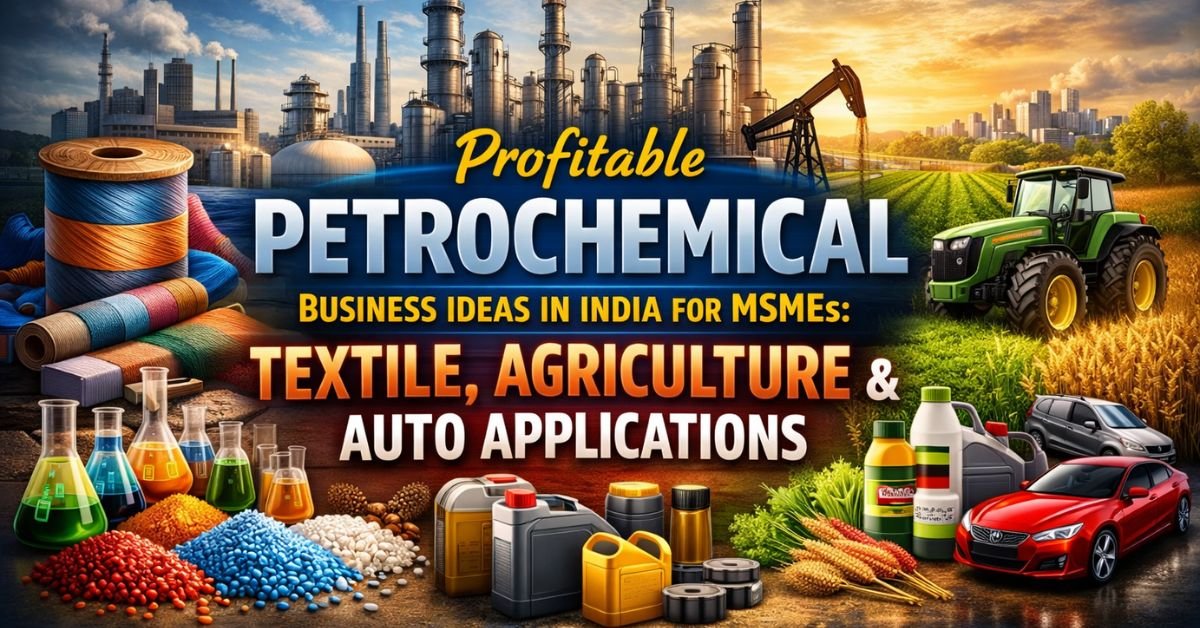
Introduction: Petrochemical Business Ideas India
Petrochemicals are some of the most important yet least tangible contributors to contemporary economic activity. Whether it is synthetic fibre to make clothes, plastic films to make agriculture products or lightweight components to make automobiles, petrochemicals are the base material for countless industrial products.
The Department of Chemicals and Petrochemicals, under the Ministry of Chemicals and Fertilizers, is continuously emphasizing on petrochemicals as an enabler industries for the textile, agriculture, automobiles, packaging and infrastructure industries. Government reports emphasize that maximum value creation occurs not at the stage of raw polymer, but in downstream conversion into ready-to-use products at the stage of their application.
For MSMEs and first-generation entrepreneurs, this distinction is very important. Upstream petrochemical production requires massive capital and control of feedstock while downstream processing would benefit from the technical understanding, product consistency and customer relationships.
Table of Contents
ToggleRead More: The Complete Book on Distillation and Refining of Petroleum Products (Lubricants, Waxes and Petrochemicals)
India's Petrochemical Production Structure and Relevance of MSME
India’s petrochemical production is highly concentrated in the area of polymers and olefins, which account for almost sixty percent of the total output. The remaining is fiber intermediates, synthetic yarns, aromatics, performance plastics, detergent intermediates, and synthetic rubber.(Petrochemical Business Ideas India)
What this structure tells to MSMEs
Instead of competing with the big corporations in the manufacture of base polymers, MSMEs can place themselves in areas like:
- Conversion of polymers into finished or semi-finished products
- Application-specific compounding and formulation
- Fabrication, coating and moulding processes
This downstream positioning enables smaller firms to command better margins based on specialization as opposed to scale.(Petrochemical Business Ideas India)
Textile Sector: From Petrochemical to Performance Fabrics
India’s textile industry has been diversified far beyond cotton. Polyester, nylon, acrylics and blended fibres predominate in modern apparel, home textiles and technical textiles. This shift has resulted in a significant increase in the dependence on petrochemical based intermediates.(Petrochemical Business Ideas India)
Textile Processing Auxiliaries: A Strong MSME Segment
Textile mills use specialty chemicals in dyeing, printing and finishing processes. These chemicals increase dye absorption, shade uniformity, fabric softness and crease resistance.
This segment is suitable for MSMEs because:
- Textile units prefer stability in processes over small variation in prices
- Once a chemical is approved, it is difficult to switch to another supplier
- Demand is repeat driven, and relationship based
Coatings for Technical Textiles
Technical textiles such as geotextiles, filtration fabrics, tarpaulins and protective clothing require polyester or acrylic-based coatings. These coatings increase durability, UV resistance and water repellency. Many high-performance coating systems are still imported, creating a very obvious opportunity for domestic MSME manufacturers with a quality and compliance-oriented focus.(Petrochemical Business Ideas India)
Agriculture Sector: Petrochemicals Aiding Contemporary Agriculture
Petrochemical products are crucial in enhancing the productivity of agriculture and water in the entire country of India.(Petrochemical Business Ideas India)
LDPE / LLDPE Mulch Film Production
Mulch films are extensively used in horticulture and greenhouse farming. They help to retain soil moisture, control weeds, and improve crop yields.
Key success factors in this segment are:
- Uniform thickness control
- UV stabilization for longer field life
- Resistance to tearing and puncture
Seasonal demand is evened out by repeat consumption and government supported agricultural practices.(Petrochemical Business Ideas India)
Drip Irrigation Pipes and Polymer Compounding
Micro-irrigation systems are based on polymers that can tolerate UV light, pressure fluctuation and chemical fertilizers. MSMEs can either compound performance grade polymers or make pipes locally, cutting logistics costs and providing better service to rural markets.(Petrochemical Business Ideas India)
Read More: Project Reports & Profiles
Automotive Sector: Lightweight Materials and Steady Demand
Automobile manufacturers are turning to plastics and synthetic rubber made from petrochemical ingredients to make vehicles lighter and more fuel-efficient.(Petrochemical Business Ideas India)
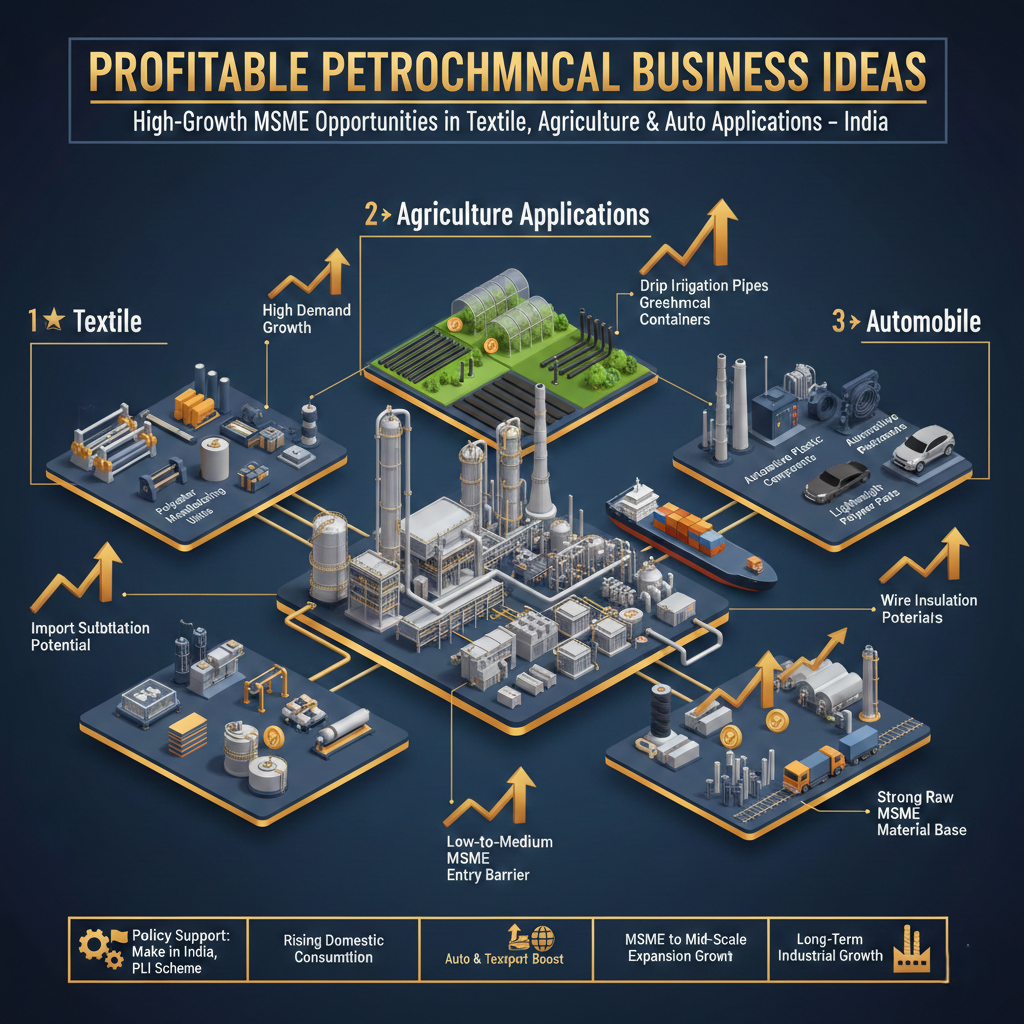
Automotive Plastic Component Manufacturing
MSMEs can provide injection moulded parts such as dashboards, interior trims, bumpers and electrical housings. While OEM approval is mandatory, once approved, suppliers have the benefit of predictable demand from production cycle to production cycle.(Petrochemical Business Ideas India)
Synthetic Rubber Based Adhesives
Automotive assembly requires adhesives and sealants used for bonding, vibration damping, and sealing. This segment rewards suppliers that provide:
- Uniform bonding performance
- Technical documentation
- On-site process support
Price competition comes second to reliability.
Why Petrochemical Clusters Are Important to MSMEs
India’s Petroleum, Chemical and Petrochemical Investment Regions (PCPIRs) provide common infrastructure in the form of effluent treatment plants, utilities, and logistics infrastructure connectivity.
For MSMEs, cluster based locations offer:
- Lower compliance and infrastructure cost
- Easier access to raw materials
- Close proximity to large anchor customers
Lessons Learned from India's Petrochemical Leaders
India’s industrial leaders have some obvious lessons for MSMEs.
Mukesh Ambani showed the strength of downstream integration.
Kumar Mangalam Birla demonstrated the global scalability of application specific materials.
Karsan Bhai Patel proved that consistency and trust can create long-lasting chemical businesses.
The common sense is that value is greater the closer to the end user you can get.(Petrochemical Business Ideas India)
How NPCS Helps MSME Founders
Niir Project Consultancy services help entrepreneurs by Market Survey and Detailed Techno-Economic Feasibility Reports analysing technology, raw materials, machinery, finance, compliance requirements and scalability before investment is made.(Petrochemical Business Ideas India)
Conclusion
For the founders of MSME’s it is not about refineries or molecules when it comes to petrochemicals. They are all about converting base polymers into performance-based products for textile, agricultural and automotive applications. By taking a closer to application, focusing on consistency and building long-term customer relationships, MSMEs can build scalable and resilient businesses that are aligned to India’s industrial growth.
Frequently Asked Questions
Which Petrochemical Projects are most suitable for MSMEs?
Downstream projects such as textile auxiliaries, agricultural films, polymer compounding, automotive plastic moulding and industrial adhesives are well-suited for MSMEs.
Is downstream processing more profitable than upstream production?
Yes. Down Stream processing enables the differentiation based on performance and customer reliability rather than raw material pricing.
How important is OEM approval in automotive manufacturing?
OEM approval is critical and results in long term, predictable orders once achieved.
Do agricultural polymer products have an export potential?
Yes. Mulch films and irrigation systems become more and more in demand in agriculture-driven economies.
Why are petrochemical clusters important?
Clusters minimize the cost of logistics, better manage compliance, and increase access to raw materials and customers.


