






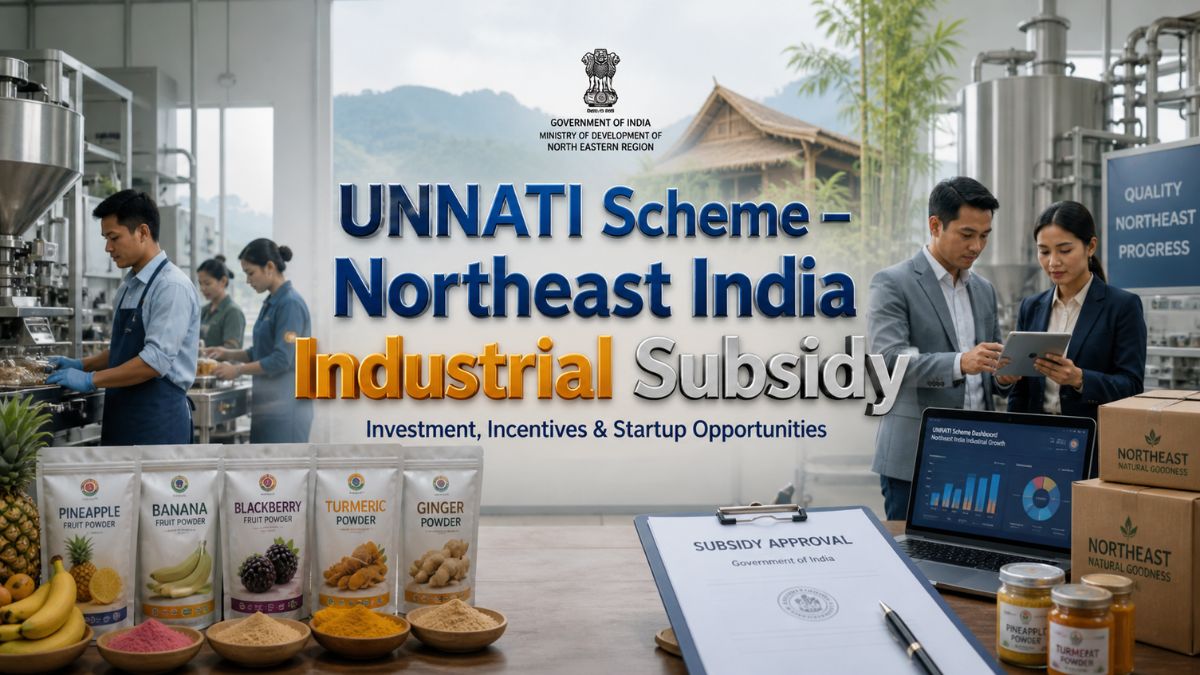
Introduction: UNNATI Scheme India
Among the most effective industrial policies put forward by the Government of India to encourage manufacturing in Northeast India and some of the hill states is the UNNATI Scheme (Uttar Poorva Transformative Industrialization Scheme).
This scheme unlike other normal incentives like tax rebate or interest subsidy, gives a direct capital subsidy on plant and machinery and this lowers the actual project cost by a significant margin. In most instances, businessmen can earn back a maximum of 30 percent on their investment, and it is one of the most attractive industrial schemes currently in India.
This scheme is receiving even more attention in 2026 thanks to India driving to a decentralized manufacturing approach, China+1 supply chain changes and more infrastructure building in the Northeast.
Related Article: How Modi’s Industrial Push Is Changing India’s Manufacturing Industry | PLI Scheme Explained
How UNNATI Scheme Works (Simple Understanding)
The main concept of UNNATI is quite simple: in case you establish a manufacturing plant in qualifying states, the government is able to compensate part of your investment once the project is launched.
The general subsidy is:
- 30% of plant and machinery cost in Zone A states.
- 25% in Zone B states
This implies that your effective cost of capital is lower and enhances profitability and payback period.
Indicatively, when you invest 1 crore in machinery, your actual cost after subsidy will be lower by 2530 lakh depending on the zone.
Why Northeast India Is Focused for Industrial Growth
The natural and resource potential of northeast India is immense, yet slow historical growth of industry has been caused by logistical difficulties and inadequate infrastructure.
Increased transportation costs, lack of adequate industrial ecosystem, and lack of skilled labour in remote locations are some of the key challenges.
But the government is working hard to reverse this situation by improving infrastructure, creation of new industrial belt, and incentive programs such as UNNATI.
The region is no longer considered as a disadvantage zone but a strategic manufacturing and exporting region, particularly in agro-processing, bamboo products and light manufacturing industries.
Get Detailed Insights from This Book: Our Books
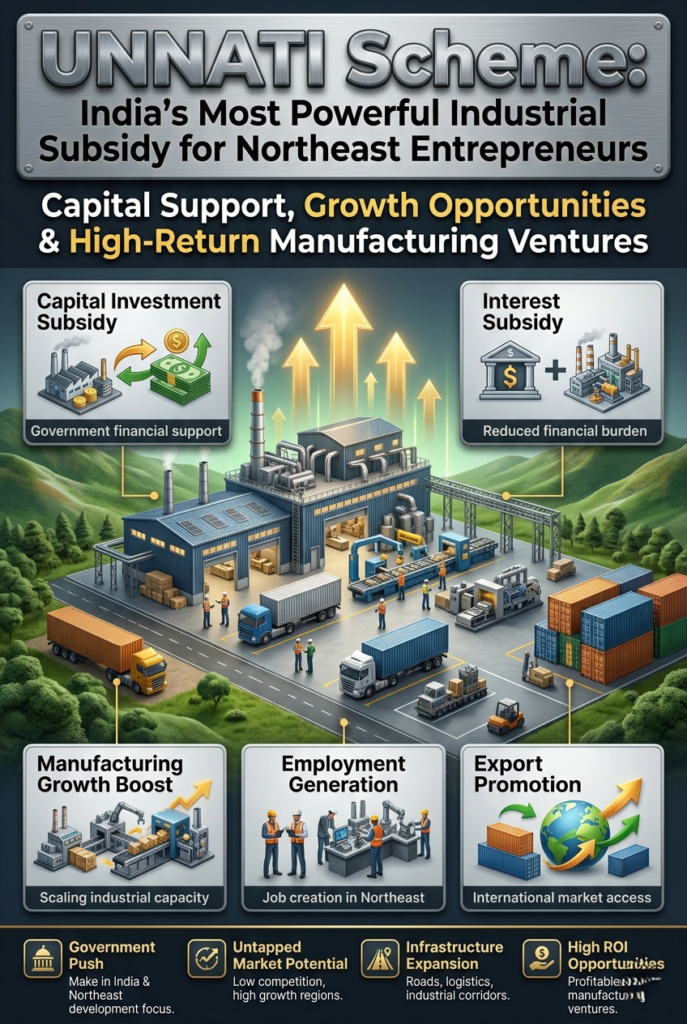
Who Can Apply for UNNATI Scheme
The scheme primarily embraces manufacturing units, although certain service-based industries are also encompassed in certain categories.
Usually eligible sectors would be:
- Agro-based industries and food processing.
- Bamboo and wood products.
- Pharmaceuticals and healthcare manufacturing.
- Electronics assembly units
- Industries of rubber and plastic.
- Tourism infrastructure and hospitality (select cases)
The minimum investment requirement is typically in the range of 1 crore of plant and machinery that guarantees the scheme focuses on serious industrial setups.
Step-by-Step Process to Start a Unit Under UNNATI
Under this scheme, one has to plan in order to start a business. The initial process is to select the appropriate industry in accordance with the local resources and market demand. Assam, for instance, is good in food processing, whereas Mizoram and Nagaland are good locations in industries that use bamboo.
After selecting a sector, it is significant to select a location in a notified industrial area, as it assists in quick approvals and support of infrastructure.
Subsequently, one must have the following registrations:
- Udyam Registration
- GST Registration
- Factory License
- Pollution Clearance Certificate
- Industrial Entrepreneur Memorandum (IEM).
- FSSAI License (food industries)
Once registrations are done, machinery purchase and installation commence. The documentation at this level is very crucial as invoices, installation evidence, and classification of capital are critical in subsidy approval.
Lastly, once the unit is operational the subsidy application is submitted and authenticated by the government.
Access Complete Business Plan: Project Reports & Profiles
Profitability and ROI Under UNNATI Scheme
The benefits of this scheme are one of the greatest as it results in increased profitability because of lower capital cost.
With a well thought out manufacturing unit, it is possible to:
- First year stable revenues.
- 14% to 28% net margins based on scale.
- Break-even in 2.5 to 4.5 years
The reason why ROI will be better with UNNATI:
- Reduced effective investment as a result of subsidy.
- Less reliance on expensive capital.
- Availability of local raw material at cheaper rate.
- Financial support ecosystem endorsed by the government.
This renders Northeast India to be a very promising land among MSMEs and industrial investors.
Importance of DPR (Detailed Project Report)
One of the most important documents of any UNNATI-based project is a DPR. It is no mere formality–it is the basis of your whole business approval process.
A powerful DPR entails:
- Breakup of investment planning and cost.
- Machinery details
- Market demand analysis
- Financial projections
- Subsidy calculation structure
In the absence of a proper DPR, bank loans may be held up or even rejected as well as subsidies.
Role of NPCS (NIIR Project Consultancy Services)
NIIR Project Consultancy Services (NPCS) is a reputed consultancy company in India, which provides consulting services to industrial projects and MSME.
NPCS provides:
- Detailed Project Reports (DPRs).
- Feasibility studies
- Market research reports
- Plant setup guidance
Entrepreneurs extensively use their reports due to their structured format, which corresponds with:
- Bank loan requirements
- Government subsidy guidelines
- Technical feasibility standards
NPCS assists the first-time entrepreneur, in particular, in schemes such as UNNATI, to minimize confusion and enhance the rate of success in approvals through professionally drafted documentation.
Identify high-growth industries before others do
Common Mistakes Entrepreneurs Should Avoid
Avoidable mistakes often lead to failure or delayed completion of many projects under government schemes. Some of the most prevalent ones are:
- Commencing construction without approvals.
- Machinery cost wrongly classified.
- Late or omission IEM filing.
- Poor or incompetent DPR writing.
- Financial planning or unrealistic projections.
By avoiding such errors, one will save months of delays and increase the chances of subsidies being approved.
Conclusion
One of the most powerful industrial incentives today in India is the UNNATI Scheme. It will minimize the cost of startup, enhance profitability as well as stimulate manufacturing in geographical areas that were once undeveloped.
The success lies however in the planning, correct documentation and selection of the appropriate sector. Under this scheme, entrepreneurs can establish very lucrative and viable manufacturing enterprises.
Simply put, UNNATI is not simply a subsidy- it is a long run prospect of industrial development in Northeast India.
FAQ
How much will it cost to invest in UNNATI Scheme?
The lower limit of investment is usually 1 crore in plant and machinery.
UNNATI subsidy is a loan or grant?
It is not a loan, but is a capital subsidy given upon commissioning of the project.
UNNATI can be used together with other schemes?
Yes, it may be used together with such schemes as PMEGP, MUDRA, CGTMSE and occasionally PLI.
What is the average time of approval of the subsidy?
Appreciation may require a number of months based on documentation and verification.
DPR of UNNATI Scheme?
Yes, both a loan and subsidy approval require a Detailed Project Report.
What is NPCS?
NPCS (NIIR Project Consultancy Services) is a professional consultancy to offer DPRs, feasibility studies and reports on industrial projects to MSMEs and large projects.


