





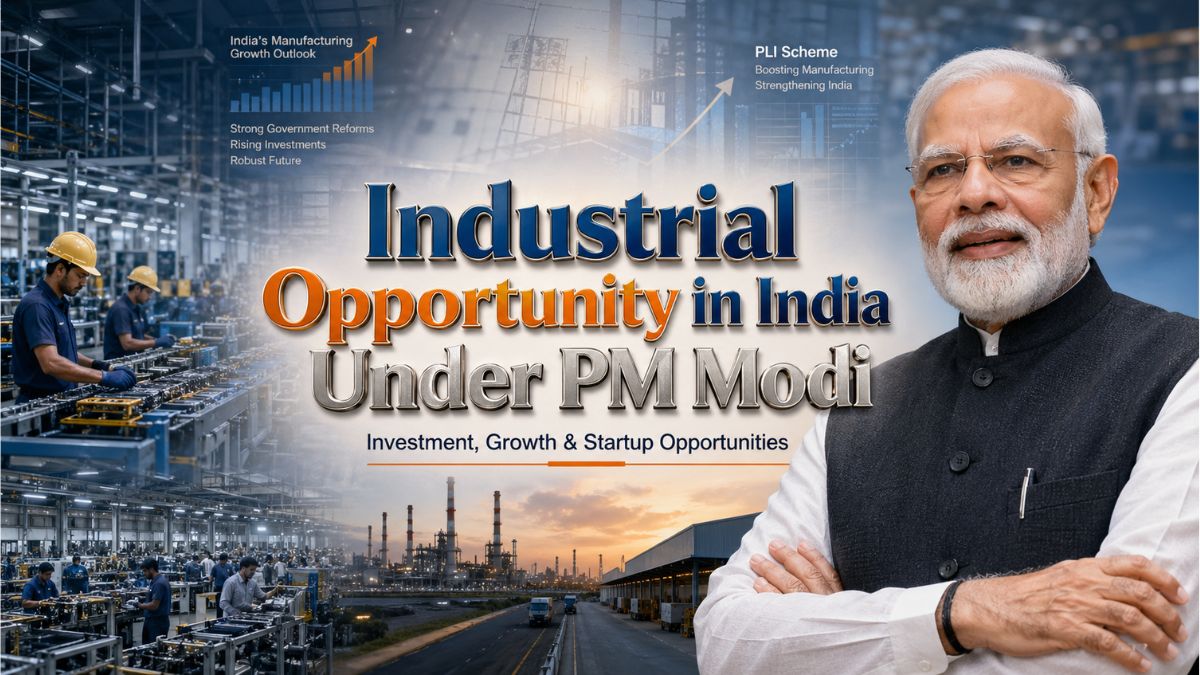
Introduction: MSME manufacturing in India
The manufacturing scene in India is a revolution. India has moved from policy predictions to industry and this under the industrial policies of PM Narendra Modi. It is no more just the big corporate companies and it is the MSMEs and the first-time entrepreneurs who are leading the manufacturing rise.
Government initiatives such as the Production Linked Incentive (PLI) scheme, credit for MSMEs and cluster development have laid the groundwork for entrepreneurs. Now entrepreneurs are not looking for a market, they are looking for the right opportunity from several high growth sectors.
Table of Contents
ToggleWhy India’s Manufacturing Opportunity Is Growing Fast
India’s industrial opportunity is being fuelled by domestic consumption and global supply chain dynamics. Multinational corporations are diversifying away from China towards India through the “China + One” approach.
However, in the meantime, consumption in certain segments is seeing a massive increase in India:
- Electronics demand growth is high with smartphones, EVs, appliances
- Food processing is picking up pace with lifestyle changes and quick commerce
- Export demand is good in automobiles and engineering
This domestic export demand mix has led to a manufacturing rise in India.
Government Support: PLI Scheme and MSME Ecosystem
The government has built a stable ecosystem for manufacturing. One such program that has aided in the growth of manufacturing production is the Production Linked Incentive (PLI) that incentivizes production of manufacturing segments like electronics, pharmaceuticals, textile, and drone.
And there are simpler loan access and approval for MSMEs.(MSME manufacturing in India)
Key support systems include:
- Guaranteed loans of up to ₹5 crore from governments
- Single-window clearances in most states
- Subsidies on land, power and infrastructure in industrial clusters
This has made it easier for entrepreneurs to get started.
High-Growth Manufacturing Opportunities in India
India has a number of promising growth sectors. These are a strong combination of domestic market, exports and government encouragement.
Electronics Manufacturing
India is emerging as a global electronics manufacturing powerhouse with robust growth in mobile phone components, PCB assembly and consumer electronics.
This sector is attractive because:
- Multinational companies are relocating to India
- Export demand is increasing
- PLI benefits from government boost profits
Get Detailed Insights from This Book: Electronic Products Handbook With Circuit Diagrams
Specialty Chemicals
Specialty chemicals are one of the highest margin manufacturing segments in India. These include pharmaceutical intermediates, agricultural chemicals and industrial chemicals.
This sector offers:
- High export demand
- Good opportunities for import substitution
- EBITDA margins of 24% – 32%
But stringent environmental regulations are needed.
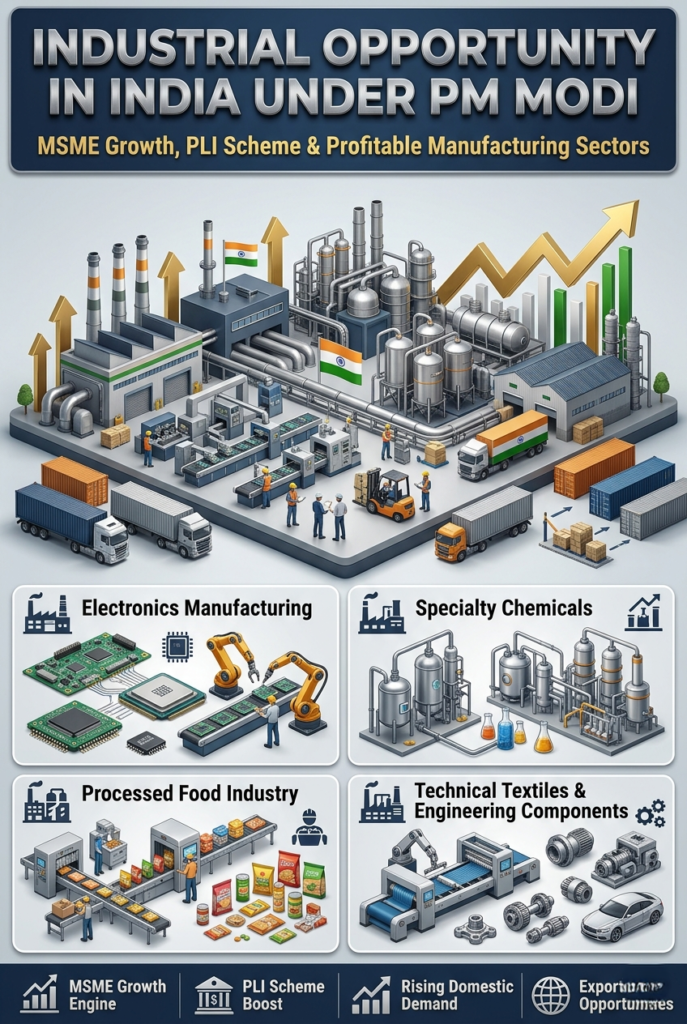
Processed Food Industry
Urbanisation and organised retail is driving rapid growth in the processed food industry.
The main drivers for growth are:
- Growing consumption of RTE foods
- Growth of DMart, Reliance Retail, Blinkit and Instamart
- Expansion in Tier-2 and Tier-3 cities
Common items include frozen and snacks, sauces, and ready-to-eat meals.
Get Detailed Project Report (DPR): Food Processing and Preservation of Fruits and Vegetables
Technical Textiles and Engineering Components
These are export-oriented and growing industries.
- Technical textiles supply medical, construction and automotive industries
- Engineering components supply industries such as automotive and machinery
The two industries are supported by the government and can export.
Profitability in Manufacturing: What Actually Matters
The key to profitability in manufacturing is product placement in the value chain. Firms focusing on manufacturing commodity goods tend to have low margins, whereas exports and branded products are more profitable.
In simple terms:
- Commodity manufacturing → Low margins (8% – 14%)
- Branded consumer products → Moderate margins (18%–28%)
- Export-oriented engineering products → High margins (22% – 35%)
Success is more about skill than scale.
Key Risks Entrepreneurs Must Understand
Despite the opportunities, manufacturing is risky business. The common challenges include:
- Lack of cash flow from slow payments
- Variability in raw material prices
- Regulatory and licensing issues in the initial phase
- Insufficient scale in expansion
The majority of business collapses happen due to incorrect financial and operational planning rather than lack of demand.
Importance of Feasibility Study Before Starting
For any manufacturing business, a feasibility study or a detailed project report is vital. This study helps entrepreneurs to have:
- Market and competition
- Plant and machinery needs
- Costs and investment
- Break-even period and projected profits
Good DPR will result in easier bank finance availability while reducing risks.
Role of NPCS (Niir Project Consultancy Services)
Niir Project Consultancy Services (NPCS) are integral for the MSMEs in India.
NPCS provides DPR, feasibility studies and market research reports that helps entrepreneurs with investment decisions.
NPCS provides the following key services:
- Detailed Project Reports (DPRs) for manufacturing plants
- Feasibility of the product in the market
- Advice on machinery and plant setting up
- Cost and profitability calculations
- Export-import business planning support
NPCS assists entrepreneurs in turning their ideas into a business plan that can be submitted to financial institutions for loans and funding. This helps first-time entrepreneurs make better decisions and minimise risks.
Export Opportunity for Indian Manufacturers
India is emerging as a key exporter in many areas because of global diversification from China. Import substitution is a major opportunity for Indian business.
Key export industries include:
- Pharmaceuticals
- Engineering goods
- Processed food
- Specialty chemicals
- Textiles
Major markets for Indian products are UAE, Vietnam, Africa and Europe.
Conclusion: A Good Time for Industrial Entrepreneurs
India is in a manufacturing transformation phase. The focus on manufacturing, increased domestic demand and supply chain restructuring has all come together to present an opportunity for MSME entrepreneurs and startups.
But manufacturing success is not a foregone conclusion. It’s a matter of discipline, planning and execution. Those entrepreneurs who identify the right industry, optimise their working capital, and develop a strong supplier base will have a successful cycle.
This is not a policy cycle – it is a long-term industrialisation of India.
FAQs
- What are the best manufacturing sectors in India in 2016?
The best manufacturing businesses are electronics, special chemicals, processed food and engineering components.
- How much capital is required to start manufacturing in India?
Typically, investment in MSME manufacturing business ranges from ₹2 crore to ₹10 crore.
- Does the PLI scheme benefit small businesses?
PLI primarily helps large manufacturers, but indirectly helps MSMEs by including them in their supply chains.
- Which is the most profitable MSME?
The most profitable are export-oriented engineering and speciality chemicals.
- When will the business be profitable?
It generally takes 3-5 years for manufacturing firms to settle down and become profitable.


