




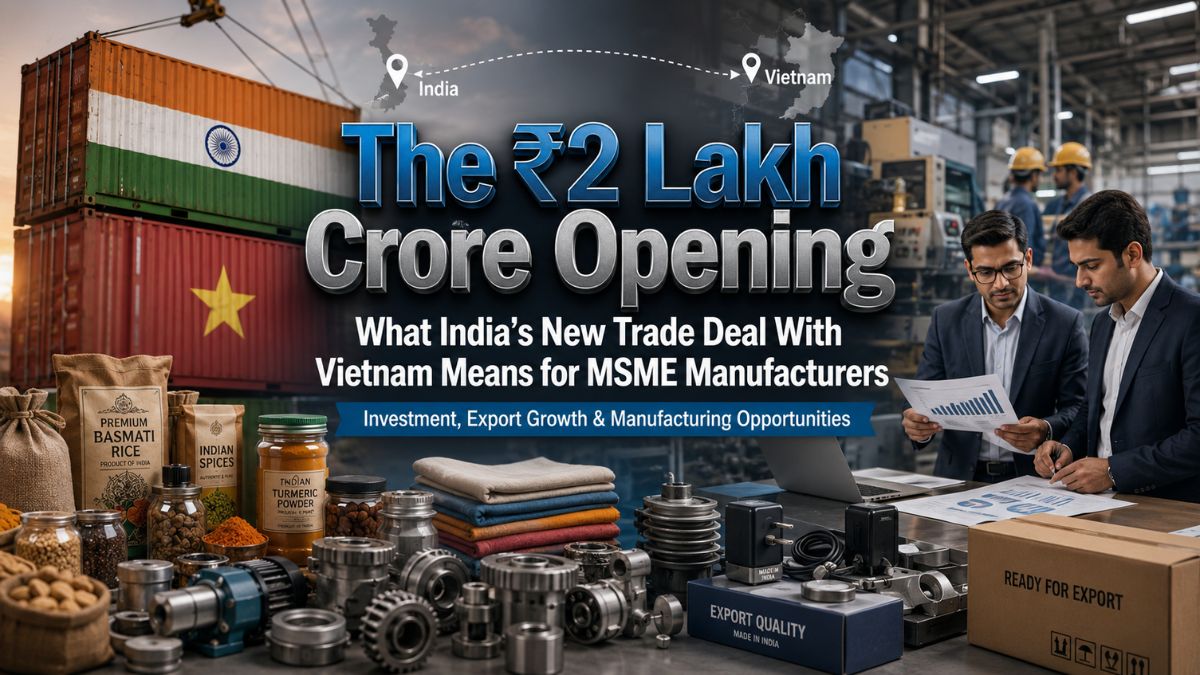
India Vietnam trade opportunity for MSME
Indian businessmen have been paying particular attention on the markets in the USA and Europe for years. However, Southeast Asia is also emerging as a bright, near competition that is growing rapidly — but in secret.
Vietnam has grown to one of the world’s fastest-growing manufacturing hubs with a population of more than 100 million. The surprising aspect is that it imports over 80% of its industrial raw materials. It’s here that India comes into the picture.
The new India-Vietnam agreements to boost trade up to $25 billion from the current level of $15 billion have opened a market that is both hungry and accessible for MSMEs.
Table of Contents
ToggleRelated Article: India-Vietnam Trade Deal: 6 Manufacturing Projects Now Worth a Detailed Feasibility Study
Why This Trade Deal Is a Big Turning Point
This is more than an agreement; it’s a transformation of supply chains. India’s contribution is beyond just exporting raw materials; it’s emerging as a significant manufacturing partner.
The areas covered under the agreement are India’s areas of strength, such as:
- Rare earth minerals and processing
- Pharmaceuticals and APIs
- Arts and Crafts
- Components of engineering and industry
- Renewable energy equipment
This alignment is what creates the opportunity as it is real and actionable.
Where MSMEs Can Actually Make Money
Smart entrepreneurs will target those sectors in which there is already a proven demand instead of trying everything.
Rare Earth Minerals: High Potential, Low Competition
The country is endowed with huge reserves and a lack of processing capacity in Vietnam. India can be a part of this.
Early entry may provide benefits of:
- The world’s demand for EV and electronics materials is increasing.
- The shift of supply chain from China to other countries.
- Long-term industrial contracts
Pharmaceuticals: Ready Market Entry
The healthcare industry in Vietnam is rapidly growing and Indian medicines are already accepted worldwide.
Opportunities include:
- Medicines that are exported are generic medicines.
- API manufacturing
- Manufacturing and distributing to hospitals and pharmacies
Get Detailed Insights from This Book: Drugs & Pharmaceutical Technology Handbook
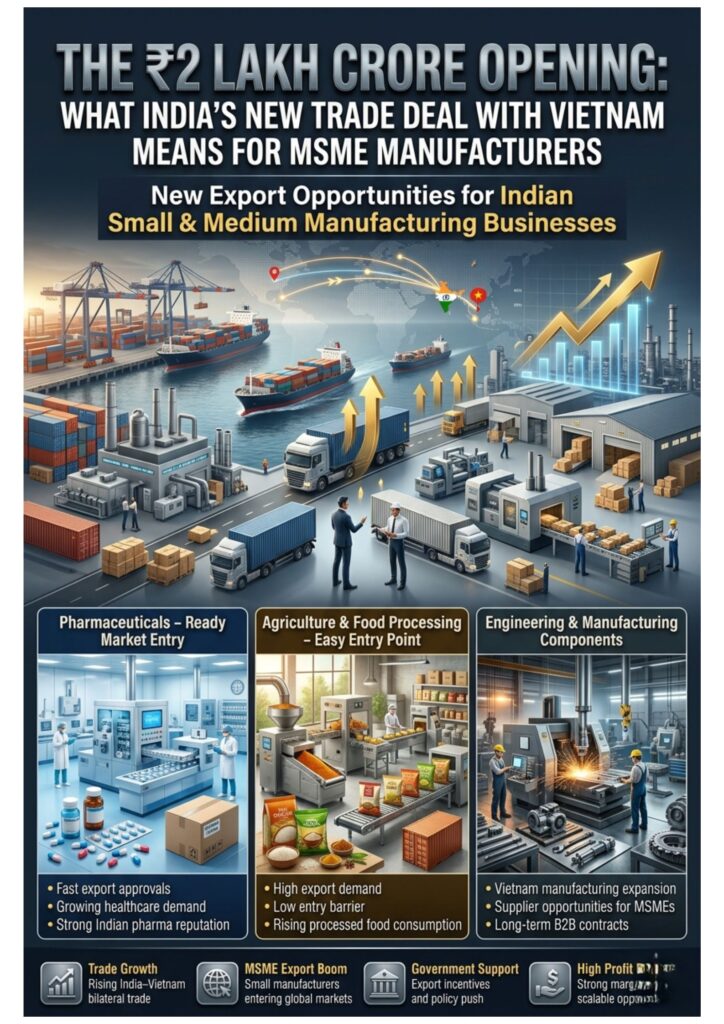
Agriculture & Food Processing: Easy Entry Point
Among the most user-friendly choices for novices is this one.
You can start with:
- Exports of fresh produce (e.g., grapes)
- Packaged food products
- Cold storage and logistics
Engineering & Manufacturing Components
Industrial inputs are needed continuously for Vietnam’s factories.
There is good demand for:
- Steel parts
- Auto components
- Fabrication products
If you are already in operation and running a small manufacturing business, it is easier to scale than it is to start a new manufacturing enterprise.
Access Complete Business Plan: Steel Fabrication & Galvanizing Business Guide
Why Timing Is Perfect Right Now
There are lots of trade deals, but this is one that stands out due to timing.
Here’s why:
- Global corporations are cutting down on relying on China.
- Vietnam’s manufacturing sector is growing at 8–9% yearly
- Digital payments such as UPI integration will make things easier for exports.
This makes it a unique opportunity, with its low barriers and high demand.
Investment and Profit Reality
Cost is one of the primary apprehensions of MSMEs. The great news is this opportunity is not exclusive to big companies.
The start-up time for a small manufacturing unit is usually about:
- ₹60 lakh to ₹95 lakh for small scale
- ₹2.7 crore to ₹3.6 crore for large scale.
With the system in place, the profitability may be as follows:
- The monthly revenue is ₹22–30 lakh when it is running at full capacity
- Net profit margin: 18–25%
- Payback period: 2.5 to 3.5 years
It can also boost profit margins with a better price by exporting to Vietnam.
How to Start Without Confusion
It may seem like a daunting process to start your own manufacturing or export business, but it is easy if you follow the steps.
First, select a sector that is in line with your location and experience. After doing basic registrations such as MSME (Udyam), GST, IEC etc.
Next, work on the items that need to be approved: pollution control, factories, etc. These are time consuming processes so it is important to begin early.
Government schemes can help to lighten your load for funding. The best ones to have are:
- Collateral-free loans (CGTMSE)
- Capital subsidy – PMEGP
- Mudra loans for small business loans
- EPCG scheme for machinery import benefits
When your unit is set up, the last stage is to market your product to customers in Vietnam via export platforms or trade networks.
How NPCS Can Help You
When it comes to investing, the hardest thing for first time entrepreneurs is getting clear.
NIIR Project Consultancy Services (NPCS) assists you to get detailed project report including following:
- Complete cost estimation
- Machinery and set up instructions
- Financial projections
- Step-by-step regulatory process
These reports also help to secure bank loans because they are a business plan in structured format.
This type of advice can help save time and money in technical industries such as mineral processing or pharma.
The One Move That Can Change Your Business
People are usually waiting too long and opportunities are lost. This is an instance where early moves make a difference.
Don’t overthink, just do one thing:
- Identify your sector
- Study feasibility
- Start basic registration
Taking any step within the next 30 days will help you beat 90% of the competition!
Conclusion
The India–Vietnam trade deal is not just policy news — it is a real business opportunity backed by demand, government support, and global trends.
This represents a learning opportunity for the MSMEs-to venture outside the domestic economy into global supply chains. The investment is within the capacity, margins are attractive, the timing is appropriate.
Those who act early will build strong positions before the market becomes crowded.
FAQs
What is the lowest amount of money that you need to put aside?
The cost of a small unit is as low as ₹60 lakh to ₹95 lakh, depending on the sector.
Does exportation seem intimidating for newbies?
It has been made easier by the rules that are being made simple and upcoming digital payment integration.
So what sector is recommended for the inexperienced?
The most easily accessible are agri-processing and basic manufacturing.
What is the time needed to make up?
Typically, 10-14 months from ordering to installation approved.
Is it possible to get a loan without putting up any collateral?
Yes, you can avail of a loan of up to ₹ 5 crore without any collateral under CGTMSE.
How can NPCS help?
NPCS offers project reports and financial planning, along with technical advice, to help you get your project off the ground and to obtain funding.


