





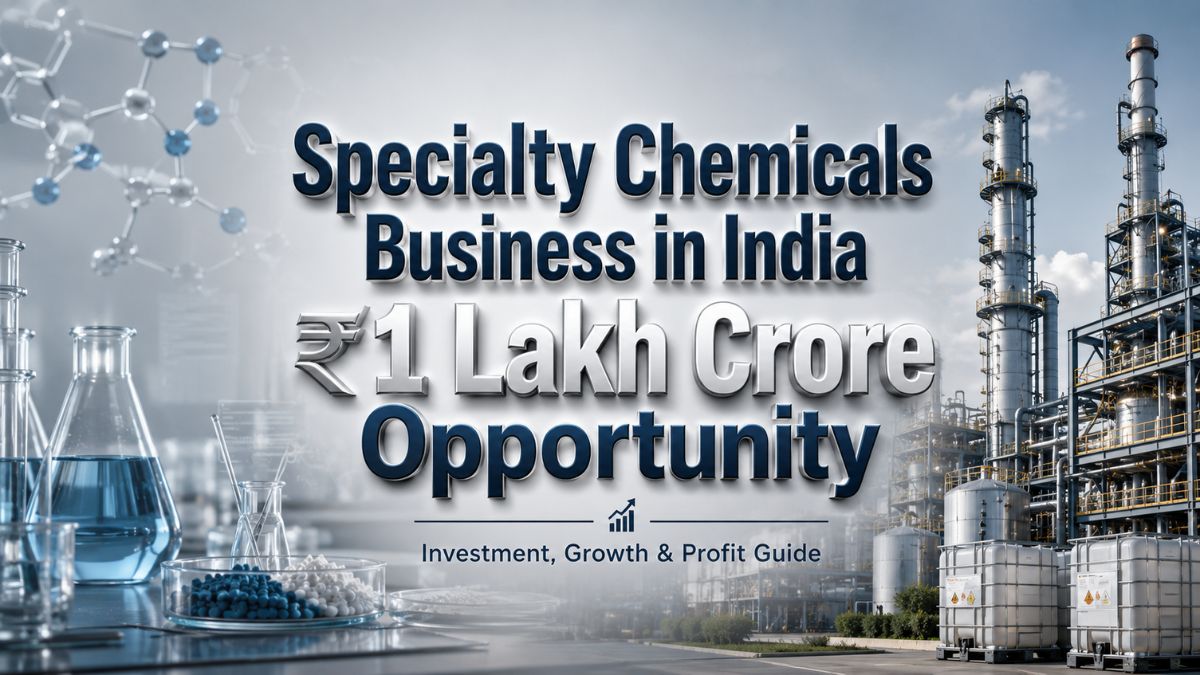
Introduction: Specialty Chemicals Business India
The chemical industry in India is huge but there is still a segment that is yet to realize its potential- specialty chemicals. They are not mass-produced commodities but high-value products intended to be used in a particular industry. Due to this, they have better pricing, customer loyalty and better margins.
Over the past few years, there is an increasing demand-domestic supply imbalance in the case of specialty chemicals in India. This is presenting a strong opportunity to entrepreneurs who are ready to explore manufacturing with a strategic and focused approach.
Table of Contents
ToggleRead the Complete Book Here: Handbook On Chemical Industries (Alcohol Based)
Why Specialty Chemicals Is a Strong Opportunity
This sector is experiencing growth due to several factors. The reliance of India on imports and particularly Chinese imports has created a gap in supply to be satisfied by the local manufacturers. Meanwhile, international businesses are in the process of diversifying their sourcing models, which provide the Indian suppliers with an opportunity to enter international markets.
The demand is also increasing due to the steady growth of industries like construction, textiles and automotive. These industries depend on specialty chemicals which translates into their growth directly driving growth.
The major growth drivers are:
- Good domestic demand by various industries.
- Global move towards India (China+1 strategy) is increasing.
- Manufacturing incentives by the government.
- Greater margins than the commodity chemicals.
Choosing the Right Segment Matters
One of the most significant choices is the right category of products. Alternatively, attempting to create numerous chemicals, concentrating on one of its segments assists in developing expertise and in sustaining quality.
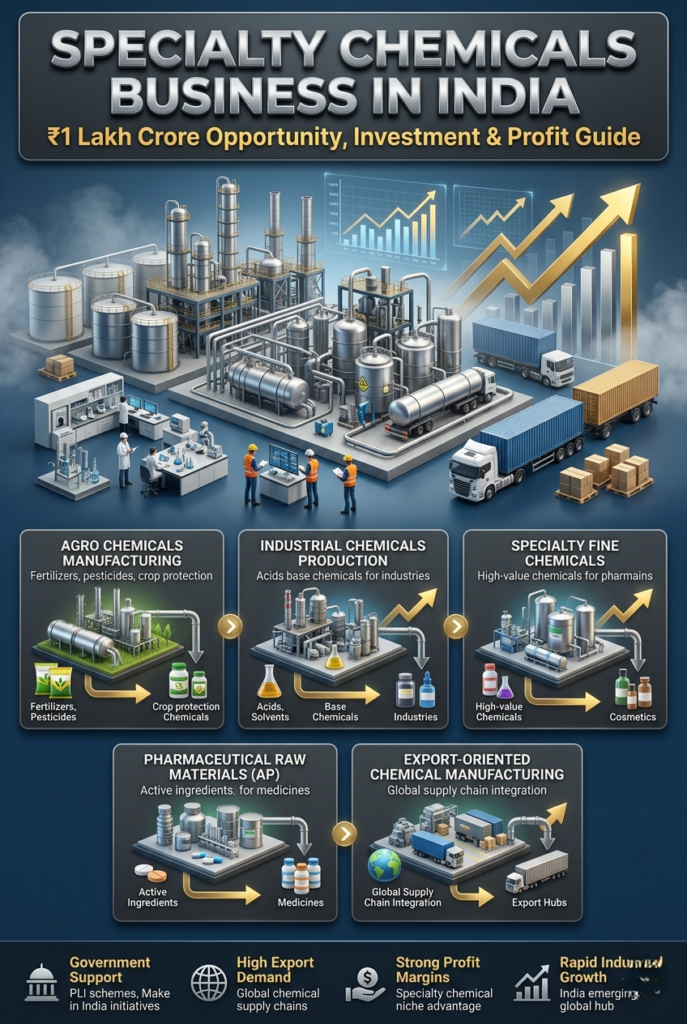
The most feasible sections that can be offered to new entrepreneurs are:
- Water treatment chemicals (coagulants, disinfectants)
- Construction chemicals (admixtures, waterproofing agents)
- Textile chemicals (auxiliaries, softeners)
- Chemicals used in cleaning industries (degreasers, surface cleaners)
- Specialty adhesives (packaging, furniture)
All these segments are characterized by constant demand and comparatively easy technical needs of newcomers.
Get Detailed Project Report (DPR): Chemicals (Organic, Inorganic, Industrial) Projects
Investment and Setup Requirements
It is not as difficult as many may think to start a specialty chemical unit. A small-scale unit can be established with moderate investment and simple infrastructure.
Typical requirements include:
- Investment range: ₹50 lakh to ₹1.5 crore (small scale)
- Space: 3,000–5,000 sq ft industrial shed
- Capacity of production: 1-5 tonnes/day.
For larger operations:
- Investment: ₹1.5 crore to ₹5 crore
- Increased production capacity and automation.
Major cost areas:
- Plant and machinery (reactors, mixers)
- utilities such as boilers and effluent treatment
- Working capital: raw material and operation.
This could significantly reduce the start-up costs by taking a factory space on rent instead of on purchase.
Step-by-Step Process to Start the Business
The establishment of a chemical manufacturing facility is a coordinated process. It starts with product identification and concludes with the establishment of a stable customer base.
The process generally has the following steps:
- Clearing the product and market demand.
- Choosing an appropriate industrial site.
- The purchase and installation of machinery.
- Organization of suppliers of raw material.
- All legal registrations and approvals.
- Hiring a basic operational team.
- Beginning production and contacting customers.
The whole procedure can typically be in the range of 10 to 15 months depending on the approvals and the pace of implementation.
Licenses and Approvals Required
Adherence is a very important aspect in the manufacturing of chemicals. Whereas certain registrations can be done swiftly, environmental approvals are to be planned thoughtfully.
Essential licenses include:
- Udyam Registration (to receive MSME benefits)
- GST Registration (in the instance of business transactions)
- Pollution Control Board (PCB) NOC.
- Factory License
- Hazardous waste certification (where necessary)
An early start on the Pollution Control Board approval is noteworthy in that it can take several months.
Financial Potential and Profitability
The specialty chemicals business is a business that has good financial returns provided it is managed well. The revenue potential is a promising one even when the capacity is half.
An average financial situation will resemble the following:
- Monthly income is increasing steadily with the rising capacity.
- Gross margins are also high in as far as it is product specialization.
- The normal range of net profit margin is 14 to 22.
Most businesses break even after four to five years with constant operations and dependable clients.
Government Support and Financing
The government has proposed a number of programs to encourage manufacturing and MSMEs. Such programs increase the ease of entering a business and lowers the financial strains.
Important schemes include:
- PMEGP (subsidy on the project cost)
- CGTMSE (collateral-free loans)
- MUDRA loans (to small business)
- The advantages of PCPIR (to units in chemical zones)
These programs are designed to enable entrepreneurs to obtain funds and decrease the risk of initial investment.
Why Proper Planning Is Crucial (Role of NPCS)
Most of the new business starters fall into this trap of rushing and starting to set up without any planning. This may cause costs to overrun, delays, and compliance in chemical manufacturing.
To prevent these hurdles, NIIR Project Consultancy Services (NPCS) is a professional service that aims to help avoid these challenges. Their services include:
- Detailed project reports (DPR).
- Techno-economic feasibility studies
- Market analysis and demand forecasting.
- Financial planning for bank loans
With the right advice from experts, it will be possible to make well-informed decisions, with higher probability of success.
Conclusion
The Indian specialty chemicals sector is growing and is a relatively straightforward opportunity to enter for an aspiring entrepreneur. High demand, favourable policies, and higher profit margins made this one of the most suitable businesses to undertake.
Key factors for success are: targeting the right segment and achieving the right quality levels, with strategic planning. The first ones to move, if they have the required expertise and execution skills, could build up a fairly stable and easily expandable business relatively fast.
Frequently Asked Questions (FAQ)
Q1. What kind of capital will be needed to initiate this business?
A small-scale unit can be initiated at 0.5 to one point five crore (50 lakh to 1.5 crore) and large-scale settings may be initiated at up to 5 crores.
Q2. Which part is most suitable to start with?
Water treatment chemicals and construction chemicals are considered excellent in these two industries, due to their consistent demand, and simpler process.
Q3. What are profit margins?
The average net profit margins are between 14-22% depending on efficiency and the type of product.
Q4. What is the time needed to commence production?
The set up typically takes 10-15 months before commencing commercial production.
Q5. Is there any government aid?
Yes, it can. There are already a lot of subsidizes and funding schemes like PMEGP and CGTMSE available for better access to capital.
Q6. What can NPCS do to assist this business?
NPCS assists in project report, feasibility study, and financial planning making it easier to initiate and grow a chemical manufacturing unit successfully.


