





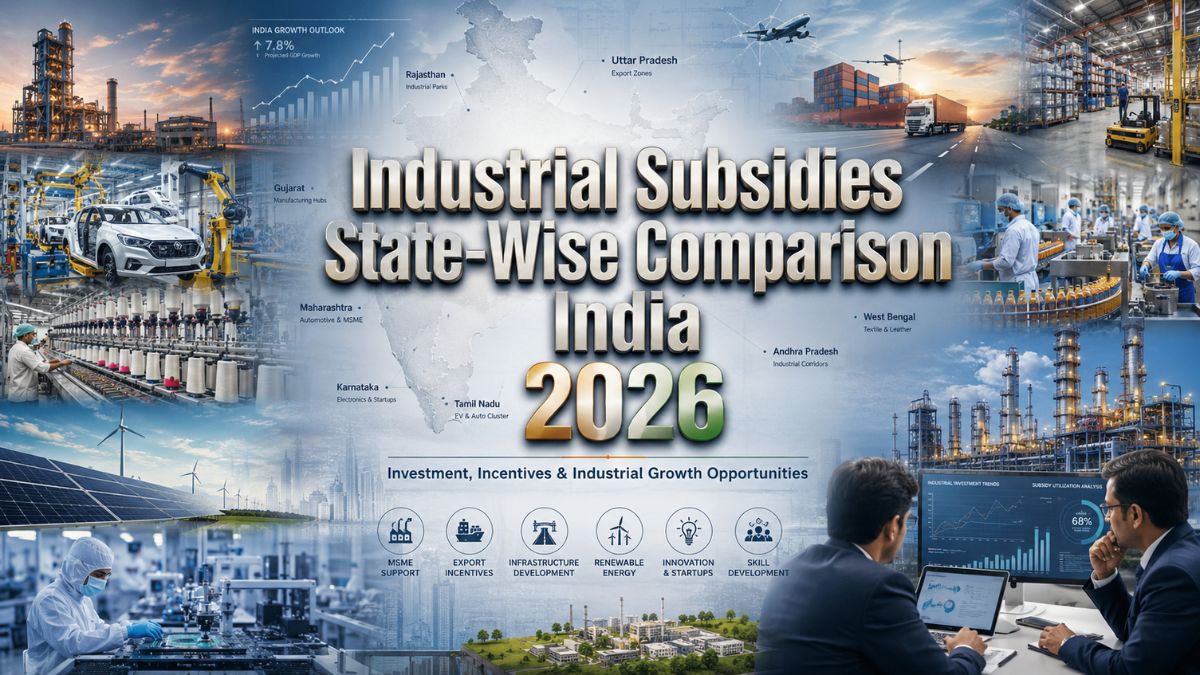
Industrial Subsidies State Wise Comparison India
As Indian manufacturing grows at an accelerated pace in 2026, industrial subsidies represent a key consideration for any aspiring entrepreneur hoping to start new manufacturing facilities. To lure industries, the state governments are competing with each other by providing capital subsidy, refund of SGST turnover, power subsidy, land subsidy, and employment incentives. These benefits help MSMEs and manufacturers to break even quicker and expand business operations with financial ease, cutting down their startup costs by 25-40%.
If you are starting a business in the chemicals, electronics, EV parts, textiles, engineering, or aerospace industry, choosing the right state can make a difference to your profitability. The difference in profitability between two companies could just be the difference in the states they’re in, due to electricity costs, tax refunds or land subsidies.
Table of Contents
ToggleWhy Industrial Subsidies Matter in 2026
Under the “Make in India” and PLI (Production Linked Incentive) policy, the government puts a lot of emphasis on local manufacturing. The country still imports billions of dollars’ worth of electronics, chemicals, and industrial products every year. The central and state governments are providing strong support to manufacturers to cut imports and boost exports.
Industrial subsidies benefit businesses by:
- Lowering upfront capital investment
- Lowering electricity and operating expenses
- Enabling cash flow improvement via SGST refunds
- Cultivating less costly industrial land
- Supporting employment generation
- Increasing export competitiveness
Combined incentives of about ₹5-8 crore can be saved for a manufacturing start-up with an investment of ₹20 crore. These savings have a positive effect on margins and the financial risk in the early years.
Gujarat – Best State for Chemicals & Export Manufacturing
Gujarat is one of the leading industrially strong states of India due to their ports, chemical industry and the investor-friendly policies. The state is well suited for export-oriented industries and large manufacturing project.
Major Benefits in Gujarat
- 20–30% subsidy on fixed investment costs
- 75% land rebate in selected industrial zones
- SGST reimbursement for up to 10 years
- Electricity subsidy of ₹2 per unit.
- 100% stamp duty exemption
Gujarat is particularly appealing for making chemicals because raw material is readily available and ports can lower the expenses of export logistics. Investors from all over India are still flowing into industrial areas such as Dholera and GIDC.
Gujarat is extremely lucrative for long-term development of industries with subsidies alone being able to save up to ₹6 crore per chemical manufacturing project worth ₹25 crore.
Get Detailed Insights from This Book: Handbook On Chemical Industries (Alcohol Based)
Tamil Nadu – India’s EV and Auto Manufacturing Hub
Tamil Nadu is the hub of automobile and electric vehicle industry in the country. The state is already home to leading auto manufacturers and nearby industrial corridors make it an extremely appealing destination for component manufacturers and EV startups.
Key Subsidies in Tamil Nadu
- 25–40% capital subsidy
- 100% SGST refund for up to 15 years
- ₹1 per unit power subsidy
- Employment-linked incentives
- Full stamp duty waiver
The state is good for:
- EV battery assembly
- Auto components
- Renewable energy equipment
- Export manufacturing
Tamil Nadu also has a good infrastructure of ports and trained technical manpower. The fact that there are existing supplier ecosystems is driving rapid growth in EV component startups.
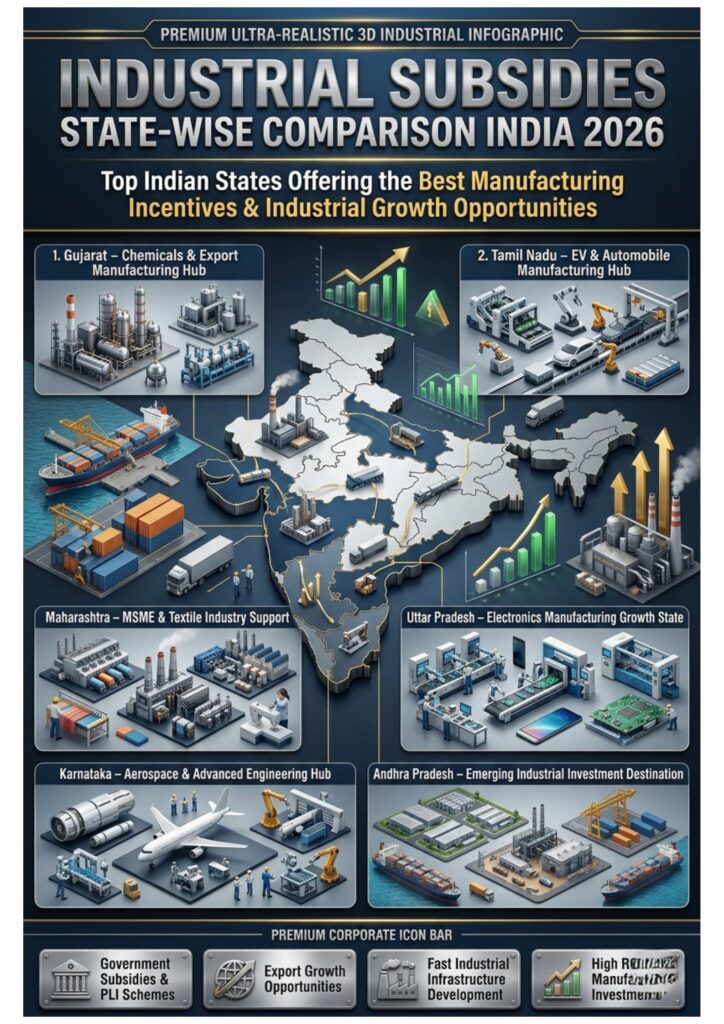
Maharashtra – Strong MSME & Textile Support
The state of Maharashtra has continued to have great infrastructure and operational subsidies for MSMEs, textile and engineering industries.
Why Maharashtra Attracts Manufacturers
- Re 1/unit electricity support in selected areas
- 50–100% SGST reimbursement
- 100% stamp duty exemption
- EPF reimbursement support
- Strong industrial clusters
The State has significant logistics and domestic market access strengths. The textile machinery industry is contributing to the growth of engineering companies and food processing industries in Maharashtra.
The cities are linked to Mumbai, Pune, Nashik and Bhiwandi, which provide good supplier linkages and export connectivity.
View Full Project Details: Complete Guide to Textile and Garment Industry
Uttar Pradesh – Fastest Growing Electronics Manufacturing State
The electronics manufacturing sector has become the centre of gravity of the Indian electronics industry, particularly in the vicinity of Noida and Greater Noida in Uttar Pradesh.
The government is proactively promoting electronics startups with tax relief and approvals.
Main Advantages of Uttar Pradesh
- 100% SGST reimbursement for eligible projects
- 100% stamp duty exemption.
- Affordable electricity support
- Fast-track approvals
- Strong mobile manufacturing ecosystem
UP has strong growth industries, such as:
- PCB manufacturing
- Mobile assembly
- LED production
- Consumer electronics
Many big smartphone companies already have their presence in Noida, so smaller companies can easily access the market and have opportunities to scale up.
Karnataka – Best for Aerospace & Advanced Engineering
Karnataka emphasizes on high-tech manufacturing and not traditional industries with low technology. Bengaluru is now India’s hub for aerospace & defence manufacturing.
Karnataka’s Key Industrial Strengths
- Capital investment subsidies
- Turnover-linked incentives
- Innovation support of R&D grants
- Aerospace ecosystem
- Defense manufacturing support
The State is suitable for:
- Aerospace components
- Robotics
- Precision engineering
- Industrial automation
Karnataka is pro-innovation and advanced engineering creates strong long-term opportunities for businesses.
Andhra Pradesh – Attractive for New Industrial Investments
Early-investor incentives and supportive export policies for manufacturers are drawing significant attention from the manufacturers from Andhra Pradesh.
Key Incentives in Andhra Pradesh
- Up to 30% capital subsidy
- SGST reimbursement
- ₹1 per unit power subsidy
- Export-linked benefits
- Industrial corridor support
The state is emerging as a preferred destination for electronics, renewable energy, food processing and export-based manufacturing.
Why Feasibility Reports Are Important Before Starting a Factory
Planning is essential in starting a manufacturing business. Entrepreneurs must analyse:
- Machinery costs
- Raw material availability
- Market demand
- Profit margins
- Electricity requirements
- Government subsidy eligibility
This is where NPCS (Niir Project Consultancy Services) becomes valuable.
About NPCS
NPCS is one of the premier industrial consultancy firms in India – which prepares:
- Detailed Project Reports (DPR)
- Techno-economic feasibility studies
- Market research reports
- Financial projections
- Manufacturing process guidance
- Subsidy evaluation reports
Thousands of entrepreneurs use NPCS report before taking loan from industries, subsidy and approval of factory. Good feasibility studies minimize risk and enhance investment choices.
Conclusion
The future of manufacturing in 2026 is a transformation brought about by industrial subsidies in India. The states are giving lavish financial incentives in the hope of bringing factories to them and jobs. By examining the policies in various states, entrepreneurs can make informed decisions to save money and boost profitability during the startup phase. With detailed study of state policies, the businessmen will be able to make better decision and can lower the initial cost as well as maximize the profit.
The state of Gujarat excels in chemical industry / export manufacturing and Tamil Nadu are an auto and EV manufacturing dominant. Uttar Pradesh is gaining prominence as the electronics manufacturing destination and Maharashtra supports the MSME and textile sector. The long-term opportunities in Karnataka seem to be in the aerospace and advance engineering segments.
Entrepreneurs need to conduct in-depth research and analysis of subsidies, infrastructure, market demand, and feasibility reports, as well as getting guidance from experts such as NPCS, before investing in any manufacturing project.
FAQs
India’s most industrialized state is:
Currently, some of the best industrial subsidy packages are in place in Tamil Nadu and Maharashtra.
Which state would you like to build a electronics factory in it?
The Noida ecosystem makes Uttar Pradesh the fastest growing electronics manufacturing hub in India.
Is it possible to implement both state subsidy and PLI scheme for MSMEs?
Yes, there are many start-ups which avail both the state industrial subsidy and central government PLI scheme to achieve higher profitability.
Why is the refund of SGST important?
The refund of the SGST helps in boosting cash flow and also helps in lowering the operating cost during the first few years of manufacturing companies.
What are the services NPCS offers?
Entrepreneurs and industrial investors can make use of project reports and feasibility studies, financial projections and manufacturing guidance prepared by NPCS.


