





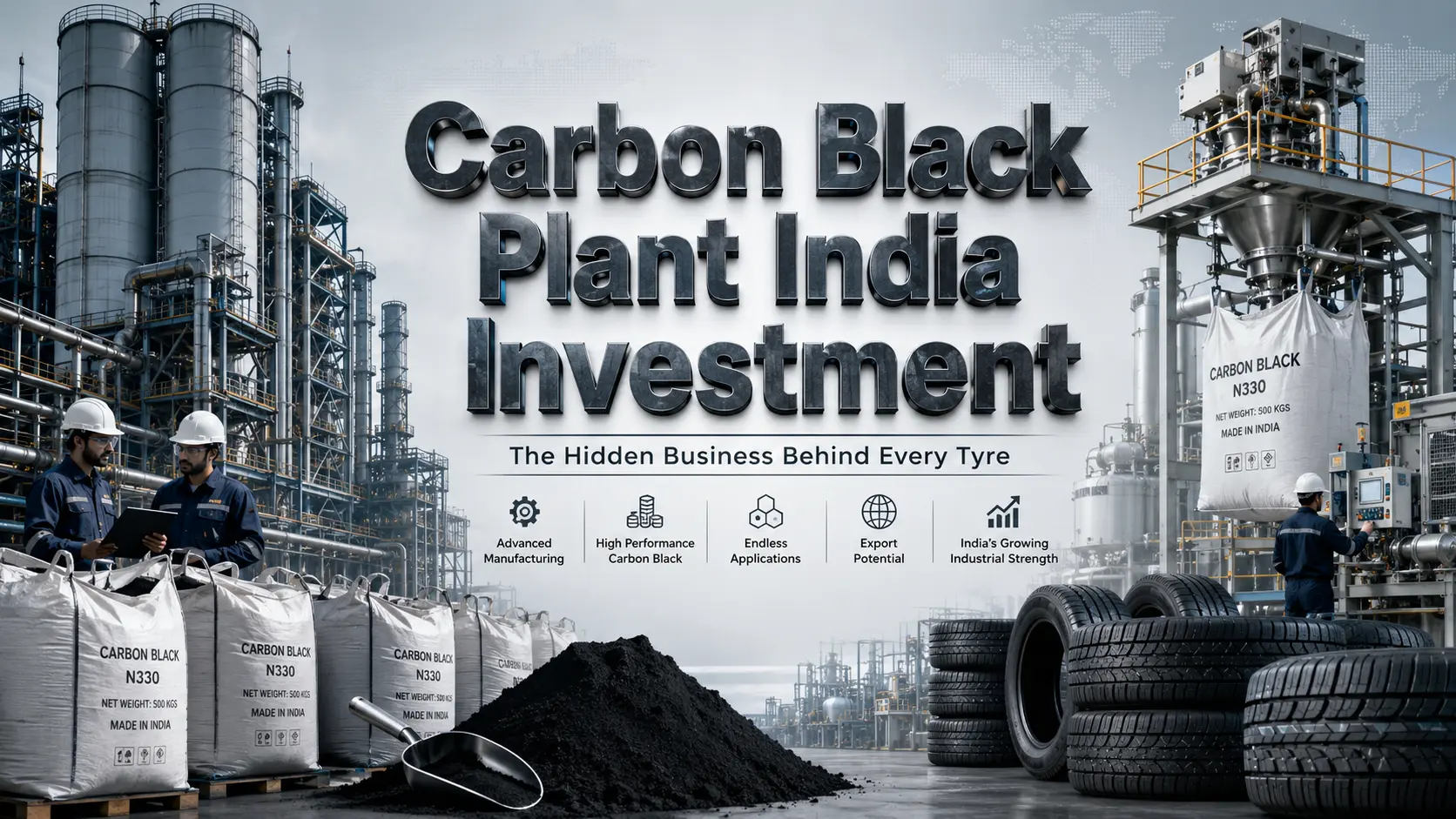
Carbon Black Plant Investment in India
High-Sulphur crude is responsible for the huge amount of petroleum coke, also known as petcoke, generated in India’s refining industry. The country currently produces 258.12 MMTPA of petcoke with 22 operating refineries, which are either used as fuel or exported at low realizations. In the meantime, India is importing substantial amounts of carbon black, the carbon material that the tyre, rubber, plastics and paint industries truly require. This imbalance between what is stored in the refinery yards and what the manufacturers are willing to pay in hard currency is what the sharp industrial entrepreneurs would want to step in. It is not a wild guess as far as an investment in a carbon black plant in India is concerned. It’s a supply chain fix in the making.
Get Detailed Insights from This Book: The Complete Book on Rubber Processing and Compounding Technology (4th Revised Edition)
Why This Sector Is a Strong Startup Opportunity
The Raw Material Is Abundant and Domestic
Petcoke isn’t a material that you must scrounge for. Produced as a by-product at almost all Indian refinery. Based on the data from the Annual Report 2024-25 of Ministry of Petroleum and Natural Gas, Government of India, India’s refinery capacity utilization in FY 2024-25 was at 104.24%, indicating that the refineries are running hard and producing more petcoke in the process. Expansion plans under PSUs for significant further additions are expected to be realized by 2028-29 and feedstock availability will only continue to grow.
The appeal of using petcoke as a manufacturing feedstock is the high carbon content, which is typically 90-95% dry, ash-free. Currently the dominant furnace black process around the world is to combust feedstock oils derived from petcoke under controlled conditions and produce carbon black of the correct size for specific applications.
Demand Is Real and Growing
The tyre sector in India is another substantial sector in Asia with carbon black constituting about 25–28% of the tyre’s weight. Apollo Tyres, CEAT, MRF and JK Tyre are some of the major suppliers of hundreds of thousands of tonnes of tyres every year. More significant demand pockets are in the rubber goods industry, such as conveyor belts, hoses, and moulded automotive components. Inks and coatings use a more expensive, yet still low-quality grade that is not well-supplied by domestic suppliers.
Indian demand for total carbon black is in the range of 900,000 to 1,000,000 tons/year. A part of this is produced domestically by Phillips Carbon Black (PCBL) and Himadri Specialty Chemical. Specialty grades, such as high-structure blacks for UV-resistant plastics and conductive compounds continue to be imported.
Import Substitution Is a Policy Priority
The government has directed industrial policy in favors of domestic production which can replace imports, as seen in the PLI scheme announcements, and the production-linked incentive framework in specialty chemicals. At the crossroads of petrochemicals and advanced materials, carbon black is eligible for a number of MSME cluster development schemes and the investment facilitation schemes of the Ministry of Chemicals and Fertilizers. The influences of state-level incentives adds to the location calculus in Gujarat, Rajasthan and Odisha, all states that have proximity to refineries.
Entry barriers are not high. The capital outlay for the civil, mechanical and utility infrastructure for a minimum economic scale plant of 20,000-25,000 tonnes of standard furnace grade carbon black would be Rs 80-120 crore, while pollution control would require Rs 15-25 crore. This is mid-sized MSME land — affordable, controllable and bankable when a solid techno-economic report is ready. The other challenge is licensing; environmental clearance from MoEF&CC as well as State Pollution Control Board consent takes 12 – 18 months to get, unless it is factored in from the ground up.
Get Detailed Project Report (DPR): Rubber and Rubber Products Industry Guide
Business Selection Logic: Grades, Margins, and the Scalability Path
There is no standard to distinguish all carbon black, and the margin structure is very different depending on the grade. The furnace blacks used in tyres, N330 and N550, are the workhorses of the tyre compounding industry which are traded at relatively thin margins as a result of the scale advantages of PCBL and Himadri. Wherever smaller players can level the playing field:
- Specialty grades: N110, N115 used in high-performance tyres carry 15–20% premium over commodity grades.
- Plastics and masterbatch blacks: High-jetness grades command Rs 80,000–1,20,000 per tonne versus Rs 55,000–75,000 for commodity tyre black.
- Conductive carbon black: Antistatic applications, batteries, cable sheathing — Rs 1.5–2.5 lakh per tonne, with import substitution logic strongest here.
The scalable roadmap: level off the buyer relationship by beginning with the commodity adjacent grades at 20,000 to 25,000 TPA, and then scale to a second reactor optimized for specialty grades in 5–6 years. Premiumization of phase two financed by cash flow from phase one.
Risk factors to model: a volatile price for petcoke influenced by global refinery rates; rigorous pollution compliance cost by the CPCB; concentration of customers – the top five tyre manufacturers have more than 60% of the domestic carbon black market.
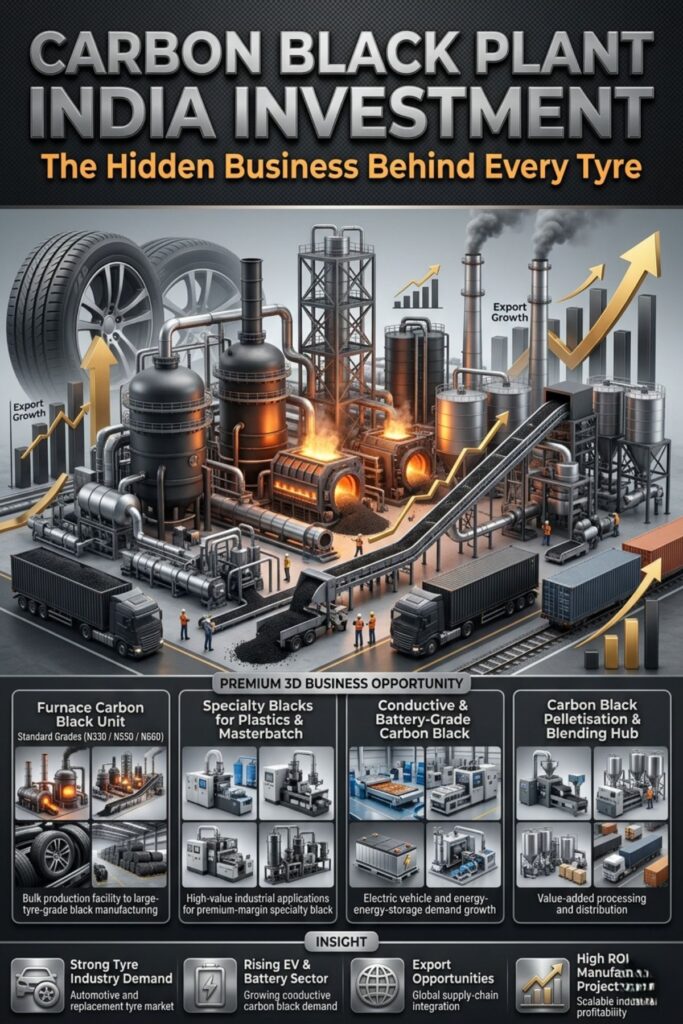
Project Opportunities: Four Concrete Directions
1. Furnace Carbon Black Unit — Standard Grades (N330/N550/N660)
The 20,000 TPA plant with N330 grade is used for bulk tyre compounding. Target customers: mid-size retreading companies, automotive rubber goods producer and conveyor belt manufacturer in the Rajkot-Moravi belt of Gujarat. Estimate capex: Rs 90-110 crore (plus utilities/ effluent treatment). It expects that operating margins will be in the range of 14–18% EBITDA at steady state, with a petcoke procurement cost of Rs 8,000–12,000 per tonne and carbon black realization cost at Rs 65,000–75,000 per tonne. Break-even at 60–65% utilization. It’s a cashflow business but not a small-scale margin expansion play.
2. Specialty Blacks for Plastics and Masterbatch
High-jetness carbon blacks for plastics compounding and masterbatch (5,000 – 8,000 TPA). Target buyers: colour masterbatch manufacturers from Ahmedabad, Pune and Daman and the polymer compounders who are providing OEMs in consumer products. Opex: Rs 73–132 crore (slightly more instrumentation expense on lower reactor scale). The margin in this segment is 22–28% EBITDA due to a high level of import dependency from South Korea and Germany. Feedstock specification is more stringent but once it is proven it is stickier.
Identify high-growth industries before others do
3. Conductive and Battery-Grade Carbon Black
The most technically challenging, and highest-margin play in the sector. Conductive carbon black is a key missing ingredient in India’s lithium-ion battery manufacturing value chain, one that no domestic manufacturer has been able to produce in bulk, or at the required specifications. A 3,000–5,000 TPA unit needs Rs 60–80 crore capex with R&D budget built in. Margins are in the 30-35% EBITDA range for validated battery grade products with an actual export potential to the SE Asian market. For buyers to trust the company, having technology licensing from European or Japanese developers is a must.
4. Carbon Black Pelletisation and Blending Hub
A relatively lower capex entry point: Buy the standard carbon black powder, mix with binders and pelletise for certain tyre/ rubber applications. Pelletised carbon black has a better handling property in factory, reduces dust pollution and enhances mixing efficiency. The cost of setting up a pelletisation plant of 10,000 – 15,000 TPA is Rs 12 – 20 crores. Thinner margins (8-12% EBITDA) but capital recovery is quick, and buyer relationships are established rapidly. This can be a way to enter the market prior to the entrepreneur’s investment in the full production.
Indian Entrepreneur Benchmarks: Who Has Done It and What They Proved
Himadri Speciality Chemical (Kolkata): From Coal Tar Pitch business in the 1980s, it has grown into the largest specialty carbon company in India. Bajoria made a switch from distribution to manufacturing after he realised that imports of carbon materials were causing structural dependency for Indian rubber goods manufacturers. The takeaway: The window of petcoke availability has improved near the refineries, compared to when Himadri began. Today the entry case is much cleaner with improved infrastructure, cleaner feedstock logistics and better anchor buyer options.
Kaushik Roy, Phillips Carbon Black Limited (RP-Sanjiv Goenka Group, Kolkata): PCBL has expanded its business by adhering to the refinery feedstock belts, such as Durgapur, Palej (Gujarat) and Kochi near BPCL refinery. In the case of carbon black, location is not just a cost element; it’s a competitive moat, proved by Roy’s team. Locate close to the main refinery to reduce the cost of logistics for feedstock and to ensure a supply of a consistent quality of petcoke. The principles of that calculus remain the same.
Maulik Patel, Aarti Industries (Vapi, Gujarat): The example of backward integration by Aarti in speciality chemicals is relevant. The idea of validating on a small pilot, then gaining two or three anchor customers before scaling is directly applicable to anybody who is entering specialty carbon black grades. The lesson to take is that the discipline of capital is more important than the scale commitment.
Related Article: How to Start a Tyre Carbon Black Powder Manufacturing Business in India (Complete Guide for MSME Entrepreneurs)
Import–Export Opportunity Analysis
India is a large importer of specialty grade carbon blacks, such as plastics, inks and conductive types from European and Korean suppliers. When import duty, freight and long cycle working capital are added in the landed cost of specialty blacks is usually 20-30% higher than for a domestic producer of an equivalent quality product.
On the export side, Indian furnace blacks are being successful, in markets such as Bangladesh, Sri Lanka, Vietnam and the East Africa which provide Indian with a competitive cost position and closer proximity than the European or USA supply. A carbon black plant India investment with a strategy of import substitution and regional export creates a strong revenue base as compared to a purely domestic play.
Feasibility Preparation: What Founders Must Get Right
Any serious promoter should get a detailed techno-economic study, before putting in any capital, on the various processes used for production (furnace black, thermal black, channel black), specification of feedstocks and availability of feedstocks, product quality validation of the product with the buyer specification, environment clearance requirements as per the Environment Protection act, and complete project financials and sensitivity analysis for different petcoke and carbon black prices.
The Niir Project Consultancy Services (NPCS) has prepared techno-economic feasibility reports and detailed project reports for manufacturing investors in various industries and is well equipped to do exactly this work in a way that is understanded by financial institutions and industrial park authorities. Such a capital intensive, compliance-driven industry as carbon black cannot afford to miss out on this step.
Conclusion: The Window Is Open, But Not Indefinitely
The refining capacity will continue to grow in India. The amount of petcoke will continue to increase. Tyres, rubber products, plastics, batteries, all of the industries that use carbon black, are on structural growth curves, with no exception. The government has made a definite policy move to promote value addition of petrochemical products within the country instead of merely exporting raw feed stocks at commodity prices. All this makes a strong case for carbon black plant investment in India, especially for the entrepreneurial players who can enter within the next 18-24 months before the big industrial players get a hold of it.
It’s in the specialty grades where the real return on capital resides. Commodity black – for that, you need a scale that can only be efficiently applied by established players. The intelligent entry is a focused specialty plant (5,000 to 8,000 TPA of high value grades) that has anchor buyer agreements before breaking ground. Several inputs are critical to the profitability of this business and these include site selection near a refinery, careful feasibility preparation, and disciplined product focus.
The feasibility work deserves serious resources to be put into it. When the entrepreneur has to do a stress test on every assumption, whether it be the cost of feedstock, realisation of the product, compliance with regulations (time) or working capital cycle, then the entrepreneur is forced to prepare the techno-economic report. This is how promoters find out that the margin model they constructed is based on too-good-to-be-true inputs instead of proven market data.
This isn’t a business where improvisation is the key to success. The entrepreneurs who get the basics right before they start production volumes will find a market for what they produce — and the supply of petcoke will only increase with the addition of more refinery capacities in India.
Data Table: Carbon Black Grade Comparison for Startup Decision-Making
| Grade | Primary End Use | Supply Status | Realisation (Rs/tonne) | EBITDA Margin | Scale (TPA) |
| N330 / N550 (Furnace) | Tyre compounding | Adequate (PCBL, Himadri) | 65,000–75,000 | 14–18% | 20,000+ |
| N110 / N115 (Furnace) | High-performance tyres | Partially imported | 80,000–95,000 | 18–22% | 10,000+ |
| High-Jetness Blacks | Plastics, masterbatch | Heavily imported | 90,000–1,20,000 | 22–28% | 5,000–8,000 |
| Conductive Carbon Black | Batteries, cable sheathing | Almost entirely imported | 1,50,000–2,50,000 | 28–35% | 3,000–5,000 |
| Pelletised Commodity Black | Rubber goods blending | Limited domestic supply | 70,000–82,000 | 8–12% | 10,000–15,000 |
FAQ
Q1. What is the minimum capital requirement to set up a carbon black plant in India?
A bare-minimum viable unit producing 15,000-20,000 TPA of standard furnace black would need around Rs 80-100 cr all-in including plant, utilities, pollution control, working capital margin etc. Specialty grade plants can be much smaller- Rs 35-60 cr for 5,000-8,000 TPA-but would need higher technical investment for process control.
Q2. When would a carbon black manufacturing investment break even?
A commodity-grade plant running at 65-70% utilization can break even on a cash cost basis within 5-6 years. Premium realizations at specialty grade plants could enable cash break-even in 4-5 years if anchor buyer contracts are already established pre-commissioning.
Q3. What is the licensing and clearance process?
An environmental clearance from MoEF&CC is a mandatory requirement, as carbon black production involves particulate emission. Other permits are State Pollution Control Board’s consent to establish and operate, factory license and fire NOC. In case of site located near refinery, it could also be a PESO clearance for handling the feedstock.
Q4. Is petcoke availability reliable for a small player?
PSU refineries of India- IOCL, BPCL, HPCL-provide petcoke to the market through open tendering and auctions. A 20,000 TPA carbon black plant would require roughly 25,000-30,000 tonnes of feedstock per annum, easily within the supply capacity of a single refinery. Once the plant is commissioned and creditworthy, long-term supply arrangements can be entered into.
Q5. Can Indian-manufactured carbon black be competitive with imports in terms of quality?
In case of standard furnace grades, Indian manufacturers are already producing to international specifications. In case of specialty grades, the technical gap can be covered (as demonstrated by PCBL and Himadri) but it requires adequate investment in quality control infrastructure and process consistency. Typical conversion cycle would be 3-6 months of trial supply.


