





Biomass Gasification Business in India
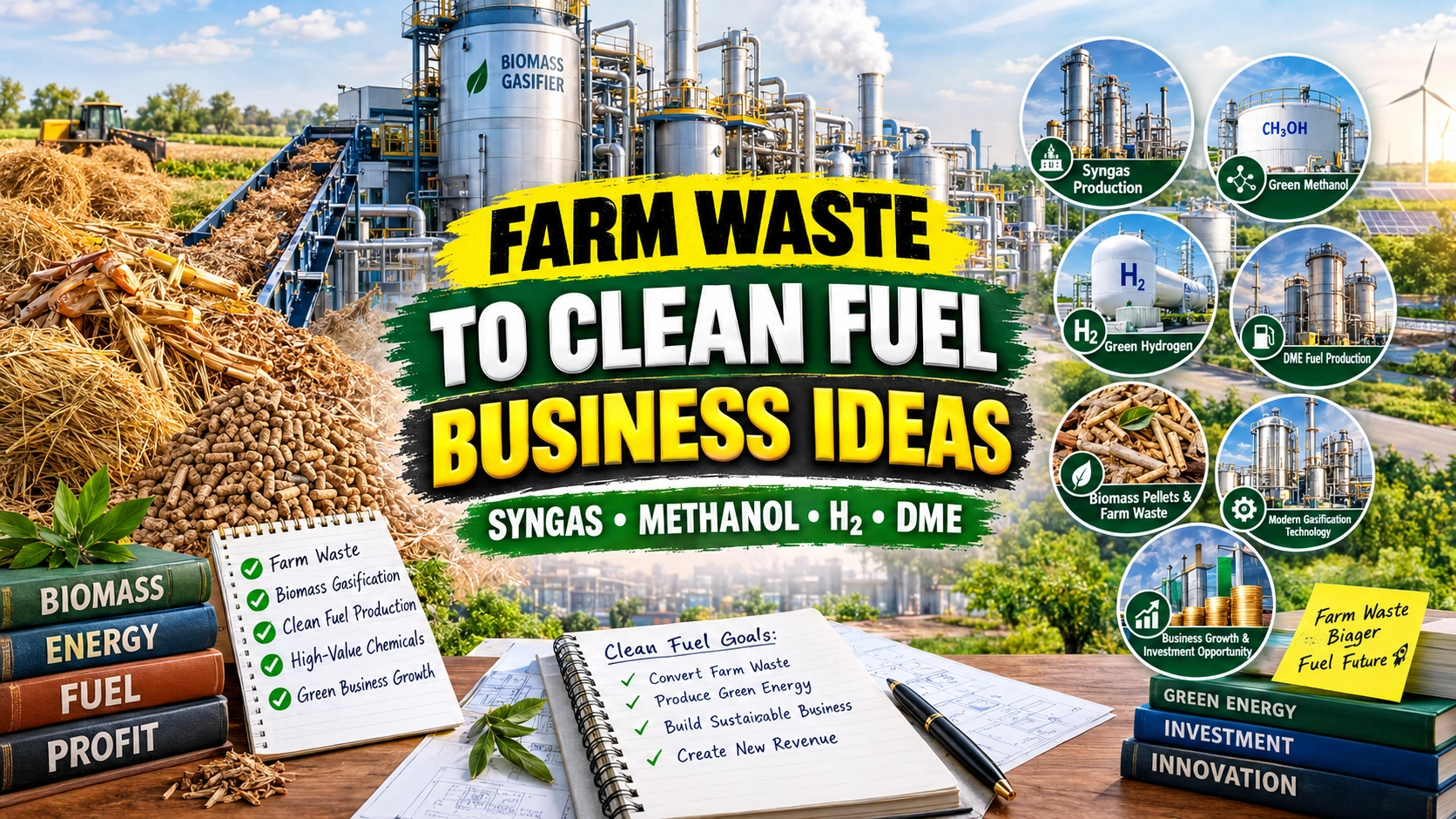
The biomass to fuel conversion is one of the few business ideas that promise both commercial returns and impact on the environment. More than 500 million tonnes of biomass residue (agricultural waste, wood chips, sugarcane bagasse, and municipal solid organics) are produced each year in India. However, a large proportion of this feedstock is wasted by being burnt in the open or discarded. This is rapidly changing. The conversion of biomass to syngas, methanol, hydrogen and dimethyl ether (DME) is one of the most promising business opportunities for new-age entrepreneurs, MSMEs, and green-energy startups. This sector is especially interesting at the moment given the government policy, demand from importing economies, and global decarbonisation pressure.
Why This Sector Is Gaining Strong Momentum
Methanol and LPG imports are significant in India, which can be replaced by DME and biomass-methanol in part. The Ministry of Petroleum and Natural Gas has already started a programme called ‘Methanol Economy’ which involves blending methanol with petrol and using it as an alternative cooking fuel. At the same time, the National Hydrogen Mission, under the Ministry of New and Renewable Energy (MNRE), aims to achieve a consistent production of 5 MT per year of green and clean hydrogen. One of the proven ways to achieve this target at the distributed scale is biomass gasification.
Moreover, syngas, which is a combination of CO and H2, can be used as a raw material in the production of many industrial chemicals, fertilizers and synthetic fuels. This flexibility on the supply chain allows a single biomass gasification plant to serve several downstream business lines. It’s the sort of leverage a seasoned consultant looking for an MSME project is searching for.
The NITI Aayog has also stressed decentralised energy systems as a rural development measure, which provides an opportunity to small and medium enterprises to establish small modular Gasification units in close proximity to biomass rich agricultural clusters.
Explore This Book: The Complete Book on Biomass Based Products (Biochemicals, Biofuels, Activated Carbon) Out of Stock
Government Policies and Incentives Supporting New Businesses
Today, the policy environment for biomass to fuel businesses is stronger than ever in the Indian energy history. Capital subsidy and viability gap funding are allocated for second generation of biofuel plant projects through the advanced Ultra Super Critical Technologies in the framework of National Mission on Advanced Ultra Super Critical Technologies (NM-AUSCT) and Pradhan Mantri JI-VAN Yojana (PM-JI-VAN Yojana).
The MSME schemes under the Ministry of MSME provide Credit Guarantee Fund Trust for Micro and Small Enterprises (CGTMSE) collateral based loans up to ₹2 crore for new units in this segment. The Production Linked Incentive (PLI) scheme by the Department for Promotion of Industry and Internal Trade (DPIIT), which is more geared towards advanced chemistry cell manufacturing, is opening a wide avenue for investment for clean energy startups.
Further, India has a concessional debt financing facility available with the Indian Renewable Energy Development Agency (IREDA) for biomass energy projects with low interest rates. The state-level bioenergy policies provide an additional subsidy in the form of capital grants, which vary among different states from 15% to 30% of project costs, for entrepreneurs in states such as Punjab, Haryana, Uttar Pradesh, and Maharashtra. For instance, Punjab Energy Development Agency has actively supported biomass based distributed power and fuel projects by creating dedicated incentive windows.
Profitable Manufacturing Business Ideas for Startups in This Sector
1. Biomass Gasification Unit for Industrial Syngas Supply
One of the less investment intensive ways to enter this market is a biomass gasification plant that converts agricultural residues – paddy straw, corn cobs or wood chips – into syngas. Syngas can be utilized as a raw material by glass manufacturing units, ceramic manufacturing units, industrial boilers as substitute of furnace oil or natural gas directly as raw material. The module plant capacity of 500 – 1000 Nm³/hr allows an entrepreneur to choose specific areas of the country for the regional industrial clusters and enter into long-term fuel supply contracts.
The Bureau of Energy Efficiency (BEE) has been actively encouraging industries to move from fossil fuels to biomass-based ones and as a result of this, offtake agreements are fairly easy to negotiate. The investment requirement is normally in the range of ₹1.5 to ₹3 crore for a pilot scale unit and payback time is around 4 to 6 years based on the availability of feedstock and pricing of the gas offtake.
Access Complete Business Plan: Biomass Gasification Power Plant – Detailed Project Report
2. Green Methanol Production from Biomass
In India, thermochemical conversion of biomass is becoming a commercially viable way to produce methanol. Biomass gasification syngas is used as a feedstock and is reformed to methanol through catalytic synthesis. The green methanol can be sold to the chemical industry, the pharmaceutical blending units and fuel distributors who are interested in meeting the blend requirement regulations. This market is gaining a lot of institutional attention under the Methanol Economy programme by NITI Aayog and the Methanol Institute.
A medium sized plant (5 to 10 tonnes per day) is a realistic option for a new company. The capital outlay for such a unit would be around ₹4-7 crore but the revenues would be in excess of ₹10 crore per year after the system of acquiring feedstock is stabilised and the off-take channels are set.
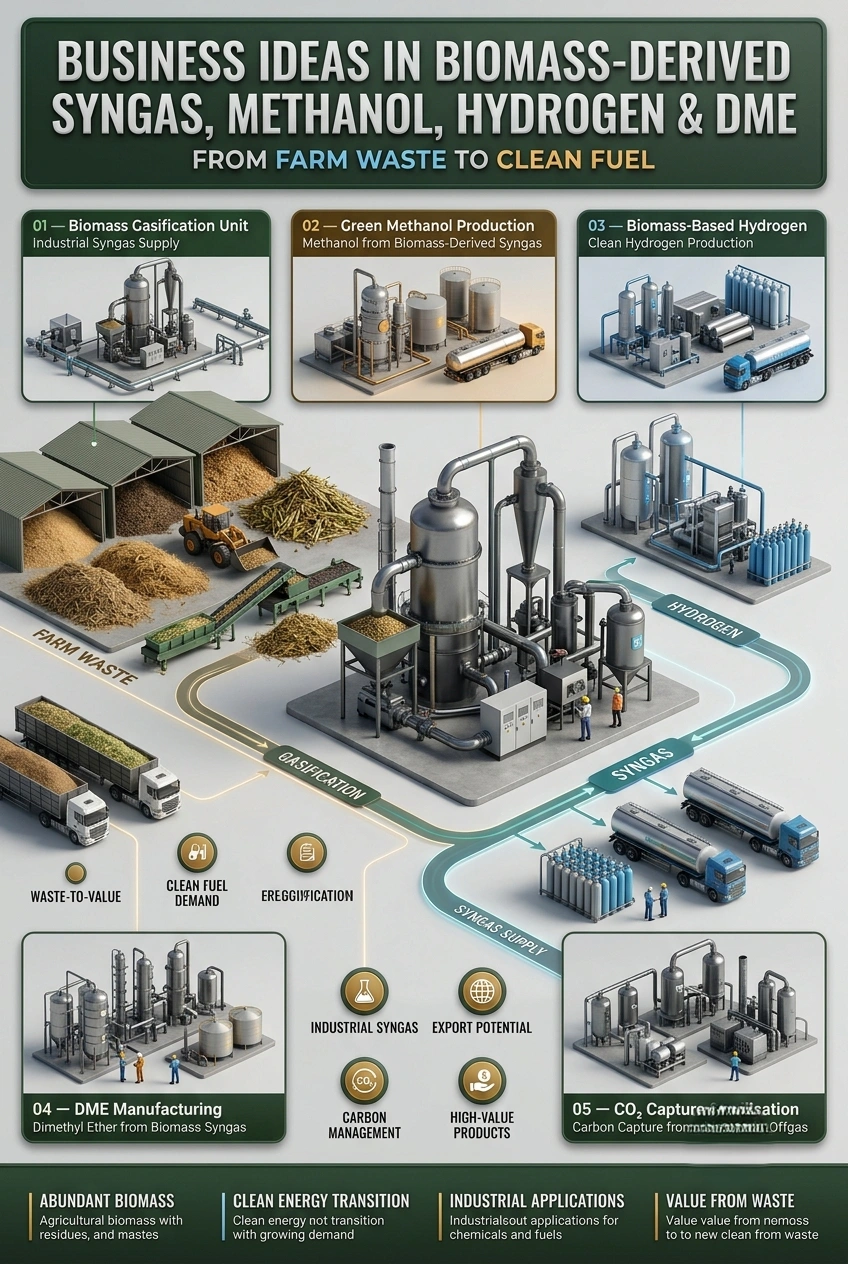
3. Biomass-Based Hydrogen Production Facility
Biofuels-derived hydrogen, which can be produced from biomass gasification – this is called turquoise or brown-green hydrogen – is becoming a sought-after buyer in the refinery industry, ammonia synthesis plants and fuel cell development companies. Businessmen who can co-locate their operation near the biomass aggregation points such as sugarcane mills, rice mills or wood processing units are best suited to this business idea as the logistics of transporting feedstocks is minimized. Small scale hydrogen purification/compression unit on top of the gasification system can generate certified hydrogen with a purity of 99.9 percent. Sugarcane entrepreneurs of Uttar Pradesh and Maharashtra with huge infrastructure should be more focused on this model.
4. DME (Dimethyl Ether) Manufacturing from Biomass Syngas
DME is a clean burning fuel, which can be used in domestic and industrial applications as a substitute for LPG, and has an emission profile close to zero particulates. It is produced from syngas via methanol dehydration. The blending of DME with LPG has already started in several Asian countries and India is closely monitoring this. The Confederation of Indian Industry (CII) considers that adoption of DME in India will have a significant impact on LPG imports in the coming couple of years. A biomass-to-DME unit can be a commercially viable and socially beneficial solution that can be marketed to the rural cooking fuel market or to the industrial heating market, thereby targeting private capital and government grant support.
5. Carbon Dioxide Capture and Utilisation from Gasification Offgas
All gasification plants have CO₂ rich off gas streams. The CO₂ can be captured and used by entrepreneurs for carbonation of beverages, greenhouse agriculture or by chemical producers. This secondary revenue stream does not require much additional capital investment over a gas separation membrane or the pressure swing adsorption system besides the primary gasification business, but it makes a real contribution to the primary gasification business economics. Early-stage industrial businesses regularly depend on ancillary revenue streams to turn a profitable profit or not.
Import–Export Opportunity Analysis
India is at present importing large quantities of methanol from Iran, Saudi Arabia and China. A tonne of domestic production of biomass methanol replaces this import cost. According to figures from the Directorate General of Foreign Trade (DGFT), the imports of methanol account for an outgo of many thousands of crores of rupees per year. This reliance can be increasingly eroded by the production of competitive cost structures of biomethanol.
The green hydrogen and biomass methanol certified with international sustainability standards (e.g. International Sustainability and Carbon Certification – ISCC) are premium priced in European and Japanese markets. The markets are premium markets and the price of green hydrogen is much higher than its conventional counterparts; exporters can therefore benefit from establishing the right quality certifications and traceability systems to enable access to these markets. This translates to a long-term export strategy for resourceful start-ups that establish the right institutional architecture from the start.
The Federation of Indian Export Organisations (FIEO) offers advisory services to exporters on niche, industrial chemical markets like green fuels. It is important that entrepreneurs take the initiative to reach out to the different sector desks of FIEO to determine the appropriate channels for buyers and certifications for export markets.
Indian MSME Success Stories in Clean Fuel Manufacturing
Husk Power Systems – From Paddy Husks to Distributed Energy
Husk Power Systems was established by Manoj Sinha and Gyanesh Pandey and their initial concept was to develop biomass gasification plants using rice husks in Bihar. The company has proven that small gasification plants can be economically operated in rural areas without the need for electric power distribution networks. What they have learned and the core operating principle of any new player in the field is co-locating plants close to co-location of feedstocks to reduce logistics cost. Husk Power is now expanding from one geography to another and has been able to attract international institutional investment, proving the sustainability of the business model of biomass powered energy projects.
Related Article: Profitable Biomass Pellet Business: Non-Torrefied & Torrefied Pellets
Bharat Renewable Energy – Scaling Green Methanol in Maharashtra
Bharat Renewable Energy (BRE), based in Maharashtra, is one of the pioneers in biomass-to-methanol conversion using sugarcane farming residue. The promoters used the bioenergy subsidy programme of the Maharashtra State and the facility was financed by IREDA to set up a semi-commercial plant of methanol. Their experience illustrates that, with the right incentives at the right level, state subsidies can lower the cost of a project by more than 35 percent, a message that is particularly important for first-generation entrepreneurs considering the feasibility of a project.
Chhattisgarh-Based MSME Gasification Clusters
A group of small MSMEs has emerged in Chhattisgarh based on rice husk gasification for providing thermal energy to rice mills, food processing industries at a competitive cost as compared to diesel. The clusters have been facilitated by the Chhattisgarh State Renewable Energy Development Agency in the form of capital subsidy and feedstock aggregation. While the individual units are small (usually less than ₹2 crore investment), the total capacity and the business model that it has brought along provide a solid template for biomass-rich states’ entrepreneurs.
Find the most profitable startup for your investment range
Expert Feasibility Support: How NPCS Helps Entrepreneurs
Many factors must be considered when assessing the technical and financial feasibility of a biomass gasification and/or a biomass-to-methanol synthesis project. Niir Project Consultancy Services (NPCS) prepares Market Survey cum Detailed Techno-Economic Feasibility Reports (DPRs) for Projects in Clean Energy, Chemical manufacturing and Advanced fuels industry specifically.
We provide full manufacturing processes and process flow diagrams, detailed raw material and machinery specifications, site and infrastructure requirement, market research and demand analysis, product mix and capacity planning, and complete financial projections such as profitability and payback analysis. Our goal is simple: to guide entrepreneurs to evaluate feasibility, compare investment results, and present themselves to lenders and investors with a professionally prepared project paper before investing their money.
Indicative Market and Project Data: Biomass-to-Clean Fuels Sector
| Product | Typical Plant Scale | Est. Capital Cost (₹ Cr) | Est. Annual Revenue (₹ Cr) | Key Feedstock |
| Syngas (Industrial Supply) | 500–1,000 Nm³/hr | 1.5–3.0 | 3–6 | Agri Residue / Wood Chips |
| Green Methanol | 5–10 TPD | 4–7 | 8–12 | Biomass Syngas |
| Biomass Hydrogen | 200–500 kg/day | 5–10 | 7–15 | Syngas (Biomass-derived) |
| DME (Dimethyl Ether) | 3–8 TPD | 3–6 | 6–10 | Methanol / Syngas |
| CO₂ (Offgas Capture) | Co-located unit | 0.5–1.5 | 1–3 | Gasification Offgas |
Conclusion: A Sector Worth Serious Entrepreneurial Attention
Syngas, methanol, hydrogen and DME production from biomass are among those very few business opportunities where market fundamentals, government policy and environmental considerations converge. The structural demand is positively inclined for entrepreneurs who are moving fast and with a sense of caution in India due to the sufficient availability of agricultural biomass, the government’s fuel import substitution policy, and the global momentum towards green hydrogen and clean fuels.
For first-generation founders and MSME investors, the path forward requires a clear understanding of technology options, a realistic assessment of feedstock supply chains, and a bankable project document. Engaging with institutions like the National Institute of Bioenergy (NIBE) and the The Energy and Resources Institute (TERI) can provide valuable technical grounding. Additionally, checking state-level incentives through resources like the Haryana Renewable Energy Development Agency (HAREDA) adds state-specific depth to your business planning.
This is no place for passive players that want to get rich quick. However, if entrepreneurs are ready to invest in the right feasibility studies, establish strong feedstock connections and deal with regulatory requirements with the help of informed professionals, the biomass-to-clean-fuel industry promises returns, scale-wise and time-timetable that surpasses many other MSME manufacturing industries.


