





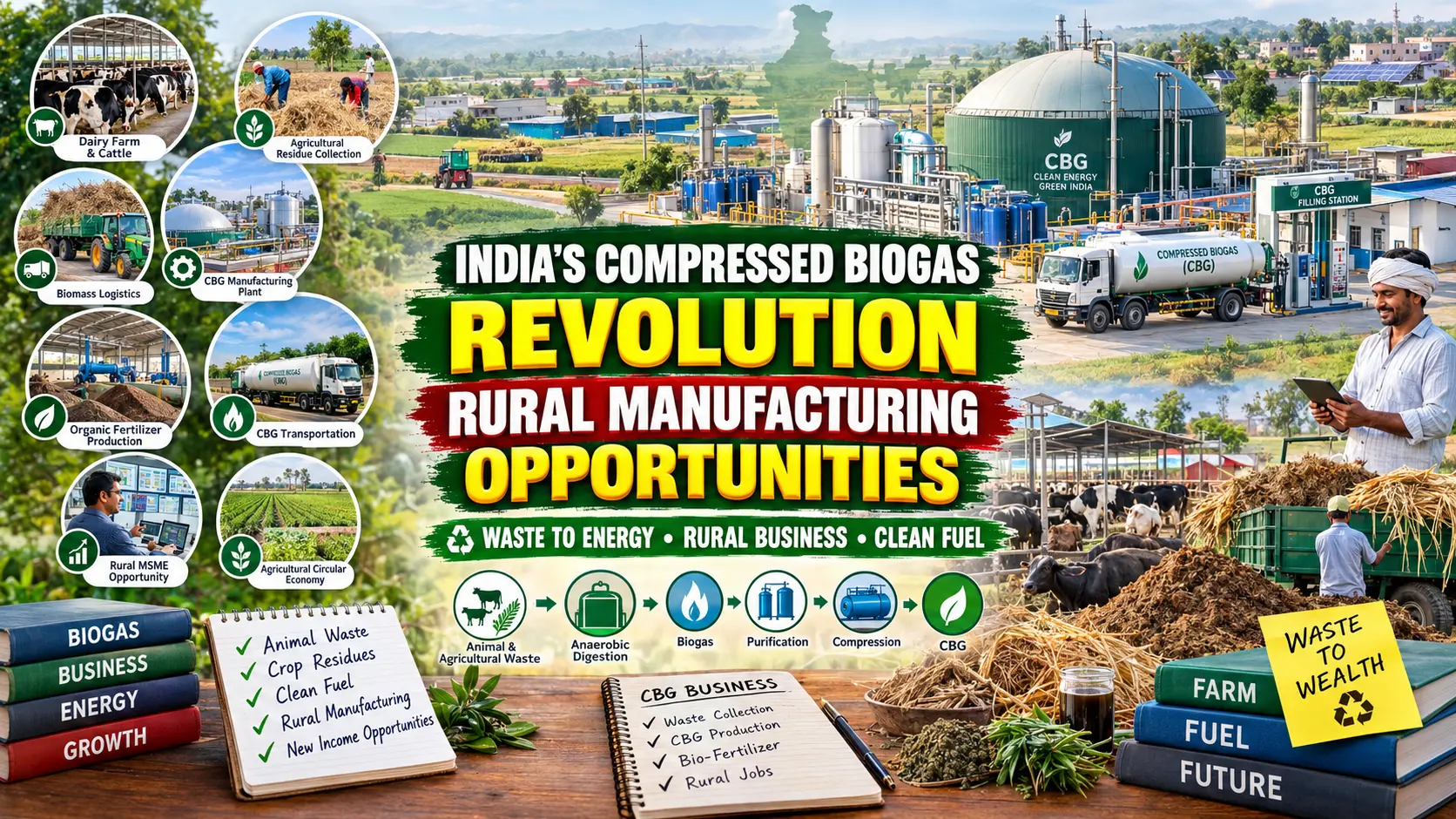
A New Wave of Manufacturing and Investment Opportunities Is Emerging From India’s 62 MMT Compressed Biogas Potential
Compressed Biogas CBG Plant
India is rich in a source of clean energy, not from a geological deposit, but from the fields, dairies, sugar mills, and municipal waste yards scattered across the country. With a detailed assessment of the organic waste streams in India, the potential of compressed biogas (CBG) that could be generated annually from an estimated 472 million metric tonnes (MMT) of largely unused organic wastes has now been quantified.
The number itself is only significant commercially because of the variety of feedstocks that are involved. Animal waste turns out to be the biggest contributor, accounting for around 41 per cent of the total CBG potential in the country, making the country’s livestock population, which has 300 million animals, a clean energy raw material. The remaining 59 per cent comes from agricultural residues, municipal solid waste, sewage treatment plant biomass and press mud from sugar mills – and these are geographically dispersed, with opportunities in almost every state.
It’s a very crucial period for Indian entrepreneurs, MSME manufacturers, and investors. The government’s policy on the promotion of bioethanol has shifted from an incentive-driven approach to mandatory blending targets. The proportion of CBG increases sharply and City Gas Distribution (CGD) companies need to mix CBG into their distribution networks. There is a huge demand-supply mismatch. That’s the business opportunity.
What This Development Means for Indian Businesses
The quantification of India’s CBG feedstock base is a game-changer, as it changes the perception of entrepreneurs and investors in the biogas sector. Up until now, many regarded CBG as a policy-dependent corner green-energy market in need of charity. That’s a description that has been rendered obsolete.
The CBG Blending Obligation (CBO) has been introduced starting from FY 2025-26 with an institutionalised demand floor of 1% of total CNG/PNG consumption, which needs to be stepped up to 5% by FY 2028-29. This implies that OMCs and CGD firms have a legitimacy to buy, and not just a discretion. This means that developers of the CBG plant have reliable offtakes.
The impact is also profound for businesses above the CBG production. From this single policy-market nexus, a number of sub-sectors are commercially viable such as feedstock collection and aggregation, biogas upgrading equipment, packaging and marketing of fermented organic manure (FOM), carbon credit advisory, and plant operations.
Areas most directly impacted are agro-waste management, ancillary activities of dairy farming, byproduct utilization in sugar mills, municipal wastes processing and clean fuel distribution. Small-scale CBG plants (2–5 MT per day) are technically feasible for MSME operators and even businesses in rural areas with no previous manufacturing experience can participate.
Why This Industry Could See Stronger Growth
The sector has commercial momentum which is likely to persist for a while, not because of policy, but because of a number of structural factors.
Increasing procurement requirement, despite spot price: The CBO’s increasing procurement requirement with the escalating schedule of 1%, 3%, 4% and 5% over four years, regardless of spot price, makes the procurement requirement ever greater for CGD companies. The total CNG/PNG consumption in India is in the hundreds of millions of cubic metres per year. A 1% blending requirement at present usage levels would equate to millions of cubic metres of CBG offtake annually.
Desirable feedstock economics: Animal dung, agricultural residues and press mud are available for free or at low cost. There is no doubt that press mud from sugar mills is a more attractive as it does not require any pretreatment and single point sourcing makes project economics of the press mud based CBG plants among the best in the sector.
Dual revenue from FOM: For every tonne of CBG generated there is fermented organic manure as a co-product. As farmers look to cut costs on chemical inputs, the demand for natural fertilisers is rising, and FOM introduces a material second revenue stream, which makes a significant impact on the economics at the plant level.
Crop residue burning: About 87 million MT of crop residue is being burnt every year in Indian fields due to air quality and waste policy pressure. The conversion of this residue directly addresses the issue of stubble burning which is a major cause of severe air pollution in the season, and so such projects can be granted further regulatory and environmental support.
Import substitution driver: India will continue to have a high dependence on imported LNG. Domestic CBG production goes directly to ending this import reliance and thus is well supported by energy security policy and clean energy targets.
Government Policies and Incentives
The policy framework for CBG in India is surprisingly multifaceted, with a focus on energy policy, waste management policy, agricultural policy and rural development policy all being utilized at once. Some of the most important government initiatives that entrepreneurs should consider are:
SATAT Scheme: The Sustainable Alternative Towards Affordable Transportation (SATAT) scheme, launched by the Ministry of Petroleum and Natural Gas, provides guaranteed offtake through 15-year purchase agreements with OMCs. As of July 2025, 108 CBG plants have been commissioned with 1,094 active letters of intent issued — indicating ample room for new entrants to secure offtake guarantees.
GOBARdhan Initiative: Under the GOBARdhan scheme (Galvanising Organic Bio-Agro Resources Dhan), part of the Swachh Bharat Mission (Grameen), projects focused on cattle waste conversion receive specific policy promotion and coordination support at the state level.
Central Financial Assistance (CFA): Ministry of New and Renewable Energy (MNRE) under its Central Financial Assistance scheme is giving financial assistance of up to ₹10 crore per CBG project, which is provided at a rate of ₹4 crore per 4,800 kg/day of CBG capacity. Plants with minimum 2 TPD capacity with more than 50% biomass feedstock are also eligible under Biomass Aggregation Machinery (BAM) scheme for ₹90 lakh CFA.
CBG-CGD Synchronisation Scheme: The CBG supply is managed by the Petroleum and Natural Gas Regulatory Board (PNGRB) and the infrastructure is supported by pipeline construction subsidies of up to ₹50 lakh per km for distances up to 50 km.
MSME Support: CBG plants of 2–5 MT/day scale fall within MSME investment thresholds, making them eligible for credit-linked capital subsidies under the MSME Ministry’s Credit Linked Capital Subsidy Scheme (CLCSS) and priority sector lending classification by RBI.
Startup India: CBG-related technology startups — those developing feedstock aggregation systems, gas upgrading equipment, or FOM product lines — can apply for recognition and benefits under the Startup India programme, including tax exemptions and simplified compliance.
Export Incentives: FOM exports and CBG-related equipment manufacturing can access promotional benefits through the Agricultural and Processed Food Products Export Development Authority (APEDA) for organic products and through DGFT for machinery.
State-Level Support: Several states offer additional incentives. Andhra Pradesh, for instance, has sanctioned ₹60 crore to establish CBG plants in urban local bodies. Entrepreneurs should also assess the Ministry of Agriculture and Farmers Welfare for schemes covering crop residue management, which directly support agricultural feedstock availability for CBG projects.
Manufacturing Business Opportunities Emerging From This Development
1. Compressed Biogas (CBG) Plant Development
The most direct manufacturing opportunity is to establish a CBG plant. The market is very under-supplied in terms of plants, with just about 108 plants commissioned, whereas 472 MMT of feedstock is available. MSME scale (2 – 5 MT/day) can be achieved in the regions where the concentrated livestock, sugar mill or crop residue is available. The assured revenue from 15-year offtake contracts with OMCs under SATAT and dual product stream from CBG and FOM make it more economically viable. States with high dairy belts are still underdeveloped, however, while they currently have a larger pipeline of projects, states like Uttar Pradesh, Maharashtra, Gujarat and Madhya Pradesh are doing fine.
2. Biogas Upgrading Equipment Manufacturing
To convert raw biogas to CBG quality, CBG plants need to be equipped with Pressure Swing Adsorption (PSA) units, membrane separation systems, water scrubbing equipment, and compression systems. Much of this equipment is imported or supplied from a few local manufacturers. The hundreds of plants being commissioned over the next 3-4 years can provide an MSME with the requirements for the procurement of PSA skids, compressor assemblies or gas purification modules. Local equipment would have costing and proximity support advantages over imported equipment.
3. Fermented Organic Manure (FOM) Processing and Packaging
All CBG plants are also FOM plants. Yet most operators have insufficient “downstream” infrastructure that they can use to process, dry, certify and sell FOM commercially. This forms a truly independent manufacturing facility: FOM processing units aggregate raw digestate from several CBG facilities, adjust it to FCO (Fertiliser Control Order) specifications, wrap it and deliver it to farmers directly or through agricultural input networks. The market for organic farming was strong for FOM with the prices ranging from INR 8 – 15 per kg depending on NPK concentration and organic certification.
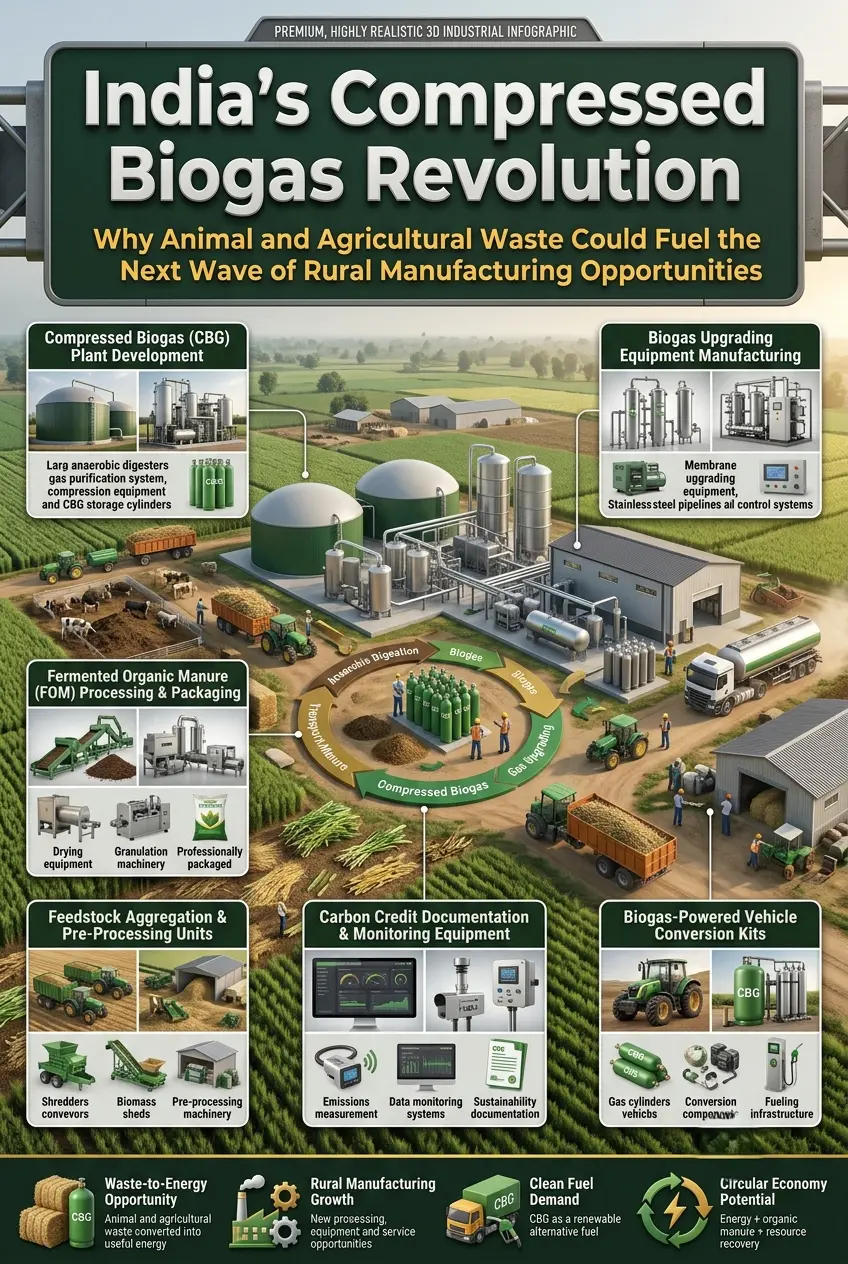
4. Feedstock Aggregation and Pre-Processing Units
Animal dung and agricultural residue will need to be collected, pre-treated (sized, slurried, moisture adjusted) prior to going into a biogas digester. The lack of an aggregation infrastructure is the single most constraint in scaling CBG sector in India. The demand for the manufacturing units for producing dung slurrying equipment, straw choppers, biomass densification presses, and covered storage for wet feed is immediate. A small-scale feedstock aggregating business for several CBG plants in the same or close vicinity can also be a viable business with a low capital cost for entrepreneurs in rural areas.
5. Carbon Credit Documentation and Monitoring Equipment
CBG generation allows for the generation of measurable carbon credits for methane capture, stub burning avoidance, and reduction of fossil fuel usage. CBG plants in India can tap into domestic market as well as Verified Carbon Standard (VCS) credits. The manufacturing or supply of a commercially relevant product line of gas flow meters, emissions monitoring sensors and data logging systems calibrated to PNGRB and BIS standards. As required blending will be subject to regulatory scrutiny, software linked IoT monitoring systems that provide emissions reduction data ready for audit are especially sought after.
6. Biogas-Powered Vehicle Conversion Kits
There is an increasing demand for vehicles that can run on CBG due to the increasing availability of CBG in retail outlets (315 outlets now sell CBG). Conversion for tractors, three-wheelers and light commercial vehicles is a manufacturing opportunity that is very applicable to agri-equipment suppliers. If farmers can use CBG as fuel for their tractors, fuel cost arbitrage will be a huge benefit for them. The production of such conversion kits, coupled with after-sales network, may see high consumption in agriculture areas.
Import-Export and International Market Opportunity
Export Opportunity
India’s increasing experience in designing, building and operating CBG plants makes it a potential exporter of this technology to its neighbouring developing countries in south Asia, south east Asia and sub–Saharan Africa where there is plenty of agricultural waste but a relatively less developed clean energy infrastructure. Biotech companies based in India can play a cost competitive role in these markets in manufacturing biogas upgrading equipment, digesters and gas compression systems.
Indian biotech companies can be cost competitive in these markets by producing biogas upgrading equipment, digesters and gas compression systems. FOM, that is now aligned to the international organic certification requirements, can be exported to markets where the certified organic organic inputs for sustainable farming are needed and are cost-effective.
Import Substitution
India is currently importing large amounts of biogas upgrading equipment such as membrane separation modules and HP compressor for compression of CBG to 250 bar. It would also facilitate import independent domestic manufacturing of these components, given the existing engineering expertise in industries such as industrial gas and petroleum equipment which would cut lead times for procurement by Indian CBG developers and possibly enable them to receive further incentives of the PLI variety. Likewise, the project developers import anaerobic digestion reactor vessels and control systems, and these can be domesticated, with current projects of reactor additions being technically feasible and commercially profitable.
Indian MSMEs and Startups in Related Industries
Verbio India (Sangrur, Punjab): The Verbio Sangrur plant is one of the most prominent CBG initiatives in India as it showcases the commercial potential of CBG derived from agricultural residue at scale. They use rice straw (burned in the fields) for their facility to produce CBG and FOM. MSMEs in other crop-residue-surplus states can implement this use of a single commodity feedstock that is available in predictable volumes, with dual revenue streams.
Pristine Logistics and Infraprojects: It is a Pune-based firm that has been working in the biogas and organic waste processing sector, focusing on CBG projects for development in the state of Maharashtra. What they have learned in the SATAT LOI process, the aggregation of feed stocks under contracts and the integration of the CGD network is a practical model that can be adopted by entrepreneurs who are interested in project development as their main business model.
Bio Energy Resource operates in Uttar Pradesh, where the project pipeline for CBG is the highest, on cattle waste-based biogas projects to dairy cooperatives and gaushalas. The problem of collectability of dung in the national assessments is addressed by their concept of gathering dung from several small dairies in a radius of 15–20 km and this could be imitated in the areas where dairies are concentrated in Rajasthan, Gujarat and Haryana.
What Entrepreneurs Should Evaluate Before Investing
Anyone who is seriously interested in becoming a part of the CBG value chain must do a structured feasibility study in the following areas:
Feedstock availability and cost: Identify the primary feedstock within a 30–50 km radius of the proposed site. Animal waste from dairies and gaushalas is often zero-cost or available at nominal transport cost; crop residue requires aggregation contracts with farmers during harvest windows. Press mud from sugar mills is advantageous for its year-round availability at a single sourcing point.
Scale of the plant and technology: Capital investment for a MSME-scale plant (with production capacity of 2-5 MT/day CBG) is estimated at around ₹8-18 crore for different technologies and feedstock. The economies of scale argument also apply to larger plants with a capacity of 10+ MT/day, but the amount of capital and feedstock security needed are significantly increased. Wet anaerobic digestion is suitable for most of the Indian conditions whereas dry digestion would be more suitable for predominantly agricultural residue feedstocks.
Offtake & regulatory approvals: Please submit an LoI on the SATAT platform prior to committing any capital. Construction of plants should follow the obtaining of the LoI that provides access to the 15-year OMC purchase agreement. Pollution Control Board and local authority regulatory approvals take 6-12 months and should be considered in project planning.
Infrastructure & location: When the CGD network is nearby or an OMC fuel station, compression & transport costs are significant reduced. States with established CGD coverage and retail CBG network cut go-to-market complexities. Water is a utility to consider in site selection for digesters, as is compression power for digesters.
FOM marketing: Do not neglect to market FOM. Project economics are substantially improved if FOM is sold at market rates instead of being donated. Structure project at the beginning to incorporate FOM off-take agreements with farmer groups, organic farms or agri-input distributors.
Challenges: Feedstock aggregation in scattered rural areas is not easy to operate; crop residue availability is seasonal, and planning is necessary. The CBG pricing though has improved but is still tied to the retail price for CNG and is subject to change. Differently composed projects are more resilient to single-source supply disruptions.
How NPCS Can Help Entrepreneurs Evaluate the Opportunity
With a portfolio of project reports and feasibility studies in 85 countries and a successful portfolio of 150,000+ projects, NPCS – Niir Project Consultancy Services has been assisting entrepreneurs, MSMEs and investors in evaluating industrial and manufacturing opportunities for more than three decades. NPCS offers the CBG and biogas sector:
Detailed Project Reports (DPRs) including feedstock analysis, plant design parameters, specification of machinery, utility requirements, manpower planning, statutory approvals, financial projections (capital cost, operating cost, profitability), ROI analysis, Break-even assessment and applicable government incentive mapping.
Techno-economic feasibility studies for investors and lenders who want third-parties to perform a project viability assessment. For the entrepreneurs who wish to know the market before investing in the project, market research on CBG demand, competitive market, pricing trends, and FOM market analysis is also available.
A detailed print reference book has been published by NPCS covering technology, market analysis, the investment parameters and manufacturing processes. The printed book is available on the link: Handbook on Biogas and Compressed Biogas (CBG) Production Technology.
To obtain a detailed Project Report on the manufacturing business in this industry such as plant economics, list of required machines, financial projections, government scheme for this industry, etc. Project Report on Explore the Complete CBG Production Guide.
Business Opportunity Snapshot
| Parameter | Details |
| Industry | Clean Energy / Biogas / Waste-to-Energy / Agro-Industrial |
| Market Driver | Mandatory CBG Blending Obligation (1%→5%, FY2025–26 to FY2028–29) |
| Key Development | India’s total CBG potential quantified at 62 MMT/year from 472 MMT feedstock base |
| MSME Opportunity | CBG plants (2–5 MT/day), FOM processing, feedstock aggregation, biogas equipment |
| Manufacturing Potential | Biogas upgrading equipment, FOM packaging, biomass pre-processing machinery |
| Export Potential | CBG technology/equipment to South Asia, SE Asia, Africa; FOM to organic markets |
| Import Substitution | PSA units, membrane separators, gas compressors, digester vessels |
| Government Support | SATAT offtake agreements, MNRE CFA up to ₹10 cr, BAM scheme, RBI PSL status |
| Investment Consideration | ₹8–18 cr for 2–5 MT/day plant; 15-year OMC PPA de-risks revenue |
| Risk Level | Medium (feedstock aggregation risk, CGD connectivity, seasonal variation) |
| Growth Outlook | Strong — supply at ~2% of SATAT target; mandatory demand growing through 2029 |
Conclusion
The combination of India’s 62 MMT annual CBG potential, blending mandate, financial assistance by the government, a near-emptied plant pipeline makes this business environment extremely clear. The majority of sectors are looking for either policy continuity or demand creation for entrepreneurs. What the CBG sector provides is more tangible: a guaranteed demand curve until 2028-29, operational offtake agreements across SATAT, and a feedstock spread across the country.
India produces huge quantities of animal waste alone (41% of CBG potential) as a zero or low cost raw material every day and utilises it at economic and environmental cost. The companies developing the infrastructure to transform that waste into CBG, FOM, and carbon credits will be in the process of a structural change, rather than a business opportunity.
The opportunity is much more than owning a plant. Each of the four main business segments (manufacturing, logistics of feedstock, FOM commercialisation and monitoring technology) offers a separate business opportunity with a different growth path. From small feedstock aggregating entrepreneurs to large CBG developers (multi plants), there is a commercially viable entry point for MSMEs at all scales.
The initial steps are market research, the right feasibility study and a bankable Detailed Project Report. Prior to investing any capital, any serious investor should learn about the feedstock dynamics, regulatory journey and the financial structure of the opportunity they are considering.
Your Investment Deserves the Right Opportunity
Every serious investment begins with choosing the right sector and the right business model. With hundreds of industrial opportunities available across India’s manufacturing and clean-energy landscape, making the most informed choice is critical. NIIR’s Startup Selector tool helps entrepreneurs, MSMEs, and investors identify the most suitable business opportunities based on their investment capacity, location, and interests — so your capital is directed toward a venture with the strongest fit and potential.


