






Udyam Registration Benefits 2026
34 Crore Jobs and Counting: The Scale of India’s Formalisation Drive
The union MSME minister recently shared an astonishing figure in Parliament – over 34 crore jobs created in Udyam registered enterprises since 2014 on Udyam and Udyam Assist portals. The Ministry of MSME has announced that there are no fund limitations for small workers, and funding is available under various schemes under the ministry such as PM Vishwakarma or PMEGP. However, on entering an industrialized area today, you will come across capable unit owners who are still operating without any formal registration. They dread paperwork, taxation or just forgot.
That attitude costs money. Udyam registration is free, takes less than 30 minutes to complete online and is the only way that unlocks priority lending, collateral-free guarantees, subsidy schemes, protection against repayment defaults and the purchase preference of the Government. Formalisation is definitely at the top of the list for businesses with high ROI for micro business entrepreneurs. There’s no time in an entrepreneur’s year which is more productive.
The Hidden Tax of Informality
The majority of unregistered micro unit owners think that they are staying lean. But in fact, they are paying a hidden tax each and every day. A micro enterprise without Udyam registration will be at a structural disadvantage with regard to every dimension of financial aspects.
Think about how informal work is expensive:
- The banks cannot relate the unregistered unit to the priority sector norms and hence the owners have to borrow from moneylenders for which the interest rate is 24–36% annually, while the interest rate of the bank is 9–12%.
- The MSMED Act does not provide for delayed payment protection to unregistered MSMEs, meaning that they are not eligible for compound interest on late payments on their invoices.
- Government tenders, most of which are exclusively for MSEs, are still unavailable without Udyam status.
- The subsidies from PMEGP, CLCSS and state capital subsidy schemes are not available at all.
There is no cost of compliance for formalisation. It’s the process of turning these default modes from working against you, to working for you. According to the
Formalisation isn’t a burden on compliance. It’s about changing these defaults from working against you to working in your favor. The MSME Development Act provides three benefits to registered enterprises which informal do not get — enforceable payment timelines, assured credit access, and government purchase preference.
Get Detailed Insights from This Book: Just For Starters: How To Become A Successful Businessman?
What Udyam Registration Actually Unlocks
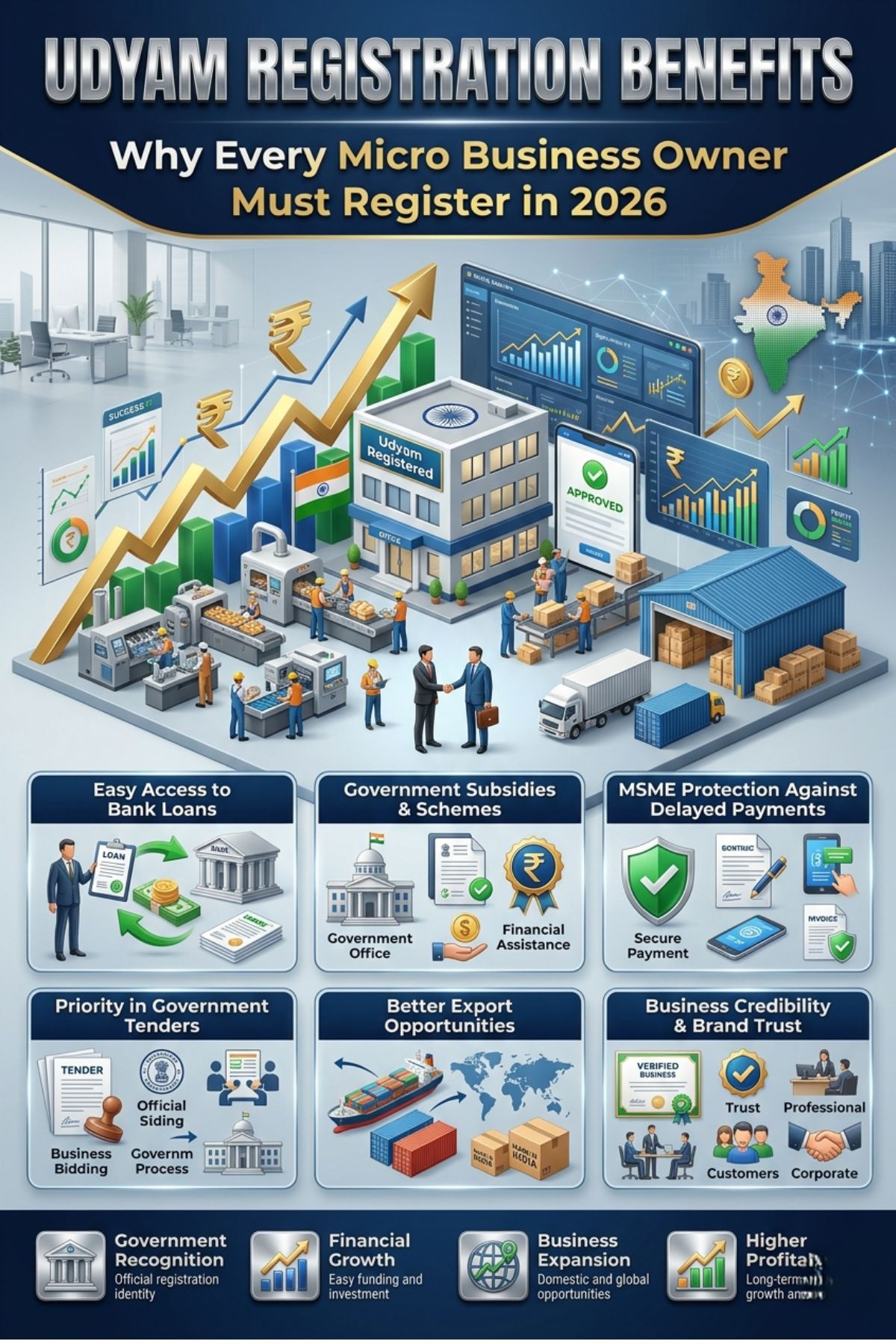
After registering on the official udyamregistration.gov.in portal, a micro enterprise receives a complete package of benefits from the Government. These are not hypothetical rights or entitlements — they are real rights, real entitlements and valuable dollars.
| Benefit | What It Means in Practice | Backed By |
| Priority Sector Lending | Banks must direct credit to registered MSMEs — easier sanctions, better rates | RBI PSL Norms |
| Collateral-Free Credit | Guarantee cover on loans up to Rs. 5 crore under CGTMSE | CGTMSE Guidelines |
| Subsidy Eligibility | PMEGP, CLCSS, PMFME, state capital subsidies require Udyam status | Scheme Guidelines |
| Delayed Payment Protection | Buyers must pay within 45 days or owe compound interest — enforced via MSME Samadhaan | MSMED Act |
| Government Purchase Preference | Share of central procurement reserved for MSEs; tender fee and EMD exemptions apply | Public Procurement Policy |
| TReDS Access | Sell receivables for cash in as little as 72 hours via the RBI-backed platform | RBI TReDS Framework |
| Concessions and Rebates | Electricity tariff cuts, patent/trademark fee rebates, ISO reimbursement in many states | Central and State Schemes |
| ONDC / MSME TEAM Onboarding | Subsidised digital-commerce entry and market access support | MSME TEAM Scheme |
All these benefits come with a definite monetary cost. Combined, they can turn the financial fortunes of a micro unit within the first year of registration.
Udyam vs. Udyam Assist: Understanding Which One Applies to You
The Government of India has now implemented two distinct formalisation architecture to cater to the entire gamut of informal economy.
Udyam Registration (Full)
This is the main pathway for units that have PAN/ GST credentials. Proprietors may register only with Aadhaar and companies or LLPs will have to add PAN as well. Investment and turnover are declared first and then automatically verified by the system with the data of income tax and gst returns. Yashasvini campaign The RBI guidelines on the priority sector lending require banks to proactively channel credit to the Udyam registered enterprises.
Udyam Assist (Informal Track)
Udyam Assist is for informal micro enterprises not having PAN, not having GST, street vendors, household production units, tiny workshops etc., and can be onboarded through banks and designated agencies. The Yashasvini campaign is targeted to reach the benefit of priority lending to informal units owned by women in India through this route. This path guarantees that any kind of business idea, no matter how grassroots, can have access to the formal financial infrastructure.
View Full Project Details: Business Ideas with Investment of ₹10 Crore to ₹15 Crores
How to Register: A Simple 30-Minute Process
Registration process is simple. No fees, no agents and no premises visit. Follow these steps:
- Go to the official website of udyamregistration.gov.in. Be wary of paid websites that look similar to the government one; there is no charge for the government process.
- Provide the Aadhaar number of the proprietor/partner and validate using the OTP. PAN of companies/ LLPs shall also be added
- Self-Identify your activity by the appropriate NIC Code, your investment in Plant and Machinery and your turnover/turnover for the year. This data will subsequently be automatically synced with GST and Income Tax return data.
- Get your permanent Udyam Registration Number and Certificate within a minute via email
- Ensure that your registration is up to date. If classification changes, revise certificate. Revamped investment and turnover caps make it easy to expand investment without losing MSME benefits
Home units are routinely registered. No premises requirement, making it particularly convenient for household manufacturers, service providers and artisans who operate their informal businesses from their homes.
The Real Cost of Staying Informal: A Financial Comparison
Let’s take an example of a typical micro manufacturing unit that has Rs. as its asset base. 30 lakhs. Let’s understand the financials of becoming a Udyam registered entity:
| Parameter | Unregistered | Udyam-Registered |
| Working Capital Source | Informal credit at 24–36% p.a. | Bank CC at 9–12% p.a. |
| Annual Interest on Rs. 10 Lakh Float | Rs. 2.4–3.6 lakh per year | Rs. 0.9–1.2 lakh per year |
| Receivables Beyond 45 Days | Absorbed silently by the unit | Compound interest claimable under MSMED Act |
| Subsidy on Rs. 20 Lakh Machinery | Nil | Rs. 3–7 lakh (scheme-dependent) |
| Government Tenders | Inaccessible | Fee/EMD exempt with purchase preference |
| Effective Annual Disadvantage | Rs. 4–8 lakh+ | — |
Note: This is an illustrative comparison to a typical micro manufacturing unit. Actual figures are dependent on sector, state and scheme mix.
Informality cost conservatively Rs. This is about 4 to 8 lakh which is beyond any administrative burden of registration that is perceived. Moreover, the Credit Guarantee Fund Trust for Micro and Small Enterprises (CGFMSE) has been established.
The annual monetary costs of informality are at least Rs. Is it at all burdensome to register on the part of administration for 4 to 8 lakh units? Moreover, the Credit Guarantee Fund Trust for Micro and Small Enterprises (CGTMSE) provide guarantee cover for loans up to Rs. and with no collateral. 5 crores, but just for the Udyam-registered business.
Start with clarity—choose the best business idea
Key Government Schemes Exclusively Available to Registered MSMEs
The gateway to multiple high value government schemes is Udyam Registration. These programmes are otherwise completely unachievable, even if you have great business ideas and plans, no matter the size and type.
- Margin money subsidy of 15-35% of the cost of a project for new manufacturing and service units. PMEGP (Prime Minister’s Employment Generation Programme):
- Provides a capital subsidy of 15% in the initial stage of institutional financing for technology upgradation. CLCSS (Credit Linked Capital Subsidy Scheme):
- PMFME (Pradhan Mantri Formalisation of Micro Food Enterprises): Provides credit linked subsidy up to Rs. in individual micro food processing units. 10 lakh, capacity building support.
- Facilitates registered MSMEs to sell the receivables to the financier within 72 hours, addressing the long-standing working capital crunch problem.Trade Receivables Discounting System (TReDS):
- An online delayed payment monitoring site where registered MSEs can submit claims for late payments, and facilitate councils have the authority to resolve conflicts.MSME Samadhaan:
These schemes are backed by credible institutional data. The role of MSMEs in India’s manufacturing output and employment has been found to be significant by the National Sample Survey Office (NSSO) and the Annual Survey of Industries, respectively, which further underscores the need for continued government support to the sector.
How NPCS Supports Your Business Beyond Registration
The doors open when the registration comes out. The project report that passes through them is a bankable project report. Niir Project Consultancy Services (NPCS) have been converting entrepreneurial ideas into bank appraisable projects for more than 45-years covering over 50+ industries, and generating and delivering over 8000 Detailed Project Reports (DPRs) to the bank.NIIR Project Consultancy Services (NPCS) has been converting entrepreneurial intent into bank appraisable projects for more than 45-years covering more than 50+ industries generating and delivering over 8000 Detailed Project Reports (DPRs) to the bank as per PMEGP and CGTMSE requirements.
From feasibility reports to raw material sources and machinery suppliers’ identification, NPCS equips the founders with practical guidance at every stage of the business process whether they are formalising an existing business or exploring new business ideas from scratch, detailed sector project profiles are available at www.niir.org and practical guidance is available at www.entrepreneurindia.co.in.
Related Article: 10 Best Business Books for Entrepreneurs in India (Startup Guide)
Frequently Asked Questions
Q1. Will the tax officials be coming to my door on account of Will Udyam registration?
No. Udyam is not a tax registration but it is a classification registry. GST compliance is based on the thresholds of turnovers and not on the concept of Udyam status. There is no new tax burden as a result of registering.
Q2. Is there any fee to register?
None. The official udyamregistration.gov.in portal is totally free. There are a few private sites that charge fees for ‘assistance’ — it’s not necessary and should be avoided.
Q3. The unit is self-contained and operated from home. Can I still register?
Yes. There is no premises requirement. As long as they are manufacturing or service based, and are not part of an organization, home based units register routinely, and fully informal units can access the Udyam Assist pathway.
Q4. My buyer has not paid on time for 120 days! So, what can I do?
Lodge a complaint in the MSME Samadhaan portal. If the payments are not made within 45 days, then the registered MSEs are entitled to compound interest at three times the bank rate. These claims are addressed to the facilitation council and may be heard by them.
Q5. Does registration expire?
No. The Udyam registration number will be permanent. Your classification (micro, small or medium) will be automatically updated as your turnover and investment fluctuate over time based on your filing.
Q6. Is there any startup that has not made any of their money yet can register Udyam?
Yes. If you’re in the idea generation stage of building your business, you can apply for Udyam registration. Turnover is considered to be zero, with classification adjustments after returns submission. Early registration equates to earlier access to credit, subsidies, procurement preference.
Conclusion: The Most Productive 30 Minutes an Entrepreneur Can Spend
The MSME formalisation initiative in India is well-supported, proactively promoted, and has a solid structure that benefits those who are formalized. The maths is easy: it costs nothing to register, it takes about 30 minutes, and a typical micro unit can gain several lakh rupees a year.
Meanwhile, the price of staying informal silently increases every month in the form of higher interest rates on loans, loss of subsidies, inability to secure tenders, lack of enforceability of receivables, etc. This is a continued drain without any justification of paperwork.
If you are an existing unit which has never registered as a Udyam or you are thinking of new business ideas and starting a new venture, Udyam registration is the first and most crucial step. This is the difference between an invisible and an investable enterprise and the minutes are worth it.


