





MSME digitisation roadmap India
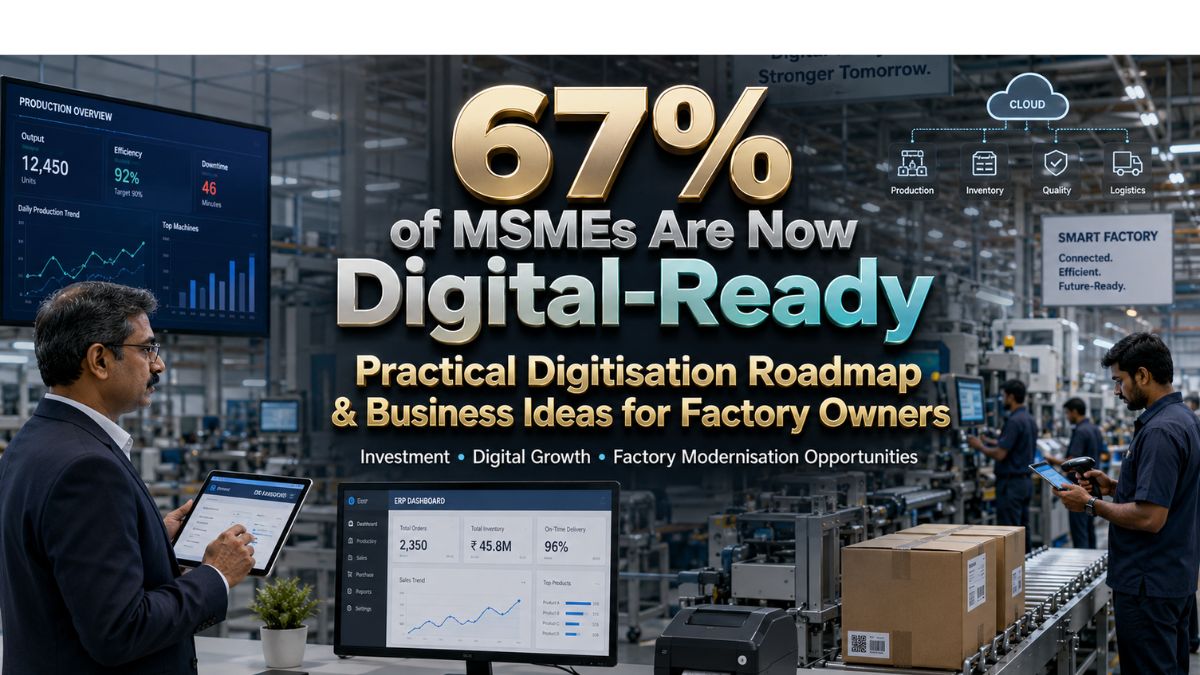
But a quiet threshold was crossed somewhere between pandemic and today. In today’s digital era, industry leaders believe that almost 67% of India’s 6.3 crore-plus MSMEs are now digitally ready, thanks to the penetration of smartphones, the cost of data being affordable for all, the normalisation of cashless transactions by UPI, and the increasing expectations from buyers who only go online to search for suppliers. But it’s not the same thing to be “digital” ready as it is to be “digital” run. Most factory owners are missing out on money just there. If you’re a budding businessman who’s looking into a more viable business idea in manufacturing and industrial supply, closing this gap — in a systematic manner — could prove to be a growth opportunity as equivalent to a significant capital investment.
Today, millions of supplier stores are on B2B platforms and they continue to grow by double digits. It’s gone beyond UPI in the B2B payments ecosystem because it now addresses the management of high-value digital payments, automated reconciliation, and financing in the supply chain. In the meantime, the MSME Ministry is actively working on the remaining one-third of enterprises to venture into the digital space via schemes such as MSME TEAM, which proposes to bring five lakh enterprises on board the ONDC. If you’re still using a phone diary and cash ledger, you’re no longer early, you’re late. You’re conceding orders to those that quote, invoice, and collect electronically — and at lower working capital cost and quicker.
The straight, honest, and numbered method to get caught up in one quarter.
Related Article: Digital Supply Chain Opportunities for Indian MSMEs: AI, IoT & Government Support
The Gap: Digital-Ready Is Not the Same as Digital-Run
A unit which has a mobile phone and accepts UPI payment is digitally ready. This won’t have it working digitally. The true difference lies in four key aspects that have a direct impact on revenue and cash flow:
- Discoverability: Will a new buyer in another state be able to find you online?
- Responsiveness: Do enquiries get answered in hours — or in days?
- Cash velocity: Do invoices convert to bank credits automatically, without follow-up calls?
- Records: Can you get a complete year of clean financial records for a bank in one afternoon?
Of the units, most have passed the first test and failed the next three. This is the roadmap that resolves them in order of effort to recovery. The series of stages is as important as the tools themselves, as each will build upon the next.
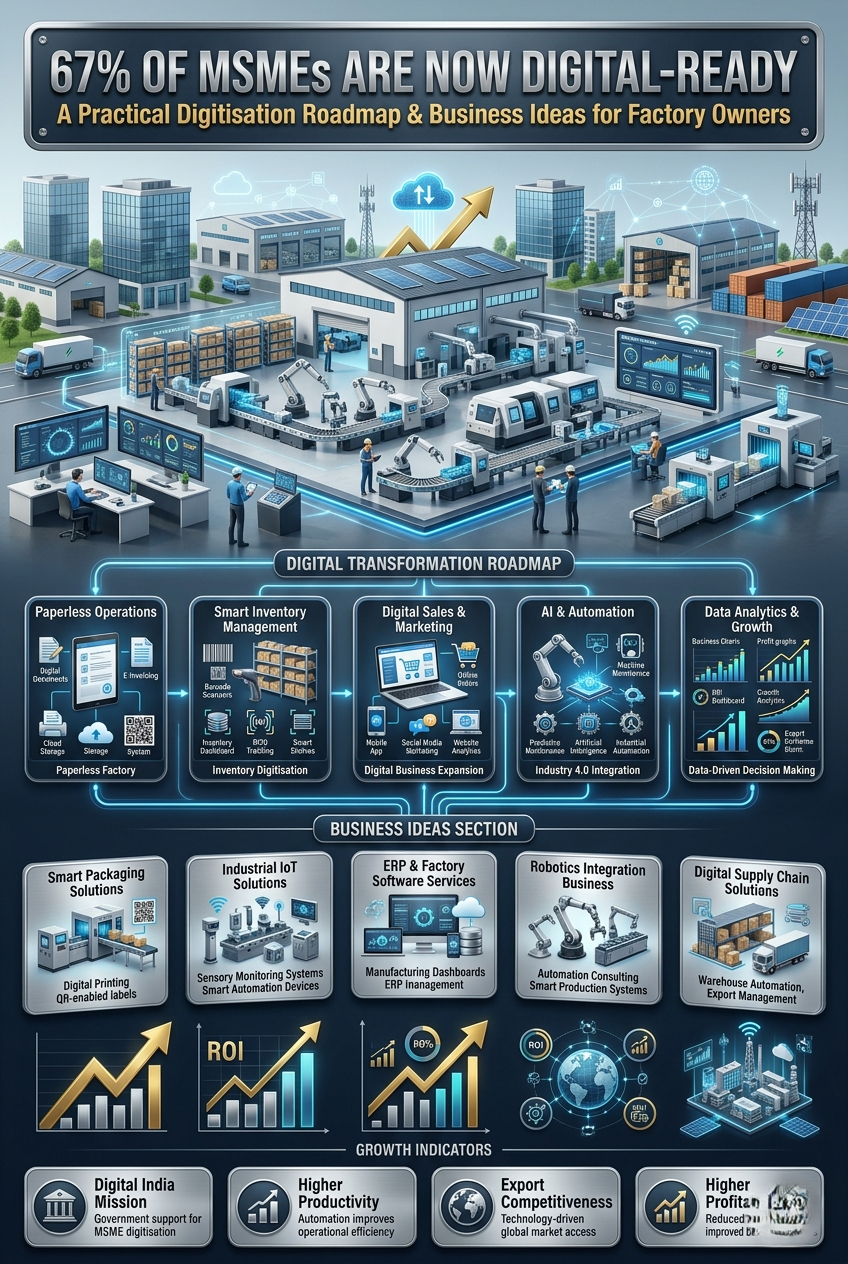
The Four-Stage Digitisation Ladder
Imagine that digitisation is a ladder of four rungs. The stages can be implemented individually, but each will result in a greater business advantage when deployed collectively, which cannot be matched by any competitors that do not have digital infrastructure.
| Stage | What You Implement | Monthly Cost |
| 1. Be Findable | Google Business Profile, B2B marketplace storefront, basic website, WhatsApp Business catalogue | Rs. 0 – 3,000 |
| 2. Respond Fast | Lead manager app, templated quotes, WhatsApp auto-replies, enquiry log | Rs. 1,000 – 5,000 |
| 3. Collect & Account Digitally | GST-compliant invoicing software, payment links/QR on every invoice, auto-reconciliation, TReDS for corporate receivables | Rs. 1,500 – 6,000 |
| 4. Sell on Networks | ONDC onboarding (MSME TEAM support), GeM registration, export marketplace listing | Rs. 0 – 5,000 |
For a unit with a turnover of two crore rupees, the annual expense of operation of all the four stages is comfortably in between Rs. 60,000 and Rs. A mere 1.5 lakh, a small drop in the ocean compared to what the impact of that business brings.
The 90-Day Implementation Plan
Most factory owners expect digitisation to take months of IT work and a costly IT consultant. The biggest barrier is not cost, it’s sequencing, says the National Sample Survey on MSMEs. The plan below will take that obstacle away.
Days 1–15: Build Your Digital Presence
Get your Google Business Profile and add nice photos of the plant and products. Update or redo your marketplace storefront including complete specifications, certification and minimum order quantities (MOQs). This is the most common mistake made by MSME suppliers when they first make the move online – they list incomplete listings.
Days 16–30: Systematise Your Response Process
Unify all enquiries in one inbox for the lead-manager. Create 5 quote templates for your most popular products, and have any trained employee, NOT owner, be able to provide a quote in 2 hours or less. Orders are won by speed. Two days is industry standard, 2 hours makes a competitive differentiator at the same cost.
Get Detailed Insights from This Book: Just For Starters: How To Become A Successful Businessman?
Days 31–50: Digitise Collections and Invoicing
Make the switch to GST ready and payment integrated invoice management software. Never take ‘will transfer later’ as a business process. The Trade Receivables Discounting System TReDS guidelines issued by RBI allow MSMEs to be suppliers to corporates/PSUs and can be able to discount their receivables, thereby compressing the collection cycle from months to days. If your buyer profile fits the bill, register now!
Days 51–70: Enter Government and Open Digital Networks
To access the Government buyers, register on the Government e-Marketplace (GeM) as one of the fastest growing procurement channels in India. Meanwhile, start the onboarding for ONDC. The MSME TEAM scheme covers the costs related to cataloguing and seller side cost for micro and small enterprises making the stage comparatively costless for eligible MSMEs.
Days 71–90: Measure, Adjust, and Sustain
Take a look at the numbers: enquiries received, average response time, quote-to-order conversion rate, and days-sales-outstanding (DSO). Un-measured quiet decay is the fate of digitisation. There need not be a monthly digital ops review, let alone a 30-minute discussion, to ensure that the first 70 days of gains do not disappear over the subsequent three months.
Access Complete Business Plan: Business Ideas for ₹10–15 Crore Investment
What Changes When You Climb the Ladder
How the business will be affected by all four stages is not additive, it is multiplicative. Each stage supports the preceding one and collectively works to move the unit’s competitive position in ways that not only are hard for manual-process competitors to duplicate but are also easy to miss.
- Wider funnel: Units with complete digital storefronts consistently report enquiry flows from states they never previously marketed in. Established sellers on major B2B platforms attribute the majority of their business to online channels.
- Speed premium: A two-hour quote turnaround against the industry’s two-day norm wins orders at equal prices, without discounting.
- Cash velocity: Payment links combined with TReDS compress collection cycles from months to days, significantly reducing working capital requirements.
- Bankability: 12 months of clean digital records change bank conversations. Top NBFCs and fintechs with cash-flow based lending products cost you based on data quality and not on collateral.
- Export option: Digital catalogues and clean documentation are the prerequisite for export marketplaces — the on-ramp to global buyers that offline suppliers cannot access.
Moreover, the Confederation of Indian Industry (CII) has repeatedly pointed out that digitised MSMEs can get vendor clearance from big corporates two to three times quicker as compared to their non-digital peers as the procurement team can easily validate credentials, certifications and product specs.
Financial Snapshot: Digitisation Economics for a Rs. 2 Crore-Turnover Unit
Numbers give a better foundation to the decision than does narrative. The table below is a summarisation of indicative outcomes for a manufacturing MSME with around Rs. With the four stages, 2 crore turnovers annually.
| Parameter | Indicative Value |
| Total tools cost (all four stages) | Rs. 60,000 – 1.5 lakh / year |
| One-time setup effort | 60–90 days, largely existing staff |
| Typical new-enquiry uplift (Year 1) | 30–100%+ |
| Quote turnaround improvement | Days → hours |
| Receivable cycle compression | 15–30 days saved |
| Working capital released (on Rs. 50 lakh receivables) | Rs. 8–15 lakh equivalent |
| Payback on digitisation spend | Typically within 6 months |
Note: Indicative ranges are based on outcomes reported by sellers on platforms. The results are dependent upon the category and quality of the listing.
To put it in perspective, the SIDBI MSME Pulse Report keeps a regular check on the relationship between use of digital and better credit access and working capital efficiency for small manufacturers. The data clearly reveals that formal credit for access to units is available at significantly improved terms for the units that are digitised.
Discover business ideas that actually make money
Business Ideas for New Units: Born Digital from Day One
Structure is an advantage that new manufacturing units have over old ones – they can be born digital, rather than retrofitted. By beginning with project economics that include building digital sales channels, modern invoice generation and Industry 4.0 readiness, the unit gets a commercial platform that most competitors are still working on after years.
The digitisation stack outlined above should be an integral component of the project feasibility itself, and not simply an add-on for entrepreneurs considering business ideas in manufacturing, fabrication, chemical processing, food processing or any industrial sector. The cost is modest. The effect on bankability and market reach is immediate as is the effect on cash velocity.
As per Government of India Ministry of Commerce and Industry, digital-first MSMEs are much more likely to venture into export markets in their first three years of operation. For those business owners who wish to expand their operations from a local or regional level, it is an attractive structural argument to consider digital infrastructure from the beginning.
How NPCS Can Help You Start Right
Having prepared over 8000 Detailed Project Reports for various industries over the last 45+ years with its rich experience of consulting, NIIR Project Consultancy Services (NPCS) also prepares feasibility studies and DPRs that integrate digital sales infrastructure, modernized invoicing systems, and Industry 4.0-ready into project economics.
The entrepreneurs who are considering new business ideas, as well as those business owners who are contemplating business expansion, can access sector-specific playbooks and project reports on www.niir.org as well as www.entrepreneurindia.co. Digital market access is a fundamental project assumption in all DPRs developed today by NPCS.
Frequently Asked Questions
Q1. I’m not technically inclined and can’t afford to get an IT guy. Is this realistic?
Yes — entirely. All the tools in stages 1-3 are aimed at non-technical business owners. If you are able to use WhatsApp, you can run them. Follow the order, and assign one of the personnel currently in place as the digital operations owner. The initial 30 days are critical and beyond this period the system is relatively self-sufficient.
Q2. Where do I list my product on the first B2B marketplace?
Browse where your buyers browse. Leverage major platforms of India for B2B trading, GeM for Government trading, ONDC for open network retailing and more and more for B2B trading as your B2B listings mature and you have all documentation ready for exports.
Q3. To understand the meaning of ONDC and why it matters for MSME TEAM?
The Open Network for Digital Commerce (ONDC) is an open-commerce platform that is government-backed and allows merchants to register and sell to buyers using various apps. MSME TEAM scheme is a subsidy programme that will cover the cataloguing and entry fees of five lakh micro and small enterprises to make it almost free for the eligible units.
Q4. If I’m already at marketplaces, is it still necessary to have a website?
A simple one, yes. Large orders are always placed after corporate procurement teams and export buyers verify a supplier through their website. A five-page website, with products, certifications, plant pictures and contact details is enough — and it is not that costly. From 15,000 to establish professionally.
Q5. What are my risks of online payment fraud when digitising?
Always check with a trusted number — not email or WhatsApp — if there is any change in your bank details. Set up 2FA for all business accounts. Ensure that all relevant staff are trained to recognise phishing attempts. The digitisation and its basic cyber hygiene should go hand in hand, otherwise additional risks will arise.
Q6. What if my buyer continues to want cash or cheque?
Provide digital payment first, not required. The majority of buyers will move when they discover the convenience. Even if some buyers lag behind, your internal records, invoicing and supplier payments can all be entirely digital. The speed and bankability go both defenders regardless of the means of payment of your buyers.
Conclusion: The Cost of Waiting Has Never Been Higher
India’s MSME digitisation journey is at no longer the story of the early adopters. Two thirds of the sector have already entered the digital readiness zone. It is not a question of whether to digitise, but how quickly can you go from digitally ready to digitally run?
Compared to the four-stage ladder, the cost of this ladder is less than Rs. For most factory scale units’ annual compensation is fixed at 1.5 lakh. The 90-day plan involves no IT hire nor consultant. In most documented examples, the payback is realized in 6 months, stemming from better enquiry conversion, quicker collections and reduced working capital needs.
For entrepreneurs considering manufacturing business concepts, or factory owners contemplating the next factory, the inclusion of these digital foundations from the very beginning of the project, will be the best ROI and lowest cost strategic move in 2026.
Today the factories which will lead Indian manufacturing for the next 10 years are being constructed-and operated-on digital foundations.


