







Cashew processing business in India
The Margin No One Talks About
Approximately 800,000 tonnes of raw cashew nuts get produced in India every year but only about 40% is sold as a branded, flavoured, packaged product. The difference between a raw cashew and a vacuum-sealed cashew, which is spiced and sold under a recognisable label, is a kilogram? Anywhere from ₹80 to ₹220 per kg. It’s not a rounding error. This is a 4x multiplication on the table, uncollected season after season.
When Rajan Shetty walked in the orchards of Sattari in North Goa this morning, he saw this gap. He was no economist. Was a small family-owned provision shop. What he knew, on a gut level, on an esoteric level, was that the farmer beside him was selling the same cashew that the Mumbai gourmet shop was charging ₹900 for a 250-gram tin, without a nice tin. The owner of the store was not retaining any of that value. The middleman was capturing some. Most of the “urban branded” retailer was taking.
Shetty’s journey of understanding the processing chain took 14 months, and she obtained a small plot in Goa Industrial Development Corporation (GIDC) estate at Kundaim, and constructed a processing and value addition unit of cashews worth of investment of ₹38 lakh. His brand Konkan Select today sells in three south Indian states, ships to four cities in Europe and generates annual revenues of over ₹1.8 crore. It’s not a one-time thing. It is a template. This is replicable across Karnataka, Kerala, Maharashtra and Odisha – the five states that produce more than 85% of the cashewnuts in India.
Get Detailed Insights from This Book: The Complete Book on Cashew (Cultivation, Processing & By-Products)
The Billion-Rupee Processing Gap
India processes the maximum quantity of raw cashew nuts in the world, accounting for more than 45% of the world’s total raw cashew nut consumption. But the story behind the statistic is uncomfortable. India’s exports of cashew on volume basis have increased at the rate of approximately 8–10% annually, but in value terms, the growth has been slow as the predominant form of export is still the ‘W-180’ or ‘W-240’ grade whole kernel, not finished product for consumers, according to the Agricultural and Processed Food Products Export Development Authority (APEDA).
Value addition deficit is structural and measurable. The price of a kilogram of W-240 whole cashew kernels is about ₹650–720 FOB. The same kg of the same product, when sold as a consumer brand under the name, roasted, salted, flavoured (masala, chilli lime, honey pepper) and packed in 200g retail packages at the factory gate, fetches ₹1400 to 1600. When sold through direct to consumer channels, it fetches ₹2200. That’s not closing down quickly enough.
Availability of raw materials is local and available. The two districts of Maharashtra, Sindhudurg and Ratnagiri, account for more than 80,000 tonnes per year. Another 30,000+ tonnes comes from Goa. The remaining domestic crop is in Kerala’s Kollam-Kasaragod belt, Uttara Kannada and Phulbani and Koraput districts of Odisha. The Cashew Export Promotion Council of India (CEPCI) puts the value added to the cashews produced locally at only 12-15% before they are sold. The rest 85% of the crop is sold raw nut or semi-processed kernel, with hardly any brand value.
The domestic retail sector is rapidly evolving. Urban consumers, especially in Tier 1 and Tier 2 cities, are increasingly moving away from loose dry fruits bought from the local kirana stores to the branded, sanitarily packed fruits. This change is corroborated by the organised Indian snacking market, which is expanding by 14-16% every year and is valued at ₹32,000 crore, per data released by the Confederation of Indian Food Trade & Industry (CIFTI). One of the highest margin products in the premium nuts category is the cashew. The newcomer really has a chance.
Table 1: State-wise Cashew Production, Processing Clusters & Export Readiness
| State | Annual Raw Cashew Production | Key Processing Clusters | Value-Addition Units (est.) | Export Infrastructure |
| Goa | 30,000–35,000 MT | Kundaim (GIDC), Bicholim, Pernem | 45–55 | Mormugao Port, Air Cargo Dabolim |
| Maharashtra | 80,000–90,000 MT | Sindhudurg, Ratnagiri, Vengurla | 120–150 | JNPT Mumbai, Ratnagiri Jetty |
| Kerala | 60,000–70,000 MT | Kollam, Kasaragod, Kozhikode | 200–230 | Kochi Port, Cochin SEZ |
| Karnataka | 45,000–55,000 MT | Uttara Kannada, Udupi, Sirsi | 80–100 | New Mangalore Port |
| Odisha | 40,000–50,000 MT | Phulbani, Koraput, Rayagada | 40–55 | Paradip Port, Dhamra Port |
| Tamil Nadu | 25,000–30,000 MT | Cuddalore, Villupuram | 30–40 | Chennai Port, Ennore |
Why Right Now is the Right Time
Cashew value addition is looking more promising than over the past decade, with a confluence of three forces.
A tail wind from the India-EU Free Trade Agreement (FTA). The India-EU FTA negotiations are in the advanced stage with a recent draft of the preliminary text shared by the industry bodies (FIEO — Federation of Indian Export Organisations) indicating that the duty phase-out on processed food products such as packaged nuts will be phased. Nuts are imported into Germany and France at an annual cost of more than €420 million. Currently, Indian cashews enjoy a 9% import duty in the EU. Bringing this to zero would be possible in 3-5 years with an FTA, and Indian brand cashews would thus be price competitive with Vietnamese and Brazilian product.
D2C and quick-commerce revolution. The platforms such as Blinkit, Zepto and Swiggy Instamart have made available the instant delivery of branded packaged products, which was never available 5 years ago. With a minimum of 3-4 products with BIS and FSSAI certification, a retail-ready pouch design, a cashew can be listed on a major quick-commerce platform within 60-90 days of production start. This takes out the old 2-year retail shelf penetration period altogether.
Policy support through PMEGP, MUDRA and ODOP. The food processing units under the Prime Minister’s Employment Generation Programme (PMEGP) will be eligible for subsidy of 15-35 per cent of the project cost (as per category and location) with bank loan for 90 per cent of project cost. This results in a capital subsidy of ₹6–14 lakh per unit of processing cost of ₹40 lakh to the cashew processor. This means that a capital subsidy ranging from ₹6 to ₹14 lakh is paid to the cashew processor for a processing unit of ₹40 lakh. Cashew has been identified as a focus product under the One District One Product (ODOP) initiative under several districts of Goa, Kerala and Odisha providing extra promotional support and branding grants at state level.
The working capital requirement for a small setup for processing cashew nuts can directly be tapped on MUDRA Tarun loans of up to ₹10 lakh without any collateral. To mitigate the risk of the bank, CGTMSE (Credit Guarantee Fund Trust for Micro and Small Enterprises) offers collateral free credit cover up to ₹2 crore, making the loan more likely to get approved for first-generation entrepreneurs.
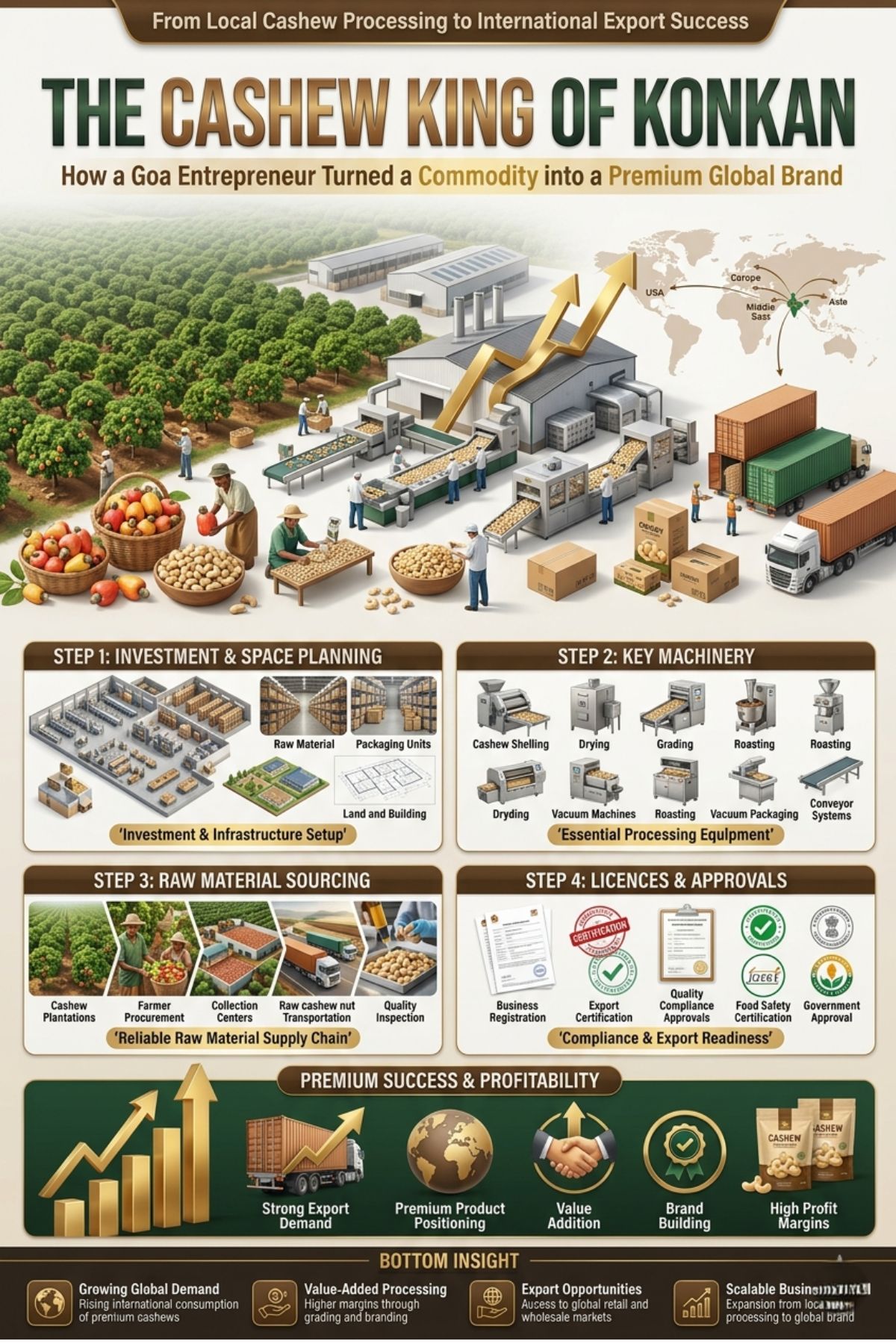
Setting Up a Cashew Processing and Value-Addition Unit
Step 1: Investment and Space Planning
The built-up area for a small-scale processing unit for cashew with input capacity of 200 kg/day is 800-1200 square feet respectively. This may be in any GIDC or SIDCO estate in leased industrial sheds in all the states. Don’t consider buying land in the beginning; it involves tying up working capital and machinery funds. For such a size, the total capital expenditure is in the range of ₹35-55 lakh, which covers plant and machinery, first batch raw material, packaging design, initial stock and other civil works.
Step 2: Key Machinery
The main processing line consists of:
- Steam cooker / boiler (for raw cashew steaming): ₹1.8 – 2.5 lakh
- Drying / roasting oven (electric / LPG): ₹3.5-5 lakh
- Shelling machine (semi-automatic): ₹2.5–4 lakh
- Peeling machine: ₹1.5–2.5 lakh
- Manual/Vibro-sorter grading and sorting table: ₹80,000-1.5 lakh
- Drum (rotary coating) – ₹1.2–2 lakh
- Packaging machine for nitrogen flushing: ₹4–7 lakh
- Vacuum sealer (for premium tin-pack SKUs): ₹80,000–1.5 lakh
Suppliers of processing and packaging machinery are more concentrated in Coimbatore (Tamil Nadu) and Ahmedabad (Gujarat), respectively. Sri Murugan Cashew Machinery, Sree Valsa Engineering and ATC Packaging are a few vendors that provide turnkey lines to units throughout South India.
Step 3: Raw Material Sourcing
Co-operative or advance-contract sourcing is the smartest sourcing strategy, not spot-market purchase. Ensure a direct link with farmer producer organisations (FPOs) in the area before harvest (January – March for most states). When buying FPO linked procurement products, you will get an edge of 12-18% compared to raw cashew available from traders. NAfed and the State Horticulture Department Offices have FPO directories in Goa and Maharashtra. NAfed and State Horticulture Department Offices have FPO directories in Goa and Maharashtra. During the last couple of years, direct farmer linkage has also been made easy through the Marked scheme in Odisha and Horticorp in Kerala.
Step 4: Licences and Approvals
Mandatory registrations and licences:
- All food processors need to secure FSSAI Central/State Licence (licence application form available on foscos.fssai.gov.in)
- All MSME related schemes open with Udyam Registration which is available free of cost.
- The processed cashew is subjected to 12% GST and raw cashew is subjected to 5% GST.
- Factory Licence (if employing 10+ workers with power or 20+ without)
- The Pollution NOC is a green category (usually 30–45 days) certificate issued by the State PCB.
- APEDA Registration (required for export, apply through the newapeda.gov.in)
- Modern retail chains prefer cashew to be BIS-marked (not compulsory now)
The following is the typical timeline for registration to first commercial production; where the process of machinery procurement and shed readiness are running concurrently with the regulatory process the timeline could range from 4–6 months. Normally 8 to 12 workers are recruited, consisting of 4 in the processing line, 2 in the packaging line, 1 QC, 1 dispatch/store and 1 owner manager.
Access Complete Business Plan: Cashew value added Products and Projects
Table 2: Capital Investment Breakdown — 200 kg/day Cashew Value-Addition Unit
| Item | Low Estimate (₹) | High Estimate (₹) | Notes |
| Land (shed lease, 1,000 sq ft, 12-month advance) | 1,20,000 | 2,40,000 | Industrial estate preferred |
| Steam cooker + boiler | 1,80,000 | 2,50,000 | LPG-fired recommended |
| Roasting oven (electric) | 3,50,000 | 5,00,000 | Energy cost: ₹8–12/kg |
| Shelling machine (semi-auto) | 2,50,000 | 4,00,000 | Capacity: 100–150 kg/hr |
| Flavouring drum (rotary) | 1,20,000 | 2,00,000 | Multi-flavour capable |
| Nitrogen-flush packaging machine | 4,00,000 | 7,00,000 | Extends shelf life to 12 mo |
| Misc. equipment (peeler, grader, sealer) | 2,50,000 | 4,50,000 | |
| Packaging design + initial stock | 1,50,000 | 3,00,000 | Foil pouches, tins, labels |
| First-batch raw material (3 MT) | 6,00,000 | 9,00,000 | FPO-linked pricing |
| Working capital buffer (3 months) | 4,00,000 | 6,00,000 | Salaries, utilities, misc. |
| Civil works + electrical | 1,50,000 | 3,00,000 | Shed fit-out |
| Contingency (10%) | 3,00,000 | 4,80,000 | |
| TOTAL | 32,70,000 | 53,20,000 | Central estimate: ₹42–44 lakh |
Financial Snapshot: What the Numbers Look Like
The economics of it are as follows when the raw cashew is sent at a central with a processing capacity of 200 Kg per day and the central investment is ₹43 Lakhs, and the amount of raw cashew sent is approximately 120–130 Kg of cashew nuts after the processing losses.
Monthly operating cost: ₹4.8–6 lakh (raw material ₹3–3.8 lakh; labour ₹60,000–80,000; packaging ₹40,000–60,000; utilities ₹25,000–35,000; miscellaneous ₹25,000)
Revenue at 60% capacity (78 kg/day finished product x 24 working days x ₹720/kg blended realization): around ₹13.5 lakh/month.
Revenue at 100% capacity (125 kg/day × 24 days × ₹720/kg): approximately ₹21.6 lakh/month
Gross margin: 32-38% when using raw cashew (the main variable) at full capacity. Net margin, after all overheads and depreciation: 18–24% (full capacity). Realisation in premium SKUs (flavoured and export grade tin packs) stands at ₹950-1200/Kg and with that, the net margin on these product lines can improve to 28-32%.
Payback period: 28-36 months with 60-70% capacity utilisation. Typically, Units that receive institutional supply contracts (corporate gifting, airline caterers, HORECA) in the first year pay back in less than 24 months.
Build a profitable business with the right idea
Table 3: Government Schemes Applicable to Cashew Processing Units
| Scheme | Administering Body | Benefit | Eligibility | How to Apply |
| PMEGP | KVIC / KVIB / DIC | 15–35% capital subsidy on project cost up to ₹50 lakh | New MSMEs, SC/ST/women get higher subsidy | kviconline.gov.in/pmegpeportal |
| MUDRA Tarun | Scheduled Commercial Banks | Loan ₹5–10 lakh, collateral-free, ~10–12% interest | Existing or new MSMEs | Nearest PSU bank branch; Udyam Registration required |
| CGTMSE | SIDBI / Banks | Credit guarantee cover up to ₹2 crore, no collateral | MSMEs with bank-sanctioned term loan | Bank applies on borrower’s behalf; fee ~0.75% of credit |
| ODOP (One District One Product) | Ministry of Commerce / State Govts | Branding support, packaging design grant, exhibition subsidy | Units in notified districts | State MSME / Industries department offices |
| NHM (National Horticulture Mission) | DAH&F, State Horticulture Depts | 50% subsidy on post-harvest machinery up to ₹3 lakh | Horticulture-linked processing units | District Horticulture Officer |
| APEDA Export Support | APEDA / Commerce Ministry | Market development assistance, fare to trade fairs, transport subsidy | APEDA-registered exporters | newapeda.gov.in; online application |
Source: SIDBI CGTMSE; APEDA Export Support Programmes.
ENTREPRENEUR SPOTLIGHT
Rajan Shetty is the Founder of Konkan Select in North Goa, Goa and is based in Mumbai.
In 2019, she began with a unit that cost her ₹38 lakh, from a shed where she leases her equipment and from where she processes 80 kg per day. By the third year, he had grown to 180kg/day and was on BigBasket and a supermarket chain in Goa. His pivotal point: ‘The packaging expenditure seemed a lot when I was beginning. I paid ₹22 for each clean labeled tin, ₹4 for each simple pouch. The tin is sent to gifting channels and exports, however. The ₹22 tin sells for ₹380. The ₹4 pouch sells for ₹120. There was no comparison.’ Now 28 percent of her annual revenues come from export business which she got in Germany from Shetty.
Related Article: From Farm to Factory Floor: Top Agro Manufacturing Business Ideas in Agricultural Processing, Natural Oils, and Aquaculture
Getting the Project Fundamentals Right
The most prevalent pitfall faced by first generation food entrepreneurs is the lack of understanding about the complexity of a techno-economic feasibility study, especially for a unit looking for bank funding under PMEGP or CGTMSE. Bankers are not interested in stories; they are interested in numbers. Niir Project Consultancy Services (NPCS), an ISO 9001:2015 certified consultancy firm in New Delhi with a vast experience of over 45 years in the field of industrial consultancy, has a large database of detailed project reports (DPRs) in the areas of Cashew Processing, Dry Fruit Packaging, Agro-processing, and Food Manufacturing. Their DPRs contain plant layout designs, machinery specifications, working capital computations, and regulatory compliance checklists — all the stuff a banker or government appraisal officer needs. Reports and project profiles can be found on niir.org and entrepreneurindia.co. The project report library for NPCS project is easier and more structured than self-learning, being an excellent starting point for first-time entrepreneurs in the field of cashew processing.
Your Next Step
Cashew processing is real, not speculative. It exists, it’s validated and its underutilized. Raw material exists, policy environment exists, exports channels exist. The arbitrage between what farmer earns, and the price of branded is 200-500/kg which is lying there, waiting to be filled each harvest.
If you are looking at this space – do 3 things this week. Step into your closest GIDC / SIDCO industrial estate and look at sheds for rent/ lease and rates. Apply under PMEGP with the district office of Industries, year-round. Download APEDA cashew export data from apeda.gov.in and find 3 markets with your state’s trade corridors – this took 2 hours and will tell you more than half a year of generalised strategizing.
The king of cashew, from Konkan, started off with 38 lakh and a leased shed. In every district where cashews grow, in every village in those districts, there’s infrastructure that could power the next chapter of that story. The only thing required now is your willingness to build it.
Frequently Asked Questions
Q1. What is the minimum investment needed to start a cashew processing unit?
You can install a working unit which processes 100-150 kg of raw cashews in a day, by investing just around 28-38 Lakh including cost of machines, shed lease, 1 batch of raw cashew and 3 months of working capital. For a business sized, working unit that can process 200kg raw cashew per day, the cost will come up to around 40-55 Lakh. Subsidy of 15-35% on project cost will be provided to you, through the PMEGP scheme and this can considerably reduce your equity amount to be invested.
Q2. Which licences are mandatory before starting production?
Your business must already hold an FSSAI (State or Central), Udyam Registration, and GST Registration at the point of first sale. If the plan to export to another country, you will need the APEDA registration as well. If your unit has 10+ workers on power machinery, you will need Factory Licence, and NOC Pollution from State Pollution Control Board.
Q3. How do I secure raw cashew at competitive prices?
Direct sourcing from farmer producer organisations (FPOs) before the January–March harvest season typically gives a 12–18% cost advantage over spot-market purchases. In Goa and Maharashtra, NAFED and state horticulture departments maintain FPO directories. In Kerala, Horticorp facilitates direct farmer linkage. Advance procurement contracts of 3–6 months protect you from price spikes during peak demand.
Q4. What are the realistic profit margins in cashew processing?
Gross margins run at 32–38% at full capacity for standard roasted and salted SKUs. Net margins land at 18–24% after all overheads. Premium flavoured and export-grade products (tin packs, organic certified) command realisations of ₹950–1,200/kg and push net margins to 28–32% on those lines. Payback period at 60–70% capacity utilisation is 28–36 months.
Q5. Which government schemes are most useful for a new cashew processing unit?
PMEGP – Best for capital subsidy (15-35% on project cost up to 50 lakh). CGTMSE – Collateral-free credit up to 2 crore – helps first-generation entrepreneurs who do not own property to offer for pledge. APEDA – Market development assistance schemes – reimburses costs incurred for participation in trade fair & for exports (on freight). NHM – Post harvest processing – subsidy on the cost of machinery – 50% (up to 3 lakh) for horticulture sector.
Q6. How can NPCS help me plan and finance a cashew processing unit?
Niir Project Consultancy Services (NPCS) provides detailed project reports (DPRs) for cashew processing units that include machinery lists, plant layout, financial projections, and regulatory compliance checklists — in the format banks and government appraisal authorities require. These reports are available at niir.org. NPCS also provides techno-economic feasibility studies, end-to-end project consultancy, and can help structure your PMEGP or CGTMSE application file. For publication-specific queries, visit entrepreneurindia.co.


