





India Oman CEPA MSME Export Opportunities
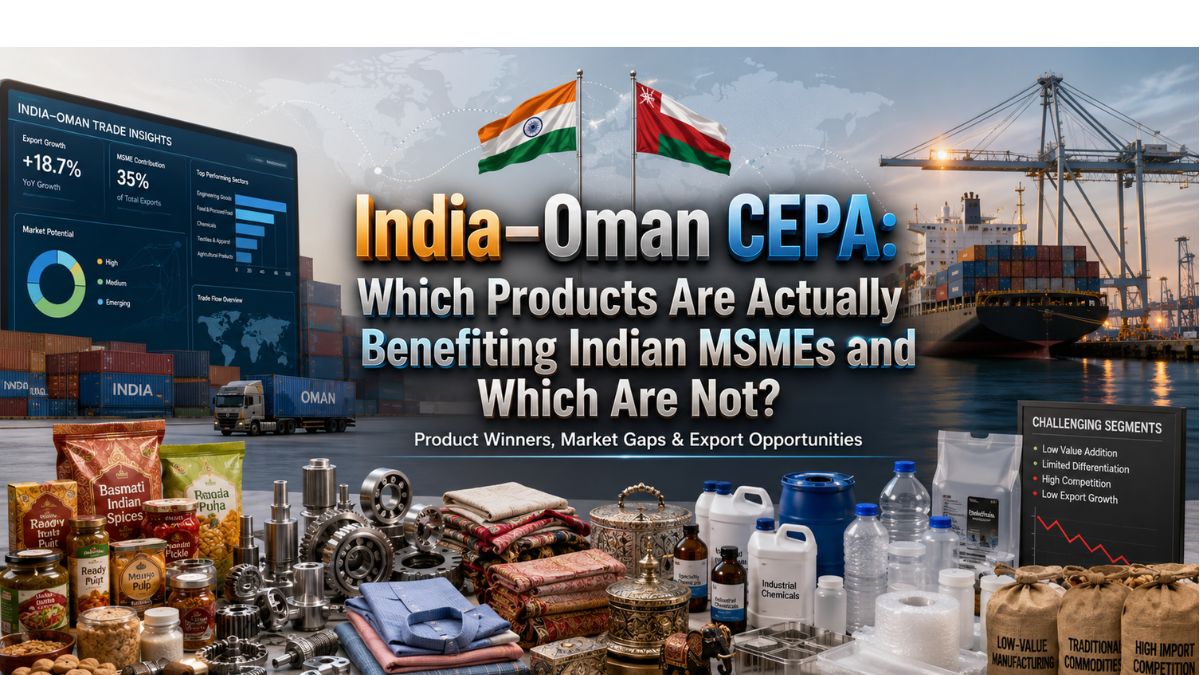
The Comprehensive Economic Partnership Agreement between India and Oman (CEPA) is the hot topic for India’s exporters. It has been encouraged by both the policymakers and trade bodies as one of the most promising business ideas for the MSME exporters to the Gulf. The reality on the ground is another story though. Some product categories are not doing as well as others. Some sectors are indeed benefiting from duty concessions, and easier access to them. Others are at a standstill — constrained by compliance issues, logistics expenses, or simply not prepared for the market. This article looks behind the smoke and dust and analyses who is and who isn’t benefiting from this agreement.
What the India-Oman CEPA Actually Offers
India-Oman CEPA, in the broader context of the India’s trade policy towards the Gulf, offers preferential tariff access for a large basket of Indian goods to Oman. DPIIT (Department for Promotion of Industry and Internal Trade) has declared that the agreement is an important tool to facilitate growth in manufactured goods exports from the MSME base in India.
The duty concessions are partial or total in different categories like engineering goods, textiles, processed food, chemicals and plastics, for Indian exporters. The advantage, however, is highly dependent on the exporter’s ability to comply with the rules of origin, provide necessary documentation and obtain goods that meet the quality requirements of imports in Oman.
View Full Project Details: Investment Opportunities & Business Ideas in Oman
Products That Are Actually Benefiting
Engineering Goods and Metal Fabrication
The most uniform uptake observed across all product categories is that of engineering goods such as fabricated metal parts of all kinds, parts and components of industrial machinery, and precision instruments and tools. The on-going infrastructure development driven by the Oman Vision 2040 and SEZ developments around Duqm have resulted in consistent and strong demand. For Indian manufacturers, the duty advantage is a reality if they can ensure compliance with the HS code classification and certificate of origin for the goods in clusters such as Rajkot, Ludhiana, Coimbatore, etc. Further, the Indian suppliers are preferred by many Omani buyers as compared to Chinese suppliers in terms of technical fabrication work, thus this segment has experienced real order growth.
Processed Food and Agri-Products
Processed food exporters have seen a significant improvement, especially in the spice, rice, packaged snack and ready-to-eat categories. The large South Asian population base in Oman provides a good base for retail demand. Processed food from India is more competitively priced under CEPA, as the import duty is reduced, thereby making India’s products more competitive as compared to other exporters. APEDA (Agricultural and Processed Food Products Export Development Authority) has been helping a few MSME food exporters in getting phytosanitary clearances and certifications for products backed by the Geographical Indications (GI) for the access to the modern retail chains in Oman.
Textiles and Garments
Textile exporters, especially the mid-value end such as cotton fabric, readymade garments and industrial workwear have availed the benefits of CEPA at an early stage. Demand for workwear and uniforms is a result of the construction boom and growth of the hotel industry in Oman. Indian manufacturers in Tiruppur and Surat have made themselves successful in this niche. But for those manufacturers that make premium or fashion forward apparel, Oman is comparatively shallow and many have shifted focus to Dubai as a transshipment centre.
Products That Are Not Benefiting — And Why
Chemicals and Pharmaceuticals
Chemicals and pharmaceuticals are one of India’s top export industries globally but the exports of chemicals have not benefited much in Oman under CEPA. The main challenge is the Oman’s drug registration process which obligates drug companies to obtain separate regulatory approvals based on their preferences. The bandwidth to manage these two compliance requirements is limited for a small MSME pharmaceutical unit. Likewise, specialty chemicals must meet compatibility certification requirements which constitute a de facto non-tariff barrier. The duty savings are theoretical and not common practice.
Plastics and Rubber Products
Oman is itself a big producer of plastics and petrochemicals. Indian plastic exporters will face stiff competition from locally-subsidised Omani production, because of local production by ORPIC (Oman Oil Refineries and Petroleum Industries Company). The tariff benefit of CEPA is not sufficient to offset the raw material cost benefit to the Omani manufacturers. Despite the duty concession, several Indian MSMEs in this category have seen their margins affected.
Related Article: How to Export to Oman Under CEPA: MSME Setup Guide
Government Policies and Support Mechanisms
The Ministry of MSME has launched several schemes for facilitating the small exporters to avail CEPA benefits. MSME Export Promotion Scheme offers financial support to participate in an international trade fair, product testing and packaging compliance. Furthermore, the Export Credit Guarantee Corporation (ECGC) provides risk cover for MSME exporters for entering new markets such as Oman.
The Make in India initiative has given a prominent export thrust to certain manufacturing clusters with a high concentration of MSMEs. The exporters of these clusters get RCMC (Registration cum Membership Certificate) documentation and DGFT assistance for compliance of Certificate of Origin to avail CEPA duty concessions faster.
Moreover, the Federation of Indian Export Organisations (FIEO) organizes buyer-seller meets with Omani partners periodically, enabling Indian MSMEs to directly reach importers in the Gulf without having to establish trade desks.
Business Ideas for MSMEs Looking to Enter the Oman Market
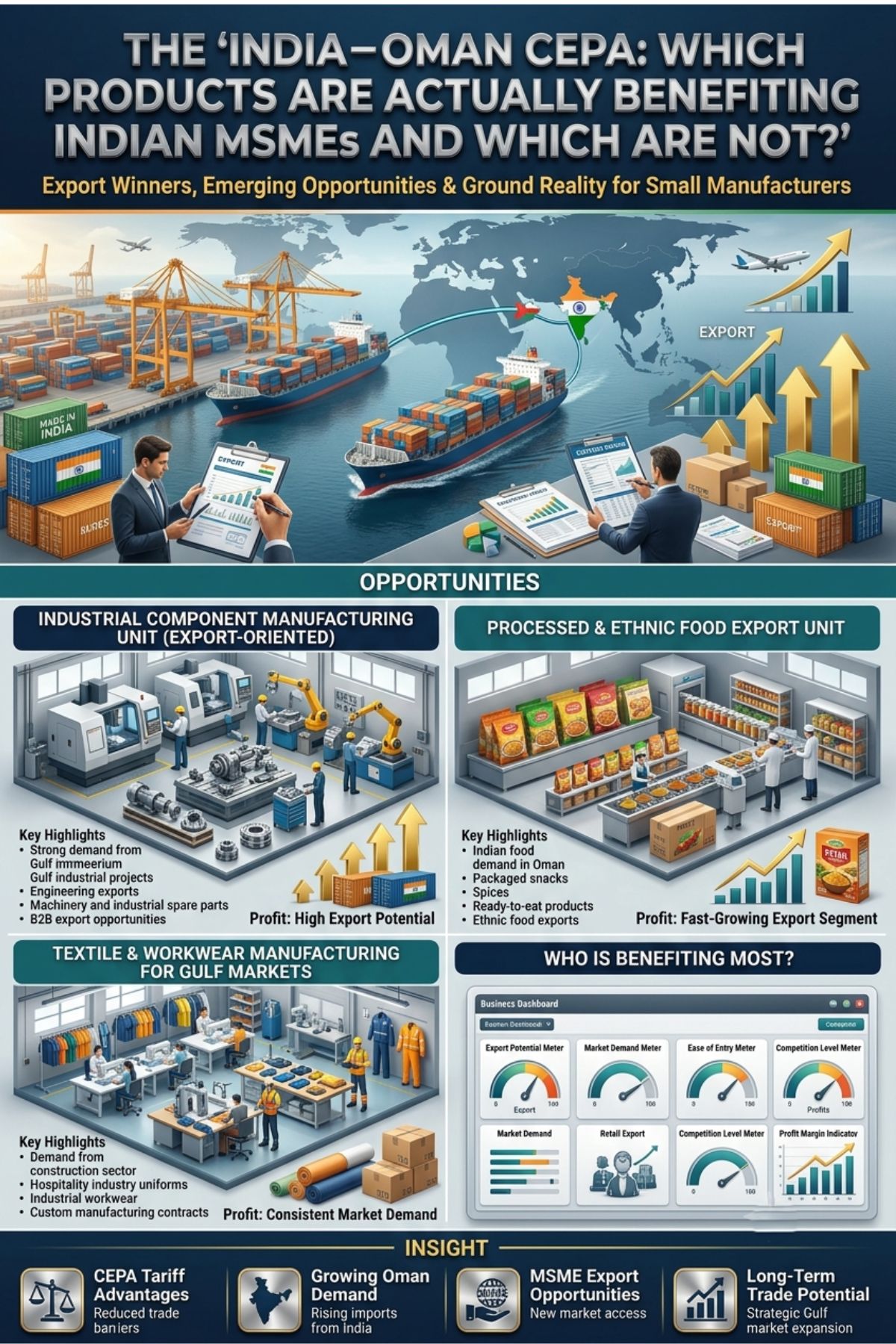
1. Industrial Component Manufacturing Unit (Export-Oriented)
One of the most concrete business ideas that come from the CEPA framework is the creation of a small precision engineering or metal fabrication business with a focus on the need of the Gulf export markets. A unit capable of manufacturing CNC made parts, flanges or structural steel products can be set up with an investment of ₹50-80 lakh. The focused MSME unit with appropriate quality certifications (ISO 9001 and CE mark) with the active support of the Duqm Special Economic Zone and industrial cities of Oman can easily achieve an export turnover of ₹3–5 crore per annum in the two to three years of its operation. The trick is to make production “cluster” to avoid high unit costs.
2. Processed and Ethnic Food Export Unit
An existing processed food facility that markets to the Indian and South Asian Asian expatriate community in Oman is a relatively low-risk entry point. Under CEPA, import duties are lowered on goods such as RTE (ready-to-eat) meals, masala packs, pickles and rice. A food unit certified by MSME and licence from FSSAI and Halal and properly packaged according to the requirements of the Gulf Standard Organisation (GSO) can enter into the Omani supermarkets and Indian grocery stores with competitive prices. With just a few logistical arrangements for the cold chain, an initial investment of ₹25-40 lakh can produce profit on a regular, repeat basis from retail orders.
3. Textile and Workwear Manufacturing for Gulf Markets
Oman’s construction, hotel and oilfield industries continue to be consistent demanders of industrial work wear, safety clothing and cotton uniforms. A MSME garment unit that is able to produce the garment in bulk at affordable prices and capable of producing standardised workwear products would benefit from the preferential tariff afforded by CEPA and hence would be able to offer better prices for its products than non-CEPA producers, especially if it is located close to the textile hub in Tamil Nadu, Gujarat or Maharashtra. Modest investment amount required. The cost of a 20-machine unit, having basic finishing capability, is ₹30-50 lakh. In the workwear sector, exports are generally recurring products, which provide more predictable cash flow than the fashion-driven export segments.
Get Detailed Insights from This Book: The Complete Technology Book on Textile Spinning, Weaving, Finishing and Printing
Import–Export Opportunity Analysis Under India-Oman CEPA
The least explored aspect of MSME is the import side in India-Oman CEPA from the MSME point of view. Oman is a competitive exporter of petrochemical feedstocks, crude-derived polymers and aluminium ingots. These should be available to Indian MSMEs in the plastics processing and aluminium die-casting sectors at lower rates of tariffs, both of which could lower the input cost, and make finished product competitive in the domestic market.
Further, India’s Directorate General of Foreign Trade (DGFT) has announced certain product items qualifying for the standard and enhanced CEPA concessions. This cross-matching between the products exported by MSMEs and the notified schedule by DGFT helps the MSMEs identify the products where they can save on import cost and get export revenue — a combination of benefits that is very seldom discussed in conventional trade briefings.
Indian MSME Success Stories in Gulf Trade
Cera Sanitaryware — Domestic Leader, Gulf Exporter
Vikram Somany’s Cera Sanitaryware was a mid-sized ceramics company that expanded into a luxury brand for ceramics through quality production and strategic entry into the Gulf markets. The company’s UAE and Oman success was due to their knowledge of the construction quality requirements in the region and designing their products to meet them, rather than just selling by volume. The new MSME exporters’ takeaway: Market fit and compliance readiness are more important than competitive pricing.
Parag Milk Foods — Dairy Export Model
Parag Milk Foods by Devendra Shah established a business for exporting dairy products to the Gulf countries, based on Halal products. As he invested early in certification infrastructure and Halal compliance, Parag found entry into the retail chains in the Gulf countries which were inaccessible to the non-certified Indian dairy products. This strategy, which is about compliance as a competitive moat is directly applicable by smaller MSME food units who are targeting Oman’s supermarket chains.
Choose the right startup backed by real market demand
How NPCS Can Help Your Export Business
Niir Project Consultancy Services (NPCS) offers industry expert consulting for new industry/business setup Market Survey cum Detailed Techno-Economic Feasibility Reports (DPRs). The manufacturing processes covered in our reports are detailed, market research and demand analysis is included, process flow diagrams have been provided, product mix, capacity planning, machinery details, raw material details and full project financials along with profitability analysis have been included. Our feasibility assessments can be useful for MSMEs thinking about exporting into Oman through CEPA to gauge product-market suitability, regulatory compliance expenses, and the realistic expected time of return, empowering founders to make informed investments instead of blind optimism.
India-Oman CEPA: Sector-Wise Benefit Assessment for Indian MSMEs
| Product Category | CEPA Duty Benefit | MSME Uptake | Key Barrier |
| Engineering / Metal Fabrication | High (10–15%) | Strong | Certification compliance |
| Processed Food & Spices | Moderate (5–10%) | Moderate-High | Halal + GSO packaging norms |
| Textiles & Workwear | Moderate (8–12%) | Moderate | Fashion segment shallow |
| Chemicals & Pharma | Moderate (7–12%) | Low | Dual regulatory hurdles |
| Plastics & Rubber | Low–Moderate (4–8%) | Very Low | Local Omani production competition |
| Agri-Commodities (Rice, Spices) | Moderate (5–8%) | High | Phytosanitary compliance |
Frequently Asked Questions (FAQs)
Q1. What are the most promising sectors for Indian MSMEs to gain from the India-Oman CEPA?
Consistently, the largest uptake is for engineering goods, processed food and textiles. These sectors offer duty concessions and high demand on ground from the Dubai’s infrastructure and consumer market which is largely driven by the Omani expatriate.
Q2. Which is the most frequent challenge that hinders MSMEs’ uptake of CEPA benefits?
The major obstacle to rules of origin compliance is the lack of understanding. MSMEs with no CofO or insufficient local value addition in their product are not eligible for the preferential tariff at the Omani port of entry. Further, many MSMEs are not aware of which HS codes are covered under the CEPA schedule.
Q3. Is CEPA applicable to a small MSME having a turnover of less than ₹5 crore?
Yes, there are no size restrictions! But smaller MSMEs must invest in their compliance infrastructure, such as registering for RCMC, getting trained in export documentation, and obtaining quality certifications, in order to reap preferential rates. Multiple small units under one cluster-type export model are an efficient pathway because of sharing logistics and documentation expenses.
Q4. From the point of view of MSMEs, are there any import benefits under CEPA for Indian MSMEs from Oman?
Yes. Oman exports Petrochemical feed stocks, aluminium, polymers which can be imported by Indian MSMEs at reduced duties. This is good for plastics processors, packaging producers and aluminium fabricators who benefit from the two-way preferential structure of CEPA that reduces their raw material costs.
Q5. Under CEPA, what are the certifications required to export food products to Oman?
Exporters of food products to Oman are required to be accredited with FSSAI certification, have a valid Halal certificate from an accredited body and be certified by GSO (Gulf Standards Organisation) for packaging compliance. APEDA is available for support with phytosanitary documentation which is also needed for raw agricultural products.
Q6. Where is the official product schedule that is available for MSMEs?
DGFT Trade Notice is the official website on which the India-Oman CEPA official tariff schedule and notified product lines under the CEPA are available. The duty eligibility of the product should be verified by cross checking HS codes with the published concession list by MSMEs.
Conclusion: Use CEPA with Open Eyes, Not Just Open Doors
The India-Oman CEPA is a real opportunity, but it is for those who are prepared exporters and not passive. Compliance efforts are translating to clear gains for MSMEs with engineering, food, and textiles. Chemicals and plastics continue to be mostly academic victories because they are not likely to be removed by duty concessions without tackling the non-tariff barriers. The most crucial part of the process for entrepreneurs and first-generation exporters is product-specific due diligence, and not blind faith in trade agreements. Who will reap the benefits of this CEPA will be decided by a feasibility-first strategy and the appropriate certifications, plus understanding the dynamics of the import regime in Oman.


