





Propylene Oxide Manufacturing Business in India
A Chemical with Extraordinary Commercial Potential
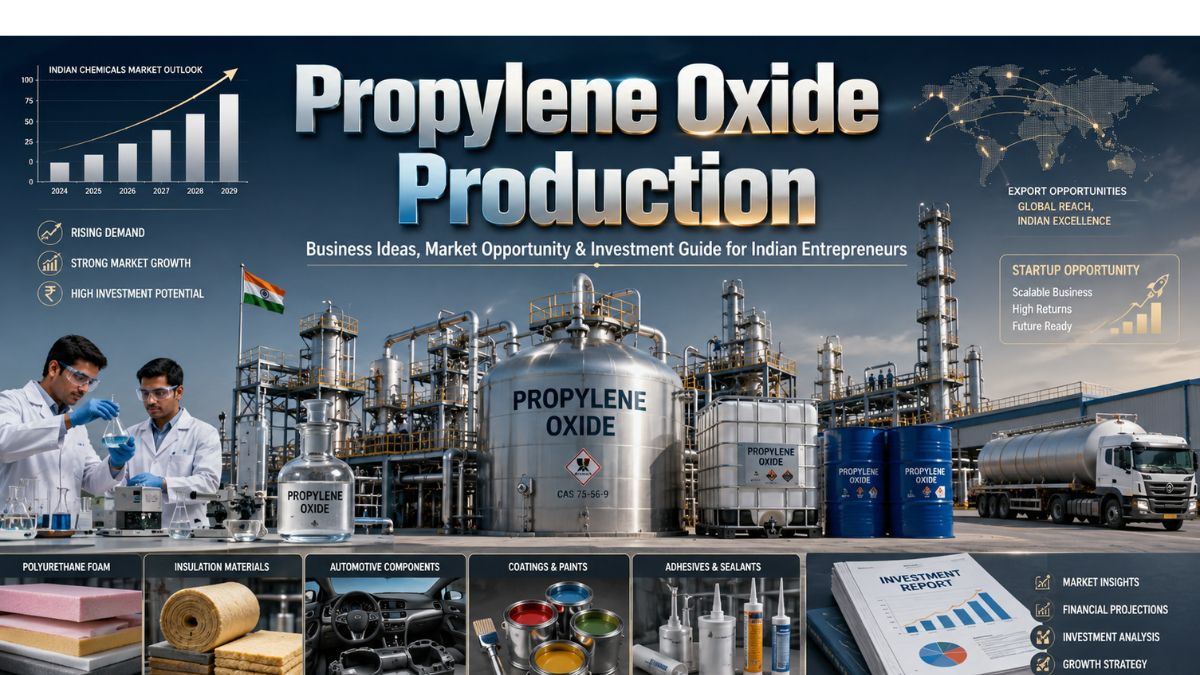
Propylene oxide is at the core of one of the fastest growing manufacturing segments in India. The compound is certainly worth considering if you are looking into business ideas in Specialty Chemicals. It also serves as an important component of polyurethane foams, propylene glycol, surfactants and flame retardants. They are used in various applications, ranging from automotive interior systems and building materials to food products and personal care items.
The Indian chemical industry is growing at a fast pace. Growth in the domestic market for polyurethane foam has been robust due to the real estate expansion, growth in furniture manufacturing and expansion in the automotive industry. All of these are fed by propylene oxide. However, India still imports a considerable amount of this intermediate chemical. That is an attractive manufacturing opportunity for progressive businessmen, investors in industry and MSME planners.
Why the Propylene Oxide Sector Deserves Serious Investment Attention
The case for going into propylene oxide production is based on simple demand logic. The market for polyurethanes in India is consistently growing due to the construction, cold chain logistics and consumer goods manufacturing sectors. Another important derivative, propylene glycol, is used in pharmaceuticals, food processing and cosmetics. Demand in these sectors is less sensitive to the recession and is in a growth phase with the rise of GDP.
Data provided on IBEF (India Brand Equity Foundation) reveals that Indian chemical industry is one of the most diversified industries in the world and is expected to become significant in the coming years. Propylene oxide is part of the segment of Reactive Chemicals and Intermediates, which is compounding at double-digit rates, owing to demand from the downstream industry.
Further, the world is dominated by a few key producers of propylene oxide in the United States, Europe and China. This means that Indian importers are vulnerable. Whatever the disruption, geopolitical, logistical or pricing, in an instant, the door is open for the domestic producers. The push towards Atmanirbhar Bharat has been given a further boost to the investment case for establishing local production capacity.
Get Detailed Project Report (DPR): Manufacturing of Propylene Oxide. Investment Opportunities in Chemical Industry.
Government Policies and Incentives Supporting Chemical Manufacturing
PLI Scheme and MSME Support Framework
The Government of India has been keen to promote the specialty chemicals sector as a key manufacturing industry. The Ministry of Chemicals and Fertilizers is responsible for a variety of policies such as investment facilitation, streamlining environmental clearance and export promotion for chemical manufacturers.
The MSME Ministry offers the Credit Guarantee Fund Trust (CGTMSE) to support small and medium chemical manufacturers to avail loans up to ₹2 crore without pledging any collateral. This eliminates one significant hurdle for first-generation entrepreneurs to start a specialty chemical manufacturing business.
Make in India has marked chemicals as one of its key manufacturing areas. This includes access to industrial land allocation, single window clearance support and priority infrastructural development of chemical parks and PCPIR (Petroleum, Chemicals and Petrochemicals Investment Region).
Besides this, DPIIT’s Startup India initiative provides income tax exemption for three years, easy compliance, and access to government procurement facilities to registered startups. New chemical process start-ups that have novel formulation methods may be eligible.
Business Ideas in Propylene Oxide: Specific Project Opportunities for Entrepreneurs
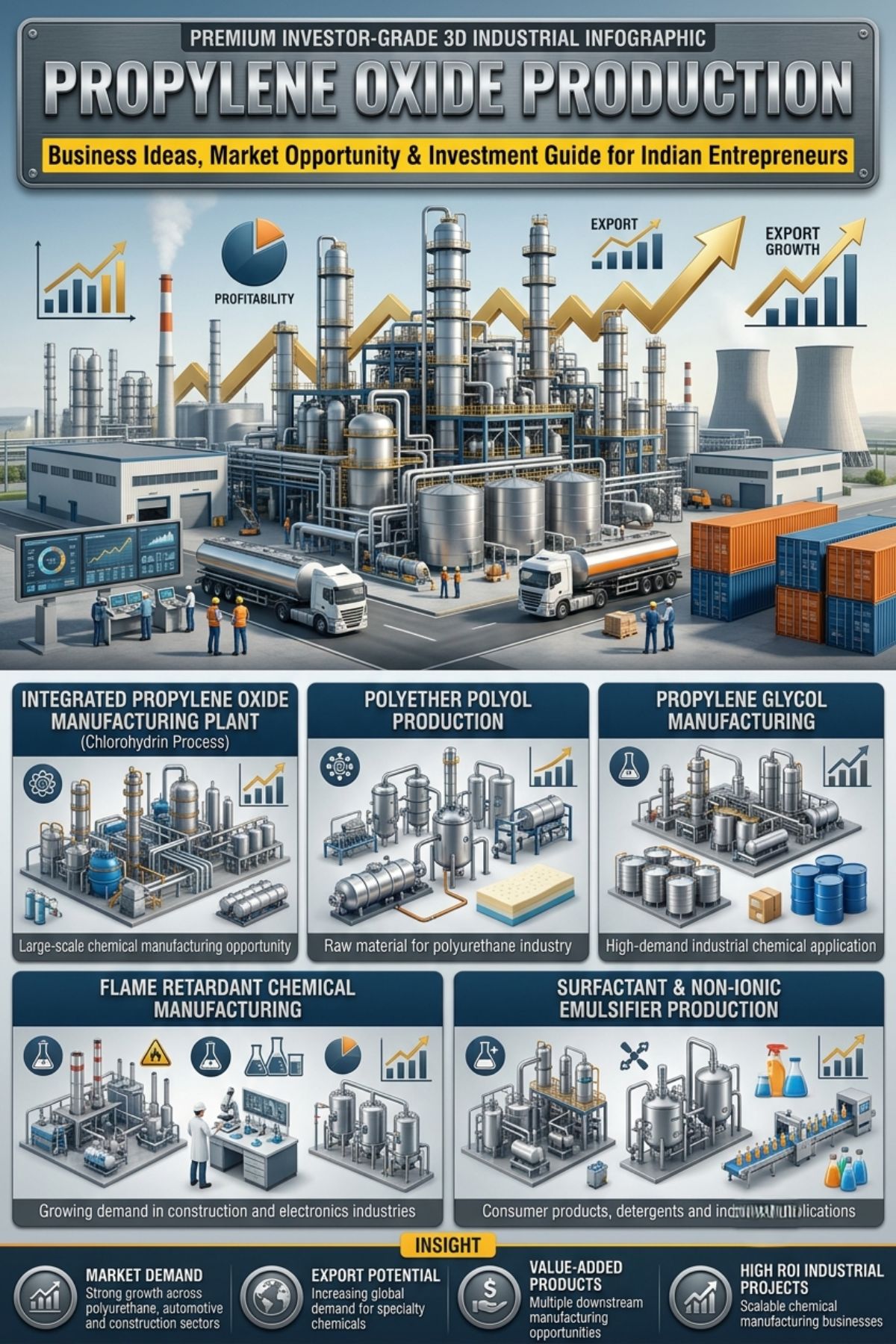
1. Integrated Propylene Oxide Manufacturing Plant (Chlorohydrin Process)
One of the most direct business ideas in this field is the establishment of a production unit for propylene oxide via the chlorohydrin process. This reaction is a combination of reacting propylene with chlorine and water, and then treating the desired product with calcium hydroxide or sodium hydroxide to produce propylene oxide. Though newer processes are available, chlorohydrin process is commercially viable for small to medium scale production in India as raw materials such as propylene from domestic refinery/petrochemical complexes are becoming increasingly available. The capital cost of the unit of capacity 5,000 MT/year can vary from ₹3 crore to ₹6 crore depending on the amount of process automation and effluent treatment facility. The technically sound entrepreneurs having access to a chemical industrial estate can achieve revenues in the range of ₹10 crore to ₹15 crore per year at current market rates, which is a high margin project.
2. Polyether Polyol Production Using Propylene Oxide
The polyether polyol production is a high value opportunity downstream propylene oxide. The most important raw material used for making rigid and flexible polyurethane foams is polyols. Polyether polyols are a major import into India for the applications such as furniture, mattress, automotive seating, and thermal insulation. A facility for producing polyol with a high value added can be realized by creating a separate production unit close to a propylene oxide feedstock source. It suits business owners with existing business relationships with their suppliers such as foam manufacturers, automobile OEMs or construction material manufacturers. The product is less complicated to deal with than propylene oxide, which is subject to stringent regulatory requirements. The investment range for 3,000 MT/year polyol unit is between ₹ 4 crore and ₹ 7 crore and has strong backward linkages to mitigate the raw material risk.
Your investment deserves the right opportunity
3. Propylene Glycol Manufacturing
Propylene glycol is a direct product of propylene oxide that is obtained through hydration. It is used widely in pharmaceuticals as a solvent and excipient and in food products as a humectant and additive, and it is used in cosmetics and personal care. Importantly, the pharmaceutical grade propylene glycol is more expensive than the industrial grade and India is one of the world’s largest pharmaceutical industries by volume. A propylene glycol plant for pharmaceutical and food grade applications can be operated as a high-value niche, if the right people will be recruited. This business will need quality certification investment given the compliance requirements from FSSAI and pharmaceuticals, but will have pricing power and customer stickiness. With proper certification, a businessman can develop long-term supply contracts with the middle-size pharma manufacturers and the FMCG companies.
4. Flame Retardant Chemical Manufacturing
Tris(1-chloro-2-propyl) phosphate (TCPP) and other halogenated flame retardants are derivatives of propylene oxide. The chemicals are required by building safety and fire codes in construction foams, upholstered furniture and electrical enclosures. The demand for flame retardant chemicals in the building industry as well as for public infrastructure is growing in India, with the regulatory bodies in the country becoming stricter in fire safety guidelines. A special flame-retardant factory is developed for construction and foam market can meet a developing market with regulation requirements. The business idea is appropriate for entrepreneurs who have a chemistry background or access to chemical engineering talent, and is a differentiated positioning in the market, most of which are import-dependent.
5. Surfactant and Non-Ionic Emulsifier Production
Propylene oxide reacts with ethylene oxide or fatty alcohols to form a variety of non-ionic surfactants and emulsifiers. They are commonly applied in farming (spray adjuvants), fabric, personal care and cleaning industrial products. The agrochemical industry in India is growing and there is ample evidence of the need for effective spray adjuvants which would enhance the spray coverage. The production of surfactants in mid-scale capacities, with agricultural and industrial cleaning as a niche, can cater to the huge domestic market in India and also tap the export market in the neighbouring SAARC and Southeast Asian countries. This is one of the easier entrances due to the fact that the scale can begin tiny, the regulatory process is more transparent than the pharmaceutical applications, and customer diversification occurs naturally.
Import–Export Opportunity Analysis
Indian trade in propylene oxide and its derivatives shows definite imbalance. According to data from Import Data from DGFT (Directorate General of Foreign Trade), India imports huge quantities of propylene oxide, polyether polyols, propylene glycol annually, mostly from China, the United States, and Germany.
On the export side India has proved its competitive edge in downstream chemical products especially in those where manual processing and formulation skills are added value. But exports of base chemicals, such as propylene oxide, are still restricted because there is no large-scale domestic production.
There is a twofold opportunity. First, import substitution is very feasible, any domestic pro-ducer who has reasonable efficiency will be able to compete with landed import price, importers also have a freight cost disadvantage and a risk of rupee depreciation. Secondly, export diversification will begin once the production is established. Propylene Glycol and Surfactants are in growing demand in Bangladesh, Sri Lanka and East Africa, and Indian Manufacturers can effectively compete on price and lead time.
To comply with the building of export-oriented units, the entrepreneurs should also consider the scheme of Merchandise Exports from India Scheme (MEIS) successor and Remission of Duties and Taxes on Exported Products (RoDTEP) scheme for chemical exporters which involves tax and duty rebates on embedded taxes.
Indian MSME Success Stories in Specialty Chemical Manufacturing
Aarti Industries – Building Scale from a Small Base
Indian specialty chemicals is an example where one of the most cited success stories of the transformation of an MSME to large enterprise is Aarti Industries promoted by Gogri family. It started as a small dyestuff intermediate business and gradually diversified into benzene chemistry, nitration chemistry and eventually pharmaceutical intermediates. The morals for the novel business owners is that of backward integration and customer connections depth. Aarti was unable to pursue all products – it strengthened its presence in certain chemistry segments and enhanced captive raw material security. Today it serves global companies such as BASF, Bayer and Clariant. The logic for making the decisions was strong: select chemistry segments with a high dependency on imports, expand process scale, and invest in quality certifications early.
Get Detailed Insights from This Book: Detailed Project Profiles On Chemical Industries
NOCIL Limited – Rubber Chemicals and Specialty Chemistry
The Mafatlal Group with its support, NOCIL emerged as the top rubber chemicals producer in India, a very niche segment of specialty chemicals. The strength of the company is due to the importance of the narrow product range of high technical barriers and stable industrial demand. The NOCIL model is a clear one for entrepreneurs aiming to create a propylene oxide enterprise—it’s about focus. Over-serving customers downstream will spread out capital and management effort. NOCIL selected rubber chemicals as a market with little sex appeal, and succeeded in establishing a strong market presence as there was little competition. Today, the same first-mover advantage is available to entrepreneurs who play by the rules in the production of propylene glycol and polyol.
Vinati Organics – Export-Driven Niche Chemistry
Vinati Organics is one of the best examples of new chemical entrepreneurs in India. Vinati Saraf Mutreja, the company, made a mark for itself in chemicals like ATBS (2-acrylamido-2-methylpropanesulfonic acid) and IBB (isobutyl benzene) which have very specific industrial usage. The company has more than 65% share of the ATBS market. The idea was to find chemicals for which the world is dependent and develop a very efficient Indian manufacturing base capable of exporting it. The model should be studied by entrepreneurs who intend to venture into the production of propylene oxide derivatives. Starting with one of the most demanded derivatives, e.g. pharmaceutical-grade propylene glycol, and establishing cost leadership with quality certification builds a defensible, and exportable, business.
How NPCS Helps Entrepreneurs Enter the Propylene Oxide Business
We, at Niir Project Consultancy Services (NPCS) have expertise in preparing professional Market Survey cum Detailed Techno-Economic Feasibility Reports (DPRs) for establishing new industries or new business. Our reports include detailed manufacturing processes, market research and demand analysis, process flow diagrams, product mix, capacity planning, machinery details, raw material details, and complete project financials with profitability analysis.
Our feasibility reports offer process engineering overview, market intelligence and financial modelling to help entrepreneurs make a sound investment decision in the production of propylene oxide or the manufacture of downstream derivative products. The goal of ours is to assist you in performing feasibility, profitability and long-term scalability analysis before investing money. Whether you’re a new-age entrepreneur or an MSME seeking to expand your business into specialty chemicals, NPCS offers the analytical backbone necessary for your project.
Related Article: Best Chemical Industry to Start in India: High Profit MSME Business Ideas, Investment & Setup Guide
Propylene Oxide & Derivatives: Key Market and Investment Data
| Product / Segment | Indicative Investment (₹ Crore) | Revenue Potential (₹ Crore/year) | Key End-Use Sectors |
| Propylene Oxide (Chlorohydrin Route, 5,000 MT/yr) | 3 – 6 | 10 – 15 | Polyurethane, Construction, Auto |
| Polyether Polyol Unit (3,000 MT/yr) | 4 – 7 | 8 – 13 | Foam, Seating, Insulation |
| Propylene Glycol – Pharma Grade (2,000 MT/yr) | 2.5 – 4.5 | 7 – 11 | Pharma, Food, Cosmetics |
| Flame Retardant Chemicals (1,500 MT/yr) | 2 – 3.5 | 5 – 8 | Construction, Electrical, Foam |
| Non-Ionic Surfactants / Emulsifiers (2,000 MT/yr) | 1.5 – 3 | 4 – 7 | Agro, Textiles, Cleaning |
Source: Indicative estimates based on industry benchmarks. For detailed project financials, refer to CII (Confederation of Indian Industry) and NPCS feasibility reports.
Frequently Asked Questions (FAQ)
Q1. What is the minimum investment to start a propylene oxide or derivative manufacturing unit in India?
Minimum Investment – depends upon the product A production unit of propylene glycol to produce an industrial product may require anywhere between INR 2.5 – INR 4 crores. A propylene oxide unit based on the chlorohydrin process will require approximately INR 3-6 crore. Upstream, activities like surfactant blending or flame-retardant formulators may require just INR 1.5 crore, hence, an option open to MSME entrepreneurs with modest capital base.
Q2. Is government approval required to manufacture propylene oxide in India?
Yes. Propylene oxide being considered a hazardous chemical under Manufacture Storage and Import of Hazardous Chemicals Rules, manufacturing facilities will need environmental clearances from the State Pollution Control board, have to obtain a factory license under Factories Act and site safety clearance under the Chemical Accident (Emergency Planning Preparedness and Response) Rules. Industrial units can be set up only in a demarcated Chemical Industrial estate and PCPIR areas. New entrepreneurs may need to account extra time and capital for statutory compliances during the setting up the plant.
Q3. Where can propylene oxide derivatives be sold domestically in India?
Large scale end users such as producers of PUF (furniture/ mattress foam manufacturers, automotive seat manufacturers, construction material manufacturers, FMCG manufacturers in personal care segment and agricultural product manufacturers require propylene glycol as well as surfactants). Several companies are established in manufacturing centers like Gujarat, Maharashtra, Rajasthan, and Andhra Pradesh. For new market entrants, direct B2B with contractual long-term supply agreements offers stability in revenue.
Q4. What are the key raw materials needed for propylene oxide production?
For the chlorohydrin process, raw materials required are propylene (from refinery or petrochemical units), chlorine (from chlor alkali units), water and lime or caustic soda. India already has substantial chlor alkali capacities (mainly concentrated in Gujarat & Maharashtra), so chlorine is not a bottleneck; in fact, access to Propylene is improving steadily due to increased refining and cracking capacities. A business decision for entrepreneurial investment in such a business should take into consideration, the proximity to raw materials suppliers, primarily as propylene transport could entail significant costs and security considerations.
Q5. Can a propylene oxide business in India be export-oriented from day one?
It is feasible in theory, but practically complicated in the initial years. An export unit will require to ensure the standards required by international buyers, get the REACH certification (for Europe) and others, as well as figure out the logistics for moving a hazardous chemical. A more practical way to approach the matter for new entrepreneurs would be to gain depth in the Indian market, get credentials from buyers in India, then layer on export buyers – perhaps focusing on the SAARC and SE Asian regions once you have consistency.
Q6. How does NPCS help entrepreneurs plan a propylene oxide manufacturing project?
NPCS prepares comprehensive Market Survey cum Detailed Techno-Economic Feasibility Reports (DPRs) that cover manufacturing process selection and flow diagrams, raw material sourcing and costing, machinery specifications and supplier identification, plant layout and capacity planning, market demand analysis and pricing benchmarks, and full project financial projections including break-even analysis, IRR, and payback period. These reports are specifically designed to help entrepreneurs evaluate whether a project is financially viable before committing to investment, and serve as the basis for loan applications to banks and financial institutions.
Conclusion: A Strategic Opportunity That Rewards Early Movers
Propylene oxide and derivatives are one of the most interesting investment prospects in India’s specialty chemicals market. Demand is of structure and multi-sector nature. The dependence on imports is high. There are lots of incentives in place to support local manufacturing. Entrepreneurs with the ability to prepare themselves technically and use capital wisely are poised to have a first-mover advantage in the gap between market demands and local supply capabilities.
The business concepts discussed in this article can include both “upstream” (propylene oxide) as well as “downstream” (polyols, glycols, flame retardants, and surfactants) opportunities that are appropriate to various capital structures and risk tolerances. They all share a common need – industrialisation in India requires the use of these chemicals and it requires them to be made within India.
Entrepreneurs who are serious about this opportunity should follow this up with a thorough feasibility study. In a business where margins rely on operational efficiency from the ground up, knowing the process cost, regulatory procedures, and market pricing before investing capital is no longer an option. Disciplined project evaluation is where they started and that is where your propylene oxide business should begin as well with the likes of Aarti Industries, NOCIL and Vinati Organics.


