





India Oman CEPA Business Opportunities
One Agreement. Eight Businesses. Zero Import Duty.
Ninety-four percent. This is currently the proportion of India’s imports of bovine meat in Oman. Not 40%. Not 60%. Ninety-four percent. Indian meat processors, however, continued to get the same import duty (5%) for sales to Oman for years. Now that duty is no more.
India-Oman Comprehensive Economic Partnership Agreement (CEPA) has been in effect since June 1st. As a result of it, 99.38% of Indian exports to Oman are now duty free from day one with no phase out schedule. Prior to the CEPA, only 15.33% of Indian exports were duty-free into Oman. This figure has risen to 99.38% of the population overnight.
This isn’t a policy statement to be filed away by a first-generation entrepreneur. It is a price advantage for all Italian Jewellers, Thai seafood processor and Chinese electronics exporters into the USD 28 billion import market of Oman. None of them have any CEPA with Oman. You do.
The focus is no longer on whether or not to target Oman. It is what business to do and how quickly to do it.
The Gaps Indian Entrepreneurs Are Not Yet Filling
Last financial year, India’s bilateral trade with Oman was valued at USD 11.18 billion. Eye-catching up to a point, and then when you go into the individual sectors and see all that’s being left on the table.
Emphasize gems and jewellery. Oman imports USD 1.07 billion in this category every year. India’s share? USD 25.78 million. Less than 2.5%. The surgical work is barely visible in the Gulf market as it is eight hours by sea from JNPT Mumbai while the clusters from diamonds and the gold jewellery, which produce maximum number of polished diamonds in the world, are located almost at the corners of Surat, Jaipur, Mumbai and Kolkata.
The market for marine products is also under penetrated. In the previous year reported, Oman imported USD 35.3 million in seafood. That is because some of the world’s biggest shrimp processing clusters are located in India, with operations spread out across the states of Andhra Pradesh, Kerala, Tamil Nadu and Gujarat, but accounting for just USD 10 million of it. India suffered a 5% tariff disadvantage so that the shrimp was less competitive on price compared to the shrimp from Thailand and Vietnam.
Electronics has the same history. Oman imported around USD 1.7 billion in electronics products while India only accounting for USD 146 million. India’s engineering exporters, including those under PLI scheme, were playing fair with the MFN rates charged by other countries that are subject to MFN duties imposed by Oman.
These markets are not developed by CEPA. They are already in place and are expanding. What CEPA does is to give Indian exporters a structural price advantage which can’t be matched by the competitors. With the pharmaceutical import market of Oman valued at USD 302.84 million and projected to grow at 6.6%, Indian generic manufacturers can now obtain 90-day marketing authorization for the products approved by USFDA, EMA or UK MHRA.
Source: PIB – Ministry of Commerce & Industry | APEDA Agri Export Data
Get Detailed Project Report (DPR): Investment Opportunities and Business Ideas in Oman (Middle East)
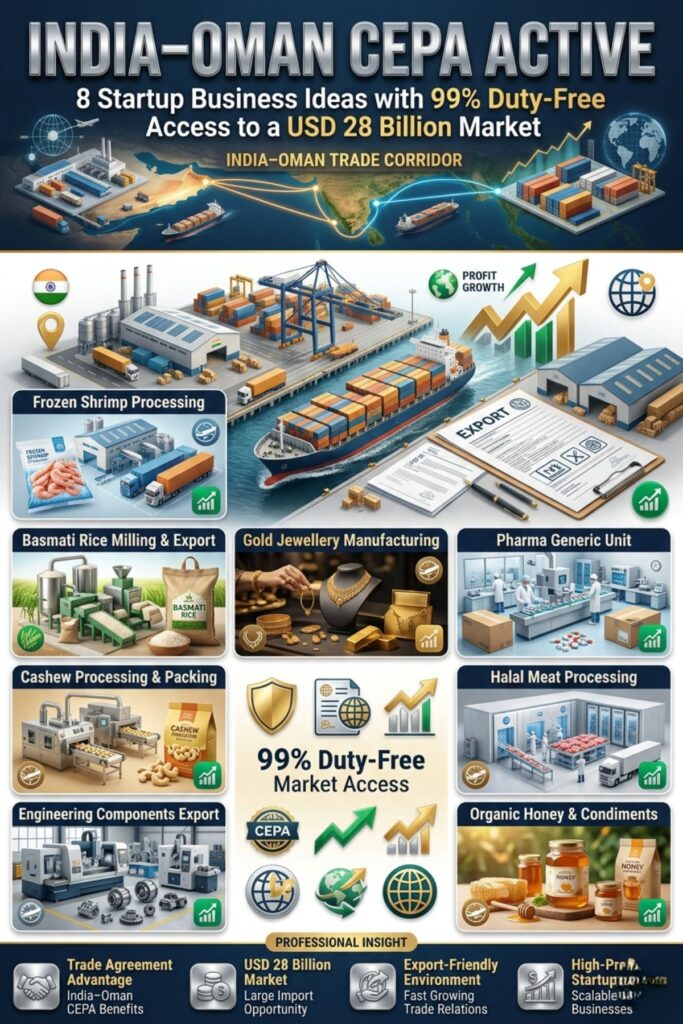
TABLE 1: 8 Startup Business Ideas Under India-Oman CEPA – Opportunity Snapshot
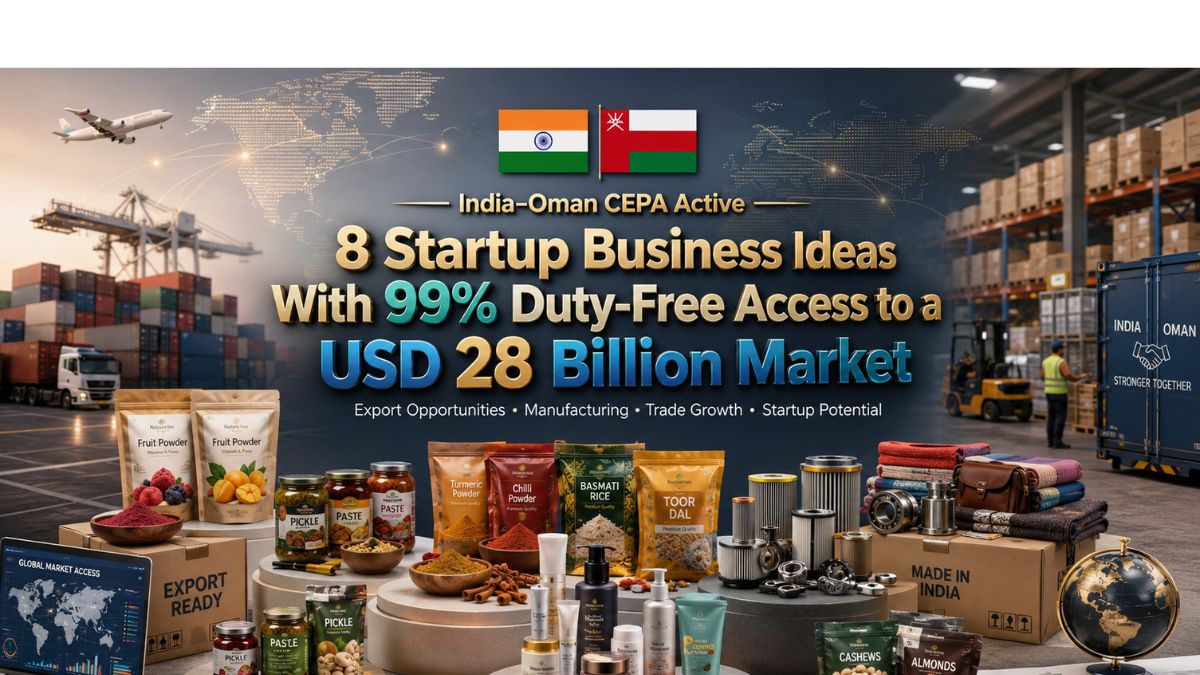
| Business Idea | Target Export Product | Min. Capital (INR) | Oman Market Size | Key Advantage Under CEPA |
| Frozen Shrimp Processing | Vannamei shrimp, black tiger prawns | Rs 55-90 lakh | USD 35.3 mn | 5% duty eliminated; EIC cert accepted at Omani ports |
| Gold Jewellery Manufacturing | 22kt gold sets, CZ studded jewellery | Rs 40-75 lakh | USD 1.07 bn total | Indian exporters now beat Italy, Turkey on price |
| Basmati Rice Milling & Export | Premium basmati, parboiled rice | Rs 80 lakh-1.5 cr | Large: India holds 17.8% share | Duty eliminated; India already 2nd-largest agri supplier |
| Pharma Generic Unit | OTC tablets, syrups, vitamins | Rs 1.5-3.5 cr | USD 302.84 mn | 90-day market auth for USFDA/EMA-approved products |
| Cashew Processing & Packing | W180, W240, W320 cashew kernels | Rs 30-55 lakh | Growing Gulf demand | Zero duty + APEDA certification support |
| Halal Meat Processing | Frozen boneless bovine meat | Rs 70 lakh-1.2 cr | India holds 94% of Oman’s bovine imports | Duty removal protects near-monopoly position |
| Engineering Components Export | Precision parts, castings, valves | Rs 1.2-2.5 cr | USD 875.83 mn (India-Oman) | MFN tariffs of 5% removed; PLI incentive available |
| Organic Honey & Condiments | Honey, mixed spice blends, sauces | Rs 15-30 lakh | Niche but high-margin | NPOP certification recognised; zero duty on entry |
Source: PIB Press Release; APEDA; Ministry of Commerce & Industry. Market sizes in USD for international comparison. Capital in INR.
Why These Eight Businesses Work Right Now
However, this is a moment in the Gulf trade announcement that is unlike all previous ones, for three reasons.
The duty removal is permanent and immediate. No sunset clause, no grace period, no phase-in for the sectors covered. Today the exporter of a container of frozen shrimp to Sohar port is charged no import duty. A Thai competitor ships the product at the same price but only charges 5%. That’s not going to fill in until Oman makes a stand-alone deal with Thailand – and that’s not in the cards.
Second, non-tariff barriers have been addressed in Oman in addition to tariffs. There is no duplication of testing as India’s Export Inspection Council certificates are now mandatorily accepted at Omani ports. NPOP organic certification and the halal certification system is formally recognised in India. This is the biggest operational obstacle for food startups and agri-processors to access the Gulf market.
Third, Oman is not a place to end up like a destination; it is also a gateway. It is connected by its ports at Sohar, Duqm and Salalah to the wider GCC market and East Africa. Having established an Oman distribution relationship, a startup can access a supply chain that extends to Riyadh, Nairobi and Dar es Salaam.
There are a number of schemes that directly support the founders entering this space. Under Startup India Seed Fund (DPIIT), Rs 50 lakh is being offered to the eligible startups in the agri-processing and food-tech sectors. Capital subsidy of 15-35% on the project cost (upto Rs 25 lakh) is offered to first generation entrepreneurs under PMEGP. CGTMSE will eliminate the need for collateral and provide credit guarantees to MSMEs with working capital requirements for export orders worth up to Rs 5 crore.
Exporters of packaged food and marine food exports get an incentive of 4-10% on incremental sales from PLI for food processing. These are the three largest cost barriers to be crossed by a first-time agri-exporter, namely certification, upgrading of cold chain and packaging compliance, which are covered by the development assistance grants provided by APEDA.
Scheme References: DGFT – RoDTEP & Foreign Trade Policy | MSME Ministry – PMEGP & CGTMSE | APEDA – Certification & Export Support
How to Launch an Oman-Focused Export Business: Step-by-Step
The process of setting up is the same for all eight business ideas. The sequence below is for a founder who begins from zero.
Step 1 – Legal and Export Registration (Week 1-2)
Incorporate your business as a Private Limited Company or LLP with MCA (3-5 days). Register for Udyam online and free of cost, on MSME Ministry portal. Get your Importer-Exporter Code (IEC) from DGFT at dgft.gov.in. Fees: Rs. 500. The only compulsory licence for any export business.
Step 2 – Sector-Specific Certifications (Month 1-2)
Various certifications are necessary before a Gulf buyer will engage in various products. Get FSSAI Central Licence for any food product. Marine products require EIC registration which is now accepted by Oman’s customs without re-inspection. Meat, sea food and food products must have halal certificate from Jamiat Ulama-i-Hind or Halal India. Pharmaceutical exporters require WHO-GMP certification, and USFDA/EMA approval will enable them to obtain a 90 day marketing authorization from Oman.
Step 3 – Production Setup and Space
APIIC, Gujarat (GIDC), Tamil Nadu (TIDCO), Maharashtra (MIDC) are the state industrial estates that provide plug & play factory spaces with subsidised rates for small agri-processing/food export units and Mid-scale engineering/pharma units at 5,000 to 15,000 sq ft.
The main equipment of the frozen shrimp processing line includes individual quick freezer (IQF) tunnel, peeling line, deveining line and blast freezer. These are sold by domestic manufacturers in Chennai and Mumbai at Rs 18-45lakh for a small unit or imported units from China and Taiwan for similar prices.
Step 4 – Raw Material Sourcing
Get from clusters that are near your unit. Shrimp and prawns: Nellore, Kakinada, Kochi. Gold and diamond inputs: Surat commodity market, Jaipur gem bourse. Karnal mandi, Amritsar mandi: Basmati paddy. Cashew raw nut (Kollam, Kerala and Goa) Pharmaapsis (APIs): The Genome Valley cluster in Hyderabad and the Ahmedabad GIDC pharma zone. Coimbatore, Rajkot and Ludhiana are engineering casting centers and forging centers.
Step 5 – Logistics and First Shipment
JNPT Mumbai, Chennai and Vishakhapatnam are the main ports for departure in Oman. It takes 7-12 days for transit. Get reefer containers 3-4 weeks ahead of time for perishable goods. Sign up on DGFT website and fill the Shipping Bill to avail RoDTEP benefits on all export consignment.
Use the Oman Chamber of Commerce and Industry directory to find your initial buyer in Oman or the directory of the India-Arab Chamber of Commerce or FIEO’s programmes on buyer-connect in the Gulf markets.
Get Detailed Insights from This Book: Just For Starters: How To Start Your Own Export Business
Timeline: Registration to First Commercial Shipment
- Month 1: Company registration, IEC, Udyam, FSSAI/EIC/Halal applications filed
- Months 2-3: Production unit setup, machinery installation, trial runs
- Month 4: Sample shipments, buyer qualification, Omani importer onboarding
- Month 5-6: First commercial shipment with CEPA preferential tariff documentation
Team Size
A small team of 10-14 members with all the production, processing members, one QA/Compliance Manager, one Export Documentation Manager, one Logistics Manager, and one Sales Person for Gulf buyers.
TABLE 2: Investment Breakdown – Frozen Shrimp Processing Export Unit (Illustrative, Scalable to Other Food/Marine Products)
| Cost Head | Small Unit (INR) | Medium Unit (INR) | Notes |
| Factory / Cold Storage Space (leased) | Rs 8-12 lakh/yr | Rs 18-30 lakh/yr | Coastal industrial estate preferred |
| IQF Freezing & Processing Machinery | Rs 18-28 lakh | Rs 45-80 lakh | Imported or FSSAI-approved domestic |
| Cold Chain Logistics Setup | Rs 5-8 lakh | Rs 12-20 lakh | Reefer van + port pre-booking |
| Raw Shrimp (3 months working capital) | Rs 12-20 lakh | Rs 30-55 lakh | Andhra Pradesh, Kerala, Gujarat sourcing |
| Export Certifications (EIC, FSSAI, Halal) | Rs 1.5-2.5 lakh | Rs 2.5-4 lakh | Halal cert essential for Gulf buyers |
| Packaging (export-grade vacuum packs) | Rs 2-3.5 lakh | Rs 5-9 lakh | Gulf labelling standards apply |
| Misc / Contingency (10%) | Rs 5-7 lakh | Rs 11-20 lakh | Always budget this separately |
| TOTAL ESTIMATED CAPEX | Rs 52-81 lakh | Rs 1.2-2.2 cr |
All figures in INR. Estimates for a coastal Andhra Pradesh or Kerala-based unit. Adjust upward 15-20% for Maharashtra/Gujarat locations.
Financial Snapshot: What a Shrimp Export Unit Earns
The figures below are an estimate for the small frozen shrimp processing unit aimed at Oman, the first market that has proven to be the easiest for the first movers. When required, the model can be scaled up or down to make it suitable for jewellery and food processing.
- Capital expenditure: Rs 52-81 lakh (in small unit) Rs 1.2-2.2 crore (in medium unit)
- Monthly operating cost: Rs 7-13 lakh (small) or Rs 20-38 lakh (medium)
- Revenue at 60% capacity: Rs 24-32 lakh/month (small); Rs 70-95 lakh/month (medium)
- Revenue at 100% capacity: Rs 40-55 lakh/month (small); Rs 1.2-1.6 crore/month (medium)
- Gross margin: 24-32% for exports of frozen seafood.
- Net margin after all costs: 13-19%.
- Payback period: 3-4 years (small unit) and 2.5-3.5 years (medium unit)
The 5% duty reduction from CEPA is essentially a per-shipment margin improvement. If the duty saved is calculated on a USD 80,000 consignment of frozen shrimp to be offered to Muscat, the duty saved is USD 4,000 or Rs 3.3 lakh. That margin adds to your profit or enables you to offer a more competitive price than your Thai and Vietnamese rivals.
There are higher margins on gems and jewellery: 20-35% net are possible with a steady volume of exports. Net margins of 18-28% are realistic for pharmaceutical generics when regulatory approvals are obtained and volumes ramp up.
Reference: FIEO – Export Promotion & Buyer Connect | EEPC India – Engineering Export Data
Identify high-growth industries before others do
TABLE 3: Government Schemes for CEPA-Aligned Export Startups – Eligibility & Benefits
| Scheme | Nodal Agency | Key Benefit | Best For |
| PMEGP | KVIC / MSME Ministry | Subsidy 15-35% on project cost (max Rs 25 lakh) | First-gen founders, rural export units |
| Startup India Seed Fund | DPIIT | Up to Rs 50 lakh grant for eligible startups | Pharma, food-tech, agri-processing startups |
| CGTMSE | SIDBI / MSME Ministry | Collateral-free credit up to Rs 5 cr | MSMEs needing working capital for export orders |
| PLI – Food Processing | Ministry of Food Processing | 4-10% incentive on incremental sales | Marine, dairy, packaged food exporters |
| RoDTEP | DGFT | Duty remission on all inputs used in exports | All goods exporters, especially engineering |
| APEDA Development Assistance | APEDA | Grants for certification, packaging, cold chain | Agri-processors, organic food exporters |
| Interest Equalisation Scheme | RBI / Banks | 2-3% interest subvention on pre/post-shipment credit | All MSME export units |
Source: MSME Ministry, DPIIT, DGFT, APEDA, RBI. Eligibility criteria apply. Verify current benefit amounts at respective ministry portals.
Entrepreneur Spotlight
Meera Pillai is the Founder of Seafood Export, Kerala.
Meera Pillai started her shrimp processing and export business in Alappuzha, Kerala, with Rs 62 lakh of capital, of which Rs 18 lakh was provided by the PMEGP subsidy scheme. Within 4 years she was shipping 8 containers to buyers in Muscat and Dubai, each month. Her main conclusion: Halal certification is not a choice but an entry ticket. Without this, Gulf importers aren’t going to even respond when queried. With CEPA eliminating the 5% duty, her Muscat buyer has already increased the order volume by 35%.
Project Planning Support for Export Startups
The most underestimated step to take in starting an export business is getting the numbers right before you invest. Based in New Delhi, NIIR Project Consultancy Services (NPCS) develop detailed Project Reports (DPRs), techno-economic feasibility studies and plant layout designs for MSME scale operations in all 8 sectors discussed in this article.
An NPCS project report gives specifications of the machinery, raw material cost estimates, roadmaps for regulatory compliance and financial viability analysis for the founder of a frozen shrimp plant in Andhra Pradesh or a cashew processing unit in Kerala based on the cost of raw material inputs in India. Information regarding export-oriented food processing, pharmaceuticals, engineering goods and agro-processing are available at niir.org and for entrepreneurial first time in the industry, they are available at entrepreneurindia.co.
The One Step to Take Before This Week Ends
Nearly all entrepreneurs read something like this, nod in agreement and take absolutely nothing for three months. It’s exactly this three-month delay that the competitor in Bangkok, Istanbul or Guangzhou is expecting.
Select any one out of 8 businesses given. Any one business, not two business. And reply answer on 3 questions, in 48 hours: Do you have access to raw material cluster? Can you obtain EIC or halal certification within 60 days? Do you have seed capital of 50-80 lakhs or access through CGTMSE?
Select any one out of 8 businesses given. Any one business, not two business. And reply answer on 3 questions, in 48 hours: Do you have access to raw material cluster? Can you obtain EIC or halal certification within 60 days? Do you have seed capital of 50-80 lakhs or access through CGTMSE?
Apply for IEC: dgft.gov.in | Oman importer directory: chamberoman.om
Related Article: India-Oman CEPA: The Trade Gateway Every Indian Exporter Has Been Waiting For
Citation Links Embedded in Article
- PIB – India-Oman CEPA Press Release: pib.gov.in
- DGFT – IEC Registration & Foreign Trade Policy: dgft.gov.in
- APEDA – Agri Export Data & Certification: apeda.gov.in
- MSME Ministry – PMEGP, CGTMSE Schemes: msme.gov.in
- FIEO – Export Promotion & Gulf Buyer Connect: fieo.org
- EEPC India – Engineering Exports Promotion: eepcindia.org
- Oman Chamber of Commerce & Industry: chamberoman.om
Frequently Asked Questions
Q1. What is the minimum investment for an export business to Oman under CEPA?
A1. Sector dependent: Honey & Condiments Startup could start from Rs.15-30 Lakh. Frozen Shrimp Processing unit from Rs.52-81 Lakh and Pharmaceutical generic unit from Rs.1.5-3.5 Cr. With PMEGP, effective capital requirement may come down by 15-35% because of the government subsidy available for first-generation entrepreneurs.
Q2. What licences do I need before I export to Oman?
A2. IEC Code from DGFT (Rs 500, 2-3 days) and Udyam Registration is required for every exporter. Food & Marine exporters also require FSSAI Central Licence & EIC registration. For any food, meat & seafood product, Halal certification is commercially mandatory. Pharmaceutical exporter requires WHO-GMP certification. EIC certificate is accepted by Omani customs directly under CEPA.
Q3. How can I find Omani buyers for Indian products?
A3. The Oman Chamber of Commerce & Industry directory (chamberoman.om) can be a good start. FIEO can introduce buyers for business via Gulf buyer-connect program, APEDA export facilitation cell can help agri and food exporters find buyers in the Gulf countries. Trade shows like Gulfood Dubai or India-GCC Business Summit is also an effective way to get the buyers.
Q4. When can a startup be profitable while exporting to Oman?
A4. A lean shrimp processing unit will break even on operations in 8-12 months from the first shipment (at 60% capacity utilization). Capital will get paid off in 3-4 years for food and marine exporter and in 2.5-3.5 years for jewelry and gem exporter. The savings due to CEPA will improve this by Rs 2.5-4 lakhper container to margins or pricing headspace.
Q5. Which govt. Scheme is the most useful for a first-time export startup?
A5. PMEGP is the most feasible in terms of capital subsidy (uptoRs 25 lakh;15-35% project cost). CGTMSE can cover loans up to Rs 5 crore for working capital without collateral, while Startup India Seed Fund provides funding for product-stage agri/food tech startup. APEDA can provide grants for certification costs and cold chain-costs, which are the largest operating expense.
Q6. How can NPCS help an export startup going to Oman?
A6. NPCS provides industry-specific DPRs and ensures entrepreneurs know exactly what they are investing in. They include a machinery list with supplier names, layout drawings for the factory, information on all regulatory approvals required and a 5-year financial estimate, for each of the 8 business models described in the article. They also have available ready reports for each sector. You can also commission NPCS to prepare a sector-specific report. Visit niir.org to download ready reports or commission custom reports.


