






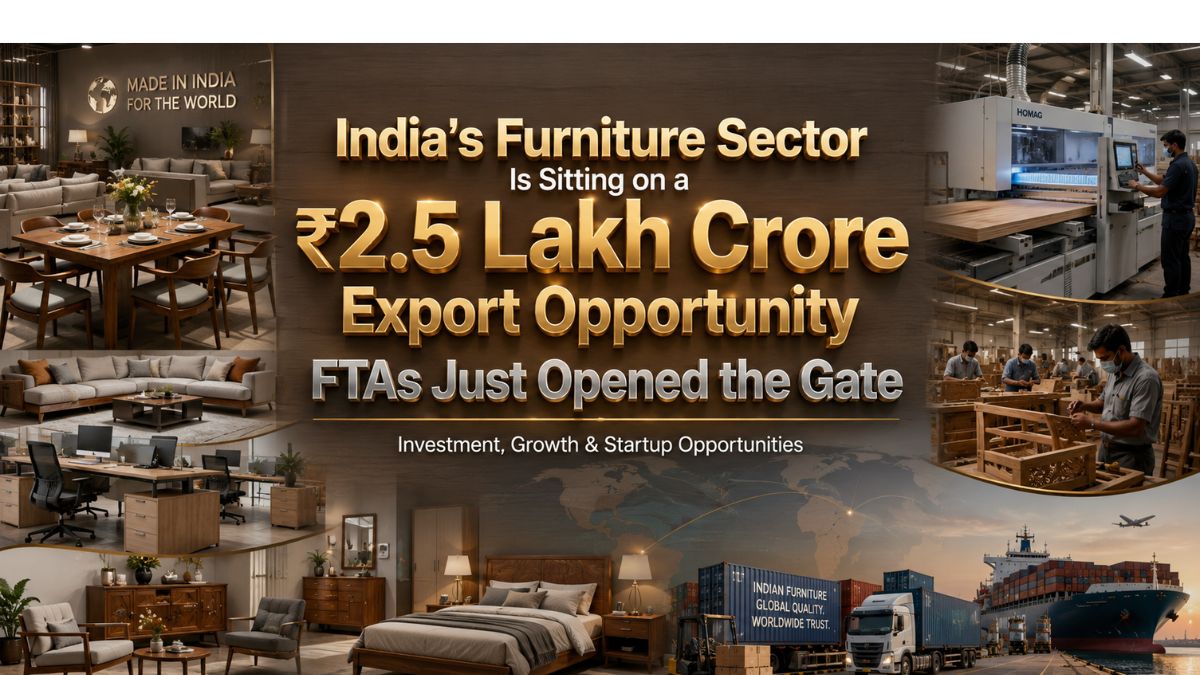
India Furniture Export Business Opportunity
A Market Signal Founders Cannot Afford to Miss
A recent Economic Times report heralded a major change in the furniture industry for India. The expanding India network of Free Trade Agreements (FTAs) will have significant impact on furniture exports and manufacturing momentum in India. The expanding Free Trade Agreements (FTAs) in India will have a significant impact on the exports of furniture and furniture manufacturing momentum in the country. Nation’s industry veterans and trade experts are terming it a structural opening which is happening for the first time in 10 years and which startups and MSMEs cannot afford to miss.
India is already 16th in the furniture export exports list of the World and accounts for only one per cent of the world’s furniture exports. However, around the world, the furniture industry is expected to reach USD 872.5 billion in 2030. The numbers make for an interesting read even if India’s share is doubled, it is a USD 8-9 billion opportunity each year.
The availability of the preferential tariff access in the UAE, Australia, UK, EFTA countries, Oman and the European Union has given the Indian manufacturers a structural cost advantage for the first time. With duty concessions, one of the largest hurdles that Indian furniture faced in overseas markets is eliminated. What is coming after is an explanation of why this market change is significant, and what it means for the founders, MSMEs and investors who are ready to take action.
What Recent Economic Times Reporting Means for the Furniture Sector
Market Signal: Economic Times identified a big policy-to-market opportunity as India’s completed and pipeline FTAs are bringing the export intent to the export reality of furniture. Check out the complete development: ET: Free Trade Pacts to Boost Furniture Exports
In a business strategy context, here is what the Economic Times development means:
- Duty walls are collapsing: Even though exports to the countries are tariff-sensitive, Indian exporters are enjoying a tariff advantage over their Vietnamese and Malaysian peers through duty-free trade agreements with the UAE, Australia, UK, EFTA and Oman.
- Ecosystem investment is accelerating: The Maharashtra Global Furniture City (MAHA-GFC) is building an integrated manufacturing-logistics-trade hub, signalling organised capital flow into the sector.
- IKEA is betting on India: It is a strategic investment in India by the Swedish retailer in the country’s manufacturing and design prowess, and reflects its confidence in the country’s manufacturing and design capabilities at global level.
- Import substitution is viable: Gujarat to Maharashtra, industry says it is in no way a lack of capability, but a matter of scale and marketing.
The Economic Times is a clear signal to the mind of the founder/ MSMEs that the structural challenges of furniture exports have reduced. It’s a short window that offers a chance to establish positions before the big guys consolidate.
View Full Project Details: Wood and Wood Products: A Complete Guide
Why India’s Furniture Industry Is Growing — And Growing Fast
The Indian furniture market was estimated to be greater than USD 30 billion and is one of the biggest in Asia. However, less than half of what is produced in the country is exported. Read the full development: ET: Free Trade Pacts to Boost Furniture Exports.
1 — Rising Domestic Consumption
Demand for domestic furniture is on the rise, at 12–15% per year, due to rapid urbanisation, expansion of the middle class and a real estate construction boom. As the consumer expectations are raised by the organised retail outlets such as IKEA, ‘at home’ and ‘pepperfry’, then quality-conscious manufacturers are compelled to react accordingly.
2 — China+1 Strategy of Global Buyers
The global procurement teams are looking to diversify their purchases from China. India is a natural beneficiary due to its huge pool of skilled manpower and the government having improved the tariff regime. US, Germany, and the UK are seeing an increase in furniture imports from Indian manufacturers, especially from the UK.
3 — FTA-Led Tariff Advantage
It’s the latest and strongest growth engine directly highlighted by the Economic Times. With decreased work under active FTAs, Indian exporters can now compete in the markets where they used to face adverse competition from their lower cost neighbours. Rated the EU deal will create another multi-billion-dollar pipeline.
Government Policies and Incentives Supporting the Sector
At the policy level, the conditions in India have become more conducive for the development of furniture industry and furniture export on several fronts:
- MSME Credit Guarantee Scheme: Credit is provided without any collateral and amounts up to ₹ 5 crore are available for furniture manufacturers who are looking to scale up and grow. Check with MSME Ministry for eligibility.
- Make in India: Furniture Focus: Make in India is committed to encouraging furniture as a priority manufacturing sector with single window investment facilitation.
- Furniture Exporters can avail Advance Authorisation, Export Credit schemes, as well as RoDTEP benefits from the Directorate General of Foreign Trade (DGFT).
- Furniture startups with the DPIIT Recognition will get income tax exemption, speedy IP processing and Fund of Funds capital. Signup on Startup India.
- Small Industries Development Bank of India (SIDBI) MSME Loans: SIDBI provides competitive interest rate loans for the capacity expansion and upgrading of furniture plants.
Five Startup and MSME Business Ideas Emerging from the FTA Signal
Each of the business opportunity listed below has grown out of the opportunity identified by the Economic Times. These are not generic ideas; they’re market valid openings.
Idea 1 — FTA-Focused Furniture Export House
Establish a dedicated export trading house exclusively for markets which India now enjoys tariff benefits – UAE, UK, Australia and EFTA countries. Serve as a middle man for 20–50 smaller furniture makers who are not well positioned to export directly. Margin potential on FOB value is 12-18%. Investment range: ₹40–80 lakhs.
Idea 2 — Bamboo and Engineered Wood Furniture Brand
Demand for sustainable furniture (FSC certified) is growing in the West. In India, there is a significant amount of bamboo and agro-waste fibre resource which is not yet commercialised on large scale. A positioning story that can’t be matched by any Chinese player is built by a furniture brand focused on design and certified sustainable, with the aim of exporting to Europe and the UK. Range of investment: ₹60 lakhs–₹1.5 crore.
Related Article: The Bamboo Billionaire: How a Manipur Tribal Entrepreneur Created a Global Eco-Furniture Brand
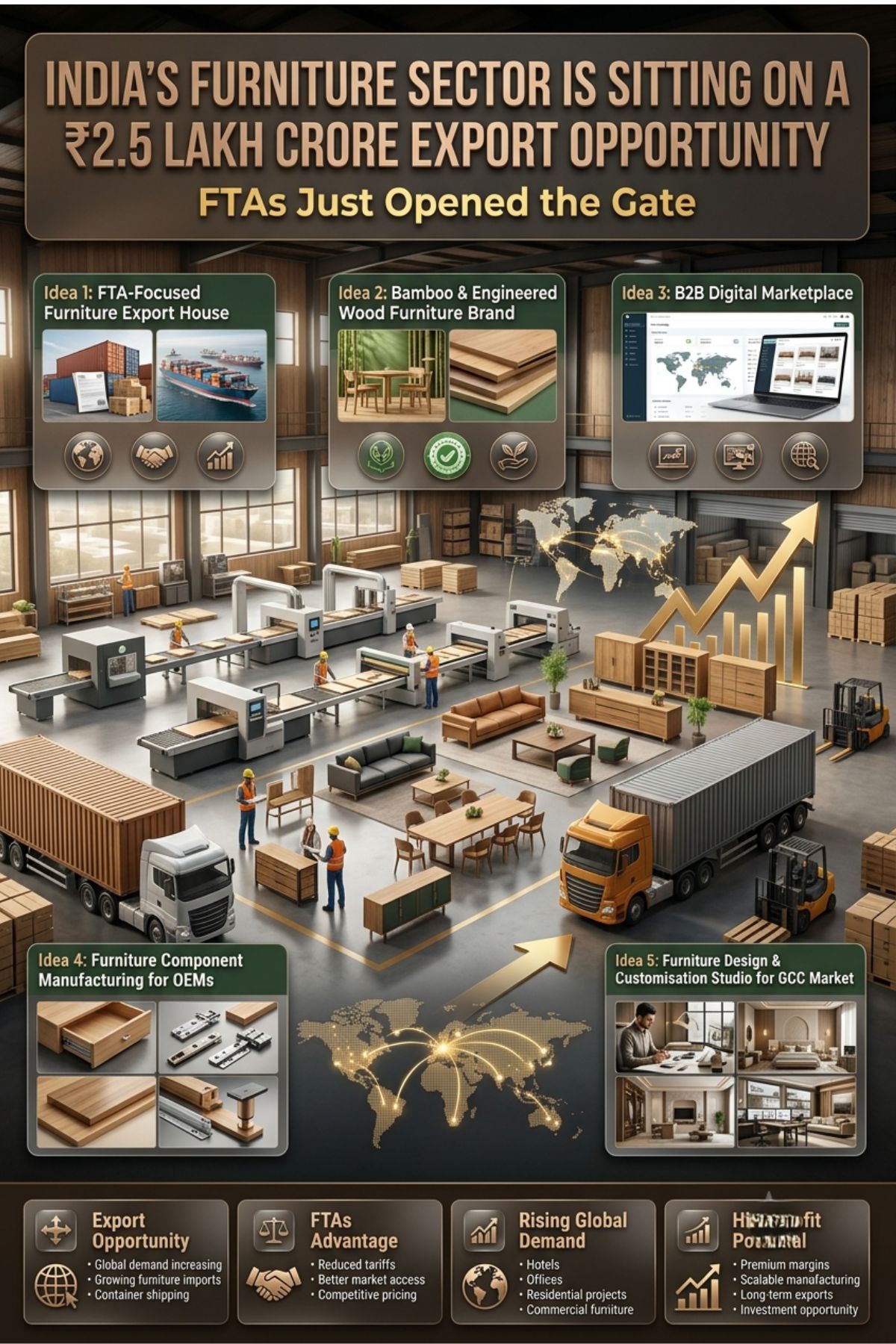
Idea 3 — B2B Digital Marketplace for Furniture Buyers and Factories
Outdated trade portals should be used for global buyers to scout Indian furniture. A B2B site that streamlines and enables international procurement teams to directly connect with Indian verified factories with price transparency, MOQ, and sample management is a real pain point addressed. Revenue Model: Subscription + transaction fee. It is a play that needs minimal up capital of ₹20-40lakh and it is an asset light digital play.
Idea 4 — Furniture Component Manufacturing for OEMs
The furniture brands from the whole world are increasingly outsourcing components. A precision hardware & component manufacturer in the drawer system, hinge, edge band and cabinet fittings industry can provide both domestic assemblers and export OEMs. It’s an upstream game and sticky B2B revenue. The investment range is between ₹1 and ₹2.5 crore in CNC equipped facility.
Idea 5 — Furniture Design and Customisation Studio for the GCC Market
The India-UAE FTA has lifted tariffs on Indian furniture imports into the GCC. Indian craftsmanship (Rajasthani carving and Saharanpur woodwork) is unrivaled in the world in the field of luxury, customization and heritage aesthetics, which are all required by the Gulf consumers. A design studio for the hospitality and home market can charge a premium price. Investment range: ₹30–60 lakhs including showroom in Dubai.
Get Detailed Insights from This Book: The Complete Technology Book on Wood and Its Derivatives
Import–Export Opportunity Analysis
The furniture import export profile of India is both a challenge as well as an opportunity. It seems that the country’s supply gap exists at the premium end as it currently imports high quality furniture, particularly from China, Italy and Malaysia. At the same time Indian manufacturers are making headway with volume buyers in USA, Germany and UK.
The FTAs are not equal opportunities. The duty saving for Indian exporters in markets such as the UK and UAE would be 6–12% for the next 3-5 years. The SCF is important in a category where the landed cost can be a deciding factor between an order from India or Vietnam.
On the import front, duty rationalisation in some of the FTAs for machinery and raw materials will enable the Indian manufacturers to upgrade plant and machinery quicker and thus narrow down the gap between the technology of East Asian manufacturers. The impact of the net is a more competitive sector in the domestic and global markets in 3-5 years.
Key Export Markets Under Active FTAs: UAE (active), Australia (active), UK (ratified, will come into effect July 2026), EFTA — Switzerland (active), Norway (active), Iceland (active), Liechtenstein (active), Oman (active), EU (negotiations concluded).
Furniture Sector: Key Market Data at a Glance
| Parameter | Current Status | Projection / Target |
| Indian Furniture Market Size | USD 30 billion+ | USD 60+ billion by 2030 (est.) |
| India’s Global Export Rank | 16th | Top 10 target by 2030 |
| India’s Share of Global Exports | ~1% | 3–5% with FTA leverage |
| Global Furniture Market | USD 550+ billion | USD 872.5 billion by 2030 (TPCI) |
| Key Export Destinations | USA, Germany, UK | UAE, EU, ANZ added via FTAs |
| IKEA India Manufacturing Plans | Product Dev. Company Launched | Expand local sourcing rapidly |
| Maharashtra Global Furniture City | Under Development (MAHA-GFC) | Integrated MFG + Export Hub |
| Major FTAs Benefiting Sector | UAE, Australia, EFTA, Oman, UK | EU, GCC, Canada pipeline |
Indian MSME Success Stories Pointing the Way
Nipponply Industries, Gujarat
Nipponply Industries, a company based in Gujarat is a real-life example of the FTA opportunity. Managing Director Ketan Thakkar has announced publicly that the company has already begun exports and that products from India are of quality par with international standard. This is not to say that the other big opportunity, import substitution, is not as big as winning orders overseas, says Thakkar: “Replacing furniture that is imported in the domestic market is just as lucrative as winning orders overseas.
Identify high-growth industries before others do
Bharat Cluster Ventures (BCVPL) and MAHA-GFC
Founder Amiet R Barot is on a visionary path. BCVPL is not just making furniture, but building the Ecosystem of the Maharashtra Global Furniture City that includes manufacturing, trade, manufacturing exports and logistics. This is the style of group thinking that has revolutionised the textile industry in Surat and auto components industry in Pune. MAHA-GFC indicates that smart capital is coming to the furniture category earlier than the rest of the market.
IKEA’s India Product Development Company
It’s a medium-term strategic wager by a global retailer for IKEA’s brand when it establishes a product development branch in a market.It is a medium-term strategic gamble by a global retailer of IKEA’s brand when it puts its own product development arm in a market. The move by IKEA is an affirmation of the quality of Indian design talent and manufacturing capability. It also indicates increasing requirements of local sourcing which is a supply chain opportunity of hundreds of crores for start-ups.
How Professional Feasibility Analysis Can Accelerate Your Market Entry
From Market Signal to Business Launch – more than enthusiasm is needed. This demands a comprehensive feasibility analysis that includes plant design, equipment procurement, raw material procurement, regulatory approval and detailed cost estimates. NPCS (Niir Project Consultancy Services) offers feasibility reports and project profiles for various furniture and allied project industries, which are technically designed to assist the MSMEs and start-ups to make bankable investment decisions backed by government funding support.
FAQ — Founder and MSME Questions Answered
Q1. What is the minimum amount of investment needed to start a furniture export business from India?
Small startups as Furniture Export Trading Houses can set shop with a minimal amount of Rs 30-50 lakhs for initial inventory purchase, marketing, internet presence, event participation, and operational capital. For large Furniture Manufacturing Facilities it would take an investment of Rs 80 Lakh to Rs 3 Crores, depending on the category of Furniture.
Q2. Which countries with FTA offer the most promising and immediate export opportunity for furniture manufacturers in India?
The United Arab Emirates (UAE) and United Kingdom (UK) markets show immense and actionable promise in 2026. The India-UAE FTA agreement is effective and available for duty-concession for furniture export since May, 2022. This agreement provides immense advantage for India. Whereas, the FTA between India and United Kingdom is set to come into effect from 15th July, 2026; thereby paving way for Indian exporters with ample opportunities in this highly consuming market. Both countries also host a significant population of Indian expats that has a penchant for Indian furniture styles and tastes.
Q3. What government schemes are available to MSMEs for furniture export financing?
India’s micro, small and medium enterprises sector gets financing under many schemes, some notable one being credit guarantee schemes such as the MSME Credit Guarantee Fund Trust (CGTMSE), which allows for loans on 85-100% collateral cover. Other facilities include the SMILE Scheme offered by Small Industries Development Bank of India (SIDBI), which offers finance for the purchase of modern machinery. Exporters benefit from duty drawbacks on inputs for export from the RoDTEP scheme, under DGFT. For the latest information regarding such schemes and the required documentation visit – www.msme.gov.in and www.dgft.gov.in.
Q4. How does a startup secure placement on international B2B furniture marketplaces?
India’s various Export Promotion Councils act as a gateway to these opportunities for furniture startups. Notable among them include: The Handicrafts and Handlooms Export Corporation (HHEC) provide assistance. CAPEXIL, the export promotion council for wood products and timber, aids furniture exporters significantly. Many buyer-seller meet ups by FICCI & CII offer opportunities for meeting with potential overseas clients. Leveraging the power of digital platforms like Tradeindia.com, IndiaMart.com and specialized global B2B portals is also highly effective for visibility and to get product listings on international B2B furniture websites and catalog marketplaces.
Q5. Can I include bamboo furniture in my export product basket?
Definitely. With an increased focus on sustainable products by global buyers, bamboo furniture has emerged as a popular option especially in the EU, UK, and Australia – markets well-aligned with Indian furniture for market entry, either via FTAs or other agreements in place and planned. The EU requires sustainability accreditations like the FSC certification to clear products in customs. Many bamboo furniture ventures in India already find favor in European countries like Germany and The Netherlands.
Q6. What are the most significant risks associated with running a furniture export business?
Three key risks define this industry: Price fluctuations of raw materials -especially timber and hardware prices – remain a concern. Quality assurance is another hurdle when producing at a larger scale, especially from Indian MSME clusters. The last factor that could impact the profit margin for exports is the exchange rate fluctuation between Indian and foreign currency. A well-diversified hedging strategy with respect to currency risk, long term contracts with reliable suppliers of furniture material and proper quality management systems are often put in place to mitigate the risks.
Conclusion: The Gate Is Open — How Long Will It Stay?
The Economic Times development is more than just a news item. It is the most definite kind of market entry signal. For years, India’s furniture industry has been preparing for this; setting up cluster ecosystems, training craftsmen, upgrading technology and building design skills. The FTA wave is now playing what policy could not even do: price competitiveness on the global shelves for Indian furniture.
The argument with the timing is simple. First movers in UAE, UK and EU corridors will start to develop buyer relationships, quality track records and secure shelf space before the inevitable rush. In industries such as textiles and pharmaceuticals, early investment in export infrastructure has enjoyed the lion’s share of the FTA benefits. Furniture is about to hit the same turning point.
The most that can benefit are MSMEs who are already manufacturing quality furniture. They possess the manufacturing know-how. They tend to be lacking in access to the market, export documentation knowledge, and networks of global buyers. These are skills that are trainable and constructible — and a time and space in which they can be trained with the most enabling policy support.
India’s export of furniture is currently less than one per cent of the world’s furniture export. All four of the FTAs, the IKEA validation, the MAHA-GFC cluster and the China+1 buyer behaviour shift converge in the same direction. The industry needs to take the opportunity as the Economic Times report indicates, as others in Vietnam, Malaysia and Turkey read the same signals and speed up.


