





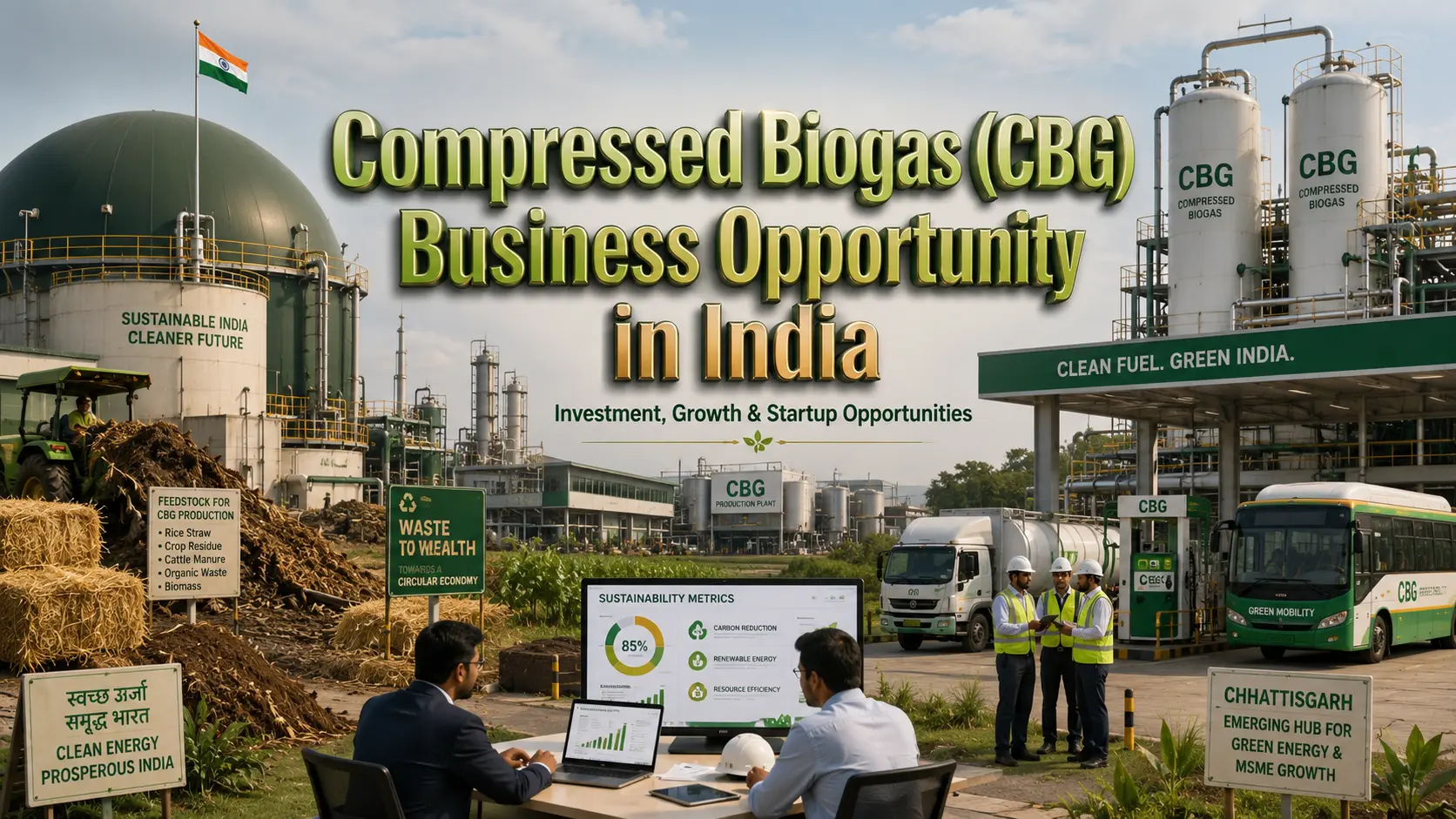
CBG Business Opportunity in India
A big change just occurred in the energy landscape of India. The Chhattisgarh government, this week, has approved the Chhattisgarh Compressed Biogas (CG-CBG) Policy 2026, a groundbreaking industrial policy to generate clean, compressed biogas (CBG) from agricultural residue, cattle dung and municipal organic waste, according to the Economic Times. It is not a step-by-step initiative that is green. This is a state level creation of a market.
The policy was approved by the cabinet led by the Chief Minister Vishnu Deo Sai on June 23, 2026. The state has already received Rs 3,600 crore worth of private investment proposals. Eight districts have had a start on plants in support of BPCL and GAIL India. The government has set an ambitious target of producing up to five lakh tonnes of CBG per year with savings of Rs 1,188 crore in forex.
This is an invitation for all entrepreneurs, MSME founders, and startup investors to watch this bio-energy economy in India come to life. This opportunity is not if it’s there, it’s when. The question then becomes, early enough to benefit from it?
This policy would help Chhattisgarh to emerge as one of the top states in the country in clean energy production, green industry, organic farming and sustainable development, said Chief Minister Vishnu Deo Sai.
Read the Complete Book Here: Biogas and Compressed Biogas (CBG) Production Handbook (from Waste & Renewable Resources)
What Recent Economic Times Reporting Means
CG-CBG Policy 2026 has been identified as a key milestone in India’s journey towards a greener economy for oil and gas, by the Economic Times. To give perspective, today India has to import a lot of natural gas. Locally produced compressed biogas helps to decrease this dependence. The ET report marks a significant shift in the country’s energy-security debate, with Chhattisgarh’s actions being tied in with it.
Why is this particular Economic Times development commercially so important?
- State-level policy provides investable certainty. Entrepreneurs require stability in the regulatory environment. With CBDA as the nodal agency, timelines of incentives and capital subsidy commitments, are exactly what the CG-CBG Policy offers.
- The alignment of the SATAT is important. India’s Sustainable Alternative Towards Affordable Transportation initiative requires oil marketing companies to purchase CBG. This is a national offtake guarantee that can be directly used by any plant in Chhattisgarh.
- Five lakh tonnes is no government wish. It is based on the available biomass such as paddy straw, cattle dung, sugarcane press mud and municipal organic waste which is abundantly available.
- The policy conveys a replicable model. What Chhattisgarh has done today, other states will do in the coming 12-24 months. In this area, a first-mover advantage really exists.
Read the original Economic Times coverage: Chhattisgarh Govt Approves Compressed Biogas Policy 2026 – Economic Times Energy
Why the Compressed Biogas Industry Is Growing in India
Since the introduction of the SATAT initiative in 2018, India’s CBG sector is picking up the pace. The target to have 5,000 CBG plants nationwide by 2025 was set by the scheme. Things have come a long way in early 2026, but nowhere close to filled to capacity. It’s your chance to close that gap.
Three Structural Forces Driving CBG Growth
Energy import substitution: India’s crude oil import bill touched a record high of Rs 12 lakh crore in FY2025. A major benefit of in-house production of clean biogas on a large scale is the direct contribution to this burden. A direct forex saving of approximately one tonne of CNG is achieved for every tonne of CBG used in place of CNG.
The agricultural waste crisis is on the verge of a tipping point in India with stubble burning being the most visible and politically sensitive pollution issue. Millions of tonnes of paddy and wheat straw are burnt in Punjab, Haryana, Madhya Pradesh and Chhattisgarh every year. This straw is sold to CBG plants which provide income for farmers and from an environmental point of view, it addresses the pollution problem in the country.
Momentum towards circular economy in India: The Economic Times has been reporting on the policy shift towards circular economy in India, consistently. CBG meets all the criteria: waste input, clean energy output, generation of bio-fertiliser as a by-product and creation of jobs in rural areas.
The figures are impressive. CBG sector in India is poised to receive investments of more than Rs 1.75 lakh crore for the next ten years, as per industry estimates correlating with the SATAT framework. The new policy for Chhattisgarh, mentioned by Economic Times, is yet another fuel in this fire.
Access Complete Business Plan: Compressed Bio Gas (CBG) Bio CNG Plant – A Guide to Clean Air and Clean Fuel
Government Policies and Incentives Supporting CBG Entrepreneurs
The CG-CBG Policy 2026 is part of a national framework of policies. There is a need for Founders to be aware of the state and central level support available.
Central Government Support
SATAT Initiative (MoPNG): Renders a mandate on the oil marketing companies to buy CBG. Gives operators a guaranteed purchase of their product.
Apply via: Startup India – SATAT Resources
MSME Development Support: Capital subsidy, credit guarantee and priority sector lending for MSME scale CBG units.
Details via: Ministry of MSME
DPIIT Startup Recognition: CBG ventures can be recognised as Startups under DPIIT which would provide tax benefits and also ease in the regulatory requirements.
Production Linked Support (PLI): CBG equipment manufacturing is eligible under PLI schemes.
Explore at: Make in India
CG-CBG Policy 2026 State Incentives (Chhattisgarh)
The policy is based on six pillars: basic infrastructure support, development of feedstock supply chain, support for plant setup and operation, bio-fertiliser management, CBG demand generation and integration into the transportation sector, and investment promotion. Together, these include:
Capital assistance for setting up plants:
- Subsidies for interest on term loans
- Preparation of reports for statutory approval and allocation of land
- Feeder road infrastructure and connectivity
- Infrastructure support for feeder roads and connectivity
- CBDA coordination for investor handholding
The Chhattisgarh Biofuel Development Authority (CBDA) acts as one-stop facilitation agency for all CBG investments in the state. CBDA can be approached for site identification, feedstock mapping and approval assistance for the founders.
Business Ideas for Startups and MSMEs Emerging from This Development
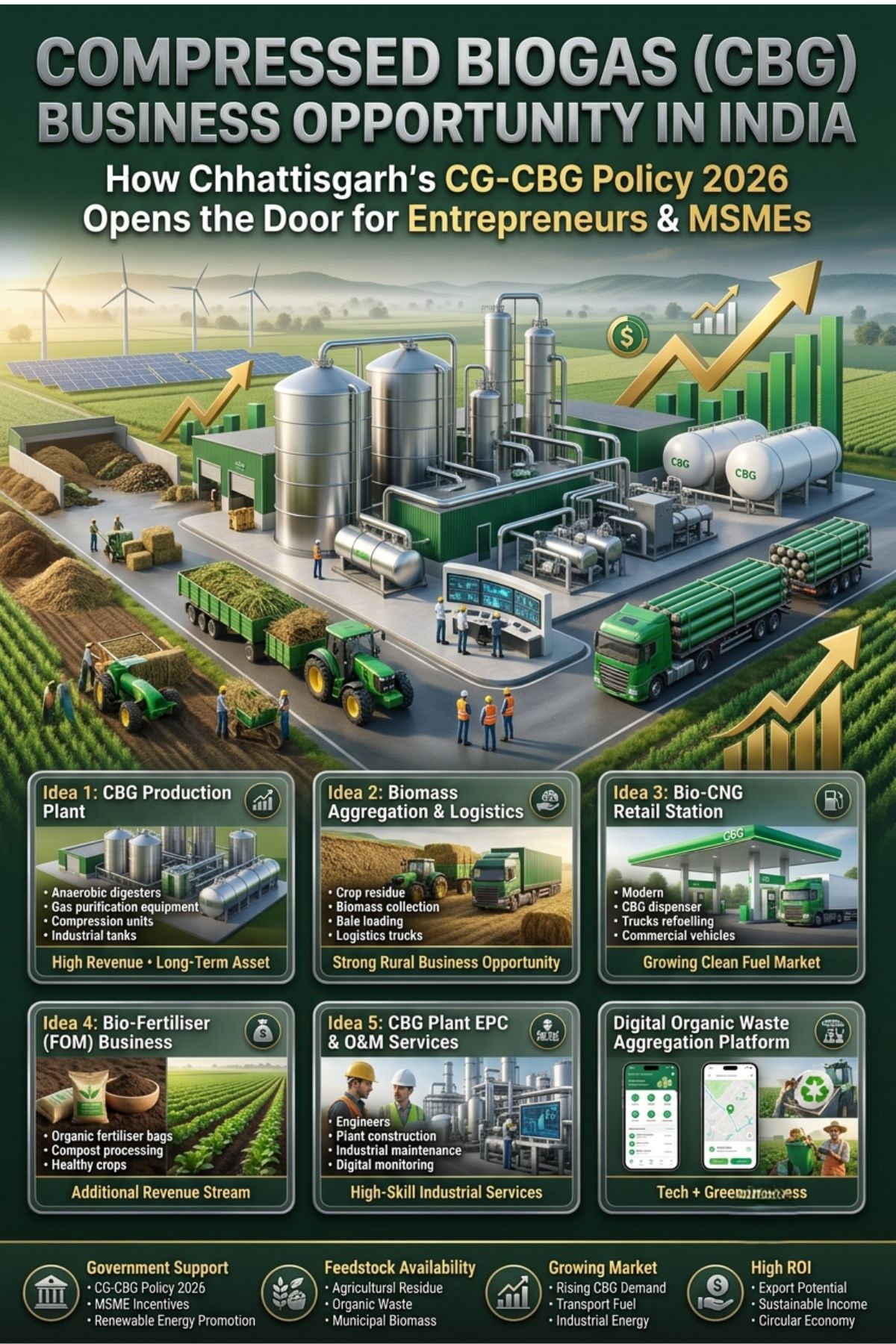
The CG-CBG Policy 2026 is not an “opportunity” to create one business opportunity. It creates an eco-system. According to Economic Times, here are the most commercially viable startup points that are directly coming out of this development.
Idea 1 — CBG Production Plant (Small to Mid-Scale)
This is the opportunity to anchor. The amount of CBG can be produced is 600–2000 kg/day in a plant processing 10–30 tonnes/day of biomass. CBG is sold to the oil companies for Rs 46 per kg under SATAT which can generate an annual income of Rs 1.5-2 crore at a rate of 1000 kg per day and has a good ROI post subsidy. Capital requirement: Rs. 3 to 8 crores depending on the size of the project and 20 to 35 percent of this capital is taken up by the state and central subsidy.
Related Article: Compressed Biogas (CBG) Plants: A Bankable Green Energy Business for New Entrepreneurs
Idea 2 — Biomass Aggregation and Logistics
A regular supply of feedstock is essential for every CBG plant. In Chhattisgarh, paddy straw, cattle dung and press mud are abundantly available, but not well aggregated. Last-mile feedstock collection, storage and delivery infrastructure, or a biomass supply chain company, is one of the biggest challenges in the sector that has been addressed by a startup. Investment: Rs 50–80 lakh. Business model: supply margin on revenues per tonne, long-term supply contracts with plants.
Idea 3 — Bio-CNG Retail Station
After the production of CBG, distribution is required. The support will be provided for dedicated Bio-CNG retail outlets which are eligible under SATAT framework. The retail station model is well established for setting up on a national or state highway, serving trucks and commercial vehicles, in Chhattisgarh. Investment: Rs 1.5–3 crore. This is a cash generation business with high defensibility – long term fuel retail margins.
Idea 4 — Bio-Fertiliser (Fermented Organic Manure — FOM) Business
A high-quality by-product bio-slurry is produced during CBG production. If done properly, this can be used as a premium organic manure, selling at Rs 6,000–12,000 per tonne in the market. A CBG startup that is based on the bio-fertiliser packaging and distribution has both supply-side (plant) and demand-side (farmers) benefits as the demand for organic farming grows and reduction in chemical fertiliser is encouraged by the government. Investment: Rs 40–70 lakh.
Idea 5 — CBG Plant EPC and O&M Services
Thousands of CBG plants need to be built in India. Not all promoters are engineers. There are opportunities for an engineering, procurement and construction (EPC) company with a track record of designing, building and commissioning small-to-medium CBG plant to take in a lot of contract revenue. Recurring revenue is added with operations and maintenance (O&M) contracts. Investment: Rs 80 lakh–2 crore. Revenue: project based – recurrent O&M income stream.
Idea 6 — Digital Platform for Organic Waste Aggregation
There is a huge amount of organic waste generated every day by urban local bodies, housing societies, hotels and food processing companies. The combination of waste management and clean energy is a SaaS or marketplace solution that links waste generators with CBG plants such as logistics, compliance and payments. A business model that is asset-light, high margin and scalable nationally. Investment: Rs 20–50 lakh.
Import-Export Opportunity Analysis
CBG as a business has an immediate import substitution advantage – one tonne of CBG produced locally saves the same amount of natural gas imports. However, the opportunity is not just limited to substitution.
Equipment Import Replacement
Indian country is now importing biogas upgrading and compression technologies from European and Chinese producers. The engineering skills of the founders enable them to produce purification membranes, compressors and gas quality measurement instruments for biogas in their country. This is a positive factor with the production-linked incentives (PLI) and make in India initiatives by DPIIT. The Directorate General of Foreign Trade (DGFT) provides export promotion support.
Choose the right startup backed by real market demand
Bio-Fertiliser Export
India exports organic produce and bio-inputs are on the increase. The high-quality organic manure produced by CBG plant can be exported to the markets of certified organic food in Europe and the Middle East, where there is an increasing demand for manure free from chemicals. The Agricultural and Processed Food Products Export Development Authority (APEDA) provides market intelligence, helps with export documentation for such exporters. APEDA – Export Promotion offers more:
The CG-CBG Policy 2026 provides a ground to not only produce energy in India but also for the country’s emerging bio-economy export basket, including fertilisers, organic inputs and clean-tech equipment.
Indian MSME Success Stories in the Biogas Space
The biogas and CBG sector have already achieved success in various areas which has proved that this space is commercially viable.
Biogas Company of India (Pune)
This Pune-based private biogas plant builder has successfully installed biogas plant in agri-processing industries, dairy co-operatives in Maharashtra and Andhra Pradesh and is one of the early plant builders in India. India’s regulatory framework is conducive to a model of feedstock-integrated plant operations that can deliver steady returns, according to their model.
Pristine Logistix (Maharashtra)
This MSME was involved in biomass aggregation and established a chain of collection centres in the sugarcane-growing districts, providing press mud and bagasse to energy companies. They have established a supply-chain-first model which is now a reference for the monetisation of feedstock logistics, apart from owning the plants.
Village-Level Bio-CNG Cooperatives (Haryana)
A few farmer-producer organisations in Haryana have started their community-level biogas plant where the dung and paddy straw are being used to generate compressed gas for transport in villages. These models highlight that it is possible to create sustainable rural enterprise even with an investment of less than Rs. 1 crore, with NABARD and SIDBI support. The support programmes for such ventures available at SIDBI — Small Industries Development Bank of India are available.
About NPCS — Naturally Integrated
The Niir Project Consultancy Services (NPCS) Platform provides a variety of reports focused on specific sectors, including market sizing, plant layout, equipment sourcing, regulatory compliance, and financial projections, for founders interested in comprehensive feasibility studies for CBG, biogas and bio-energy ventures.
The role of the NPCS reports is wide-ranging and include usage by MSME entrepreneurs, the banking credit departments and private equity investors to assess the viability of bio-energy projects before investing their money. The platform offers a range of CBG specific DPRs, which includes feedstock analysis, plant capacity optimisation, SATAT offtake modelling and a return on investment (RoI) projection for various plant scales.
CBG Business Opportunity Summary — Data Table
This report identifies the six main business opportunities that are arising in the light of the CG-CBG policy 2026, summarised in the table below.
| Business Opportunity | Target Market | Est. Investment | Viability |
| Compressed Biogas (CBG) | Chhattisgarh – SATAT, CBG mandate | ₹3 – 8 Cr | High |
| Biomass Aggregation Logistics | All agricultural states | ₹50 – 80 L | High |
| Bio-CNG Retail Station | Transport corridors in CG | ₹1.5 – 3 Cr | High |
| Bio-Fertiliser (FerMed) | Pan-India agri market | ₹40 – 70 L | Medium–High |
| CBG Plant EPC / O&M Services | Chhattisgarh + national | ₹80 L – 2 Cr | High |
| Organic Waste SaaS/Tech Platform | State + urban municipalities | ₹20 – 50 L | Medium |
FAQ — Founder-Focused Questions
Q1. What is the minimum investment to start a CBG business in Chhattisgarh?
The minimal scale for starting up a bio-fertiliser processing or small bio-mass processing unit could be anywhere from 40-80 lakh. A larger plant for CBG production could cost anything between 3-8 crore, although state and central subsidies could reduce the effective spend by as much as 20-35%.
Q2. How do I get assured revenue from a CBG plant?
Apply for SATAT scheme. OMCs viz BPCL and GAIL are required to buy CBG from such producers at the notified rates. Offtakes can be introduced through Chhattisgarh Biofuel Development Authority (CBDA).
Q3. Do I need a specific licence to set up a CBG plant?
Yes, a Clearance by State Pollution Control Board, factory licence & registration with petroleum department for compressed gases would be required. The Policy is also planning for single window facilitation via CBDA.
Q4. Can MSMEs get bank loans for CBG projects?
Yes, these types of projects do get the priority sector tag. Term Loans are available under such financing structures under SATAT from nationalised banks and SIDBI. If you register your project as an MSME then these projects can get a significant benefit of this if apply for term loan.
Q5. Which feedstocks work best in Chhattisgarh?
Chhattisgarh’s most available feedstocks include paddy straw (post-Kharif harvest), cattle and poultry dung, sugarcane press mud and municipal solid waste organic fraction. Napier grass is also being explored as a dedicated energy crop.
Q6. Is the bio-fertiliser by-product commercially valuable?
Highly. Fermented organic manure produced as a CBG by-product commands Rs 6,000–12,000 per tonne in domestic organic farming markets. Export to Europe and the Middle East is also viable through APEDA certification.
Conclusion — The Timing Has Never Been Better
The Economic Times report on Chhattisgarh’s CG-CBG Policy 2026 is not just a state-level policy story. It is the visible tip of a structural shift in how India will produce and distribute energy over the next decade. With Rs 3,600 crore in private investment already lined up, SATAT providing assured offtake, and the state actively facilitating through CBDA, the market infrastructure is in place.
What is still missing are the founders willing to take the first step — to build plants, aggregate feedstock, manufacture equipment, distribute bio-fertiliser, and provide technology services to this emerging ecosystem. Chhattisgarh is the immediate opportunity. But the replication playbook extends to Madhya Pradesh, Punjab, Haryana, Maharashtra and Uttar Pradesh — every state wrestling with agricultural waste and energy costs.
As Economic Times continues to track this sector, entrepreneurs who act early will build the businesses that the next wave of investors will want to back. The policy window is open. The market signals are clear. The question is simply whether you act before or after the crowd.
Founder’s Action Point: Contact the Chhattisgarh Biofuel Development Authority (CBDA) for site identification and investment facilitation. Simultaneously, apply for DPIIT Startup recognition and explore SATAT registration through your nearest oil marketing company liaison office.


