






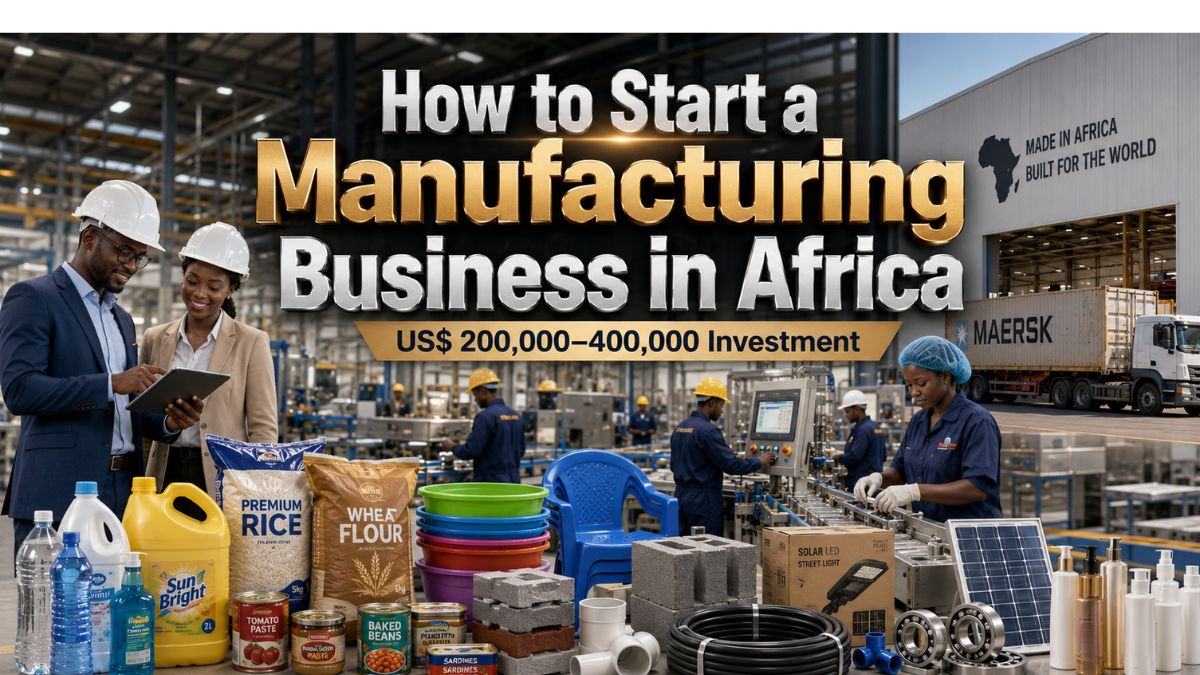
Africa’s Manufacturing Moment Has Arrived
There are few regions in the world where the raw, unfiltered business opportunity can be found today like in Africa. The jackpot opportunity for manufacturing business ideas in Africa is perhaps like never before with a population exceeding one and a half billion, a growing middle class and a continent-wide trade deal shaping policy. Today, entrepreneurs have between US$ 200,000 and 400,000 in investable capital, and they are at a sweet spot: the combination of market opportunity and policy support.
In comparison with other countries in the world, the manufacturing sector contributes a relatively small portion of GDP in Africa. But that is the space that offers opportunity, not weakness. Demand for consumer goods is growing at a quicker pace than the local supply of the same. Import bills are skyrocketing. Industrialisation is a priority for governments in sub-Saharan Africa, East Africa and North Africa. This is the cue to take action, not wait, for the serious business man.
Why Manufacturing in Africa Makes Strong Business Sense Right Now
Africa imports hundreds of billions of dollars’ worth of products that it is capable of producing locally. Domestic production is regularly inadequate to meet growing demand in the food processing, packaging, agro-chemicals, personal care, construction materials and light engineering sectors. That structural imbalance results in sustainable profitability for companies well-positioned in the manufacturing segment.
Besides, even in Africa, labour prices are significantly lower than in Asia. Although infrastructure has been improving, the last 10 years has seen significant investment in power generation, logistics and ports sectors. Now several African countries have made themselves investor-friendly with tax regimes, industrial areas and cheap factory land. The African Continental Free Trade Area (AfCFTA) — the world’s largest free trade zone in terms of countries involved — adds to the commercial sense of the idea, by eliminating tariff barriers and allowing intra-African export.
AfCFTA trade data and manufacturing incentives are regularly reported by the African Export-Import Bank (Afreximbank) in intra-African trade flows and financing opportunities for manufacturers.
Government Policies and Incentives Supporting New Manufacturers
In Africa, some governments are putting pressure on the finances to lure manufacturers. The Government of Ethiopia provides land, power and water at subsidised rates to qualifying investors in the industrial parks. The registration of business in Rwanda is one of the fastest in the world; the country has been consistently ranked among the top countries in the World Bank’s Ease of Doing Business index. The Special Economic Zones (SEZ) Act offers tax holidays and customs relief to investors in specific industrial clusters in Kenya.
To bolster the manufacturing sector, Nigeria — Africa’s largest economy — has introduced its Presidential Enabling Business Environment Council (PEBEC) while also rolling out a set of incentives to encourage manufacturing activity. Egypt provides factory land in new industrial cities at concession rates and South Africa has active incentive programmes such as the Manufacturing Competitiveness Enhancement Programme (MCEP) and the Automotive Investment Scheme (AIS), run by the DTIC.
The United Nations Industrial Development Organization (UNIDO) is actively supporting the African governments in developing industrial policies and has developed detailed country level manufacturing investment guides. These documents should be checked by entrepreneurs who are contemplating a location before deciding on the final location.
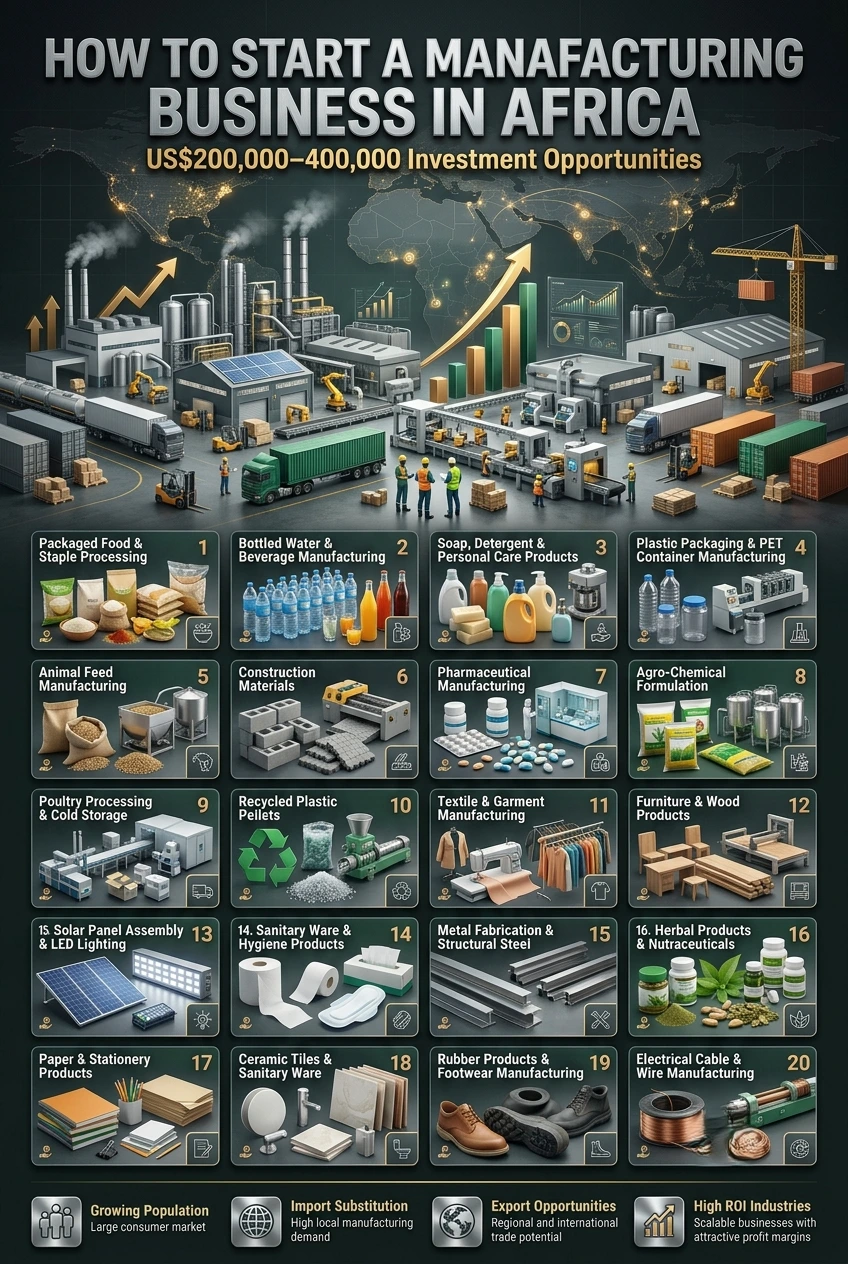
Top 20 Manufacturing Business Ideas for Africa: Detailed Analysis
1. Packaged Food and Staple Processing
The food economy is getting rewritten in Africa with its urbanisation. Processed cereal products, such as flour, rice, pasta, cereal-blends, and edible oils, replacing raw grain markets, are becoming more popular in busy city households. The cost for setting up a mid-scale food processing unit (10-20 tonnes/day) in most African markets ranges from US$ 200,000 to US$ 300,000. The demand base is huge and is mostly captive. In addition, by sourcing raw materials from smallholder farmers, there are natural community links and political risk is also reduced. This sector has excellent prospects for domestic sales as well as cross-border trade within AfCFTA member states.
Get Detailed Project Report (DPR): Complete Guide to Ready-to-Eat & Processed Food Projects
2. Bottled Water and Beverages Manufacturing
In many areas of sub-Saharan Africa, safe drinking water is in critical shortage. Bottled water plants from US$ 250,000 to US$ 350,000 can be used for urban retail applications as well as institutional applications such as schools, hospitals and offices. This is one of the steadiest cash-producing businesses to have out of the distribution model once it is set up. The adjacent opportunity is to make fruit juices from local tropical fruits, which has a strong export market to the European and Middle East markets.
3. Soap, Detergent, and Personal Care Products
The personal care and household cleaning segment in Africa is dominated by imported brands. But the sensitivity of consumers is offering good opportunity for locally produced substitutes which can be of good quality at lower prices. A soap and detergent plant can be established for less than US$ 300,000 and is a market that is continually expanding. Raw materials used such as palm oil, caustic soda and surfactants are available locally in both West and East Africa. A growing awareness of health and hygiene, in particular, has also paved the way for the increased demand for these products in this category, which has been seen to be permanent.
4. Plastic Packaging and PET Container Manufacturing
Packaging is required by all food, drinks, pharmaceutical and personal hygiene manufacturers across the continent. Plastic bottles, plastic containers, plastic films and bags are always needed. The US$300,000 to 400,000 blow moulding and injection moulding plant puts an entrepreneur at the source of several expanding businesses. Importantly, several African governments are pushing for plastic recycling mandates, resulting in a second angle – recycling plastic pellets that provide an additional revenue stream that is compliant with ESG requirements as well as primary manufacturing.
5. Animal Feed Manufacturing
The livestock and aquaculture industries are playing a significant role in meeting the protein needs of the people of Africa, particularly in the rapidly growing sector. However, production of commercial animal feeds is still underdeveloped and fragmented. A structured animal feed plant using locally available ingredients (maize bran, groundnut cake, soya bean meal and fishmeal) can be used by poultry, fish and dairy farms in a large catchment area. US$ 200,000 – 350,000 can be invested in a viable mid-scale operation. Further, this line of business is well-supported by policy interests of governments across Africa, with food security being a policy issue in almost all the countries in Africa.
6. Construction Materials – Cement Blocks and Interlocking Tiles
The housing shortages for the population in Africa is estimated at tens of millions of units. New construction buildings need blocks, tiles and construction aggregates. The cement block and interlocking tile business has relatively simple technology, local raw materials (cement sand gravel) and a local and loyal customer base (builders, contractors and housing developers). A functioning block plant in cities and towns without a large cement company’s own retail outlet is a major competitor in the local market. The up-front costs are in the range of US$ 150,000 – 280,000, which falls within the target investment range.
7. Pharmaceutical Tablet and Capsule Manufacturing
The African region imports billions of dollars of medicines every year, but only produces a very small proportion of the medicines consumed by the region. This structural deficit is what is driving the call by institutions such as the Africa CDC and the African Union to prioritise localisation of pharmaceutical manufacturing in Africa. A semi-automated tablet and capsule manufacturing facility for generic off-patent drugs can be constructed in the United States of America (USA) dollar range of USD 350,000 – 400,000 USD in a supportive regulatory environment such as Kenya, Ghana and Rwanda. The payback model is very attractive: after regulatory approval is gained, the business is in a protected revenue stream with little competition in the local market.
Related Article: Pharma Project Consultants in India: Why Expert Guidance Is Critical Before Starting a Pharmaceutical Manufacturing Unit
8. Agro-Chemical Formulation and Blending
Pests, diseases and poor crop nutrition cost African smallholder farmers valuable amounts of their crop each year. This huge requirement is catered by agro-chemical formulation plants, which are engaged in mixing and packaging the imported pesticide, herbicide and fertiliser into formulations. These are units for formulation, and not for synthesis, so investment and regulatory costs are not too heavy. The price range of $250,000 – $350,000 will allow a credible operation to be built. There is a ready channel of distribution through agro dealers. There is a business that has social impact beyond a commercial logic.
9. Poultry Processing and Cold Storage
Poultry is the fastest growing protein sector in Africa. But most birds are still sold live or in informal transactions, which raises considerable food safety and waste concerns. The value chain can be formalised through a semi-automated poultry processing unit, which can be linked to cold storage, and can be sold at a premium price to super-markets, hotels and food service units. Investment in the US$ 300,000–400,000 range can establish a 500–2,000 birds-per-day capacity. Moreover, by-products (feathers, offal) can be converted to animal feed ingredients, thereby enhancing yield.
10. Recycled Plastic Pellets Production
With increased plastic waste production in urban Africa, and now regulations becoming stricter, recycling plastic pellets is becoming an industrial opportunity with a high margin. Low cost raw material is collected and processed into pellets through grinding, washing and extrusion lines that are fed into the plastics manufacturers. The concept of the business is circular – waste comes in – industrial input goes out – and there is mounting demand from governments and international buyers for this kind of ESG. The cost of a mid-scale plant is between US$ 200,000-350,000 and the returns from this venture are better than many traditional manufacturing options because of the almost zero raw material costs.
11. Textile and Garment Manufacturing
Global fashion brands are once again taking a keen interest in Africa’s textile and apparel value chain, as a way of diversifying away from Asia. Major brands have been drawn to Ethiopia and Rwanda, in particular. An export garment unit of small to medium size (US$ 300,000-400,000) can be set up in the US$ 300,000-400,000 range including sewing machines, finishing equipment and working capital. The International Trade Centre (ITC) offers comprehensive information and tips for manufacturers looking to enter markets in Europe and America through duty-free schemes such as AGOA (US) and EBA (EU).
Read the Complete Book Here: The Complete Technology Book on Textile Spinning, Weaving, Finishing and Printing
12. Furniture and Wood Products Manufacturing
Despite the forest resources in Africa, there is a significant amount of raw log exports. The manufacturing facility for wood furniture (beds, wardrobes, chairs and tables) is meant to meet the rising middle class residential market demand, as well as the demand from hotels and offices for locally produced wood furniture. A mid-size CNC unit can be equipped for less than US$ 300,000 with the purchase of CNC routers, edge banding machines, and spray booths. Countries that have active timber industries such as Cameroon, DRC, Ghana and Mozambique provide favorable raw material procurement opportunities.
13. Solar Panel Assembly and LED Lighting
Solar panel assembly and LED lighting production are key solutions for a problem of high priority for thousands of millions of Africans that lack reliable grid power. These are assembly processes of imported parts such as cells, modules, drivers, which are then adapted to the African voltage regulations and market. A solar assembly unit and an LED manufacturing unit can be combined into a single unit at cost of US$ 250,000-400,000. Government tenders for rural electrification give the first indication of an income stream and brand building for retail channels continues.
14. Sanitary Ware and Hygiene Products
Sanitary pads, diapers and adult incontinence pads are imported into Africa, at a considerable expense. These non-woven hygiene products can be manufactured in the country, but they are produced using special equipment which has repeat-purchase demand from a growing consumer base. Attractive returns can be obtained on a sanitary napkin manufacturing line costing in the range of US$ 300,000 to 380,000 within 24-30 months of putting the plant into operation. Further, social impact-oriented language (enabling access to menstrual health) can unlock opportunities for NGO procurement, as well as government health ministry supply contracts.
15. Metal Fabrication and Structural Steel Works
Economic growth and development of infrastructure in Africa, including roads, bridges, commercial buildings and factories, generate constant demand for structural steel products such as beams, columns, roofing sheets, gratings and fasteners. The US$ 200,000-350,000 range metal fabrication shop can provide construction contractors, infrastructure project developers, and industrial clients. The real competitive edge is speed of turnaround – orders for large steel – months, including transport costs – can be delivered by a local fabricator in days.
16. Herbal Products and Nutraceuticals
The continent of Africa has one of the greatest biodiversity, but it ships out most of its medicinal plants and herbs in raw form. The step of extracting, processing and packaging the raw botanicals into capsules, tinctures, powders and teas for local and export markets is captured in a herbal extract, nutraceutical, and wellness product manufacturing unit. The demand for African botanicals, such as moringa, baobab, shea and rooibos, is strong all over the world. A unit in the range of US$ 200,000 – 300,000 can be utilized for retail and B2B sales, such as cosmetic ingredient buyers.
17. Paper and Stationery Products
Paper is used in huge amounts by schools, offices and government institutions, including exercise books, notebooks, printing paper, packaging boards etc. These products are imported by several African countries in spite of the fact that they are raw material countries. In the US$250,000 – 350,000 range, a small paper converting or stationery manufacturing plant can qualify for institutional supply contracts with education ministries, which offer stable and reliable revenue streams. The addition of value in branded school supply sets further enhances the margins.
18. Ceramic Tiles and Sanitary Ware
The building frenzy in Africa continues to keep demand for flooring and wall tiles, and bathroom fittings, buoyant. Clay deposits can be found in the countries of Ghana, Nigeria, Uganda and Tanzania which gives them an edge in the natural raw materials sector. A small ceramic tile plant in the US$ 350,000-400,000 category is capital intensive but is competing in a market that is dominated by imports, and can leverage pricing once the quality standards are achieved. This is a captive early customer base since they are usually built by the government for school, clinics and public buildings.
19. Rubber Products and Footwear Manufacturing
The rubber-producing countries of Africa sell raw rubber and buy finished products at high profit margins, which is a clear indication of the widening trade gap. The widening trade gap was evident in the fact that the countries of Africa which export rubber buy the rubber products at high margin of profit. A rubber processing plant for footwear soles, industrial gaskets and agricultural matting continues on the continent. A small (US$ 200,000–350,000) rubber products plant operates for both domestic industrial customers and footwear assemblers. The footwear sub-segment is particularly helped by high government interest on local manufacturing, due to the large consumer base size.
Find the most profitable startup for your investment range
20. Electrical Cable and Wire Manufacturing
The demand for electrical cables and wiring is boosted by industrial growth, real estate development and power infrastructure expansion. Import substitution is good, as Africa imports most cables. A medium size cable manufacturing plant with an initial investment of copper rod or aluminium conductor in the range of US$ 350,000 to 400,000 can be commissioned. Electrical equipment manufacturing is a priority sector for the African Development Bank private sector lending programmes and thus financing is a realistic possibility for well-structured projects in this sector.
Import–Export Opportunity Analysis for African Manufacturers
The AfCFTA – which has been operational in 54 member countries – is the most significant trade enabler for African manufacturers in a generation. It takes away most trade barriers between member countries. For a Ghanaian manufacturer, this translates to trading with few hassles to Senegal, Côte d’Ivoire or Nigeria. The AfCFTA Secretariat provides up-to-date market information on priority sectors and eligible goods, which is an important tool for any entrepreneur who wants to produce for exports.
In addition to intra-African trade, there are manufacturing sectors that offer good export opportunities to international markets. European, American and Asian customers are buying the growing array of products grown in Africa like herbal products, shea butter derivatives, organic agro-processed products and specialty foods. The US market is duty-free for garment manufacturers in AGOA-eligible countries in AfCFTA. These export opportunities significantly increase the revenues ceiling for the mid-scale manufacturers in Africa and make the investment band of US$ 200,000 – 400,000 investments more attractive.
The International Trade Centre (ITC) Trade Map offers African manufacturers valuable data on trade flows by product and country, helping them to precisely identify export demand gaps they can profitably fill.
Indian MSME Success Stories with Lessons for African Investors
Dharni Sampda – Agro Processing Pioneer
Dharni Sampda is an entrepreneur Sanjay Asthana, who started with a small investment and established his own spice and food processing unit in Madhya Pradesh and made it a big success. The company’s model is basically the same as is found in African agro-processing, sourcing directly from smallholder farmers, processing locally and packaging for both domestic and export markets. The takeaway message: owning the entire value chain from farm gate to final consumer has a dramatic impact on margin capture and on commodity price volatility.
Manjushree Techno pack – Packaging Manufacturing Success
Founded by the Kanoria family, the company Manjushree Technopack, based in Bengaluru, evolved from its roots in the manufacture of PET bottles in the city to become a leading rigid plastic packaging company in India. Local suppliers were required to provide a reliable quality consistent supply service to the FMCG companies, which included beverage, personal care and pharma companies, as a result of which the business grew. The model applies directly to Africa – if packaging companies continue to deliver products of a quality that meets specifications, they can be locked in as suppliers to major consumer goods manufacturers and the amount of switching costs will be high.
Vimal Agro Products – Edible Oil Processing
The Vimal group promoted Vimal Agro Products, Gujarat, showcased how the edible oil processing business from groundnuts and then expanding into sunflower and cotton could be expanded from a regional operation to a country known brand. The big lesson for African entrepreneurs: In India, the edible oil processing industry has largely succeeded through the promoters’ decision to invest together in quality process (refining, bleaching, deodorising) instead of taking the easy route and bypassing the process. Patient and quality-oriented producers have the same growth path in the edible oil markets of Africa, which include palm, groundnut, sunflower, and soybean.
How NPCS Can Help You Set Up a Manufacturing Business in Africa
At Niir Project Consultancy Services (NPCS), we offer professional consulting services for preparing new industry or business startup Market Survey cum Detailed Techno-Economic Feasibility Reports (DPRs). Our reports come with in-depth manufacturing processes, market research, demand analysis, process flow diagrams, product mix, and capacity planning, machine, and raw material details, and complete project financials with profitability analysis. We want to help our clients, entrepreneurs, assess the feasibility, profitability and scalability of their business ideas before investing money. From the analysis of a food processing unit, a pharmaceutical plant or a packaging manufacturing business for an African market, our reports provide you with an analytical base on which to make sound investment decisions.
Estimated Investment and Revenue Snapshot: Select African Manufacturing Businesses
| Manufacturing Business | Investment (US$) | Capacity (Daily) | Payback Period | Key Export Market |
| Packaged Food Processing | $200,000–300,000 | 10–20 MT | 2–3 Years | Intra-African (AfCFTA) |
| Bottled Water Plant | $250,000–350,000 | 20,000 Litres | 2–3 Years | Regional Markets |
| Soap & Detergent Unit | $200,000–300,000 | 5–10 MT | 2–3 Years | West/East Africa |
| Animal Feed Plant | $200,000–350,000 | 20–50 MT | 2–3 Years | Regional Livestock |
| Plastic Packaging (PET) | $300,000–400,000 | 500–2,000 units | 3–4 Years | FMCG Sector |
| Pharmaceutical Generics | $350,000–400,000 | 500K–1M tabs | 3–5 Years | East/West Africa |
| Solar Assembly & LED | $250,000–400,000 | 1,000 Units/day | 3–4 Years | Off-Grid Markets |
| Sanitary Hygiene Products | $300,000–380,000 | 50,000 pads/day | 2–3 Years | NGO & Gov Tenders |
| Recycled Plastic Pellets | $200,000–350,000 | 2–5 MT | 2–3 Years | Plastics Mfg Sector |
| Electrical Cable & Wire | $350,000–400,000 | 5–10 km/day | 3–4 Years | Infrastructure Projects |
* Investment ranges are indicative and vary by country, capacity, and specifications.
Frequently Asked Questions (FAQs)
Q1. Which African countries are best for manufacturing investment?
Strong regulatory environments, investment incentives, and infrastructure are generally available for new manufacturers in Ethiopia, Rwanda, Kenya, Ghana, and Morocco. For comparisons between these countries, consult the World Bank’s Doing Business Africa reports. Choice of country should match the specific supply chain and target market for each manufacturing business.
Q2. What is the minimum viable investment for a manufacturing startup in Africa?
For most of the categories discussed in this article, a credible mid-scale manufacturing unit can be commissioned between US$ 200,000 and US$ 400,000. This range covers equipment, civil works, working capital, and regulatory compliance. Businesses at the lower end include food processing, soap manufacturing, and recycled plastic pellets. Pharmaceutical and cable manufacturing require investment toward the upper end of this band.
Q3. How do I access financing for a manufacturing project in Africa?
Manufacturing projects with a development component are frequently financed by Development Finance Institutions (DFIs) such as the African Development Bank, Afreximbank, IFC and often with concessional loan facility from national development banks in case of priority manufacturing sectors by various governments across Africa. Preparation of a robust Detailed Project Report (DPR) is mandatory for any application for formal financing.
Q4. What makes the AfCFTA important for small manufacturers?
The AfCFTA tariff schedule for most intra-African trade allows even small companies to easily offer competitors for buyers in 53 countries. If a company wants to start selling outside the domestic market it can now target hundreds of millions more customers through the Africa Trade Dashboard, which outlines AfCFTA schedules and preferential duties on specific products.
Q5. What technical report do I need before investing in an African manufacturing project?
Market survey & detailed Techno-Economic Feasibility Report is required to understand. The Manufacturing Process, Market Demand, Techno-Economic Projections, Machineries required, the risks associated etc. This report serves as guide for investment purposes as well as in connection with banks for the purpose of financing as well as in connection with partner(s). These reports are being prepared by reputed consultants like NPCS. For various manufacturing fields.
Q6. Which manufacturing sectors have the fastest return on investment in Africa?
Packaged foods processing, bottled water, soap and detergent, and recycled plastic pellets have typically shorter payback periods of 2-3 years, as demand is generally high and capital investment is lower. Pharmaceutical manufacturing and cable manufacturing have longer payback periods — typically 3–5 years — but offer higher barriers to entry and more durable competitive positioning once established.
Conclusion: The Window Is Open – But Not Forever
Africa’s manufacturing gap is simultaneously its biggest challenge and its most compelling opportunity. Entrepreneurs who move with the right business plan, a sound feasibility report, and a clear-eyed view of local market dynamics can build genuinely durable industrial businesses across virtually every category discussed here.
The US$ 200,000–400,000 investment band is, frankly, the sweet spot for this continent right now. It is enough to establish a credible, scalable manufacturing operation — but not so large that it attracts only the biggest global players. Mid-market manufacturers with local knowledge and operational agility have a distinct advantage in this range.
AfCFTA, rising urbanisation, government incentives, and the consistent demand-supply gap across essential categories all point in the same direction. The window for early entry into African manufacturing is open — but as more investors recognise the opportunity, that window will narrow. The time for planning is now.


