






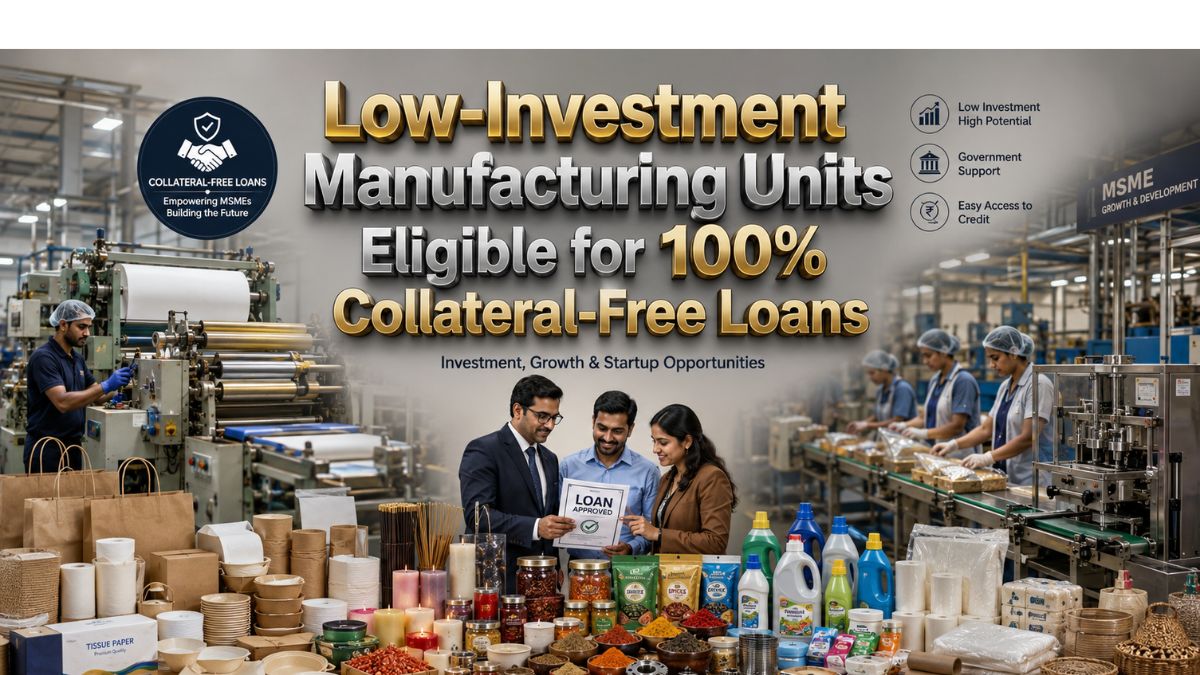
Collateral Free Loans for Manufacturing Units Under CGTMSE
“Collateral-free” is a phrase that is one of the most searched terms in the Indian MSME finance segment and is one of the most used ones. Many business owners hear this and think that they will get a loan for a business plan with no security, because the government has declared it. The truth is more particular — and knowing how it works is the key to using it, as an entrepreneur.
The Credit Guarantee Fund Trust for Micro and Small Enterprises (CGTMSE) is not a lender and does not provide any loans. It guarantees 75 to 85 percent of the loan amount to banks and NBFCs and the lender does not require any collateral or a third-party guarantee from the borrower. The loan is still from a bank, still goes through credit appraisal, and still needs to show the bank repayment capacity — the only difference is that the borrower’s need to pledge a property or other assets is no longer a deciding factor for approving the loan.
Micro enterprises can avail loans without CGTMSE involvement in the entire process with extension of loans by banks without any collateral up to ₹10 lakh. Apart from that, CGTMSE facilitates the provision of credit facility without the requirement of collateral to the extent of ₹10 crores, which has a guarantee coverage of up to 75% to 90% depending on the loan size and the class of borrower.
Related Article: Collateral-Free Business Loan up to ₹10 Crore in India: Complete CGTMSE Guide for MSMEs
What “Collateral-Free” Actually Means Under CGTMSE
Actually, there are two layers to the collateral-free lending of a small manufacturing unit in India: The first layer is a basic RBI guideline where banks can provide collateral-free loans to Micro and Small Enterprises up to ₹10 lakh without having any guarantee scheme in place — this is a normal practice for loans where the limit of loan amount is not more than ₹10 lakh, if the unit is meeting the bank’s normal credit criteria.
The second layer is CGTMSE, which extends collateral-free lending well beyond ₹10 lakh — up to ₹10 crore for Micro and Small Enterprises (classic) and up to ₹20 crore for startups recognised by DPIIT. Here, the bank does full credit appointments (DPR, financial projections and more) and the amount of exposure is guaranteed by the CGTMSE (and not by the borrower’s pledge of collateral).
The real-world meaning: “collateral-free” is not the same as “no appraisal” or “no promoter contribution.” It also means that the entrepreneur would not be required to pledge any asset, including property, gold or any other asset, as security to the bank for approving the loan, thus eliminating the single biggest hurdle faced by many competent entrepreneurs, especially the first generation and women entrepreneurs, in getting formal credit loans.
Why Low-Investment Manufacturing Units Fit This Mechanism Well
The manufacturing units that are covered in our companion guide on business ideas that can be undertaken under CGTMSE are in the ₹5-25 lakh category, which is exactly the target segment for CGTMSE lending. The projects are big enough to likely be too much for an entrepreneur to self-fund, or borrow on his own without any outside guarantees, but small enough that even at the lower end of the guaranteed percent range, with CGTMSE’s loan, the project would qualify for a loan.
In the case of these categories, CGTMSE coverage may also be covered by PMEGP margin money in the same loan package: PMEGP subsidy reduces the amount of loan, CGTMSE guarantees that the loan amount is sanctioned without collateral. What is often overlooked is that the most of PMEGP loans are automatically extended under CGTMSE, meaning that by design the schemes work together without requiring the entrepreneur to apply for CGTMSE separately for his loan.
Manufacturing Categories That Work Well Under This Structure
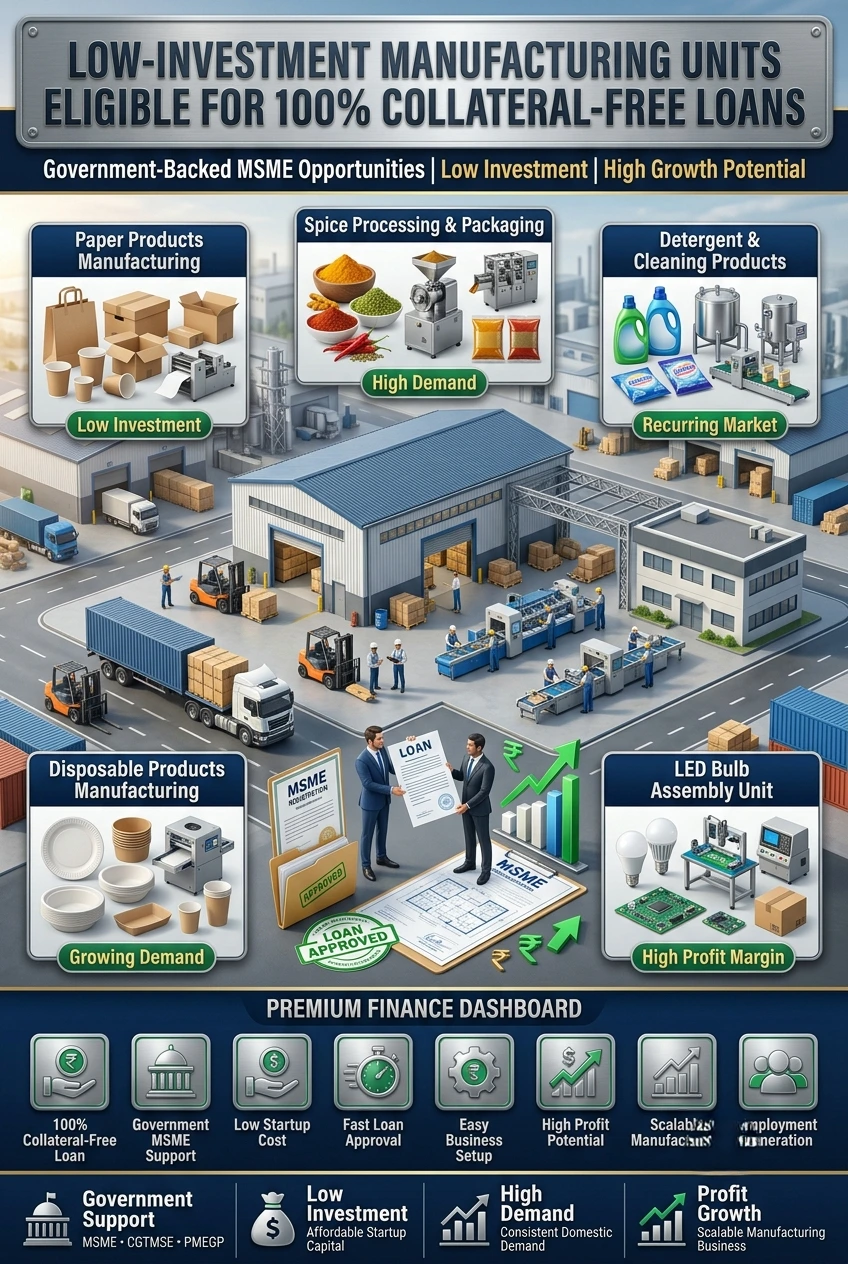
The categories of projects most often financed this way include food and agro-processing units, such as spice processing, cold pressed oil, dal milling, papad and instant mix production, because the size of the project in these cases is usually between ₹10-25 lakh, and machinery suppliers are established and the cost estimates and quotations are easily available, as the appraisal team at most banks have encountered many such applications.
The same holds true for soap, detergent and agarbatti production lines — the project cost is not very high, there is a basic knowledge of the formulation and machinery, and the market analysis section of the DPR is not that difficult to be substantiated with real market data as opposed to market projections.
A slightly separate group are packaging and printing units that provide service to other area small manufacturing companies that can include corrugated boxes, printed labels, or flexible packaging: while they may not be supplying end users directly, they can have more of a B2B revenue stream, as long as a few anchor customers are in place.
The other low investment area is the stitching unit for garments or textiles which are meant for institutional users (school uniform, workwear for local businesses, hospital linen, etc.) instead of retail. In such cases, it is likely that the project costs for a modest unit (sewing machines, cutting tables, basic finishing equipment) will remain less than ₹15 lakh.
Get Detailed Project Report (DPR): Project Reports & Profiles
The Guarantee Fee — What It Costs to Use CGTMSE Coverage
CGTMSE coverage is not at no cost to the lender; in fact, that cost is generally borne by the borrower, either in full or in part, as part of the overall loan cost. The trust pays an annual guarantee fee beginning at a small fraction of the guaranteed amount, to keep the cover in place. If an entrepreneur is considering loan offers, this fee is one he or she should not ignore as it is a true cost of the loan; it is small compared to not taking out a loan or having to place personal or family assets as collateral.
Who Actually Applies for the CGTMSE Guarantee
It may be confusing to many first-time applicants: the entrepreneur does not apply to CGTMSE directly. The entrepreneur applies for the loan as usual with the bank or NBFC and the bank applies for the guarantee cover with CGTMSE, if it finds that the loan application qualifies and it decides to consider the loan as unsecured, it does so. For the entrepreneur, it’s a typical loan application, except for what happens when the loan is granted at the bank.
This implies that an entrepreneur can’t force the bank to avail CGTMSE coverage of his loan; it’s the bank’s choice if it will take the loan to the CGTMSE. What an entrepreneur can do is to ensure that the application is structured in a manner (project cost, category, sector) that makes it a natural fit for CGTMSE backed lending which most manufacturing units fall within the category of cost ranges of ₹5-25 lakh are already.
NPCS Insight
The financial projections, DSCR, market analysis, and project cost validation are the criteria used in an appraisal, and are the same for a DPR prepared for a bank-ready loan as for a DPR prepared for a CGTMSE-eligible loan. But what is the means of finance framing – The absence of a collateral pledge should not be seen as a gap in the application, rather it should be viewed as a structural element that the bank will take care of when looking at the application as a whole in CGTMSE. NPCS prepares DPRs for manufacturing units in this category with the above framing.
Get Detailed Insights from This Book: Select & Start Your Own Industry
Collateral-Free Lending Layers
| Loan Range | Mechanism | Guarantee Coverage |
| Up to ₹10 lakh | RBI baseline guideline; no scheme needed | Not applicable |
| Above ₹10 lakh up to ₹2 crore | CGTMSE-backed bank lending | 75-85% of loan amount |
| Above ₹2 crore up to ₹10 crore | CGTMSE-backed bank lending | 75% (varies by category) |
| Up to ₹20 crore (DPIIT-recognised startups) | CGTMSE-backed bank lending | Higher ceiling for recognised startups |
Manufacturing Categories Well-Suited to CGTMSE-Backed Loans
| Category | Typical Project Cost | Why It Fits |
| Spice / agro-processing units | ₹10-25 lakh | Established machinery suppliers, predictable local demand |
| Soap, detergent, agarbatti units | ₹5-20 lakh | Modest cost, consistent demand, formulation know-how documented |
| Packaging & printing units (B2B) | ₹10-20 lakh | Anchor B2B customers provide predictable revenue base |
| Garment/textile stitching (institutional) | ₹5-15 lakh | Lower entry cost, institutional buyer contracts aid viability case |
PMEGP + CGTMSE: How the Two Combine
| Component | Source | Role |
| Own contribution (5-10%) | Entrepreneur | Demonstrates promoter commitment |
| Margin money subsidy (15-35%) | PMEGP / KVIC | Reduces effective loan principal post-verification |
| Bank loan (remaining balance) | Bank/NBFC | Term loan, often covered under CGTMSE |
| Collateral requirement | CGTMSE guarantee | Removes need for personal/family asset pledge |
Preparing an Application for CGTMSE-Backed Lending
Since the appraisal requirements for a CGTMSE-eligible loan are the same as for any other bank loan — project cost validation, market analysis, financial projections, and debt service — the most helpful preparation an entrepreneur can make is what happens in our companion guide on writing a bank-approvable DPR — realistic costs supported by quotations, local market data, and financial projections that pass the stress test.
Niir Project Consultancy Services prepares detailed project reports for low investment manufacturing units in the below mentioned categories, where absence of collateral is not a financing-structure issue of the bank and is rather treated as a separate issue during the application process where the bank has to be specifically requested to address this issue.
Your investment deserves the right opportunity
The Realistic Picture
While not a description of a loan that avoids appraisal, 100% collateral-free is a correct description of how CGTMSE works for the borrower: the borrower does not have to place any property, gold or other personal assets as a pledge. In the case of low investment manufacturing units of ₹5-25 lakh, the only realistic way is to submit a well-prepared DPR to the bank, leaving out any collateral constraint as this is usually waived in case of PMEGP loans, and the entrepreneur does not have to go through yet another application procedure on top of the loan application.
Frequently Asked Questions
Is there any automatic coverage of CGTMSE for all PMEGP loan?
One reason why the demand for collateral is seldom made by the PMEGP-funded units is that most of these loans are covered under CGTMSE as a standard feature of the loan. This is calculated by the bank during the loan application process and is not one application by the entrepreneur.
If the loan doesn’t need collateral, does that mean it doesn’t need a personal guarantee?
The specific coverage by CGTMSE includes the requirement for collateral and third party guarantees. The promoter’s personal commitment can be in the form of normal banking documentation, though this is not the same as pledging assets as security.
Does an existing business need to have any assets to use CGTMSE or is it for businesses that have no assets?
Lending with CGTMSE support is provided even if the entrepreneur does not have any assets to pledge. Some business owners who have assets would rather not make that pledge, even if they were able to, and CGTMSE coverage would permit the loan to move forward without the pledge.
Is there a correlation between loan amount and level of coverage for CGTMSE?
Guarantee coverage percentages are different for different loan sizes, for different types of borrowers and usually range from 75% to 90%, depending on the type of guarantee and the size of the loan. The percentage is determined by the bank when processing a CGTMSE application for a particular loan.
Who pays the guarantee fee and what is it?
CGTMSE coverage is paid for each year, beginning at a very small percentage of the guaranteed loan amount. This cost is usually covered in the cost of the loan by the bank and not charged to the entrepreneur separately, but should be included in the overall cost of the loan and taken into account when working financial projections.
Where can an entrepreneur get a DPR prepared for a low-investment manufacturing unit seeking a CGTMSE-backed loan?
Niir Project Consultancy Services develop comprehensive project reports for manufacturing units in the price range of ₹5-25 lakh within the following industry segments: Agro-processing, Soaps and Detergents, Packaging, Textile stitching etc. for bank appraisal for the support schemes like PMEGP, Mudra and CGTMSE schemes.
Sources and Further Reading
IIFL – Collateral Free MSME Loan: CGTMSE 2026 Limits, Eligibility & How to Apply: iifl.com
Bajaj Finserv – CGTMSE Scheme: Collateral-Free MSME Loan Guide: bajajfinserv.in
DMI Finance – Collateral-Free CGTMSE Loan Scheme: Full Guide: dmifinance.in
AIM India – CGTMSE Scheme 2026: Apply for Collateral-Free MSME Loans: aimindia.in
HDFC Bank – CGTMSE: Credit Guarantee Fund Trust for Micro and Small Enterprises: hdfc.bank.in


