





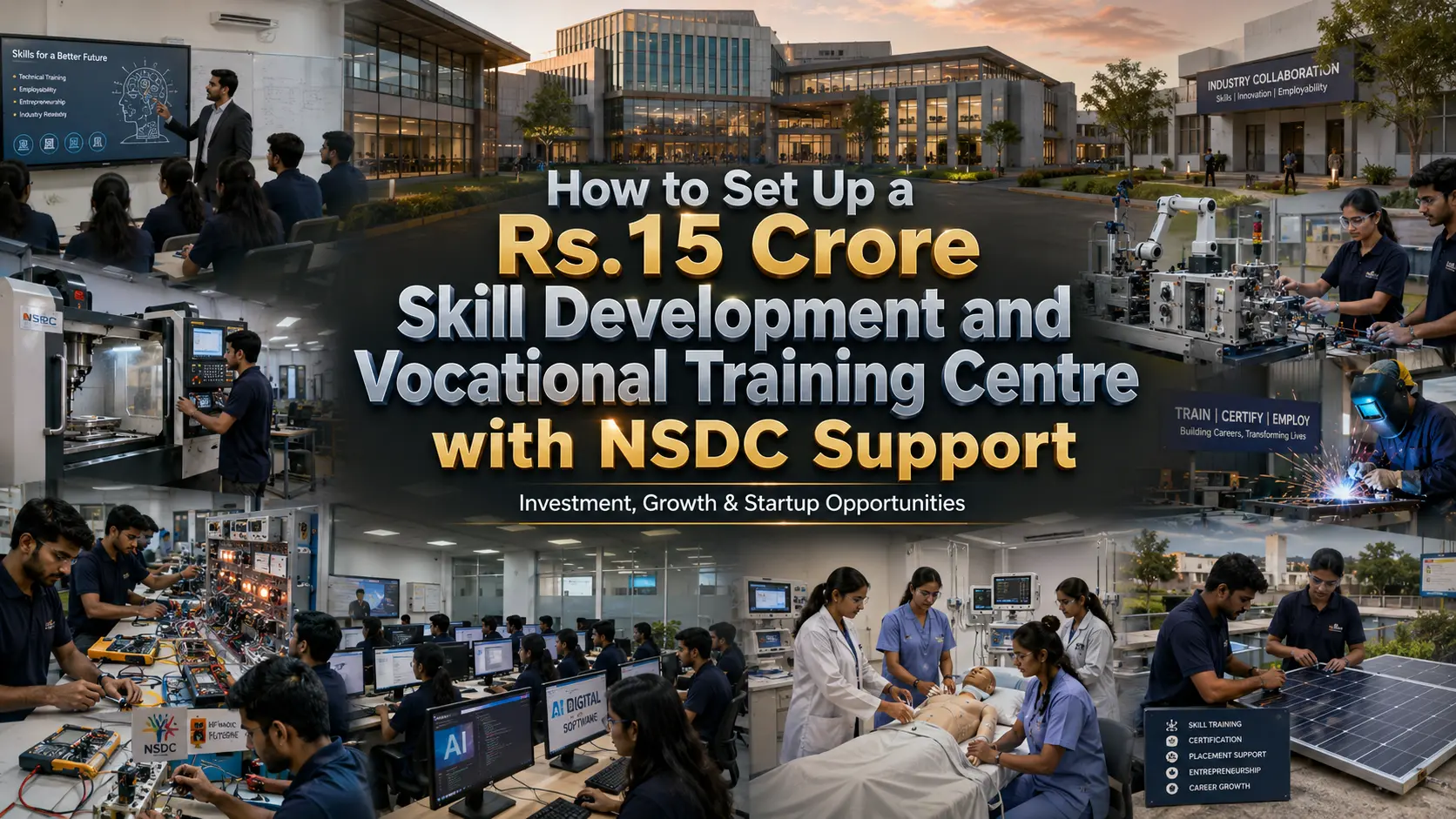
Skill Development Centre in India with NSDC Support
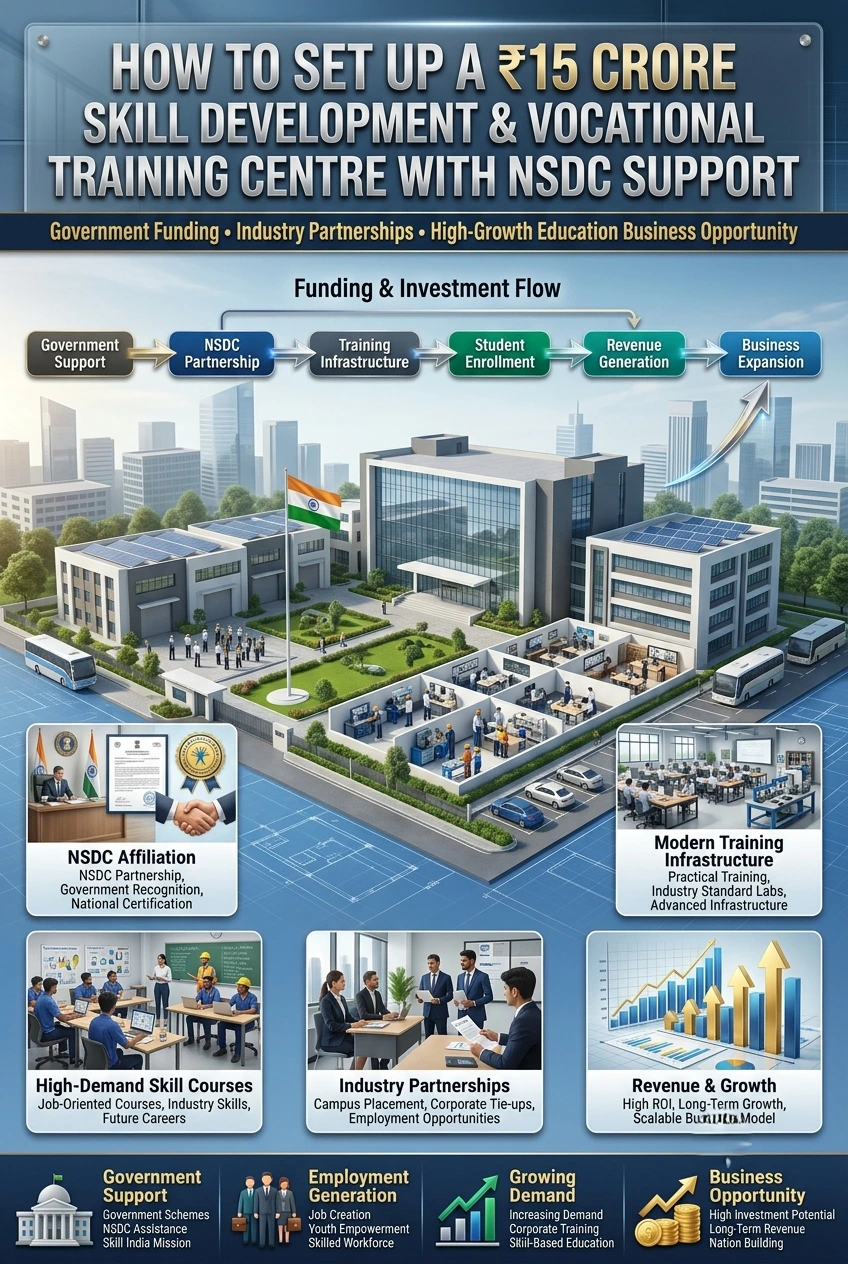
The scenario of millions of unemployed youth and millions of vacancies of skilled workers in the industry is a paradox that would make one of the most interesting business ideas in the education sector – due to the huge mismatch between the industry’s requirement and the educational output. The National Skill Development Corporation (NSDC) has established a Skill Development and Vocational Training Centre (SDVC) with a funding of Rs.15 Crore, which sits at the nexus of Government’s priority, industry’s need, and social impact. The Pradhan Mantri Kaushal Vikas Yojana (PMKVY) offers Training Partners, approved by the NSDC, the training fees per student from the government, which is a revenue stream that most education entrepreneurs are not aware of.
Why Skill Development Training Is India’s Most Policy-Backed Education Business
Under the Skill India Mission launched by the Ministry of Skill Development and Entrepreneurship (MSDE), hundreds of millions of workers are to be trained across different sectors. NSDC establishes partnerships with the private training providers on an affiliate basis, and offers curricula, assessment framework and certification, and sometimes, direct financing to the private training providers under PMKVY. The industry associations such as NASSCOM, CII and sector skill councils actively promote training centres to churn out job-ready students.
Get Detailed Project Report (DPR): Open a Skill Development Training Centre
Government Policies and Schemes Supporting Skill Development Centres
PMKVY is the biggest direct funding scheme under which training fees per student to approved courses are provided to NSDC affiliated Training Partners (TPs). The reimbursement rates vary from Rs. 4,000 to Rs. 15,000 per student per course according to the sector and course duration. MSDE’s Apprenticeship Scheme requires industries to recruit apprentices and provide a stipend, which is partially funded by the government. Maharashtra, Karnataka, Tamil Nadu and UP have state level training schemes (in addition to central funding) under the State Skill Development Missions. Check out all the available schemes in the Skill India Portal.
Top Business Ideas Within the Skill Development Centre Model
NSDC-Affiliated Multi-Sector Training Campus with Industry Tie-Ups
A multi-sector training centre, affiliated to NSDC and various Sector Skill Councils (SSCs), can provide training in IT, electronics, construction, healthcare support services, beauty and wellness, retail, logistics and BFSI. PMKVY reimbursements per trained and assessed student, short courses (upskilling of existing workers) sponsored by industry, fees charged by the state scheme, and fees charged by hiring companies for placements. Apply for NSDC Training Partner Status on Skill India Portal (Infrastructure Verification and Trainer Qualification Assessment are a part of the application process).
Sector-Specific Speciality Training Centre for High-Demand Industries
In a skill development business, it is better to specialise than to generalise. A dedicated training centre for a specific high demand sector, like IT, ITES, Healthcare, Advanced manufacturing (CNC operators, PLC programmers), or Logistics can develop industry connections quickly and have higher placement rates. The industry-trainers or training centres are the preferred trainers for MSDE’s corporate CSR trainings and apprenticeship programmes. IT and manufacturing-based Skill Development Centres can partner with the NASSCOM FutureSkills platform and CII skill development programmes.
Franchised Skill Training Network in Rural and Semi-Urban Areas
In a district town, an entrepreneur can franchise the central training campus and expand its operations without allocating proportional capital. The network has been spending Rs.20 to 50 lakhs per franchise on establishing local training space and as a cluster of franchisee, they are training thousands of students per district. The NSDC’s Training Partner network management framework lays the foundation for the operations of franchise model in the NSDC ecosystem. In North India and Odisha, with the high demand for rural youth to be skill certified, this model has been found to be very scalable.
Download the Full Guide: Education Business Startup Book
Import-Export Opportunities in the Skill Education Sector
There are bilateral agreements between several countries in the Gulf Cooperation Council (GCC) and India for skilled migration in various sectors such as construction, healthcare, hospitality, and IT support. Skilled migration between several countries in the Gulf Cooperation Council (GCC) and India is facilitated under bilateral agreements, with sectors like construction, healthcare, hospitality, and IT support seeing such arrangements. For training centres which train students for certifications relevant to the Gulf countries, premium placement fees of Rs.50,000 to 2,00,000 per migrant worker placed is possible. The Ministry of External Affairs has the administrative responsibility over bilateral skill recognition agreements with the Gulf countries. Visit eMigrate portal for emigration clearance and list of approved foreign employers.
Indian MSME Success Stories in Skill Development
NIIT Limited — From IT Training to Global Skilling
Established by Rajendra Singh Pawar and Vijay Thadani, the NIIT Limited began as a small IT training firm and has since expanded to become one of India’s biggest learning and talent development firms, reaching millions of students in India and around the world. The four key elements of NIIT (standardized curriculum, franchised delivery, technology-based learning management system and corporate training partnerships) were now the blueprint for the private training industry in India. The government scheme business was a core business for NIIT in the context of NSDC partnership.
Turn your budget into a successful business plan
Centum Learning — Building Skill Infrastructure at Scale
Centum Learning, a subsidiary of the Bharti Group, created one of India’s biggest vocational training networks that involved NSDC partnerships and government contracts. The company’s success securing multi-million-dollar government training contracts for hundreds of thousands of workers showed that a large government contract could be achieved by a well-capitalised private training organisation through a government partnership. With Centum’s success having proved that, skill development is a professional services business where execution quality, placement rates, and government relationships are a key determinant of long-term commercial success.
How NPCS Supports Skill Development Centre Planning
At Niir Project Consultancy Services (NPCS) we are professionals who can execute Market Survey cum Detailed Techno-Economic Feasibility Reports (DPRs) for the establishment of new industries or businesses. Our reports cover manufacturing processes in detail, market research, market demand analysis, process flow diagrams, product mix and capacity planning, details of the machinery, raw material details, and complete financial plan with the profitability analysis of the project. For detailed project reports on skill development centres look at www.niir.org
Conclusion
The Skill Development and Vocational Training Centre (SDVC) is one of the most impactful and commercially sensible education investments in India today being anchored in the framework of NSDC partnership with a budget of Rs.15 Crore. Get registered as a Training Partner on Skill India portal, avail of PMKVY funding and connect with industry through CII and NASSCOM to establish a business acumen in skill development for better social impact and business benefits.
Related Article: What Is The Most Profitable Business in India
Skill Development and Vocational Training Centre — Key Parameters
| Parameter | Details |
| Total Project Investment | Rs.12–18 Crore |
| Key Government Scheme | PMKVY, NSDC Affiliation, State Skill Mission, Apprenticeship Scheme |
| PMKVY Reimbursement Per Student | Rs.4,000–Rs.15,000 per course |
| Target Training Capacity | 2,000–4,000 students per year |
| Revenue Streams | PMKVY fees, industry-sponsored training, placement fees, CSR training |
| Key Sectors for Courses | IT, Healthcare, Construction, Logistics, BFSI, Retail, Manufacturing |
| Placement Rate Target | 70–85% for NSDC empanelment continuation |
| Annual Revenue Target | Rs.3–5 Crore |
| Payback Period | 3–5 years |
| Employment Generation | 50–100 direct jobs |
Frequently Asked Questions (FAQ)
What is NSDC and how do I become an affiliated Training Partner?
NSDC is a public-private partnership organisation under MSDE. Organisations can apply online through the Skill India portal by providing required organisation details, infrastructure and specifications, suggested course list, trainer credentials. NSDC reviews the application, performs site assessment visit and affiliation will be provided to the organisation that fulfil the infrastructure and quality requirements.
How does PMKVY funding work for private training centres?
Under PMKVY, NSDC-affiliated Training Partners receive per-student fees directly from the government for each student who completes a PMKVY course and passes the third-party assessment. The fee varies by course and sector (Rs.4,000–15,000 per student). Register and track student data through the Skill India portal.
What infrastructure is required for NSDC affiliation?
NSDC requires a minimum facility area per course (typically 1,000–2,000 sq ft per lab), appropriate equipment for each approved course, qualified full-time trainers (minimum NVQ Level 4 certification or equivalent), a placement cell, a Learning Management System (LMS) for digital student records, and compliance with NSDC’s Quality Standards for Training (QST).
How do I attract industrial training contracts alongside PMKVY?
Join CII’s skill development committee and NASSCOM’s workforce development programmes for IT sector corporate training leads. Companies run CSR-funded training programmes for local communities where they operate — approach CSR heads of companies in your city’s industrial areas. The MSDE Apprenticeship Scheme provides government stipend support for companies hiring apprentices from your training centre.
Can a skill centre specialise in training workers for Gulf jobs?
Yes — this is a high-value segment. The Ministry of External Affairs manages bilateral skill recognition agreements with Gulf countries. Training workers for Gulf-specific certifications commands placement fees of Rs.50,000–2,00,000 per migrant. Register training workers through the eMigrate portal for emigration clearance procedures.
What is the difference between PMKVY funding and state skill mission funding?
PMKVY is a central government programme administered through NSDC with standard per-student rates across India. State skill missions — in Maharashtra, Karnataka, Tamil Nadu, and others — have state-level programmes often with higher per-student rates for priority sectors and locations. Accessing both central and state funding simultaneously maximises the training centre’s government revenue per student.


