





Odisha’s Industrial Transformation
When looking for business ideas in eastern belt of India, Odisha proves to be a state which has metamorphosed its industrial identity in the last 2 decades. Odisha is now emerging as a significant manufacturing hub, apart from being a mineral hub, in steel, aluminium, energy, food processing and petrochemicals. The state currently has the production of more than 41 million tonnes of steel and has set a goal of 130 million tonnes by 2030, which could account for 50% of India’s steel production.
The figures are convincing. For the first time, the ‘Utkarsh Odisha’ business conclave hosted investment proposals worth Rs. 17 lakh crores. India’s oldest steel plant and one of the biggest integrated plants is in operation here at Tata Steel. The state has a significant presence of ArcelorMittal Nippon Steel, JSW Steel and JSPL. The numbers have a story to tell of industrialists and business builders who moulded the economic destiny of Odisha. This article presents the profiles of the top 10 industrialists of Odisha, their success formulas and their vision for future.
IBEF also releases comprehensive state-level investment and sector information in IBEF’s Odisha Industrial Report in a timely fashion.
View Full Project Details: Business Opportunities in Odisha
Why Odisha Leads India’s Eastern Industrial Belt
The mineral wealth of Odisha is second to none. The State has a rich deposit of high-grade iron ore, bauxite, chromite, manganese, coal and limestone, the raw materials of the steel, aluminium and cement industries. The resource base is a structural cost advantage that is not possible for most Indian States. Moreover, the government of Odisha has built infrastructure for the port at Paradip and Dhamra in the standard of the world class, which will provide the manufacturers with a safe export market in the southeast Asian and European markets.
The state’s industrial parks at Kalinganagar, which claim to be the biggest integrated steel hub in Asia, have been able to draw in a varied population of ancillary manufacturers and downstream processors. The government has taken a significant step towards promoting ease of doing business, digital single window clearances and incentive packages, sector by sector. The Ministry of Steel, Government of India has identified Odisha as a steel production frontline state and has taken several policy measures targeting the capacity expansion in the state.
Government Policies Driving Odisha’s Industrial Growth
The industrial policy of Odisha is focussed on industries. The Ministry of MSME has identified various MSME clusters in Odisha for various manufacturing sectors such as Textiles, Food Processing, Coir, Engineering Goods. MSME Development and Facilitation Office provide support to the upstream and downstream manufacturers associated with the state’s large industries.
New industrial units can avail the capital investment subsidy, VAT refund, power tariff concession and land at concessional rates from the state government’s Odisha Industrial Policy. Developed Industrial Areas are governed by Industrial Development Corporation (IDCO) in 22 districts of Odisha. To the new businessman it implies infrastructure ready to use and deploy without the time and investment needed to build greenfield sites on their own.
Odisha is one of the priority states under Make in India for steel, aluminium, defence and renewable energy production. The government of India has allocated percentages to the state which is more than Rs. 93,000 crores for port infrastructure directly supporting manufacturing near the coastal industrial belts, enhancing export logistics.
Top 10 Industrialists of Odisha: Profiles, Success Models, and Future Vision
1. T.V. Narendran – Tata Steel (Kalinganagar & Jamshedpur Operations)
T.V. Narendran, the Managing Director and CEO of Tata Steel is one of the largest industrial establishments in Odisha. The Kalinganagar plant of Tata Steel is the largest greenfield integrated steel plant of the company with its capacity being increased to 8 MTPA in Odisha. Narendran’s strategic thinking is based on proximity to raw materials — Odisha’s iron ore belt means a big reduction in input costs as compared to coastal plants. In the future, his focus will be on green steel manufacturing, as Tata Steel is poised to decarbonise its operations via a hydrogen-powered steelmaking process and electric arc furnace technology. For those new to entrepreneurship, Tata’s playbook in Odisha proves that having access to raw materials can often be a key leveraging factor in highly-capital intensive manufacturing.
Explore This Book: Steel and Iron Handbook
2. Naveen Jindal – Jindal Steel and Power Ltd (JSPL)
Naveen Jindal, Chairman of Jindal Steel and Power Limited have created one of the biggest industrial imprints in Odisha. The steel plant at Angul is integrated with captive power generation which enables JSPL to be more self-reliant in terms of energy requirement. Jindal’s strategy of creating captive sources of inputs and manage cost structures has been replicated by large-scale manufacturers in resource-rich states. He has plans to increase the capacity of specialty steel and downstream value-added products for the auto and infrastructure industry in Odisha in the coming years. Tens of thousands of people are employed by JSPL in Odisha, and have established some large ancillary groups around its factories.
3. Sajjan Jindal – JSW Steel (Odisha Expansion)
Sajjan Jindal, Chairman of JSW Group has been continuously growing the footprint of JSW Steel in Odisha with his greenfield and brownfield investments. JSW’s strategic interest in Odisha lies in ensuring long-term supply of iron ore in the state, due to its reserve base. Jindal’s business model of fast expansion of capacity and the sophistication of products downstream has propelled JSW to become one of the fastest growing steel majors in India. He hopes to make the JSW plants in Odisha export-oriented production centres, owing to the shipping infrastructure of the port of Paradip.
4. Anil Agarwal – Vedanta Resources (BALCO & Aluminium Operations)
From a humble start, Anil Agarwal of Vedanta Resources has created one of India’s biggest diversified natural resource companies. Vedanta’s footprint in Odisha is at the basis of aluminium, where the company’s Lanjigarh refinery is a part of the bauxite to alumina conversion process that produces a commodity traded internationally. A business model based on buying distressed public sector units and reviving them using the principles of the private sector has been one of the most investigated in the history of Indian industry, and was the foundation of Agarwal’s success. His next aim is to further Odisha’s engagement in the global aluminium value chain, where demand from EVs and the aerospace industry is growing rapidly.
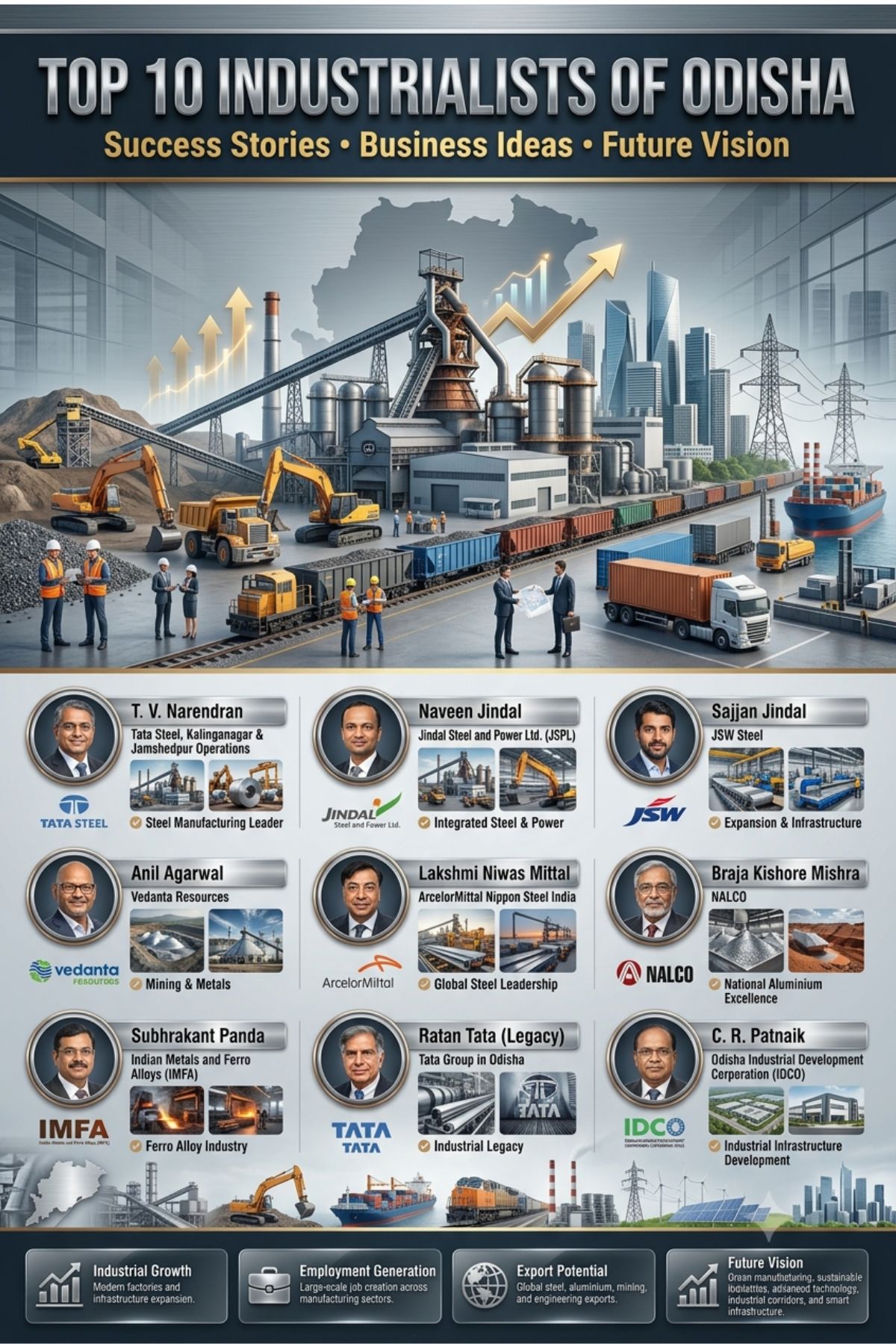
5. Lakshmi Niwas Mittal – ArcelorMittal Nippon Steel India
Through the ArcelorMittal Nippon Steel (AMNS) India joint venture, Lakshmi Niwas Mittal has agreed to invest trans formatively in Kendrapara district of Odisha. Among the biggest investments in the Indian steel sector was the Mittal greenfield integrated steel plant in the Indian state of Odisha, where the company has long believed that its iron ore resources and coastal access make it the perfect home base for world-class steel-making. He plans to manufacture high value flat steel products in his base at Odisha for the automotive, construction and appliance industry in India in future.
6. Braja Kishore Mishra – NALCO (National Aluminium Company)
NALCO is an integrated aluminum company and one of the major industrial companies of Odisha with its headquarters at Bhubaneswar in Odisha, India. NALCO has undergone multiple leadership changes and consolidated its activities into a vertically integrated model, with a focus on both mining and refining, and later smelting and power generation, of aluminium. NALCO’s future will be based on downstream fabrication, value added aluminium products and smelting using renewable energy to cater to international buyers’ global ESG demands.
Related Article: Aluminium Value-Added Manufacturing in India: A High-Growth Startup Opportunity
7. Subhrakant Panda – Indian Metals and Ferro Alloys (IMFA)
Indian Metals and Ferro Alloys (IMFA) is one of the oldest and well-known members of the ferro alloys industry based in Odisha, headed by Mr. Subhrakant Panda, Chairman. IMFA specializes in ferrochrome which is an important input to the stainless-steel industry, and procures chromite ore from the mineral-rich Sukinda Valley in Odisha. Thanks to Panda’s concept of vertical integration from mining to smelting, IMFA has an enduring cost advantage. In the future, he expects that IMFA’s position as a supplier to stainless steel makers all over Asia and Europe will increase, and there is a growing demand for high purity ferrochrome products in these regions.
8. Ratan Tata (Legacy) – Tata Group in Odisha
The vision and impact of the late Ratan Tata on Odisha is not limited to steel alone. The Tata Group’s footprint, whether in Tata Steel, Tata Power or Tata Motors, was instrumental in creating the industrial identity of Odisha in the earliest years of the economic development process. This was the case when Ratan Tata had to put his money where his mouth was when he made a long-range bet on a place like Kalinganagar even though there were early challenges. His concept of community industrialisation, the provision of schools, hospitals and townships in the vicinity of industries, is still a model for responsible industrial development in industrialised areas with abundant resources but poor economies.
9. Rajeev Jhawar – Usha Martin (Wire Ropes)
Rajeev Jhawar, Managing Director of Usha Martin, has established one of the biggest wire rope companies in the world from the industrial belt of Jharkhand and Odisha. Usha Martin’s wire ropes are used across the globe in the oil & gas, construction, mining and crane industries making the company a key player in the industrial value chains associated with the Odisha mining industry. Jhawar’s commitment to technology upgradation and developing export market makes Usha Martin reach beyond the regional market to become global.
10. C.R. Patnaik – Odisha Industrial Development Corporation (IDCO)
C.R. Patnaik is the Managing Director of IDCO and has a pivotal facilitative role in the industrial ecosystem of Odisha by linking the industrialists with the developed land, infrastructure and single window clearances. IDCO operates more than 74 industrial estates in Odisha, and has played a pivotal role in transforming Kalinganagar into a major integrated steel hub in Asia. As a result of the leadership of IDCO, the decisions taken by dozens of private industrialists to set up their plants in Odisha instead of other states have been directly influenced.
Import–Export Opportunity Analysis
New MSMEs and startup entrepreneurs have ample scope for business opportunities in the export segment in Odisha due to its industrial structure. The steel, aluminium and ferro alloys production contribute to the steel supply chains in the world, in the automotive, construction, aerospace and energy sectors. For the downstream processors and component manufacturers, the availability of raw material at competitive cost and reliability due to the proximity to JSPL, Tata Steel, NALCO and IMFA were the advantages. The Confederation of Indian Industry (CII) is proactively playing its part in providing opportunities to export market linkages to Odisha manufacturers through various export promotion programmes, trade missions and through the FEDO.
Exporters based in Odisha have competitive shipping options to the markets in Southeast Asian, Middle Eastern and European countries with the expansion of Paradip Port, and the modern terminal infrastructure at Dharma Port. These new MSMEs operating in areas such as stainless-steel manufacturing, aluminium casting, chemical manufacturing, and food processing could become part of Odisha’s export ecosystem by playing the role of a value-added player (VAP) in the existing large industry value chains.
Build a profitable business with the right idea
Indian MSME Success Stories: Lessons from Odisha’s Industrial Ground
IMFA: Vertical Integration in Ferro Alloys
Indian Metals and Ferro Alloys (IMFA) established its competitive edge by owning the mining of chromite and smelting of ferrochrome in the same enterprise. That meant the company was no longer tied to any outside ore suppliers, and it provided cost control that a competitor who bought ore on a spot basis would not be able to duplicate. The lesson for the new entrepreneurs: any vertical integration that doesn’t spread the focus too thin creates a structural cost moat that allows them to make money during commodity cycles.
NALCO: Public Sector Excellence in Aluminium
The NALCO model of combining bauxite mining, alumina refining, smelting and captive power generation is textbook value chain management. The company has been successful in the aluminium market in the world, despite the competition of private sector companies from the Gulf countries and China, which is attributed to the advantage of captive energy and raw material supply. The MSMEs in the aluminium downstream activities such as aluminium fabrication, casting and extrusion could reap huge benefits by locating their businesses close to Angul smelter of NALCO.
Tata Steel Kalinganagar: Long-Term Vision Over Short-Term Returns
Initially, Tata Steel’s Kalinganagar investment had to battle several hurdles and opposition. The group’s continued efforts in the face of the challenges of a greenfield project, its stakeholder engagement and its building of infrastructure along with the plant are an embodiment of industrial patience transforming a challenging greenfield project into an industrial anchor. Large-scale industrial projects in a resource-rich area take 10 years, not three years, to exit.A large-scale industrial project in a resource-rich area takes 10 years to get out, not three.
How NPCS Helps Entrepreneurs Enter Odisha’s Industrial Sectors
At Niir Project Consultancy Services (NPCS), we provide professional consulting for the preparation of Market Survey cum Detailed Techno-Economic Feasibility Reports (DPRs) for setting up new industries or businesses. Our reports cover detailed manufacturing processes, market research and demand analysis, process flow diagrams, product mix and capacity planning, machinery and raw material sourcing details, and complete project financials with profitability analysis.
Whether you plan to enter Odisha’s leading industrial sectors, NPCS helps you evaluate feasibility, profitability, and long-term scalability before committing capital. For entrepreneurs inspired by the business ideas and success models of Odisha’s top industrialists, a professionally prepared DPR is the first and most critical investment. Visit NPCS to explore our full project report library.
Odisha: Top Industrialists Quick Reference
| # | Industrialist | Company / Group | Sector | Key Strength |
| 1 | T.V. Narendran | Tata Steel | Steel / Green Manufacturing | Integrated Steel, Kalinganagar |
| 2 | Naveen Jindal | JSPL | Steel & Power | Captive Energy + Specialty Steel |
| 3 | Sajjan Jindal | JSW Steel | Steel / Exports | Fastest-Growing Steel Producer |
| 4 | Anil Agarwal | Vedanta Resources | Aluminium / Mining | Bauxite-to-Metal Integration |
| 5 | L.N. Mittal | AMNS India | Flat Steel | Greenfield World-Scale Plant |
| 6 | NALCO Leadership | NALCO | Aluminium (PSU) | Captive Mining + Smelting |
| 7 | Subhrakant Panda | IMFA | Ferro Alloys | Chromite Mining + Ferrochrome |
| 8 | Ratan Tata (Legacy) | Tata Group | Steel / Industrial Legacy | Community Industrialisation |
| 9 | Rajeev Jhawar | Usha Martin | Wire Ropes | Global Export, Industrial Wire |
| 10 | C.R. Patnaik | IDCO | Industrial Facilitation | Industrial Estate Development |
Source: IBEF, DPIIT, CII, State Government Reports. Data is indicative.
Frequently Asked Questions (FAQ)
Q1. What are the top industries for new entrepreneurs in Odisha?
Key opportunities lie in the downstream processing of steel, aluminium fabrication, ferro alloy ancillaries, food processing, chemicals and logistics. The presence of several large industrial anchors provides ready demand for component and service suppliers.
Q2. Which government schemes support MSME entrepreneurs in Odisha?
Odisha’s MSMEs benefits from Ministry of MSME schemes like the credit guarantee scheme for MSMEs (CGTMSE), Prime Minister’s Employment Generation programme (PMEGP), and Technology upgradation fund (TUFS). Some schemes implemented by state-owned firms IDCO and IPICOL provides land, power tariff incentive and investment incentive in capital.
Q3. What export opportunities exist for Odisha-based manufacturers?
Top exporting products include steel goods, aluminum ingots and sheets, ferro alloys, stainless steel items, food products, and processed foods. International shipment through Paradip and Dhamra ports offers competitive advantage.
Q4. What is Odisha’s steel production target?
Odisha seeks to enhance steel production to 130mtpa by 2030 – possibly covering 50 per cent of India’s total steel output, thus providing large downstream demand to ancillaries manufacturing firms.
Q5. How does NPCS help entrepreneurs plan industrial projects in Odisha?
NPCS offers complete DPR for manufacturing plants with detailed Techno economic feasibility study, which include detailed description of manufacturing technology, process, market survey for estimation of market size, demand-supply projection, list of machinery & equipment with specifications & cost estimates, financial analysis, project viability and summary etc to entrepreneurs to get in principle approval and take decisions about investments.
Q6. What is the future industrial outlook for Odisha?
Odisha is also increasingly targeting green energy, defense manufacturing, semiconductor materials, and food processing besides its existing core sectors in steel and aluminium, the IBEF said. The mineral endowments and coastal connectivity have given it a strategic advantage in multi-sector industrial leadership.
Conclusion: Odisha’s Industrial Opportunity for the Next Generation
The industrial story of Odisha is a conscious pivot-from being a mineral supplying economy to an industrial powerhouse. All these industrialists, in a way, identified the systemic strengths of Odisha and decided to make the necessary long-term capital investment, even while an industrial ecosystem was in its nascency. Today, those decisions are paying off in scale, exports, and economic multiplier effects that benefit the entire state.
The industrial leaders profiled in this article did not wait for perfect conditions. They identified the opportunity, prepared meticulously, and executed with discipline. For first-generation entrepreneurs, MSME planners, and startup founders, Odisha offers the market, the policy support, and the proven examples to build from. The next great industrial name from Odisha could well be the entrepreneur who acts today.
Key References and Useful Links
The following authoritative sources provide current investment data, policy updates, and sector intelligence:


