





Paper Cup Manufacturing Business
Every Cup Tells a Story — and India Drinks 25 billion of Them a Year
Take a step into any railway station chai stall in Patna or any Dhaba off NH-44 or any corporate canteen in Bengaluru, and you’ll see a stack of paper cups. Indians throw away about 68 million paper cups each day. This figure is not a forecast. As per estimates of the All-India Paper Manufacturers Association (AIPMA), it is the existing reality of the day. The number of organized units in these countries, which produce less than 1,200 cups, is what makes most investors sit up straight.
There’s a bit of easy math here. Demand is massive. Supply is fragmented. The product is very much necessary. The entry cost, for a working single-machine unit, begins at less than ₹15 lakh.
Paper cups aren’t a treat. They are infrastructure. There is a constant demand for local food supply in both the food service industry and the various food supply chains that cater to the needs of the railways, hospitals and office canteens in India. But large chunks of Tier-2 and Tier-3 India import their cups from Pune, Delhi or Chennai where the freight and margins that the local manufacturer would quieten instantly.
This is NOT a business idea! It’s a void that’s begging to be filled.
Read the Complete Book Here: Modern Technology of Pulp, Paper and Paper Conversion Industries
The Supply Gap: 68 million Cups a Day, Made by Too Few Hands
Data gathered by the Ministry of Micro, Small and Medium Enterprises (MSME) suggests that India’s disposable paper cup and container market is estimated to be around ₹4,200 crore and expanding by 11–13% per year. However, the production base is still at risk of being concentrated.
More than 60% of the organised production capacity is concentrated in four states – Maharashtra, Delhi-NCR, Tamil Nadu and Karnataka. This leaves an enormous unserved belt in Uttar Pradesh, Bihar, Jharkhand, Odisha, Madhya Pradesh, Rajasthan and the entire North-East. With an explosive street food scene, a fast pace of hospital construction and the mushrooming quick-service restaurant (QSR) chains, the combined population of these states is over 380 million, but most of their food has to be trucked from Maharashtra or NCR to these states, at a mere logistics cost of ₹1.50–₹2.50 per unit.
This gap has been further widened by the plastic ban. MoEFCC had restricted the use of single-use plastic products like straws, cups and plates. This resulted in an immediate need from the Government to shift the demand to paper based alternatives. Hospitals, railways, airline and stadiums frantically looked to replace plastic stock, and many continue to do so.
Then there’s the import angle to consider. India purchases PE-coated paper rolls (the basic raw material) from South Korea, China and Indonesia, at times at a premium rate. Currently seen, domestic paper mills in Maharashtra, Andhra Pradesh and Telangana are beginning to scale up their production of paper rolls coated with PE (polyethylene), which still does not meet the estimated demand of 15-18%.
TABLE 1: State-wise Demand Concentration & Key Industrial Clusters
| State / Region | Demand Level | Supply Coverage | Key Clusters | Opportunity Score |
| Uttar Pradesh | Very High | 40% Local | Kanpur, Lucknow, Agra | ★★★★★ |
| Bihar & Jharkhand | High | 25% Local | Patna, Ranchi, Bokaro | ★★★★★ |
| Rajasthan | High | 35% Local | Jaipur, Jodhpur, Kota | ★★★★☆ |
| Odisha & Chhattisgarh | Moderate-High | 20% Local | Bhubaneswar, Raipur | ★★★★☆ |
| North-East India | Emerging | 10% Local | Guwahati, Shillong | ★★★★★ |
| Maharashtra | Saturated | 95% Local | Pune, Mumbai, Nashik | ★★☆☆☆ |
| Tamil Nadu | High | 80% Local | Chennai, Coimbatore | ★★★☆☆ |
Source: AIPMA Industry Survey, MSME Ministry Cluster Reports
Why Enter Now? Policy, Demographics, and a Plastic Ban Working in Your Favour
Three forces are coming together: and each of them brings momentum to a unit making paper cups.
First, the single-use plastic ban can’t be called a “temporary noise. The MoEFCC notification is a structural change in the regulation. Paper cup users who have evaluated paper cups for the short-term are now entering long-term procurement agreements with local suppliers. The procurement office of the hospitals in cities such as Varanasi, Raipur and Bhubaneswar are actively searching for vendors, but they are unable to find many in their own states.
Secondly, the organised food service segment, i.e. the food service chains like QSR chains, cloud kitchens, hotel chains, is gaining momentum in Tier-2 cities. Every new outlet is a regular bulky consumer of various paper items such as paper cups, meal trays and containers. According to the National Restaurant Association of India (NRAI), the food service industry has created more than 7,500 new outlets every quarter.
Thirdly, the government is actively subsidizing entry. The most pertinent schemes are as follows for a paper cup manufacturing unit:
- PMEGP (Prime Minister’s Employment Generation Programme): Offers capital subsidy of 15–35% of the project cost for manufacturing units of up to ₹50 lakh (₹2 crore for service sector). Fill the form in the Khadi and Village Industries Commission (KVIC) website – kvic.gov.in.
- Pradhan Mantri MUDRA Yojana: MUDRA Loan (Shishu/Kishore/Tarun) – Collateral free loan up to ₹10 lakh (Shishu), ₹10 lakh to ₹50 lakh (Kishore), and ₹50 lakh to ₹1 crore (Tarun) for machinery purchase and working capital.
- CGTMSE (Credit Guarantee Fund Trust for MSEs): This provides guarantee for collateral-free credit to MSME units up to ₹2cr, thereby removing the risk for banks and making it easier for the first-time borrowers.
- Udyam Registration: All the mandatory MSME registration benefits such as priority sector loan, government tender preference, and fee waiver for 50% patent/ trademark applications.
The Khadi and Village Industries Commission (KVIC) has singled out the manufacture of paper cups as its priority sector under rural industrialisation policy and thus has included the units in the semi-urban areas in the enhanced subsidy rates under PMEGP.
Get Detailed Project Report (DPR): Paper Cups Manufacturing Plant Report
TABLE 2: Applicable Government Schemes, Eligibility & Benefits
| Scheme | Nodal Agency | Max. Benefit | Eligibility | How to Apply |
| PMEGP | KVIC / KVIB / DIC | 15–35% capital subsidy | First-gen entrepreneur, new unit | kviconline.gov.in |
| MUDRA – Tarun | Scheduled banks / MFIs | Up to ₹1 crore loan | MSME manufacturing | Nearest bank branch |
| CGTMSE | SIDBI + MoMSME | Collateral-free up to ₹2 crore | Udyam-registered unit | Through lender bank |
| Udyam Registration | MoMSME | Tender preference, fee waivers | All MSMEs | udyamregistration.gov.in |
| Stand-Up India | SIDBI / Banks | ₹10 lakh – ₹1 crore | SC/ST/Women entrepreneurs | standupmitra.in |
| Startup India Recognition | DPIIT | Tax holiday + fast-track IPR | Incorporated entity, < 10 years old | startupindia.gov.in |
Source: Ministry of MSME (msme.gov.in), KVIC, SIDBI
How to Set It Up: From Registration to First Production
Step 1 — Register and Secure Approvals
Let’s begin with Aadhaar based free online Udyam Registration. Then apply for GST registration (After turnover of ₹40 lakh and from day one for B2B). Additionally, for a food contact paper cup manufacturing plant, you will need:
- FSSAI Registration / License: Paper cups for food and beverages are under the food contact materials regulation. Basic registration for units having a turnover of less than ₹12 lakh and state license for turnover exceeding ₹12 lakh. Apply at foscos.fssai.gov.in.
- Pollution NOC: Paper cup manufacturing involves PE coating and printing to which a ‘Green’ category classification is awarded by State Pollution Control Boards. Before a piece of machinery is installed, one must complete a Consent to Establish (CTE) and then a Consent to Operate (CTO).
- Power: A factory license is required if you have 10 or more workers at your facility, or 20 or more for workers who do not have power. The state’s Labour Department grants these.
- BIS Certification: It is optional for all paper cups but it is suggested for catering to railways, airlines and big institutional buyers who specify IS 14534 compliances.
Step 2 — Land and Space
A covered area of 1,000–1,500 sq ft is needed for a starter unit. This includes the production floor (600-800 sq ft), raw material storage (200-300 sq ft) and the packaging/dispatch area (200-300 sq ft). The rent of such space varies between ₹8,000 and ₹20,000 per month in the industrial estates of state like UP, Bihar and Rajasthan. If owned space in a rural or semi-urban location, this cost is eliminated and can be used as collateral.
Find the most profitable startup for your investment range
Step 3 — Machinery
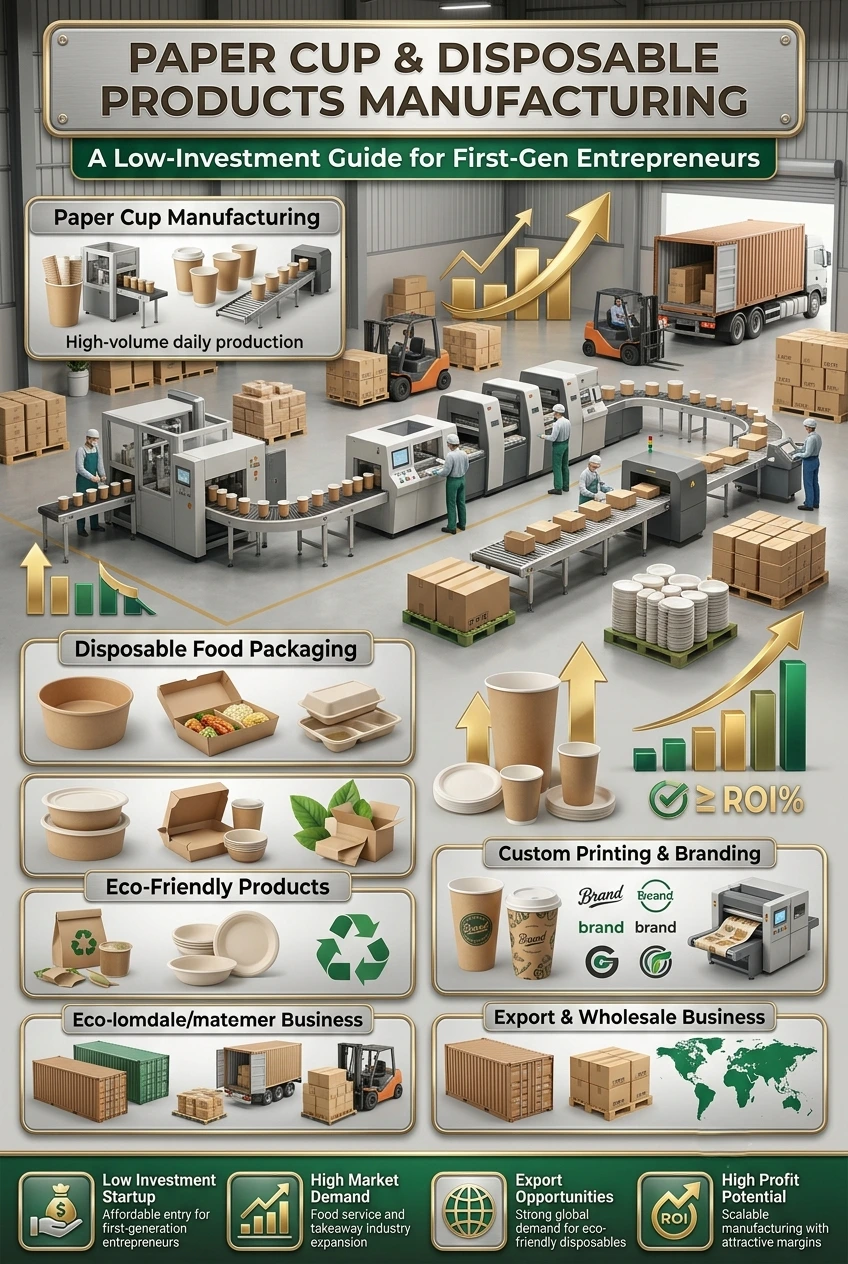
For the production process, two or three essential machines are needed:
- Paper Cup Forming Machine (Single/Double PE): Used single cavity Chinese cup forming machine prices ₹3.5 lakh, new semi-automatic Indian make paper cup forming machine prices ₹14 lakh to ₹40-80 lakh (high speed, fully automatic). Paper roll with a 65–80 gsm is coated with PE and is fed in and finished cups are ejected. Automatic machine (semi-automatic): 30–45 cups per minute.
- Other machines: Die Cutting Machine (optional for lids and trays) – ₹2-4 lakh for an entry-level machine.
- Flexographic printing machine used for printing branded cups: ₹3.5-8 lakh. A lot of smaller units take their printing out of house, at first.
For PE extrusion add-ons, the Indian machinery suppliers to contact with are Bharath Machines & Automation (Coimbatore), Ruian Mingyuan Machinery (Indian agents in Mumbai) and Rajoo Engineers (Rajkot).
Step 4 — Raw Material Sourcing
Domestic raw material used is PE coated paperboard rolls of 55 gsm to 300 gsm which are sourced from JK Paper (Rayagada, Odisha), TNPL (Tamilnadu) and Emami Paper Mills (Kolkata). The price of these is from ₹85 to ₹130 per kg as per the grammage. Recycled secondary inputs: food-grade PE granules, soy-based printing inks, packaging paper cartons.
Step 5 — Team
A starter unit requires 4-6 people: 1 machine operator, 2 helpers, 1 quality/packaging worker and 1 supervisor/owner-manager. The skilled machine operators are paid ₹12,000 to ₹18,000 per month.
From registration to first saleable production: 90 – 120 days, if the procurement of machinery and Pollution NOC are done simultaneously.
TABLE 3: Investment Breakdown — Starter Unit (Semi-Automatic, 1 Machine)
| Investment Head | Low Estimate (₹) | High Estimate (₹) | Notes |
| Semi-automatic cup forming machine | 3,50,000 | 14,00,000 | Indian-make preferred |
| Printing machine (flexographic) | 3,50,000 | 8,00,000 | Outsource initially |
| Electrical fittings & utilities | 50,000 | 1,50,000 | 3-phase power line |
| Civil work / shed modification | 1,00,000 | 3,00,000 | If rented space |
| Initial raw material (1 month) | 2,00,000 | 4,00,000 | PE-coated rolls + inks |
| Working capital (2 months) | 2,50,000 | 5,00,000 | Salary + rent + utilities |
| Licenses, registration & legal | 50,000 | 1,50,000 | FSSAI, Pollution NOC etc. |
| Contingency (10%) | 1,40,000 | 3,70,000 | |
| TOTAL PROJECT COST | ₹14,90,000 | ₹40,70,000 |
Note: Figures based on current market rates; land/building cost not included (rented space assumed). Source: NIIR Project Consultancy Services, field estimates.
Related Article: Top 20 Paper Manufacturing Business Ideas
Financial Snapshot: What the Numbers Actually Look Like
For one semi-automatic paper cup forming machine with a rated capacity of 35 cups per minute, let us assume that it is used for two shifts (16 hours/day), 25 working days a month.
When 60% full: ~5 lakh cups per month. Typical selling price for plain cups: ₹0.80–₹1.20 per cup in bulk (₹1.50–₹2.50 for branded). Average price of ₹1: Monthly revenue of ₹5 lakhs.
On full capacity: ~8.4 lakh cups per month. Monthly revenue: ₹8.4–₹10 lakh.
Operating expenses at full capacity, per month:
- Raw material (PE-coated rolls, inks): ₹3.5–₹4.5 lakh
- Salaries (5–6 staff): ₹70,000–₹90,000
- Power (3-phase, ~15 kW machine, 16 hrs/day): ₹35,000–₹50,000
- Rent + miscellaneous overheads: ₹30,000–₹50,000
- Total monthly OpEx: ₹4.35–₹5.90 lakh
The gross margin is 30–40% when running at full capacity. Net margin (after depreciation and loan servicing): 18-24%. Payback period of invested unit of ₹ 25 lakh at sustained capacity utilisation of 70%+ is in the range of 18–30 months. Units that offer printing capability and service branded clients can take the margin to between 28-32%.
These are mid-range estimates. The margins will narrow with no institutional contracts which require payment terms as long as 30 days, and they will widen if you have institutional contracts with 30+ day payment terms and annual volume commitments as this is a cost driver for raw material transportation.
ENTREPRENEUR SPOTLIGHT
Ramesh Gupta, Lucknow, Uttar Pradesh
The company began with one machine for forming cups made in China in a rented shed in the industrial cluster of Transport Nagar near Lucknow that occupied 900 square feet. The initial investment required is Rs.18 lakh (Rs.7 lakh of self-investment and Rs.11 lakh as MUDRA Kishore investment). In just 14 months, got a secured supply agreement with a regional hospital chain for 12 hospitals in UP’s eastern region, for a monthly order of 3.5 lakh cups. Now, Gupta runs three machines and has 14 people on board, making Rs.32 lakh monthly turnover. His one rule: Don’t purchase a second machine until you have locked in the one institutional buy. Volume certainty is a gamechanger.
Where to Get Detailed Project Data
To get numbers specific to their state, machine configuration or target product category, the entrepreneurs should refer to one of the oldest techno-economic research institutes in India, Niir Project Consultancy Services (NPCS) which has a specialized division of manufacturing project reports. NPCS has comprehensive project details for paper cup and disposable product units of various sizes including project layout, machinery specifications, raw material price comparison, financial calculations and break-even analysis. They make a difference in the banks, KVIC offices and the DIC officials during the project appraisal; that means the reports are designed to assist the loan application and investment decision. Entrepreneurindia.co is also home to a library of MSME business ideas and manufacturer guides curated by entrepreneurs and for entrepreneurs in various industries. In case you are looking for NPCS for project level consultancy or feasibility studies, you can directly contact NPCS at niir.org.
The One Thing to Do Next
Stop researching. Start locating your buyer.
Before you spend a rupee on machinery or space, call the purchase manager of the nearest government hospital, the catering contractor at your railway station, or the regional office of a QSR chain. Ask them: “Who supplies your paper cups? Would you consider a local vendor at the same price or lower?” You already know the answer. They are paying freight from Maharashtra or Tamil Nadu. You are local. That is your margin advantage — and it is permanent.
Once you have even one tentative buyer, apply for PMEGP at kviconline.gov.in or walk into your nearest KVIC district office with a business plan. The capital subsidy alone can cover 15–35% of your machinery cost. The Udyam Registration portal takes under 30 minutes. The market is there. The policy support is there. The only missing piece is you — in the game.
Frequently Asked Questions
Q1. What is the minimum investment needed to start a paper cup manufacturing unit?
One machine fully functioning machine can be installed with investment between 15-25 lakhs including machine, initial raw materials, license fees & two months working capital. If you already own or can rent a space cheaply, the floor cost drops to under ₹12 lakh using a refurbished machine. MUDRA and PMEGP can fund 60–70% of this amount with minimal collateral.
Q2. Which licenses are mandatory before starting production?
At minimum, you need Udyam Registration (free), GST Registration, FSSAI Registration/License (for food-contact cups), and a Pollution NOC (Consent to Establish + Consent to Operate) from your State Pollution Control Board. A Factory License is required if you employ 10 or more workers. BIS certification to IS 14534 is not mandatory but opens institutional supply contracts. See FSSAI’s FOSCOS portal for online application.
Q3. Where do I source the raw material — PE-coated paper rolls?
Locally from JK paper (Odisha) TNPL (Tamil Nadu) Emami Paper Mills (West Bengal) and Seshasayee Paper and Boards (Tamil Nadu). Prices currently range from ₹85 to ₹130 per kg. For small orders, trading agents in paper markets in Kolkata (Burrabazar), Mumbai (Kalbadevi), and Delhi (Chandni Chowk) supply in smaller lot sizes with 15–30 day credit terms.
Q4. Is this business genuinely profitable, or is competition too high?
Net margins of 18–24% are achievable at 70%+ capacity utilisation — which is realistic if you have institutional buyers. Competition is intense in metro markets (Mumbai, Delhi, Chennai) but thin in Tier-2 and Tier-3 cities in UP, Bihar, Rajasthan, Odisha, and the North-East. The plastic ban has permanently removed the largest competitor (plastic cups) from many institutional categories. Payback is typically 18–30 months.
Q5. What government support is available, and how do I apply?
Best: PMEGP scheme (15-35% of capital subsidy at kviconline.gov.in). MUDRA Kishore/Tarun loans (up to ₹1 crore, without collateral, via your bank). CGTMSE cover on your credit. Women entrepreneurs and SC/ST founders additionally qualify for Stand-Up India (₹10 lakh–₹1 crore). All schemes require Udyam Registration as a prerequisite.
Q6. How can NPCS help me with this project?
NPCS gives comprehensive report covering project details such as plant & machineries cost and its sources, raw material sourcing, cash flow projection, breakeven and all aspects for paper cup making machines at various capacity. These reports are structured to support bank loan applications and KVIC project appraisals. Access their report catalogue at niir.org or explore sector articles and business guides at entrepreneurindia.co.


