





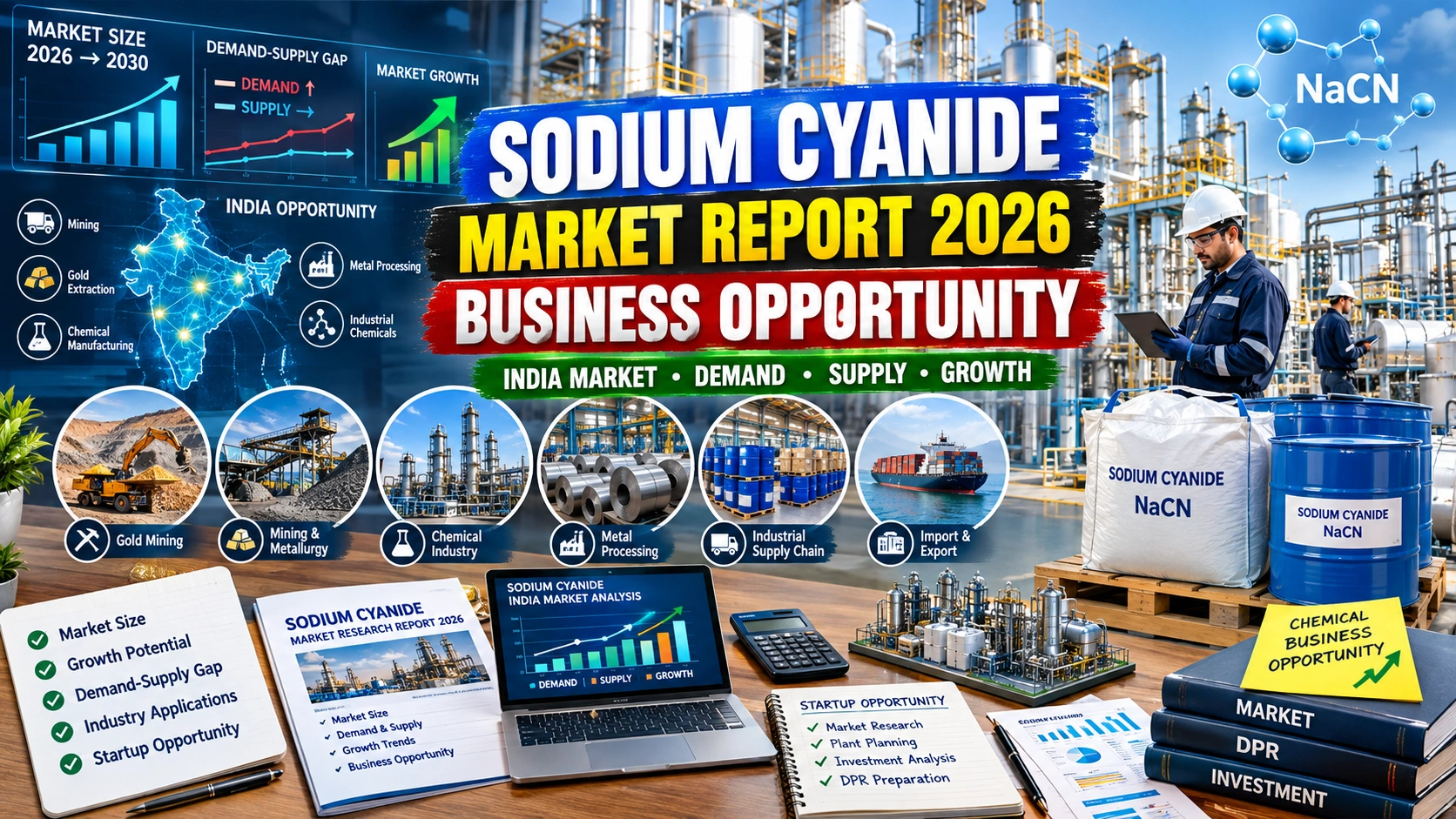
Sodium Cyanide Market in India
Sodium cyanide is a specialty inorganic chemical, virtually synonymous with one use: gold mining. About 75-85% of the world’s consumption is used in the cyanidation process, which removes gold and silver from the ore. An intentional measure by the government through anti-dumping duties on imports of sodium cyanide from China, EU, Japan and Korea in the middle of 2024, to safeguard and strengthen local production, is what makes this category relevant for Indian entrepreneurs at the moment. The step is rare and explicit policy guidance that India would like to have more of this chemical produced in the country.
View Full Project Details: Sodium Cyanide: A High-Potential Manufacturing Opportunity for Startups
What Is Sodium Cyanide?
Sodium cyanide (NaCN) is an extremely poisonous, water-soluble inorganic salt produced mainly by the reaction of hydrogen cyanide with sodium hydroxide (caustic soda). It comes in two basic types:
- Solid sodium cyanide – generally in the form of briquettes (preferred for logistics for transport, storage and handling, particularly in remote mining areas and over long distances)
- Liquid sodium cyanide – A pure solution of sodium cyanide, which is used directly at the mining site where there is dedicated tank/leaching infrastructure.
It has the following main industrial uses:
- Gold and silver mining (cyanidation) – the dominant application by a wide margin; sodium cyanide forms a soluble complex with gold, enabling extraction from low-grade ore via heap leaching, tank leaching, and carbon-in-pulp processes; recovery rates typically exceed 80%
- Electroplating – of connectors and precious-metal-plated components, a smaller but faster-growing segment tied to electronics manufacturing
- Chemical synthesis – as a precursor for cyanuric chloride, adiponitrile (a nylon intermediate), pharmaceuticals, dyes, and pigments
- Precious metal recovery from electronic scrap (e-waste) – an emerging secondary demand stream growing faster than primary mining demand
Global and India Sodium Cyanide Market Size and Growth
The range of estimates for the size of the global market is more than USD 2.5 billion to USD 4.45 billion in 2025-26, depending on whether the study includes sodium cyanide as a whole or focuses on the sodium cyanide used in the mining applications segment, and most estimates predict a market in the USD 3.96 billion to USD 6.1 billion range in the early-to-mid 2030s at CAGRs generally falling between 2.8% and 5.6%. The global market is estimated to be at around 1.26–1.38 million tonnes in 2025 and China alone is consuming an estimated 378,000 metric tonnes of the solid form of cyanide in 2024.
Note on figures: sodium cyanide market studies have significantly different results when considering the chemical in general or specifically, the segment of the market used for mining alone (75-85% of total volume). NPCS can provide you an investor grade numbers, and develop an application specific techno-economic feasibility study for your target application, either on the mining or on the chemical intermediate side.
India’s Anti-Dumping Policy Shift
This is the biggest development for Indian entrepreneurs of this sort in recent times. In April 2023, India’s Directorate General of Trade Remedies (DGTR) initiated an anti-dumping probe into the imports of sodium cyanide from China, European Union, Japan and South Korea, citing dumped imports to be causing material injury to the domestic industry. The investigation was finalized by the Department of Revenue imposing anti-dumping duties on the import of the product from the prospective date of 27 June 2024 for the purpose of protection and promotion of domestic Indian production and consumption.
This is a policy direction, because the Indian government has been very clear that it is taking steps to create commercial viability of the domestic production of sodium cyanide compared to that of imports, which is a rare and clear tailwind for new investment in this particular chemical.
Policy Tailwinds
- Anti-dumping duties on imports from China, EU, Japan and Korea – The duties will now be in effect from June 27, 2024 and will have a direct impact on the competitiveness of Indian-made sodium cyanide in comparison to the lowered-priced imports.
- DGFT export regulation for domestic supply security: In May 2024, India’s Directorate General of Foreign Trade introduced new export regulations requiring additional clearances and certifications for sodium cyanide exporters, specifically to ensure adequate domestic supply for industrial applications including pharmaceuticals and chemicals.
- India’s increasing gold mining and processing industry: India is not a significant player in the world’s gold mining, but there’s a stable demand from jewellery industry, gold refining industry and gold-processing industry, along with a small but growing gold mining industry.
- International Cyanide Management Code (ICMC) alignment: Indian producers seeking to serve export or multinational mining customers increasingly pursue ICMC certification, creating a quality/compliance differentiation opportunity for serious manufacturers.
- State industrial incentives for MSME: Chemical manufacturing process of sodium cyanide is a downstream caustic soda/alkali-caustic soda manufacturing linked process and it can avail State industrial incentives available in the established MSME clusters like Gujarat.
Read the Complete Book Here: Modern Technology of Industrial Chemicals
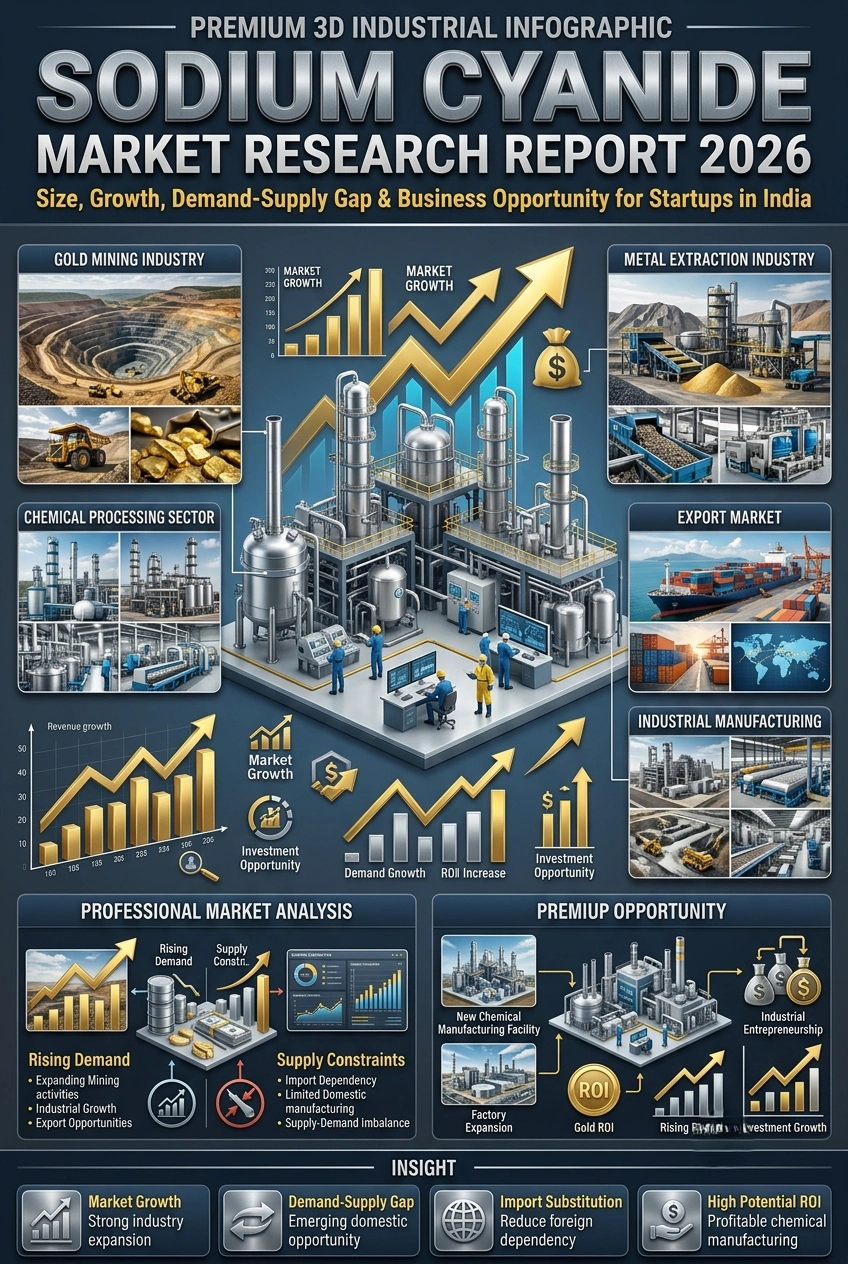
India Demand-Supply Position: Sodium Cyanide
| Parameter | Current Position |
| Domestic production base | Limited to a small number of established producers — Gujarat Alkalies and Chemicals Ltd. (GACL), Hindusthan Chemical Company, and a few others — concentrated primarily in Gujarat |
| Historical import dependence | Significant, with China, EU, Japan, and South Korea as the primary import sources — the basis for the 2023-24 anti-dumping investigation and duty imposition |
| Regulatory intervention | Anti-dumping duties in effect since June 27, 2024, explicitly designed to shift demand toward domestic production and support capacity expansion |
| Nature of the gap | An import-substitution opportunity now actively supported by trade policy — India’s domestic producer base is narrow relative to consumption, and government action has just improved the economics of building new domestic capacity |
| Downstream demand context | Sodium cyanide production is itself downstream of India’s substantial caustic soda/chlor-alkali industry, meaning integrated chemical manufacturers already producing caustic soda have a natural backward-integration opportunity |
| Opportunity for new entrants | Best suited to established chemical manufacturers (particularly chlor-alkali producers) with the safety infrastructure and hydrogen cyanide handling capability required, rather than a greenfield MSME entry point |
Reading the position: This is a narrower, more specialised opportunity than most categories in this series — sodium cyanide manufacturing requires serious hazardous chemical handling infrastructure and is not a typical MSME greenfield entry point. But for an existing chemical manufacturer, particularly one already producing caustic soda or hydrogen cyanide-adjacent products, the anti-dumping duty structure has meaningfully improved the economics of adding or expanding domestic sodium cyanide capacity — a genuine, government-supported import-substitution case.
Major Indian Sodium Cyanide Manufacturers
| Company | Base/Region | Notes |
| Gujarat Alkalies and Chemicals Ltd. (GACL) | Vadodara/Dahej, Gujarat | Major Gujarat government-promoted chemical company; manufactures sodium cyanide alongside caustic soda, sodium ferrocyanide, and other chlor-alkali derivatives; established 1973 |
| Hindusthan Chemical Company (a unit of Hindustan Development Corporation) | Mumbai, Maharashtra | Petitioner in the DGTR anti-dumping case; established domestic sodium cyanide and cyanide-derivative producer |
| United Phosphorus Ltd. (UPL) | Gujarat/Mumbai | Major Indian agrochemical and specialty chemicals multinational; co-petitioner in the anti-dumping investigation, with sodium cyanide as part of its broader chemical intermediates portfolio |
| DCW Ltd. | Mumbai (with Tamil Nadu operations) | Established Indian chlor-alkali and chemicals producer, historically involved in related cyanide/cyanate chemical production |
| Regional Gujarat-based specialty chemical manufacturers | Ahmedabad, Vadodara, and other Gujarat industrial clusters | Smaller specialty and industrial chemical manufacturers with sodium cyanide or cyanide-derivative production capability |
Major International Sodium Cyanide Players
| Company | Country | Notes |
| Orica Limited | Australia | Global market leader, holding over 18% market share; a leading global mining chemicals and explosives company using automated cyanide dosing technology |
| Cyanco International LLC | United States | Major North American sodium cyanide producer; expanded its Winnemucca, Nevada facility by 25% capacity to meet rising gold mining demand |
| Draslovka Holdings a.s. | Czech Republic | Major European producer with global expansion ambitions; recently acquired Chemours’ Mining Solutions Business and is diversifying into Prussian Blue production for sodium-ion batteries |
| Hebei Chengxin Co., Ltd. | China | Major Chinese sodium cyanide producer, part of China’s dominant 40–45% share of global installed capacity |
| Evonik Industries AG | Germany | Major global specialty chemicals company with sodium cyanide production capability |
| Australian Gold Reagents (AGR) | Australia | Upgraded its Kwinana, Western Australia plant, increasing annual capacity by over 30% to approximately 130,000 tonnes |
| Nippon Soda Co., Ltd. | Japan | Established Japanese chemicals producer with sodium cyanide manufacturing capability |
| Sociedad Química y Minera de Chile (SQM) | Chile | Major Latin American chemicals and mining materials producer |
Market Segmentation
By Form
- Solid sodium cyanide (briquette) — preferred for transport, storage, and remote-site logistics
- Liquid sodium cyanide (solution) — used directly at mining sites with tank infrastructure
By Application
- Gold mining (cyanidation) — dominant application, 75–85% of global consumption
- Silver mining
- Copper and zinc mining (secondary metal recovery)
- Electroplating (connectors, precious-metal finishes)
- Chemical intermediates (cyanuric chloride, adiponitrile, pharmaceuticals, dyes, and pigments)
- Electronic scrap/e-waste precious metal recovery (emerging segment)
By End-Use Industry
- Mining and metals extraction
- Electronics and electrical equipment manufacturing
- Pharmaceutical and chemical synthesis
- Textiles and dyes
Related Article: Future-Ready Chemical Business Ideas: Investment Prospects in Cyanides, Methanol & Acrylates
Key Growth Drivers
- Sustained global gold mining activity. With gold prices performing strongly and mining companies exploring lower-grade deposits (requiring higher cyanide dosage per tonne of ore to maintain recovery rates), underlying reagent consumption continues to grow even where gold output volumes are flat.
- India’s anti-dumping trade protection. The imposition of duties in June 2024 directly boosts the commercial viability of increasing the production capacity of sodium cyanide in India over the competition from import prices.
- An increasing demand for electronics and e-waste recycling. Manufacturing of connectors and recovery of precious metals from electronic waste are driving the expansion of the electronics/electroplating share, which accounts for 8–12% of global volume.
- Growth of gold mining in developing countries. Development of new mining projects is underway in the continents of Africa, South East Asia and Latin America, which offers the possibility of localised production of sodium cyanide in close proximity to major mining districts, thus alleviating logistics cost.
- Expanding into battery materials. The shift towards Prussian Blue production, which is a material based on sodium cyanide, in the sodium-ion battery industry represents a new application of the cyanide-based chemicals besides their use as chemical intermediates in the traditional mining sector.
Challenges and Restraints
- Extreme toxicity and hazardous handling requirements. Sodium cyanide manufacturing, storage, and transport require rigorous safety infrastructure, specialised handling protocols, and regulatory compliance well beyond most other chemical categories.
- High entry and exit barriers. Handling of hazardous materials, capital intensive hydrogen cyanide production plant and ICMC certification requirements make this a poor choice for the typical greenfield MSME entry.
- Scrutineering from the environment and regulators. Competitive risk is growing in the long term from increasing environmental regulations in the handling and disposal of cyanide, as well as an interest in alternative extraction technologies (thiosulfate, bromine-based leaching), which present a lesser threat at this time.
- Feedstock cost volatility. Production costs are linked to natural gas, ammonia, and caustic soda prices, creating input cost volatility that complicates long-term contract pricing.
- Concentrated global supply base. With production concentrated in China (40-45% of capacity) and a handful of major Western/Australian producers, new entrants face established, technically sophisticated incumbents with deep customer relationships in the mining sector.
Competitive Landscape
Sodium cyanide is a narrow and concentrated industry in India, with GACL (a Gujarat government-backed chemical major with integrated chlor-alkali operations) and Hindusthan Chemical Company, and UPL, the two petitioners who had initiated the anti-dumping case which tilted the competitiveness balance in 2024. Orica (Australia), Cyanco (US), and Draslovka (Czech Republic) dominate the market, and China has the largest production capacity. The competitive landscape for a new or existing Indian manufacturer has truly been tilted in favor of domestic manufacturing since mid-2024, with the newly established Indian trade protection.
Sodium Cyanide Manufacturing: Business Opportunity for Startups and MSMEs
- Optimizing existing chlor-alkali producers by using backward integration. The most logical ones are established caustic soda manufacturers due to the process link between the production of caustic soda and sodium cyanide and the infrastructure of safety/handling that they already have in place.
- Import-substitution capacity expansion. Existing Indian sodium cyanide capacity will be expanded, rather than new greenfield capacity, as a commercially de-risked route for an established chemical manufacturer is to be protected from anti-dumping duties on Chinese/EU/Japanese/Korean imports.
- ICMC-certified, export-oriented production. If companies are certified under International Cyanide Management Code, it allows them to sell to big multi-national mining companies in India and neighbouring countries and distinguish themselves based on quality and compliance and not price alone.
- Electronics and electroplating industry in India – regional supply. Localised supply of sodium cyanide for electroplating and recovery of precious metals is a smaller volume, less hazardous-logistics intensive market segment of electronics manufacturing in India that is developing as a direct outcome of national manufacturing initiatives.
This classification is strictly applicable to established chemical manufacturers who have existing safety infrastructure and is not likely to be an appropriate choice for the greenfield entrepreneur with an extreme hazard profile and regulatory complexity for sodium cyanide manufacturing. NPCS generates detailed Project Reports that include process technology specifications, guidance around safety and regulatory compliance, and market assessment for your specific application and capacity, and can give honest feedback on suitability of entry barriers at the feasibility stage.
Discover business ideas that actually make money
How NPCS Supports Entrepreneurs Entering This Space
Any entrepreneur or an existing manufacturer considering a sodium cyanide manufacturing project begins with a well-managed Detailed Project Report (DPR) that covers the plant capacity, production process and selection, sourcing of raw materials, comprehensive safety and regulatory compliance planning, project cost, and financial viability for the projected application and target market.
About NPCS (Niir Project Consultancy Services)
NPCS is an ISO 9001:2015 certified Industrial consultancy firm established in the year 1994 based at Delhi, with more than 30 years of experience in Techno-economic & Project consultancy. NPCS has provided over 150,000 project reports and profiles in 85 countries encompassing every manufacturing and process industry including inorganic and specialty chemical, mining chemical and hazardous material manufacturing.
NPCS is run on three joined platforms:
- niir.org — the primary repository of industry-specific Detailed Project Reports, business plans, and techno-economic feasibility studies
- entrepreneurindia.co — market research, project profiles, and manufacturing business opportunity content aimed at entrepreneurs and MSMEs
- npcsblog.com — industry insight, trend analysis, and manufacturing sector commentary
NPCS’s main activities and services in a sodium cyanide project are:
- Detailed Project Reports (DPRs) with plant capacity and machinery specification, and lay out.
- Techno-economic feasibility studies including guidance on safety and hazardous materials compliance
- Financial modelling – project cost, profitability analysis, ROI, break-even calculations
- Raw material market assessment and raw material specific to Indian mining and electronics market.
- Funding application and regulatory approval documentation support.
Entrepreneurs and established manufacturers evaluating this sector can access relevant sodium cyanide manufacturing profiles directly on niir.org and entrepreneurindia.co, or request a custom feasibility study scoped to a specific application and capacity.
Government and Institutional Reference Links
- Directorate General of Trade Remedies (DGTR)
- Directorate General of Foreign Trade (DGFT)
- Petroleum and Explosives Safety Organisation (PESO)
- Central Pollution Control Board (CPCB)
- Ministry of Mines
- Bureau of Indian Standards (BIS)
- Press Information Bureau (PIB), Government of India
- Startup India
- Invest India (National Investment Promotion and Facilitation Agency)
Entrepreneurs are advised to verify the latest anti-dumping duty schedules, PESO hazardous chemical handling requirements, and DGFT export regulations directly on these portals, as these provisions are periodically revised.
Conclusion
Sodium cyanide is one of those narrow, technically complex classes of chemicals — and just one for which India’s government trade policy has ushered a real, measurable tailwind for the home-grown manufacturer. This is a rare example of policy measures directly impacting the competition economics in favour of new or expanded domestic capacity, in the context of a documented import-dependency gap in June 2024 anti-dumping duties on Chinese, EU, Japanese and Korean imports.
Sodium cyanide provides an import substitution opportunity for established chemical manufacturers and well-capitalised entrepreneurs, as long as they’re ready to invest heavily in handling the hazardous material and ensuring safety, which the chemical requires.


