





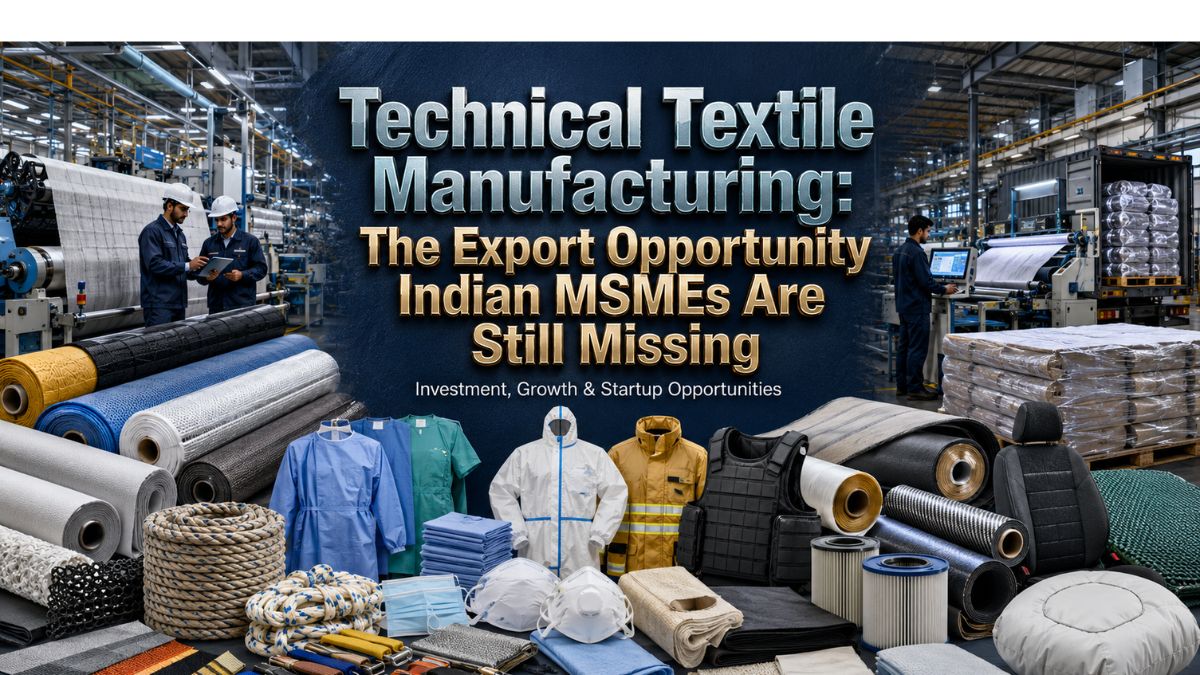
Technical Textile Manufacturing Business
The Fabric No One Is Talking About — But Everyone Is Buying
About ₹16,000 crore of conventional cotton garments are exported by India to the EU every year. However, a particular niche segment of speciality fabrics, where demand is a must in road construction, hospitals, and packaging, is largely not being met by Indian MSMEs. The product? Technical textiles. The figures speak for themselves and it has to be said that even the manufacturing entrepreneur sitting up can’t deny that India has just 6% share of the global technical textile market, even as it is the second largest producer of polyester in the world. According to consulting firm Primus Partners, the global market will see transactions worth USD 274 billion, India’s share of which could be USD 39 billion. The difference between what India could provide and what it actually exports is not due to the lack of raw materials or labour cost. It is a failure in the entry of MSMEs.
This article is all about that gap and just how you can fill it.
Get Detailed Insights from This Book: The Complete Book on Textile Processing and Silk Reeling Technology
The Supply Gap That Nobody Is Filling
The problem is simply stated. Despite the growth of domestic technical textile companies, India continues to import substantial volumes of high-quality technical textiles from China, South Korea and Germany for agrotextiles (shade nets, mulch films), geotextiles (roads, embankments, river erosion control), medical nonwovens (surgical drapes, wound dressings) and industrial filtration fabrics.
The National Technical Textiles Mission (NTTM) under Ministry of Textiles specifically categorised medical disposables, protective clothing, geotextiles and high-performance nonwovens as categories of imports. This gap was clearly evident when India faced the inability to manufacture its own nonwoven PP fabric for PPE kits on a large-scale during COVID-19. This episode also kick-started policy action and investments, however, MSME manufacturing in these segments are still sparse in the country.
The Indian technical textiles market will reach USD 23.3 billion by the mid-2020s, increasing by 12.3% annually, according to the Indian Brand Equity Foundation (IBEF). In response to this demand curve, the domestic production of MSMEs is limited to low value commodity products such as woven sacks, tarpaulins and simple shade nets. A number of items such as geosynthetics for highway construction, needle-punched nonwovens for automotive linings, and antimicrobial hospital fabrics continue to be exported. The use of geotextiles in national highway projects has been a mandatory requirement by the Ministry of Road Transport and Highways, and has created captive domestic demand; however, less than 30% of this demand is being fulfilled by the Indian MSMEs.
This is a problem faced by the most affected states such as Uttar Pradesh (highway projects under Purvanchal Expressway and Bundelkhand Expressway), Rajasthan (canal lining and road projects), Andhra Pradesh (riverbank erosion control) and the North-East (landslide mitigation). However, the most developed technical textile clusters are in Gujarat, Maharashtra and Tamil Nadu, which is definitely contradictory to the demand geography.
Table 1: State-wise Technical Textile Demand, Key Segments & Industrial Clusters
| State / Region | Key Technical Textile Segments | Major Industrial Clusters | Export Readiness | Priority Infra Initiative |
| Gujarat | Agrotextile, Geotextile, MMF Nonwoven | Surat, Ahmedabad, Vadodara | High – JNPT proximity | PM MITRA Park (Navsari) |
| Tamil Nadu | Medical Textile, Protech, Sportech | Coimbatore, Tiruppur, Chennai | High – Major ports | PM MITRA Park (Virudhunagar) |
| Maharashtra | Buildtech, Indutech, Packtech | Pune, Aurangabad, Nagpur | High – JNPT & NMIA | Textile Tech Parks (SITP) |
| Uttar Pradesh | Geotextile, Agrotextile, Hometech | Kanpur, Varanasi, Noida | Medium – Growing infra | PM MITRA Park (Lucknow) |
| Rajasthan | Mobiltech, Technical Yarn, Buildtech | Bhilwara, Jaipur, Jodhpur | Medium – Rail & road access | State Textile Policy 2022 |
| Andhra Pradesh | Geotextile, Protech, Sportech | Visakhapatnam, Guntur | High – Krishnapatnam Port | PM MITRA Park (Tadepalli) |
Sources: Ministry of Textiles (nttm.texmin.gov.in), IBEF (ibef.org), IMARC Group, Invest India
Why Right Now Is the Optimal Entry Window
The business environment is supporting MSME manufacturers of technical textiles in a very peculiar way with three converging trends.
Firstly, China’s supply chain risk premium is a reality. Global buyers (mainly from European and American countries) are actively cutting down on relying on one country. India’s involvement in the India-UAE CEPA and the upcoming negotiations for EU FTA further strengthens the tariff access. India’s inclusion in the India-UAE CEPA and the ongoing EU FTA negotiation further enhances the tariff access. The Ministry of Textiles reports that the technical textile sector has already seen a growth of more than 10% in the previous couple of years.
Second, government procurement has become compulsory, thus creating captive demand. The National Highways Authority of India (NHAI) and state PWDs are now mandating Geotextiles in all the new highway construction under BIS IS 17069 standards. The Ministry of Agriculture encourages the use of agrotextiles for mulching, shade nets and covers for greenhouses, which was funded directly to North-Eastern states via NTTM subsidy lines. These are not conceptual markets. They are non-recurring demand.
Third, the government has already capital moving. The approved outlay of the Production Linked Incentive (PLI) Scheme for Textiles is at ₹10,683 crore with a focus on MMF fabrics and technical textiles. Capital burden on new entrants has been eased by providing plug-and-play factory infrastructure by seven PM MITRA (Mega Integrated Textile Region and Apparel) Parks in Gujarat, Tamil Nadu, Andhra Pradesh, Karnataka, Madhya Pradesh, Rajasthan and Uttar Pradesh. The capital incentive offered by PM MITRA for anchor units is around 3% up to ₹30 crore of turnover.
The PMEGP (Prime Minister’s Employment Generation Programme) administered through KVIC provides upto 35% capital subsidy (for rural/SC/ST/women entrepreneurs) for manufacturing projects up to ₹50 lakh for MSMEs who are not able to meet the large scale criteria of PLI. With the CGTMSE scheme, it is possible to avail bank finance without mortgaging any assets via SIDBI and scheduled banks with loans up to ₹5 crore without collateral.
Access Complete Business Plan: Complete Guide to Textile Processing Projects
How to Set Up a Technical Textile Manufacturing Unit: Step-by-Step
Choose Your Sub-Segment First
This is the most crucial decision you will take and should be made before you book a factory shed. The three basic segments recommended for an MSME for his/her first time are:
- Geotextiles (nonwoven / woven PP): High captive government demand, BIS-standardised product, relatively simple machinery.
- Actions: Agrotextiles (shade nets, mulch films, crop covers) – big rural demand, subsidised government distribution, shorter sales cycle.
- Nonwoven fabrics for hygiene and medical application: Higher margin, export, stricter requirement of quality certification.
Minimum Investment Required
If it is a small-scale geotextile or agrotextile unit, the total capital investment will be between ₹97 lakh and ₹1.37 crore. The cost of a medium scale non-woven unit (for export markets), will be in the range of ₹ 3.7 crores to ₹ 4.7 crores. All these figures exclude any government subsidy.
Land and Space Requirements
For a small unit the requirement is 3,000/- 5,000 sq. ft. of covered factory space preferably in industrial area (for easy pollution NOC and power connection). The medium unit requires around 10,000 sq. ft. and the rent price for industrial sheds in Gujarat, Tamilnadu and MIDC regions are available at ₹18-35 per sq. ft. per month.
Key Machinery
In the case of needle-punched nonwoven or geotextiles:
- Opening & blending machine (PP/polyester staple fibre)
- Carding machine (to make web from fibres)
- In addition to this, it employs needle punch loom, a core production equipment.
- Slitter, winder and baler for finishing
- Tensile strength and permeability testing equipment (for BIS compliance)
The leading machinery suppliers in India are Lakshmi Machine Works (Coimbatore), Weavetech Engineers (Surat), and Tex Engineering (Ahmedabad). With care and caution, second hand needle punch looms from Germany (Dilo) or China.
Identify high-growth industries before others do
Raw Material Sourcing
For geotextiles: Polypropylene (PP) staple fibre (from Reliance Industries, IOCL or HPCL-Mittal traders, Surat, Ahmedabad and Panipat). For agrotextiles: HDPE tapes and monofilaments – there are good supplier bases in Rajasthan and Gujarat. The Polyester staple fibre for medical nonwovens is available in Panipat (Haryana) and Silvassa (Dadra & NH).
Licences and Regulatory Approvals
- Udyam Registration: All MSMEs are required to register on the Udyam portal for access to subsidy. Register at udyamregistration.gov.in
- GST Registration: You need to register for GST if you are going to charge any GST on your invoices and are eligible to claim input credit.
- Factory Licence – from state Labour Department under the Factories Act (if having 10+ workers who have power at the factory)
- Pollution NOC: State Pollution Control Board — PP/polyester processing generally falls in the ‘Green Category’ (Low Risk)
- BIS Certification (IS 17069): compulsory for geotextiles in Government highway projects. The BIS Bureau of Indian Standards certification is mandatory in institutional sales.\
- If you’re looking for collateral-free loans, consider getting a loan from NSIC/CGTMSE.If you want a loan without any collateral then consider getting a loan from NSIC/CGTMSE.
Timeline: Registration to First Production
- Month 1-2: Registration with Company, Udyam, GST, Shed/Land arrangement.
- Month 2–4: Machinery procurement and civil work
- Month 4–5: Trial production, BIS testing, quality certification
- Month 5–6: Commercial production and first dispatches
Team Size to Start
8-12 employees: 1 production supervisor, 4 to 6 machine operators, 1 quality checker, 1 sales/logistics coordinator and 1 accountant. Skill training support is available under NTTM’s skill development programme (upto 50,000 candidates trained according to the data available from the Ministry of Textiles).
Table 2: Estimated Capital Expenditure Breakdown — Small vs. Medium Technical Textile Unit
| Cost Head | Small Unit (INR) | Medium Unit (INR) | Notes |
| Land & Civil Construction | ₹15–20 lakh | ₹45–70 lakh | Owned/leased; industrial zone preferred |
| Core Machinery (Needle Punch / Warp Knit) | ₹40–55 lakh | ₹1.2–1.8 crore | Domestic suppliers: Lakshmi, Weavetech, Surat |
| Auxiliary Equipment (Slitter, Winder, Baler) | ₹8–12 lakh | ₹25–40 lakh | Local fabrication possible for some parts |
| Raw Material (Polypropylene, Polyester fibre, PP tape) | ₹10–15 lakh (opening stock) | ₹30–50 lakh | Gujarat & Maharashtra suppliers |
| Certifications & Testing (BIS, ISO, Lab fees) | ₹3–5 lakh | ₹8–12 lakh | BIS IS 17069 for geotextile; ISO 9001 recommended |
| Working Capital (3 months) | ₹12–18 lakh | ₹40–60 lakh | MUDRA/CGTMSE eligible |
| Contingency (10%) | ₹9–12 lakh | ₹25–35 lakh | Build this buffer; machinery delays are common |
| TOTAL ESTIMATED CAPEX | ₹97 lakh – ₹1.37 crore | ₹3.73–4.67 crore | Subsidy from TUFS/PMEGP reduces net outflow |
Sources: Industry estimates, NPCS project reports (niir.org), Entrepreneur India research. Figures indicative; vary by state, machinery choice, and product segment.
Related Article: How to Start a Textile & Apparel Manufacturing Unit: ₹5 Cr Investment, ₹20 Cr Revenue Potential
Financial Snapshot: What the Numbers Actually Look Like
The figures shown below are for a small geotextile / needle-punched nonwoven unit with an estimated total CAPEX of around ₹1.1 crore (after including the subsidy at 15% provided by the government, the outlay stands at ~₹93 lakh).
Monthly Operating Cost (at 60% capacity): ₹8.5-10 lakh, which includes raw material (PP fibre ₹80–90/kg), power (15–20 kW demand), wages, packaging and transport.
At 60% capacity, the revenue is expected to be at ₹14 – 17 lakh per month, if the production capacity is assumed as 40,000 – 50,000 sq.m. of non-woven geotextile is priced at ₹30 – 35/sq.m. (institutional/government rate).
Cost at 100% capacity: ₹17–21 lakh per month. The realisation price of the same product in EU market is USD 0.55-0.75 per sq. m., which is around 20-25% higher than the domestic institutional price.
Gross Margin: 38–44% on per-unit basis with 52–58% revenue being raw material at scale.
Net Margin (after overheads, depreciation, interest): 16–22% (at 75% capacity utilisation). With an absorption of fixed overheads, net margins reduce to 9–12% at 60% capacity.
The Payback Period for steady state capacity of 75%+ is 36-48 months. Units that are export oriented and have direct buyer relationships have a faster recovery of capital, usually within 28-34 months. The numbers are based on no significant downtime of major machinery and on the stability of the prices of PP fibres (which have ranged from ₹78 to ₹105 per kg in the last three years).
Table 3: Applicable Government Schemes — Eligibility and Benefits for Technical Textile MSMEs
| Scheme | Administered By | Benefit for Manufacturer | Max Subsidy / Incentive | How to Apply |
| NTTM – Research & Innovation Grant | Ministry of Textiles | R&D funding for specialty fibres & geotextiles | Up to ₹50 lakh (GREAT scheme) | nttm.texmin.gov.in |
| PLI Scheme for Textiles | Ministry of Textiles / DPIIT | Incentive on incremental turnover (MMF & tech textiles) | Up to 15% on turnover | investindia.gov.in |
| TUFS / ATUFS | Ministry of Textiles | Capital subsidy + interest reimbursement on machinery | 10–20% capital subsidy | texmin.nic.in |
| PMEGP (Prime Minister’s Employment Generation Programme) | KVIC / MSME Ministry | Up to 35% subsidy (rural) on project cost | Max ₹50 lakh (manufacturing) | kviconline.gov.in |
| CGTMSE (Credit Guarantee Fund) | SIDBI / MoMSME | Collateral-free loans up to ₹5 crore | 85% guarantee on loan | cgtmse.in |
| PM MITRA Park | Ministry of Textiles (7 States) | Common infrastructure, reduced logistics cost, plug-and-play factory | 3% of turnover up to ₹30 crore (anchor units) | texmin.nic.in / PM MITRA portal |
Sources: Ministry of Textiles (texmin.nic.in), KVIC (kviconline.gov.in), SIDBI/CGTMSE (cgtmse.in), Invest India (investindia.gov.in)
ENTREPRENEUR SPOTLIGHT
Rajesh Patel | Ahmedabad, Gujarat | Annual Turnover: ~₹4.8 crore
In the early 2010s, Rajesh invested ₹95 lakh in a needle-punched geotextile unit at GIDC, Vatva, where he started by supplying the local road contractors. He got his break when he became a registered vendor for NHAI projects in Gujarat and Rajasthan and got BIS IS 17069 certification for his projects. He now operates two production lines, at 80% capacity, with 22 workers, and has started experimental shipments to customers in Kenya and Tanzania, two countries that have road expansion programmes that are very aggressive. His biggest advice: “If you are looking for any order, you must get the BIS certification first, else government buyers will not even call you.
Where to Get Expert Guidance Before You Invest
If investors and MSME founders are looking to do in-depth market research and market analysis before investing capital in the project, Niir Project Consultancy Services (NPCS) available at niir.org provides detailed project reports of all 12 technical textile sub-segments such as Agro Textile Project Report, Geotextile Project Report, Medical Nonwoven Project Report and Industrial Textile Project Report. The reports by NPCS includes techno-economic feasibility, plant layout, machinery selection, raw material sourcing, licensing requirements, cost breakdowns based on capacities and locations. These reports serve as the basis for MSMEs to apply for Bank Loan under CGTMSE and MUDRA schemes. The Entrepreneur India platform (entrepreneurindia.co) also features a series of business opportunity writeups by the NPCS covering more than 200 manufacturing verticals, making it a convenient first port of call for any serious industrial investor.
The Decision Is Simpler Than You Think
India’s government has created a demand that has been pre-built. NHAI mandates geotextile. Agrotextiles are distributed by the agriculture ministries. Hospitals are in a rush to find medical nonwovens from their local manufacturers. The contracted market is already established. The missing link is the MSME manufacturer who comes with the right product, the right certification and the willingness to get up and running on the six-month curve.
The first step is very specific; just pick on sub-segment, submit the Udyam Registration form this week and secure a techno-economic feasibility report from NPCS or District Industries Centre (DIC) of your state of residence if you have export connections, if you have rural land or storage access you would focus on agrotextile. The DIC can also help you to link to PMEGP application and CGTMSE-supported lending institutions in your district.
Textiles built India’s original industrial base. Technical textiles are where the next chapter gets written — and the window for early-mover advantage is open right now.
Frequently Asked Questions
1. What is the minimum investment required to start a technical textile unit?
A small geotextile or agrotextile unit can be set up with a total capital investment of ₹97 lakh to ₹1.37 crore. After applying TUFS capital subsidy (10–15%) and PMEGP grants (up to 35% for eligible categories), the effective promoter contribution can be reduced to ₹50–70 lakh at the small-scale entry level. Medium-scale nonwoven units require ₹3.7–4.7 crore total CAPEX.
2. Which licences are mandatory before starting production?
These Registrations are compulsory, and no bargain is possible, including the following – Udyam Registration (to avail benefits of MSME), GST Registration, Factory Licence (in case using more than 10 employees and power with a state Labour department, the certificate comes from the State Labour Department), and a Pollution NOC from the State Pollution Control Board (SPCB). In the case you target to sale in govt. Highway projects, aBIS IS 17069 certificates of the fabric. For selling to institution buyers or exporting Medical non-woven the ISO 13485 is necessary to implement over a period.
3. Where can I source raw materials in India?
Raw materials polypropylene staple fibre – used in needle punched geotextiles are sourced from Indian Oil (IOCL) and Reliance Industries, in addition to many other traders located in surat, Ahmedabad and panipat. Polyester staple fiber used in medical non wovens can be supplied from Panipat (Haryana) and Silvassa. HDPE tapes and monofilaments for woven agrotextiles are available in Gujarat and Rajasthan. No significant import dependency exists for standard raw materials — a key advantage over other specialty manufacturing sectors.
4. What profit margins can a technical textile manufacturer realistically expect?
75%+ capacity utilisation would yield a net margin of 16-22%. Exports to Europe and Africa would fetch 20-25% higher revenue per unit vis-a-vis the Indian institutional rate, taking net margins towards 22-28% at scale. The typical gross margin is around 38-44%, and the cost of raw materials accounted for around 52-58% of the revenues. Payback periods of 28-48 months depend on capacity utilisation and product mix.
5. What government schemes offer financial support for technical textile MSMEs?
Six key schemes are directly relevant: PMEGP (up to 35% subsidy via kviconline.gov.in); CGTMSE (collateral-free loans up to ₹5 crore via cgtmse.in); TUFS/ATUFS (capital subsidy on machinery); PLI Scheme for Textiles (turnover-linked incentive for larger scale); NTTM-GREAT (grant up to ₹50 lakh for startups in specialty fibres); and PM MITRA parks (plug-and-play infrastructure in 7 states).
6. How can NPCS help me plan and finance this business?
NIIR Project Consultancy Services (NPCS) at niir.org publishes detailed project reports for all 12 technical textile sub-segments — covering machinery selection, plant layout, regulatory requirements, raw material sourcing, and five-year financial projections. These reports are widely accepted by nationalised banks and NBFCs as supporting documentation for CGTMSE and MUDRA loan applications. NPCS also offers direct consultancy for techno-economic feasibility studies and can customise project reports to your specific capacity and state location. The Entrepreneur India platform carries supplementary articles on sector trends, investment opportunities, and MSME policy updates.
Key Data Sources & References
- Ministry of Textiles – National Technical Textiles Mission (NTTM)
- Indian Brand Equity Foundation (IBEF) – Textiles Sector
- Invest India – Technical Textiles Investment Opportunity
- BIS Bureau of Indian Standards – IS 17069 Geotextile Standard
- KVIC – PMEGP Scheme Portal
- CGTMSE – Credit Guarantee Fund for MSMEs
- NIIR Project Consultancy Services – Technical Textile Project Reports
- Primus Partners – Roadmap for USD 100 Billion Textile Exports


