






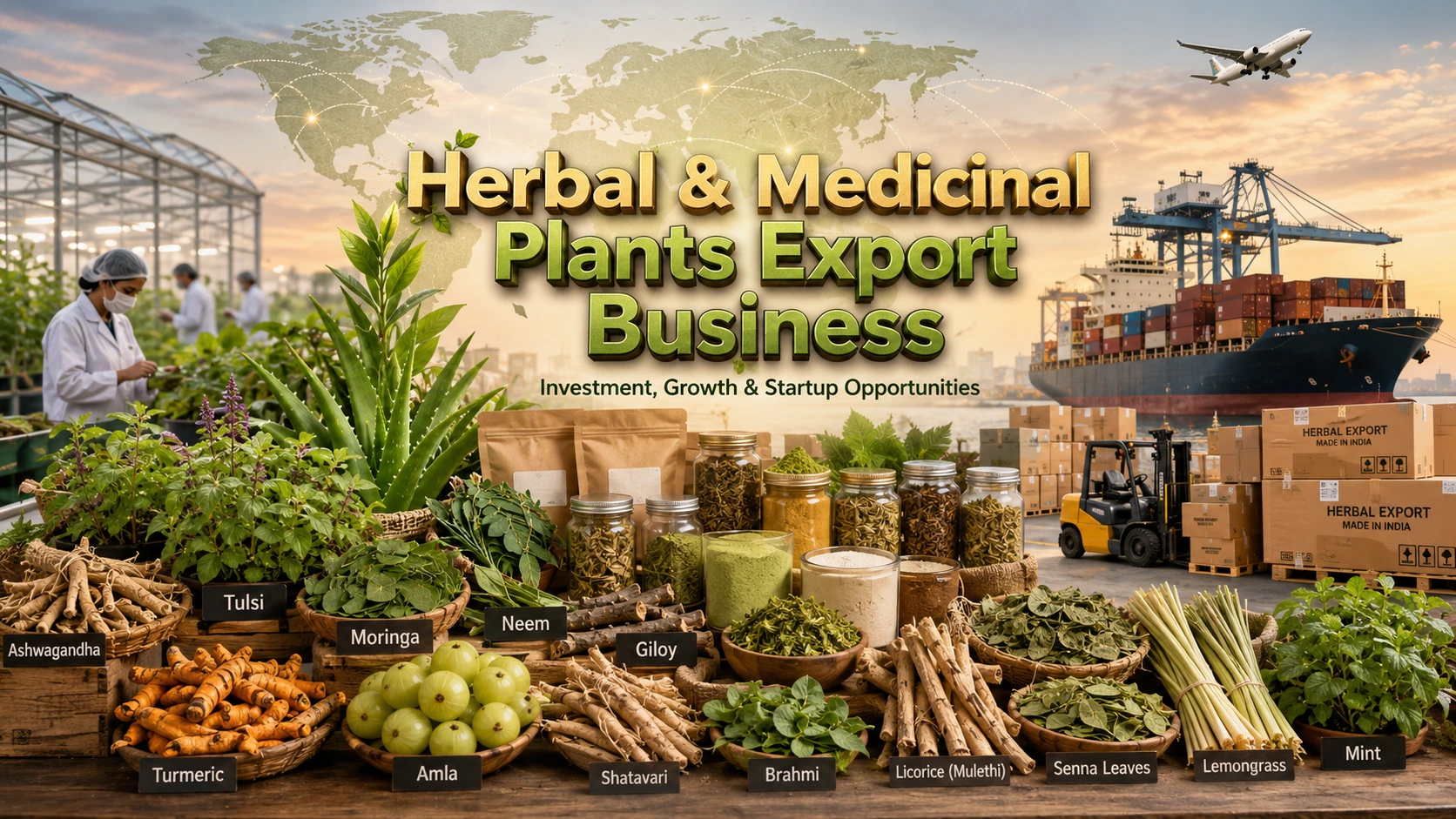
India’s unique medicinal plant diversity (more than 45,000 species of plants with medicinal potential in different agro climatic zones) provides a natural support for one of most unique business ideas in agricultural export. For exporters of herbal and medicinal products, these plants are APEDA scheduled products and are eligible for all the financial assistance, market development assistance and quality certification programmes. India, being the most biodiverse tropical country, having the knowledge system of traditional medicine is very deep, the global herbal medicine, nutraceutical and botanical ingredient market is huge, growing and looking for authentic quality tested plant materials from India. Major medicinal plant cultivation regions or established trader networks in major medicinal plant producing states in India make herbal and medicinal plants export a lucrative business due to small investment and good economics.
Why Herbal and Medicinal Plants Export Is a Structural Opportunity
The global medicinal plant market is gaining momentum owing to various parallel trends, such as the rising demand for plant-derived raw materials in the global nutraceuticals industry, the traditional medicine industry in Asia and Africa, the cosmeceuticals industry requiring plant-based actives, and the increasing demand for plant-based essential oils and aromatherapy oils around the world. India is one of the crossroads countries, providing raw botanical material to customers in the USA, EU, Japan, China and the Gulf nations, as well as processed products.
India’s competitive advantage in medicinal plants is multidimensional; with the existence of maximum diversity of medicinal plant species in the country; traditional knowledge system of medicinal plants (AYUSH) which is the largest of its kind in the world; competitive land and labour costs for cultivation; and the growing set-up of manufacturing of primary processing. This biodiversity, combined with knowledge and manufacturing capacity, makes the natural business niche for export business unattainable for the competition.
Read the Complete Book Here: Handbook on Herbal Medicines
APEDA, NMPB and Government Support
Herbal and medicinal plants belong to the schedule of products of Agricultural and Processed Food Products Export Development Authority (APEDA). The financial assistance for APEDA registration includes processing infrastructure, quality testing, packaging and market development. APEDA arranges Indian herbal exporters to attend International Natural Products trade fairs such as Natural Products Expo West (US) & Vitafoods (EU).
The National Medicinal Plants Board (NMPB) of Ministry of AYUSH gives the most direct assistance to the medicinal plant exporters in terms of cultivation assistance, post-harvest management financial assistance, geographic information system (GIS) mapping of medicinal plant resources, and quality standardisation programmes. NMPB’s cultivation support schemes provide an opportunity for entrepreneurs to establish a medicinal plant cultivation zone at a discounted price.
The Ministry of AYUSH offers export promotion support for AYUSH related medicinal plant materials and products. The AYUSH Export Promotion Programme is intended for export promotion of medicinal plants with the following activities: Market Development Activity, Participation in International Trade Fairs, and Buyer-Seller Facilitation.
Organic certification of medicinal plants, wild-crafted as well as cultivated, is done by APEDA under the National Programme for Organic Production (NPOP) which is crucial to market higher price-gain in organic raw material markets in EU and US, where certified organic botanical raw materials have a huge price premium.
Business Ideas in Herbal and Medicinal Plants Export
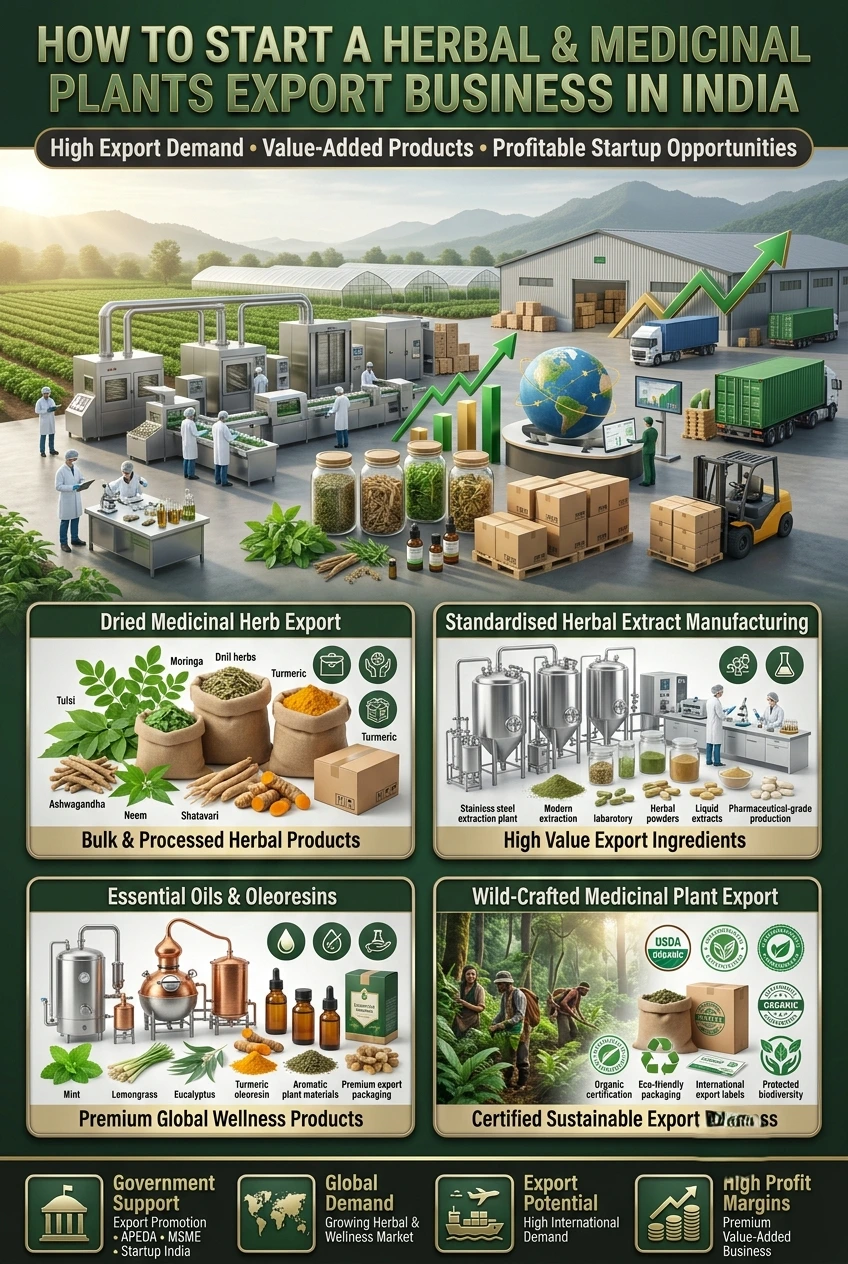
1. Dried Medicinal Herb Export — Bulk and Processed
The dried and cleaned medicinal plant raw materials such as root, bark, leaves, seeds and flowers are exported to the various herbal product manufacturers, nutraceutical companies and traditional medicine manufacturers around the world. Products like Ashwagandha root (Withania somnifera), Brahmi herb (Bacopa monnieri), Senna leaves (Cassia angustifolia), Triphala components, Neem leaves and bark, Shatavari root, and Guggul resin have consistent global demand. The investment required in an export business of dried medicinal herbs is around ₹15 lakh to ₹40 lakh with the investment in the dried infrastructure, cleaning and grading equipment and export packing. Main compliance requirements are APEDA registration and phytosanitary certification. The price premium for certified products is 30% to 60%.
2. Standardised Herbal Extract Manufacturing for Export
There is a 3X to 8X increase in export value when moving up the value chain from raw dried herbs to standardised plant extracts with a guaranteed minimum quantity of bioactive compounds.A modest incremental investment is required for this up the chain move, but the value of the export is multiplied 3X to 8X. Manufacturers of nutraceutical supplements are in great demand for Ashwagandha extract standardised at 5% Withanolides, Turmeric extract standardised on 95% Curcuminoids, Bacopa extract standardised on 20% Bacosides and Boswellia extract standardised on 65% Boswellic Acids. The cost of establishing a standardised herbal extract manufacturing unit is estimated at ₹30 lakh to ₹80 lakh and it includes cost of extraction vessel, filtration, concentration, spray drying, and analytical testing (HPLC). ISO 22000, organic certification, and FSSAI licensing are the compliance requirements. Its export markets include the United States, EU, Australia and Japan.
Get Detailed Project Report (DPR): Herbs and Herbal Based Products: Ayurvedic Medicines & Herbal Cosmetics
3. Essential Oils and Oleoresins from Medicinal Plants
Essential oils from Indian medicinal plants such as Eucalyptus, Lemongrass, Palmarosa, Citronella, Vetiver, Sandalwood and different mint oils are exported for aromatherapy, cosmetics, pharmaceutical, food flavouring, etc. The oleoresins from spice plants are used in food colouring and flavouring industry such as ginger oleoresin, chilli oleoresin and turmeric oleoresin. The investment requirement of an essential oil distillation unit is as follows: For distillation capacity of 100 kg/day, the investment required is about ₹20 lakh to ₹60 lakh. The export markets are the US, the EU, Japan and the Gulf. Eucalyptus and Lemongrass oils are more widely recognized worldwide, especially the Indian varieties.
4. Wild-Crafted Medicinal Plant Export with Sustainability Certification
When harvested in sustainable fashion from their natural habitat or forest and certified by FairWild or organic standards, wild-crafted medicinal plants can fetch a premium price. States such as Uttarakhand, Himachal Pradesh, MP and the Northeast have forest areas with good quantity of wild medicinal plants which can be sustainably tapped by the tribal and forest dependent communities. A sustainably wild-crafted medicinal plants export business (market access for tribal collectors, sustainable harvesting and Fair Wild or Organic certification) meets both market demand for ethically-sourced medicinal plants and community livelihood goals. Investment is mainly on Supply Chain Management, Certification & Quality Testing.
Import-Export Opportunity Analysis
India’s medicinal plant and herbal product exports are growing consistently. The APEDA AgriExchange herbal product data shows herbal and medicinal plant exports to the US, Germany, France, Japan, and UAE as major destinations. The global herbal ingredient market’s consistent growth trajectory supports long-term demand for quality Indian botanical raw materials.
Natural Products Expo West in California — the world’s largest natural health products trade fair — is the primary US buyer discovery platform for Indian medicinal plant and herbal product exporters. APEDA facilitates Indian exhibitor participation. European buyers are best reached through Vitafoods (Geneva) and in-Cosmetics (rotating European city) trade fairs for nutraceutical and cosmeceutical botanical ingredients respectively.
Build a profitable business with the right idea
Indian MSME Success Stories in Herbal Exports
Arjuna Natural Extracts, based in Kerala, built one of India’s most internationally recognised standardised herbal extract businesses by investing in HPLC analytical capability, ISO 22000 food safety systems, and authentic supply chain traceability from farm to finished extract. Their scientific approach to herb standardisation — publishing HPLC profiles and providing comprehensive technical documentation to buyers — built the trust with international nutraceutical buyers that drives long-term procurement relationships.
Synthite Industries, Kolenchery, built a multi-hundred crore herbal extract and oleoresin export business by focusing on consistently analysed products, innovation in extraction technology, and deep relationships with multinational food and nutraceutical companies. Their evolution from a basic oleoresin producer to a sophisticated botanical ingredient company is the aspiration model for smaller herbal extract exporters.
Several Uttarakhand-based MSME medicinal plant processors have built viable export businesses in Ashwagandha and Himalayan herb-derived products by combining NMPB cultivation support, APEDA export registration, and direct relationships with US nutraceutical supplement manufacturers — demonstrating that small-scale herbal export businesses can achieve international scale through focused product and market strategies.
How NPCS Supports Herbal Export Business Planning
We at Niir Project Consultancy Services (NPCS) provide professional consulting for the preparation of Market Survey cum Detailed Techno-Economic Feasibility Reports (DPRs) for setting up new herbal and medicinal plants processing and export businesses. Our reports include cultivation and wild-crafting supply chain analysis, extraction technology selection, APEDA and NMPB compliance guidance, organic certification pathway, market research and export demand analysis, and complete project financials with profitability projections.
Related Article: Herbal Health Powders in India: A Billion-Dollar Opportunity for Entrepreneurs
Herbal Plants Export Business: Key Data Overview
| Herbal Category | Investment Range | Key Certification | Target Markets | Typical Margin |
| Dried Medicinal Herbs | ₹15L – ₹40L | APEDA + Phytosanitary | US, EU, Japan, China | 20–40% |
| Standardised Herbal Extracts | ₹30L – ₹80L | ISO 22000 + FSSAI + Organic | US, EU, Australia | 40–80% |
| Essential Oils (Medicinal) | ₹20L – ₹60L | ISO 9001 + APEDA | US, EU, Japan, Gulf | 35–65% |
| Oleoresins (Spice/Herb) | ₹25L – ₹70L | ISO 22000 + FSSAI | US, EU, Japan | 30–55% |
| Wild-Crafted Certified Herbs | ₹15L – ₹35L | FairWild + Organic | EU, US (premium) | 40–70% |
Frequently Asked Questions (FAQ)
1. What is the NMPB’s cultivation support scheme?
NMPB provides financial assistance for medicinal plant cultivation through state-level implementing agencies. Support includes assistance for purchase of planting material, irrigation infrastructure, and post-harvest equipment. Financial assistance rates vary by species and state. Apply through state AYUSH departments or state medicinal plants boards that implement NMPB programmes.
2. Is a transit permit required for wild-collected medicinal plants?
Special varieties of medicinal plant – listed in CITES, the Convention on International Trade in Endangered Species, or notified as restricted under forest dept regulations of various states – need collection, transit, and export permits from the government and also a permit to transhiptimber/forest producefrom the state forest department. Entrepreneur needs to check the legal standing of particular plant before creating supply chain for wild-crafting.
3. What is FairWild certification and how does it benefit exporters?
FairWild provides the guarantee that wild harvested plants have been sustainably harvested responsibly-wild-crafted to a set of agreed standards for volume harvest limits, impact assessment, fair trade payments. There is increasing demand for FairWild for high value organic plant ingredients by EU and US purchasers. Premium of 15% to 40% on price can be earned and can lead to buyers with ethical sourcing principles.
4. What analytical testing is required for herbal extract exports to the US?
Generally, the American nutraceutical industry needs customers have to demand HPLC analysis (verifying the declared amount of phytocompounds) microbiology test, yeast, and mould and also total plate count (E. Coli, Salmonella, S. Aureus), heavy metal analysis (lead, arsenic, mercury, and cadmium), and the pesticide residues in the same sample. Also some consumers request solvent residues tests if an extract is provided. Third-party COA’s from an NABL or ISO 17025 accredited lab are common.
5. Which Indian states have the strongest medicinal plant export ecosystems?
Kerala and Karnataka are strongest for tropical species — pepper, cardamom, turmeric, ginger extracts. Uttarakhand and Himachal Pradesh dominate Himalayan species — Ashwagandha, Brahmi, Shatavari. Rajasthan and MP are significant for Ashwagandha, Isabgol, Senna. Northeast India has exceptional biodiversity for unique endemic species. Each region’s species profile determines the most competitive export products.
6. Can I start an herbal export business without cultivation by aggregating from farmers?
Yes, indeed, many profitable herbal exporter entrepreneurs are aggregator, buying dried herbs from various grower communities and production centres across the country, without their own farmlands for cultivating them. A good network of farmers, proper quality at the time of sourcing, efficient storage and drying infrastructure will do well in the aggregator business model of herbal exports.
Conclusion
Herbal and medicinal plants export is one of India’s most authentic and globally distinctive business ideas — rooted in the country’s extraordinary biodiversity, millennia of traditional knowledge, and a growing international consumer appetite for natural plant-based health ingredients. APEDA’s financial assistance, NMPB’s cultivation support, and the Ministry of AYUSH’s market development programmes create a comprehensive government support framework. The market opportunity — from bulk dried herbs through standardised extracts to premium essential oils — offers business models at every investment level. Entrepreneurs who build quality, authenticity, and scientific standardisation into their herbal businesses from the beginning will find this sector to be one of the most rewarding, globally distinctive, and personally meaningful agricultural export businesses available in India today.


