




Generic Drug Formulations Export Business
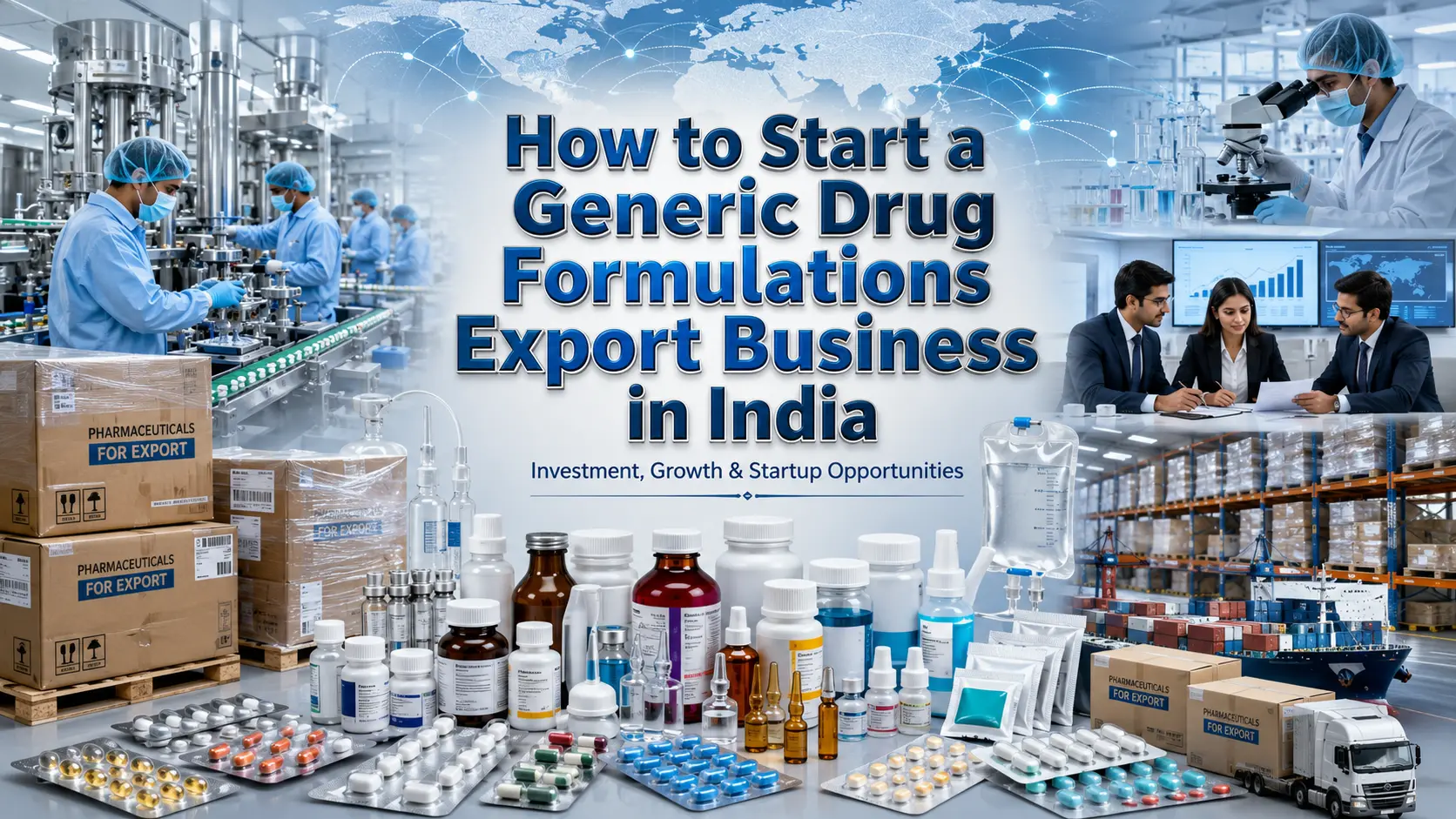
For first generation entrepreneur, one of the easier and most lucrative business ideas in the pharmaceutical industry is generic drug formulations. India is the world’s largest volume producer of generic medicines, accounting for more than 20% of global exports of generic medicines, and the pharmacy of the developing world. However, the domestic base of MSME formulation manufacturers is still under-explored compared to the global opportunity. India’s dedicated pharmaceutical export promotion council, Pharmexcil offers a complete support package to formulation exporters, from Registration of Commerce Missioners (RCMC), market access, regulatory guidance to connecting the exporters with buyers. Generics formulation export is a business with interesting fundamentals for the entrepreneurs who have an interest in the pharma manufacturing business and have ₹80 lakh to ₹3 crore investment capacity.
Read the Complete Book Here: Drugs & Pharmaceutical Technology Handbook
Why Generic Formulation Exports Are a High-Potential Business
Generic drugs are available medicines that are not under a specific brand name and are made by more than one company. After a drug’s patent runs out, any company that can make the medicine with the same quality to global standards can manufacture and market it. India’s economy, with low manufacturing cost, coupled with the talent pool of chemists, and the evolving regulatory standards, has ensured that it remains the biggest exporter of generic formulations into both developing and developed countries.
The generic drug market is big and expanding on a worldwide level. In developed countries, with growing healthcare expenses, there is a trend towards using generics instead of branded drugs. African countries, as well as those in Southeast Asia and Latin America, have put in place universal health programmes that give rise to huge institutional demand for generic drugs at affordable prices. Both are supplied from India, and formulation manufacturing for the generic drugs is one of the most consistently demand-driven business ideas in the pharma industry.
Government Policies and Pharmexcil Support
Pharmexcil (Pharmaceuticals Export Promotion Council) is the main government organization that provides support to generic formulation exporters. Pharmexcil RCMC must be availed for export incentive benefit of pharmaceutical products. In addition to compliance, Pharmexcil offers market intelligence reports, buyer-seller meets, participation at international trade fairs such as CPhI Worldwide and Africa Health and regulatory advice for the registration of drugs in individual countries.
The PLI Scheme for Pharmaceuticals is administered by the Department of Pharmaceuticals, which includes formulation manufacturers as well as API manufacturers. Production linked financial incentives are provided for six years to eligible formulation companies and the incentive rate depends on product category and investment amount. The scheme is focused on high-value products such as biopharmaceuticals, complex generics and patented products coming off-patent.
The DGFT has introduced the RoDTEP Scheme to give duty credit scrips for export of pharmaceutical formulation for embedded taxes and duties not refunded under any other scheme. If a formulation unit exports ₹5 crore worth of products annually, RoDTEP can bring about a scrip value of ₹15 lakh to ₹30 lakh for the company per year based on the product category.
Technical assistance for obtaining WHO-GMP certification (required for majority of export markets) is available with the Central Drugs Standard Control Organisation (CDSCO). State drug authorities inspect and issue GMP certificate which are the basis for WHO-GMP certificate applications.
Get Detailed Project Report (DPR): Pharmaceutical Drugs & Fine Chemicals Directory
Business Ideas in Generic Formulation Manufacturing
1. Oral Solid Dosage (OSD) Formulation Export Unit
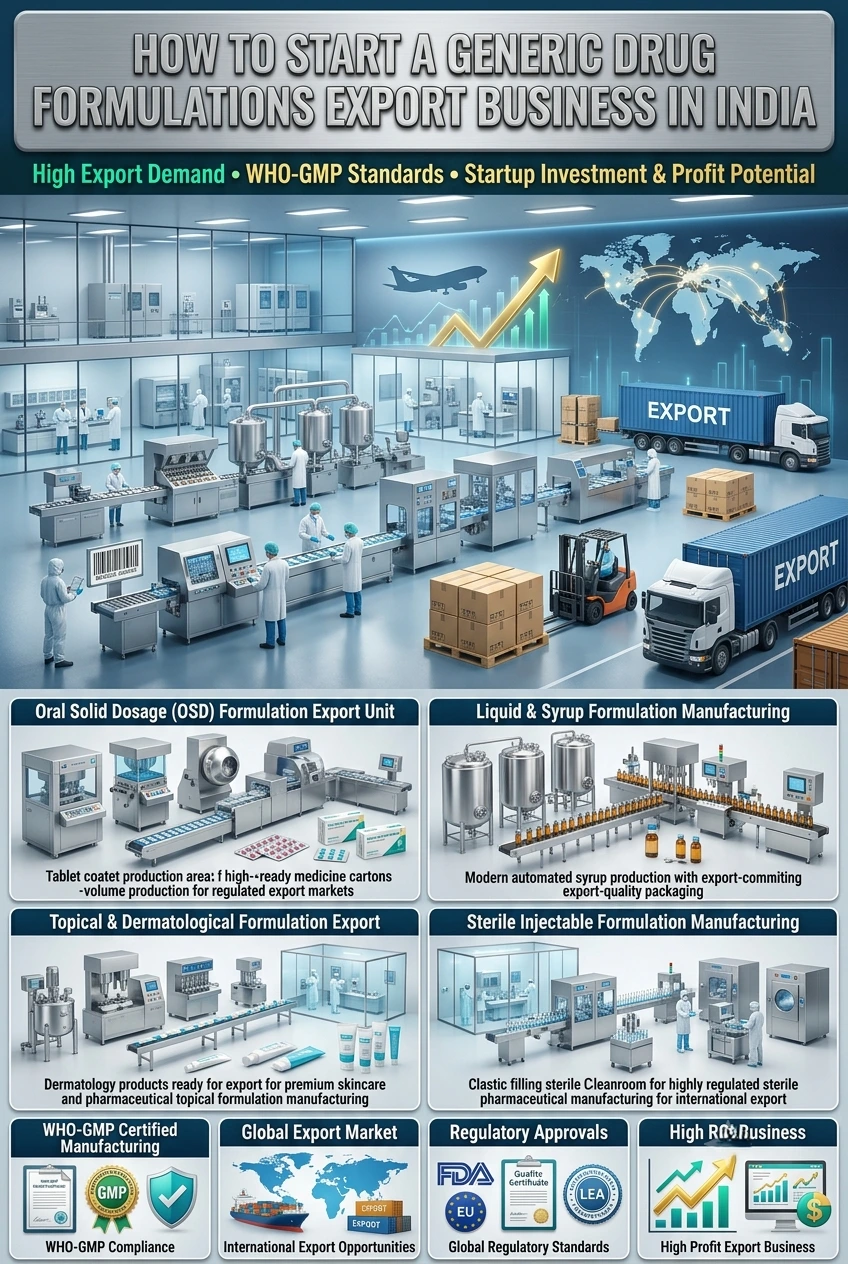
Oral solid dosage forms (tablets and capsules) are the most common and the most exported pharmaceutical formulation type. The manufacturing line is equipped with granulation, compression, coating and blister packaging lines so it can produce a variety of generic medicines for the African, South-East Asian and Latin American markets. Investment required for the OSD unit that complies with WHO-GMP standards is between ₹1 crore and ₹3 crore. The flexibility of the product range of an OSD unit means that the same equipment can be used to manufacture dozens of different tablet formulations, enabling entrepreneurs to meet market demand and the needs of the buyers without having to invest in extra equipment. A well-managed unit can achieve an annual export turnover of ₹2 crore to ₹10 crore in 3-5 years.
2. Liquid and Syrup Formulation Manufacturing
Oral liquid formulations (syrups, suspensions and drops) are important for paediatric medicines, and for markets where compliance with tablets is lower. Liquid formulations are a major product of interest for many health ministries in the African and Southeast Asian countries that purchase large quantities for public health programmes. The oral liquids manufacturing unit needs investment of ₹80 lakh to ₹2 crore, mainly in the liquid manufacturing vessels, filling and sealing lines, and clean room infrastructure. In general, the regulatory procedure for oral liquid formulations is much easier than for sterile injected formulations, and therefore is a more convenient starting point for a first-time formulation manufacturer.
3. Topical and Dermatological Formulation Export
The topical formulations of creams, ointments, gels and lotions are a rapidly expanding category of export, especially with the ever-increasing global burden of dermatological diseases. The market for anti-fungal creams, steroid combinations, and wound care products is strong in African, Middle Eastern and Southeast Asian markets. The cost of establishment of a topical formulation unit is in the range from ₹ 60 lakh to ₹ 1.5 crore. The manufacturing process is easier than for sterile injectables and the regulatory route to become a player in semi-regulated markets is more manageable for new players. Generally, the margins in topical formulations range between 25% to 45%, which is much higher than tablet generics in several categories.
Build a profitable business with the right idea
4. Sterile Injectable Formulation Manufacturing
Among the formulations, sterile injectables (IV fluids, small-volume parenteral, lyophilised injections) have the highest margins and the highest level of investment required, and their quality systems are the strictest. Investment needed for a sterile injectable unit is anywhere between ₹3 crore and ₹15 crore, depending on the product type and its capacity. Manufacturers who meet and maintain the regulatory credibility barrier, however, enjoy good competitive protection, whether it is WHO-GMP or US-FDA for injectables. High-margin categories include oncology, anti-infective, anaesthesia, and other categories. It is a segment that should definitely be considered by entrepreneurs with capital and sound regulatory and quality team.
Import-Export Opportunity Analysis
India pharmaceutical formulation exports are spread across more than 200 countries. According to data from the Pharmexcil export data platform, the top export destinations are the US, UK, South Africa, Russia, Nigeria and Brazil. African markets are expanding the most as a result of the universal health coverage programmes along with donor-supported health initiatives such as PEPFAR and the Global Fund, and that procure big quantities of generic medicines from Indian manufacturers.
The India-UK Free Trade Agreement and India-EU FTA negotiations will be a progressive step to gradually eliminate tariff barriers for India’s pharmaceutical exports in regulated markets. The timing of market entry – that is, when the new formulation is implemented in a nearby country to that of the exporting company – can offer the exporter a form of preferential market access that can give him or her a significant price advantage over European and American generic manufacturers.
Indian MSME Success Stories in Generic Formulation Exports
The Ajanta Pharma was founded by the Agrawal family of Mumbai, as a small generic formulation company, and in a planned strategy they zeroed on African and Asian markets and carried out quality consistent generic formulations business to become a ₹3000+ crore multinational pharma enterprise. Their approach is of deep regulatory investment before they commit to volume and then one market at a time, and this can be replicated by MSME formulation exporters either small or large.
Rajendra Agarwal founded Macleods Pharmaceuticals, one of India’s quickest growing businesses exporting generic formulations to WHO prequalified African markets through the funding of PEPFAR and Global Fund, that is under the anti-retroviral and anti-malarial drugs sector. This investment in their WHO prequalification, which took 3 to 4 years, opened the door for the institution to tap billions of dollars in institutional procurement which otherwise would have been unavailable to other competitors who are not prequalified by WHO.
Globela Pharma, a mid-sized formulation company from Gujarat, proved that beyond a mere idea, MSME scale formulation manufacturers could successfully scale up to achieve volumes in the African market of over ₹100 crore per year by targeting two therapeutic categories — anti-malarial and anti-infective drugs — which are consistently of WHO-GMP quality and delivery. Their experience shows that the investment in regulated market quality is profitable in semi-regulated market institutional procurement, too.
How NPCS Supports Generic Formulation Export Business Planning
We at Niir Project Consultancy Services (NPCS) provide professional consulting for the preparation of Market Survey cum Detailed Techno-Economic Feasibility Reports (DPRs) for setting up new generic drug formulation manufacturing and export businesses. Our reports feature detailed manufacturing process documentation, formulation technology selection, market research and export demand analysis, regulatory compliance roadmap, plant layout and specifications of equipment, complete project financials with profitability analysis. Our goal is to assess feasibility, profit and scalability before investing.
Related Article: Drugs and Pharmaceutical Based Manufacturing Business Ideas
Generic Formulation Export Business: Key Data Overview
| Formulation Type | Investment Range | Key Certification | Target Markets | Typical Margin |
| Oral Solid Dosage (OSD) | ₹1 Cr – ₹3 Cr | WHO-GMP | Africa, SE Asia, LatAm | 20–35% |
| Oral Liquids/Syrups | ₹80L – ₹2 Cr | WHO-GMP | Africa, ME, SE Asia | 22–38% |
| Topical Formulations | ₹60L – ₹1.5 Cr | WHO-GMP | ME, Africa, SE Asia | 25–45% |
| Sterile Injectables | ₹3 Cr – ₹15 Cr | WHO-GMP / US-FDA | US, EU, Africa | 35–60% |
| Ophthalmic Drops | ₹1 Cr – ₹4 Cr | WHO-GMP | Africa, ME | 30–50% |
Frequently Asked Questions (FAQ)
1. WHO-GMP certification is an oath that is administered by WHO.WHO-GMP certification is a type of oath that is administered by WHO.
Pharmaceutical manufacturing units that are certified by WHO-GMP (Good Manufacturing Practice) are assured to be of a quality standard suitable for export to WHO-member countries. The GMP inspections are carried out by state drug authorities in India and CDSCO issues WHO-GMP certificate based on GMP inspection. This process usually takes between 6 and 18 months from readiness of the facility and up to the time of issuance of a certificate.
2. For formulation exporters, is there any requirement for 2. Is Pharmexcil RCMC required?
Yes. Pharmexcil RCMC has to avail DGFT export incentive benefits like RoDTEP for pharmaceutical formulation exports. In addition, it is required to have Pharmexcil RCMC to be part of the government-sponsored trade show and buyer-seller meet organised by Pharmexcil.
3. How to register a generic drug product on African markets?
The drug registration agency and procedure are unique to each African country. Pharmexcil has country-specific regulatory guidance and is in touch with regulatory authorities in key markets across Africa. WHO prequalification has a tremendous effect on getting products to multiple African markets up and running at the same time, and is highly recommended for high volume institutional products.
4. What does the word prequalification mean and what is the difference between prequalification and GMP?
The manufacturing facility is certified according to the WHO-GMP. WHO Prequalification certifies a particular drug product, which includes formulation, API source, manufacturing process and quality controls, for UN agencies, PEPFAR and Global Fund procurement. Prequalification provides entry to multi-billion-dollar institutional procurement pathways, and is required for procurement of anti-retroviral products under PEPFAR funding.
5. What is the lowest size of a batch that would be suitable for manufacturing for export?
There is no minimum batch size requirement, as such. But the GMP regulations require batch size to be specified, validated and reproduced in each batch. The general size of the batch for most export oriented OSD units is 100,000 to 500,000 tablets per batch; and small validation batches are used during product registration processes.
6. May formulations be exported without any drug manufacturing license?
No. In India, all pharmaceutical formulation manufacturing must be done under a valid drug manufacturing licence issued under the Drugs and Cosmetics Act Schedule M. The state drug authorities issue the licence after inspecting the manufacturing unit for the compliance with GMP.
Conclusion
Export of generic drug formulation is one of the most established and admired business ideas in the pharmaceutical industry in India. This is because of the strong pharma export credibility of India, Pharmexcil’s market development support, combined with the financial incentive framework of the DGFT, and the large global demand, it makes the environment of a well-planned formulation unit export profitable within two to three years of its commissioning. Key investment priorities – WHO-GMP, product registration in target markets, Pharmexcil relationship development – can all be accomplished at the MSME scale. For every entrepreneur who views quality systems as a revenue-producing asset, not a cost of compliance, generic formulation export is among the most sustainable and globally-proliferating manufacturing ventures in India.


