





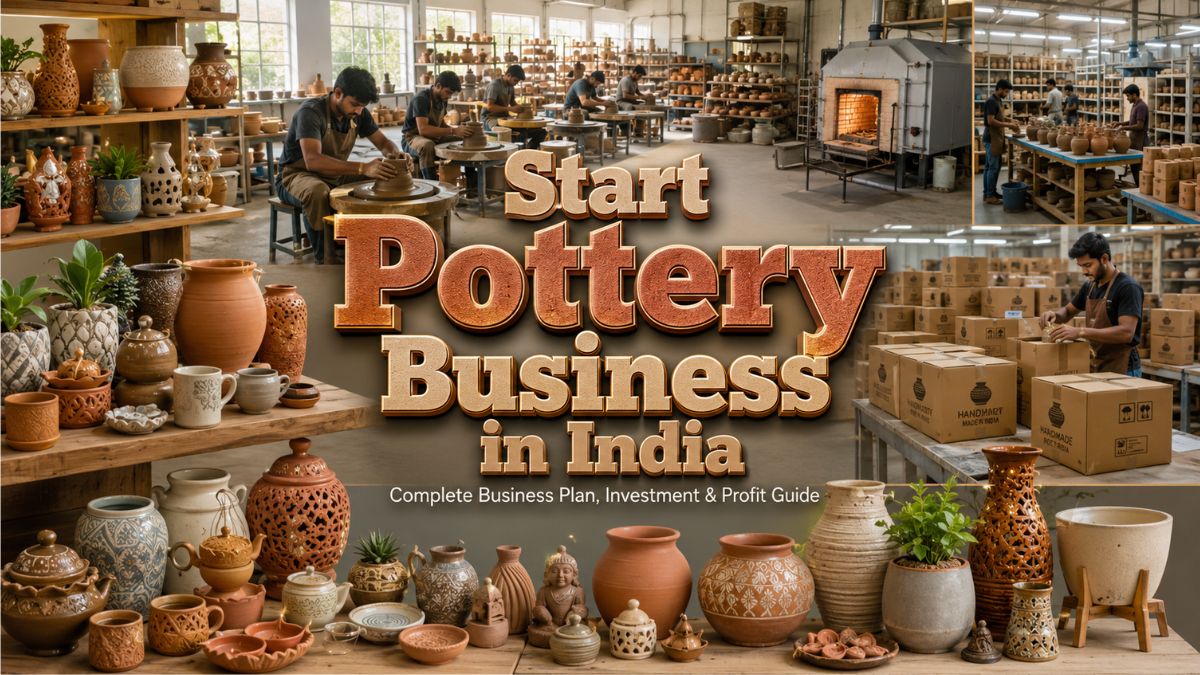
Pottery & Ceramics is one of the least known business ideas in India in the field of manufacturing. The pottery industry is built on a culture of over 5000 years in existence and from small village pottery kilns, it has developed into industrial units ready for export. When entrepreneurs carefully investigate this sector, they discover a combination of several factors that make it very attractive for low entry barriers, high local demand, increasing exports interest, and direct government support.
The pottery and ceramic industry is a space that should not be ignored by any first-generation startups founder or MSME investor who wants to invest in a project with minimal investment. This guide provides a comprehensive and step-by-step explanation on starting, funding and successfully operating a pottery business in India.
Why the Pottery and Ceramic Sector Is Growing Fast
Pottery is no longer a cottage industry in India. It is a dynamic manufacturing cluster ranging from handmade artisan ceramics, industrial ceramics, sanitary-ware, technical lab ceramics, and ceramic exports. The domestic demand is growing rapidly with the premium gifting market, the purchases made from the hospitality sector, tableware consumption for home décor on e-commerce and the demand for tableware in the restaurant industry. Moreover, the demand for genuine, handmade Indian pottery has created opportunities for exports to the USA, Japan, Germany and UK.
Pottery & Ceramic crafts are one of the major employment-intensive clusters in the handloom & handicraft industry in India, according to the Craft Council of India. At the same time, the ceramic tile and sanitaryware manufacturing companies of India are competing with the rest of the world. The blending of craft and industrial production opens several opportunities for entrepreneurs of varying investment amounts.
Also, as more and more consumers become aware of the importance of using eco-friendly, non-plastic, and biodegradable products, clay-based ceramics are emerging as a high-quality lifestyle product. Plastic tableware is being steadily phased out by restaurants and hotels in metro cities and the change is happening at a very fast pace.
Get Detailed Insights from This Book: Books
Government Policies and Incentives Supporting the Pottery Business
The Government of India has formulated a number of schemes that directly impact pottery and ceramic business entrepreneurs. These schemes not only cut down on start-up costs but also enhance the profitability of start-ups.
The Ministry of MSME’s Credit Guarantee Trust Fund for Micro and Small Enterprises (CGTMSE) offers micro and small pottery and ceramic manufacturing units’ loans without collateral up to ₹2 crore. The Prime Minister’s Employment Generation Programme (PMEGP) offers a subsidy of 25-35% on project cost to an artisan linked manufacturing unit – a clear reference to pottery units in rural and semi-urban areas.
Pottery entrepreneurs can avail of marketing support, design development support and participation in the international trade fairs from the Development Commissioner for Handicrafts under the Ministry of Textiles. Additionally, Ambedkar Hastshilp Vikas Yojana (AHVY) supports the cluster level for artisan groups, particularly in the identified pottery villages such as Khurja (UP), Molela (Rajasthan) and Andretta (Himachal Pradesh).
Entrepreneurs must also tap the DPIIT portal, Startup India, for recognition of their startups, which will offer tax exemption, self-certification facility and ease in accessing public procurement for pottery businesses.
Multiple Pottery Manufacturing Business Ideas for Startups
1. Handmade Artisan Pottery Studio
The easiest way to start the handmade pottery business is to open your own pottery studio. In this model, entrepreneurs generate handmade bowls, mugs, vases, planters and custom tableware using the traditional wheel-throwing and slip-casting methods. The initial investment of the pottery starts can be between ₹3 lakh and ₹8 lakh, which includes the pottery wheel, kiln, the amount of clay, and glazing materials, as well as for setting up the basic pottery space.
Where the true potential with this is actually the direct-to-consumer (D2C) channel. There are websites that offer a higher price for Indian handmade pottery, such as Etsy, Jaypore and The Bombay Canteen network. It is possible to achieve monthly revenues of ₹1 – ₹2 lakh after 12 – 18 months of regular production and consistent brand building. This model is appropriate for founders that require little capital but high margin.
2. Industrial Ceramic Manufacturing Unit
Industrial ceramics is a significantly more costly, but also much more scalable, manufacturing business idea. It includes ceramic insulators, refractory bricks, abrasive and technical parts for electrical, metallurgical and construction industry. The investment required for startup may be in the range of ₹20 lakh to ₹50 lakh depending on the capacity of furnace and the complexity of the product. The B2B customers, however, are relatively stable, orders are big, and repeat buying cycles are predictable. Indian industrial ceramic units have extensive presence in the infrastructure sector, power distribution companies, steel plants etc. where the demand is strong. A comprehensive feasibility study before entering this part of the business will help entrepreneurs to increase their chances of success.
3. Terracotta Decorative Product Manufacturing
The pottery business segment is one of the fastest-growing areas in the home décor segment in the manufacturing of pottery products for gardens and gifting during festive seasons. The product range is broad and ranges from wall hangings, lamp shades, garden pots, idol clusters, to cultural artefacts and the start-up cost is low ranging from ₹2 lakh to ₹6 lakh. This has been revolutionized by ecommerce. Amazon, Flipkart and Meesho sellers have seen steady demand during festival seasons (Diwali, Navratri, Pongal), where the margin per item is between 40% and 65%. With product design skills and a basic understanding of digital marketing, entrepreneurs can create a business with an annual turnover of ₹15-25 lakh in 2 years.
Access Complete Business Plan: Business Plans & Detailed Project Report (DPR) Profiles by Industry
4. Export-Oriented Pottery Manufacturing Unit
For entrepreneurs who have access to established design talent or craft cluster networks, an export-oriented pottery unit is a sophisticated, yet rewarding business idea. Indian blue pottery, black pottery and hand-painted ceramic wares are imported in big quantities in a year in countries such as Japan, USA, Germany and Scandinavia. The Export Promotion Council for Handicrafts (EPCH) actively promotes pottery exporters through Buyer Seller meets, access to trade fairs and Design IP Support.
Cost of investment in a unit for export is ₹10-25 lakh and it should emphasise on product consistency, international packing standards and conforming to quality norms in the countries to which the product is exported. This is one of the most profitable pottery business models today, with the margin premium of export orders being 2-3 times that of wholesale orders at home.
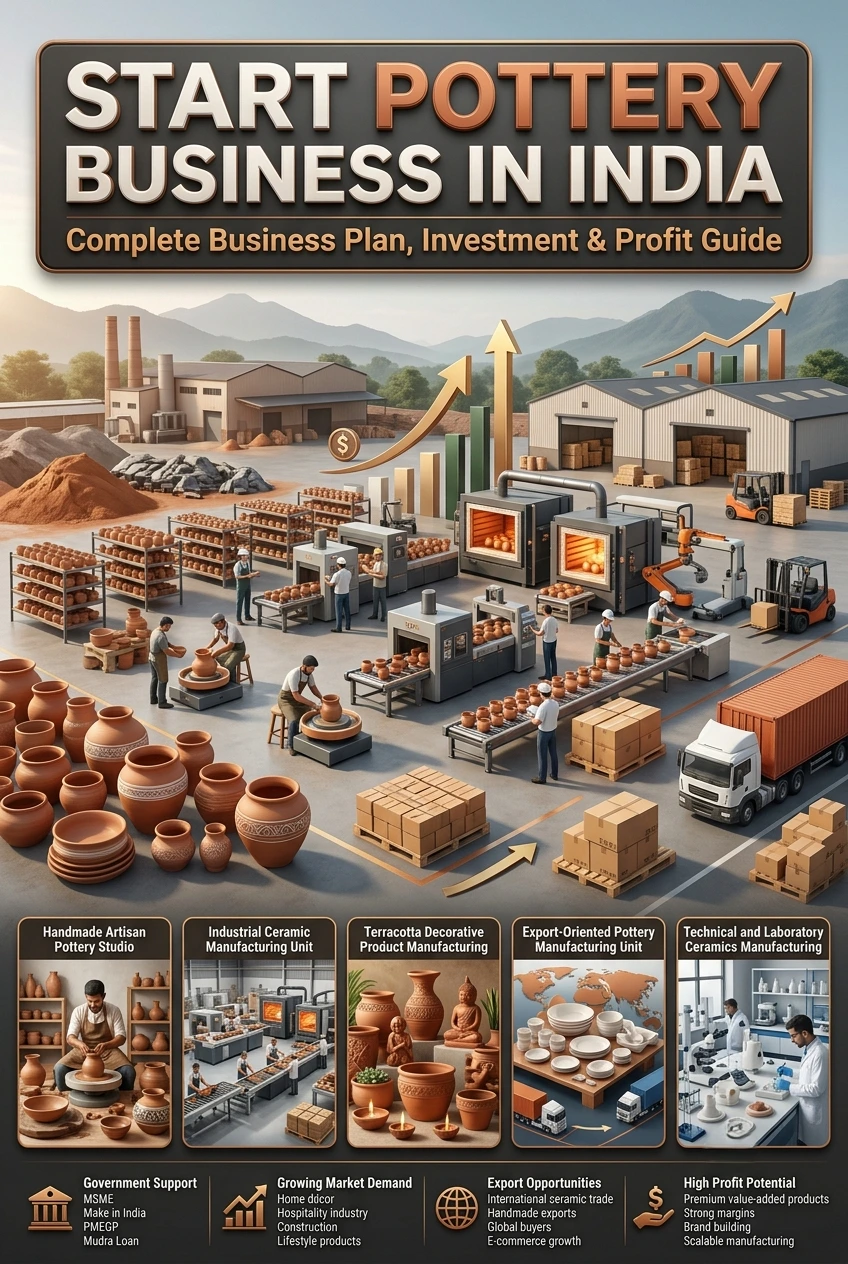
5. Technical and Laboratory Ceramics Manufacturing
Technical ceramics are a high-value manufacturing opportunity, though a niche one, and are utilized in such applications as medical devices, precision electronics and lab instruments. These products range from crucibles and substrates for the electronics industry, through to dental blanks and wear-resistant parts. This segment has a higher initial investment requirement of ₹30-60 lakh but has higher unit prices and longer period contracts with suppliers. Quality and supply reliability are paramount for the buyer, so for some industries, such as pharma, semiconductor and research, entry barriers are high, but so are the barriers to price. It is especially suited to entrepreneurs with engineering, materials science backgrounds.
Related Article: Manufacturing Business Ideas with 35 lakhs Investment
Import–Export Opportunity Analysis for Pottery Businesses
The Indian pottery and ceramic industry can boast a robust and promising export narrative. The unique craft traditions of Khurja blue pottery, Manipuri black pottery, Longpi stone pottery and Rajasthani painted ceramic are some of the premium products which are sold in international market. The ceramic and pottery export has been increasing consistently, gifting and tableware being the major volume exportable items, according to the Directorate General of Foreign Trade (DGFT).
India imports high purity technical ceramics and special type of industrial components — mainly from China, Germany and Japan on import side. This provides a clear opportunity to import substitution for the manufacturers who are willing to invest in quality production infrastructure. Make in India initiative of the Government of India is actively promoting import substitution projects in the ceramic industry through PLI related schemes and customs duty differentiation. Entrepreneurs can develop a very resilient and multiple revenue generating business model if they place their pottery business where it can fit in the export craft and the industrial substitution of import markets.
Indian MSME Success Stories in the Pottery Business
India’s pottery industry has seen some remarkable entrepreneurial stories, providing valuable lessons for aspiring entrepreneurs.
Jugal Kishore Tandon from Khurja Pottery Cluster, Uttar Pradesh, has established a medium scale ceramic tableware export unit from a family pottery background. His unit has become an exporter with an annual turnover of ₹1.5 crore by investing in the electric kilns, achieving standardisation of product quality and directing its marketing efforts to buyers from the hospitality sector of the Middle East and UK within seven years of its inception. The two most important factors that distinguish export pottery from others, he said, are quality consistency and packaging.
Sumitra Devi Pradhan, an artist from the Pipli Craft Cluster of Odisha used the Ambedkar Hastshilp Vikas Yojana scheme to establish a pottery group for women. Now the group makes appliqué-decorated terracotta wares which are sold by EPCH supported buyers and digital channels. The annual group turnover is more than ₹80,000,000. Her experience illustrates the power of government assistance to be used effectively to develop a cottage pottery business into a viable enterprise.
Rajesh Mehta, Morbi, Gujarat, started the ceramic tile business with a ₹40 lakh investment and expanded it to a ₹3 crore business by concentrating on the B2B construction sector supply. Morbi is the biggest ceramic hub of India accounting for almost 70% of the country’s tile exports. The secret to Mehta’s success was that he recognized “mid-segment” builders as his core customer base and kept a tight rein on costs in raw materials and fuel.
Turn your budget into a successful business plan
About NPCS: Feasibility Support for Your Pottery Business
Niir Project Consultancy Services (NPCS) offers expert consulting services to the entrepreneurs who are interested in starting pottery and ceramic production. End-to-end project planning is done in Market Survey cum Techno-Economic Feasibility Reports (DPRs) to cover manufacturing process flow diagrams, raw material, and machines sourcing, capacity planning, demand and market research, complete project financials, and profitability analysis. Our reports provide the analysis you need to make sure investment decisions and evaluate a handmade pottery studio or large industrial ceramic unit. The National Small Industries Corporation (NSIC) has stated that DPRs can help increase loan sanction rate for MSMEs and our DPRs are designed to do just that.
Pottery Business: Investment, Revenue & Market Snapshot
The table below summarises key manufacturing business models in the pottery sector with estimated financial benchmarks:
| Business Model | Startup Investment (₹) | Monthly Revenue (₹) | Key Market |
| Handmade Pottery Studio | 3–8 Lakh | 80K–2 Lakh | D2C / Boutique Retail |
| Industrial Ceramic Units | 20–50 Lakh | 5–12 Lakh | Construction / Sanitary |
| Export-Oriented Craft Unit | 10–25 Lakh | 3–8 Lakh | USA / EU / Japan |
| Training + Production Hub | 5–12 Lakh | 1.5–4 Lakh | Tourism / B2B Training |
| Terracotta Décor Manufacturing | 2–6 Lakh | 60K–1.5 Lakh | E-commerce / Gifts |
| Technical Pottery (Lab-ware) | 30–60 Lakh | 8–18 Lakh | Pharma / Research Labs |
Source: NPCS industry analysis, EPCH trade data.
Frequently Asked Questions (FAQ)
Q1. How much does it cost to start a pottery business in India?
The startup investment for a pottery business in India ranges from ₹2 lakh (terracotta home décor unit) to ₹60 lakh (technical ceramic manufacturing). A standard handmade pottery studio with a kiln, wheel, and raw material stock can be launched for ₹3–8 lakh. Industrial ceramic units require ₹20–50 lakh. The right investment level depends on your target market, production scale, and business model.
Q2. Is a pottery business profitable in India?
Yes, pottery is a genuinely profitable manufacturing business in India when managed with cost discipline. Handmade pottery studios report gross margins of 50–65%. Export-oriented units earn 2–3× the domestic wholesale rate. Industrial ceramic units operate on 25–40% EBITDA margins due to long-term B2B supply contracts. The key driver of profitability is market positioning — D2C and export models generate higher margins than domestic wholesale.
Q3. What government schemes support the pottery business in India?
Multiple schemes support pottery entrepreneurs. PMEGP provides a 25–35% capital subsidy. CGTMSE enables collateral-free loans up to ₹2 crore. The Development Commissioner for Handicrafts offers marketing and design support. The Ambedkar Hastshilp Vikas Yojana (AHVY) provides cluster-level assistance for artisan-linked units. Startup India recognition offers tax exemptions and easier procurement access.
Q4. Which are the best locations to start a pottery manufacturing business in India?
India has several well-established pottery manufacturing clusters. Khurja (Uttar Pradesh) is famous for blue and white pottery and ceramic tableware. Morbi (Gujarat) is India’s largest ceramic tile hub. Kumhartoli (West Bengal) is known for idol and decorative terracotta. Andretta (Himachal Pradesh) supports studio pottery artisans. Molela (Rajasthan) produces votive clay reliefs for export. Locating within these clusters gives access to raw materials, skilled labour, and existing buyer networks.
Q5. Can I export pottery from India? What are the requirements?
Yes, India is a significant pottery exporter and demand from the USA, Germany, Japan, and the UK remains strong. To export pottery, you need an IEC (Import Export Code) from DGFT, GST registration, and product compliance with destination-country safety standards. Registering with the Export Promotion Council for Handicrafts (EPCH) gives access to buyer databases, international trade fairs, and export incentive schemes. Quality consistency and international-grade packaging are the two non-negotiable requirements for sustained export success.
Q6. How do I prepare a project report for a pottery business loan?
A pottery business project report for loan sanction must include: project overview and promoter background, product details and manufacturing process, market demand analysis, plant layout and machinery list, raw material sourcing plan, financial projections (3–5 years), and profitability and break-even analysis. NPCS specialises in preparing Techno-Economic Feasibility Reports (DPRs) for pottery and ceramic manufacturing businesses — structured to meet bank, CGTMSE, and PMEGP submission requirements.
Conclusion: A Manufacturing Business Idea with Ancient Roots and Modern Potential
Indian pottery manufacturing industry is at a unique juncture — a rich cultural heritage that has become a remarkably lucrative and export-oriented business. Whether the investment is light or heavy, from terracotta studios to those technical ceramic units, there are real business opportunities in the sector for entrepreneurs at all levels and technical backgrounds. Government assistance is actual, significant and readily available. Demand for both domestic and export markets is increasing.
But, as with any business that produces goods, the principles of planning, defining a target market, and controlling costs are essential to the success of the business. With the right feasibility study and project planning, pottery can be a profitable and sustainable business for entrepreneurs, providing a lasting opportunity for success.


