





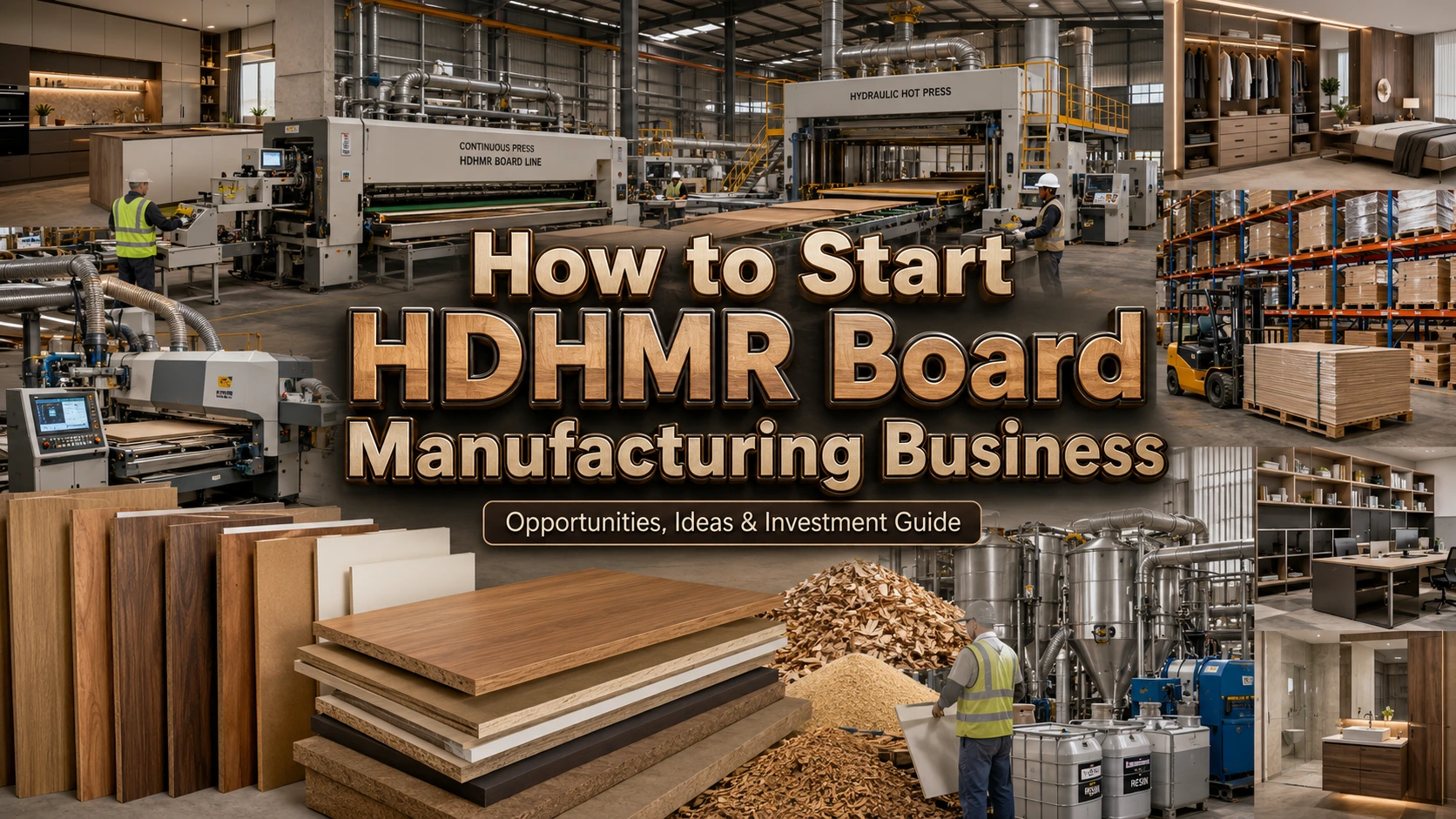
HDHMR Board Manufacturing Business
The construction and interior design industry in India is growing at an astounding rate. One of the products in this growth story has been making its way from niche to mainstream — High-Density High Moisture Resistance board (HDHMR board). Wood-based panel business people are now diverting their focus to the production of HDHMR board as a new business opportunity. The opportunity is real and the demand is measurable, and so is the investment structure within the reach of MSMEs. This article uncovers the manufacturing business, spanning its market rationale, government backing, and even providing practical business ideas and insights from the Indian industry.
Why HDHMR Board Manufacturing Is a Strong Business Opportunity
Compared with the conventional materials MDF and plywood, HDHMR boards excel in many important ways. They have a better resistance against moisture, termites, and warping — features that are extremely important in Indian kitchens, bathrooms and humid coastal climates. This has led furniture manufacturers, interior contractors and modular kitchen brands to opt for HDHMR boards over the old ones.
The processed wood panel market in India is seeing a steady growth, fueled by urbanisation, growing disposable income and the surge in affordable housing and commercial real estate. Ensures the furniture and furnishing sector, which is one of the major users of HDHMR boards, has a significant share in the manufacturing GDP of India. Further, there has been a steady increase in the export of processed wood products and furniture parts, thereby making this trade activity an attractive one from a trade perspective as well.
Get Detailed Insights from This Book: The Complete Technology Book on Wood and Its Derivatives
The Demand Story Behind the Growth
Adoption of modular furniture in India has picked up significantly in Tier 1 and Tier 2 cities. Builders, interior designers and furniture companies under brand names are increasing their demand for high-performance panels. Due to their predictable density and smooth surface, HDHMR boards are the best choice for lamination, CNC routing and digital printing and are an ideal substrate for contemporary furniture production. This means that for a new manufacturing enterprise, it means that they will have a sure and expanding client base.
Government Policies and Schemes Supporting HDHMR Board Manufacturing
The policy scenario in India is now more conducive for the manufacture of wood-based panels. There are several schemes that directly support the entrepreneurs for establishing HDHMR board plants. There are several schemes that directly support the entrepreneurs who establish the board plants of HDHMR. For the first time, entrepreneurs can avail collateral-free loans up to ₹2 crore for setting up a small-to-medium HDHMR unit from the Credit Guarantee Fund Trust for Micro and Small Enterprises (CGTMSE) of the MSME Ministry. The Prime Minister’s Employment Generation Programme (PMEGP) provides subsidy of 15% to 35% of the cost of the project depending on the category and location of the entrepreneur.
Further, the Production Linked Incentive (PLI) scheme for the furniture industry helps the industry undergo investment in scale and automation. State level industrial promotion policies provide supplementary land allotment at concessional rate, duty exemption on electricity bill and capital subsidy etc. in industrial promotion policies in the states of Rajasthan, Gujarat, Andhra Pradesh and Telangana. The entrepreneurs should also venture into Technology Upgradation Fund Scheme (TUFS) which provides finance for machinery.
To get detailed scheme guidelines, check the Ministry of MSME’s official website: Ministry of MSME for latest scheme guidelines & application procedure.
Multiple Manufacturing Business Ideas Within the HDHMR Board Sector
The board space for the HDHMR is not an opportunity to sell one product. There are multiple entry points to this manufacturing business depending on the amount of investment, technical capabilities, and market access of the entrepreneur.
1. HDHMR Board Manufacturing Plant (Core Product)
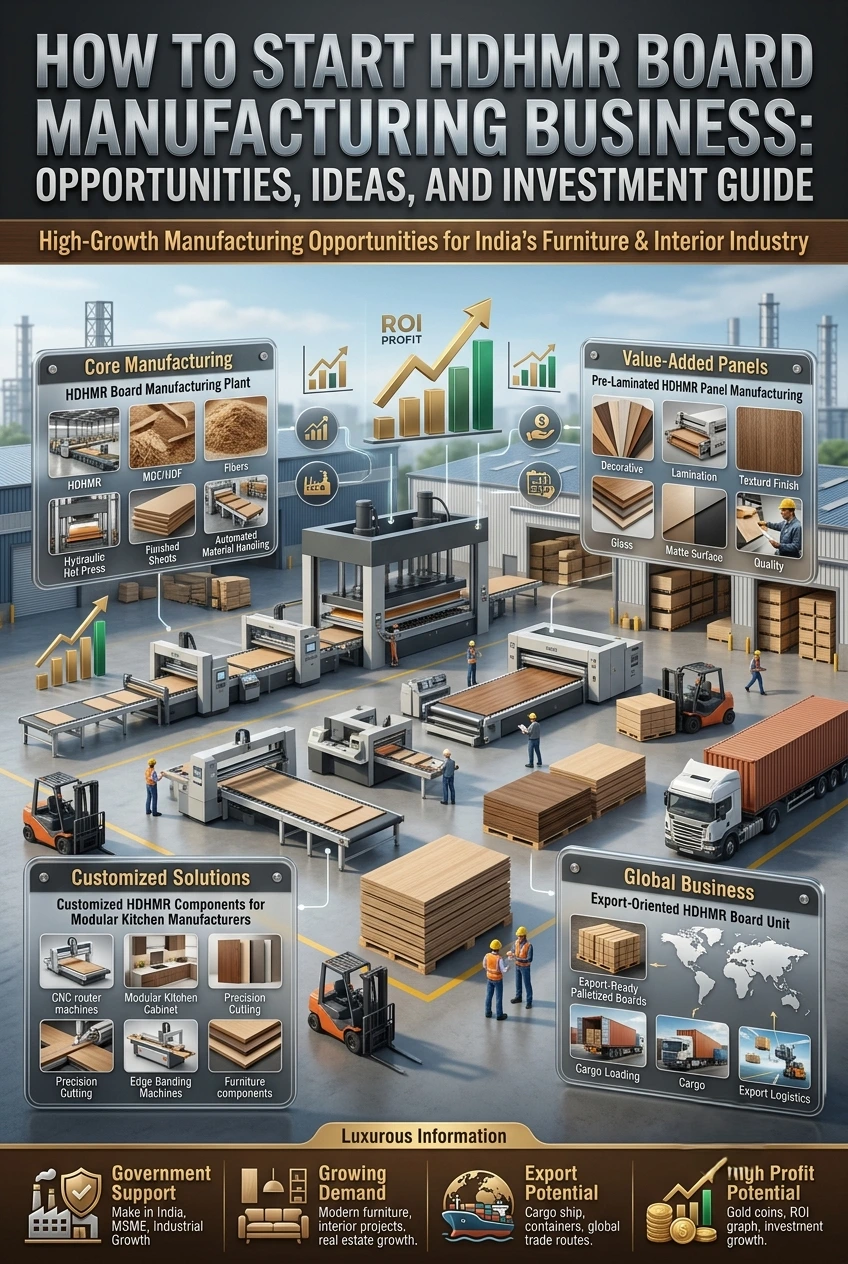
The most straightforward business idea is to establish a basic board manufacturer for HDHMR. This includes the purchasing of agro-residue, or wood chips; refinement of these through some refiners; mixing with urea formaldehyde or melamine resins; and pressing of these into some boards at high temperatures and pressure. A standard plant with a capacity of 15,000 to 25,000 cubic meters per year can be installed with an investment of between ₹1.5 crore to ₹4 crore. Completed boards can be sold to furniture makers, plywood stores or big retail stores.
Margin profiles are positive and particularly good if the raw material supply is optimized via long-term supply agreements for agro-residues. India’s high dependency on processed board panels as imported items provides a great opportunity for import substitution with Indian manufacturers as pointed by Indian Plywood Industries Research and Training Institute (IPIRTI). Indian Plywood Industries Research & Training Institute. Indian Plywood Industries Research & Training Institute (IPIRTI).
Get Detailed Project Report (DPR): Wooden Furniture Manufacturing Project Report
2. Pre-Laminated HDHMR Panel Manufacturing
A business idea with a high margin is to add a lamination line to the manufacturing business. Pre-laminated HDHMR panels are more expensive than plain boards, and come in hundreds of surface textures, colours and finishes. The furniture companies rather would purchase ready-to-use laminated boards as it would reduce their own processing costs. Spending on a semi-automatic lamination press and short cycle lamination system can help contribute about 40 to 80 lakhs to the base plant cost, but can boost gross margins quite a bit. Value added products also provide access to brand retail markets, e-commerce furniture supply chains.
3. Customised HDHMR Components for Modular Kitchen Manufacturers
Another business opportunity is to start a precision-cutting and CNC-routing business, where you take existing HDHMR boards and create parts for kitchens and wardrobes. The modular kitchen market is expanding in India at a double-digit pace and a majority of mid-market brands are sourcing the cutting of components from their local vendors. The requirement for a well-equipped cutting and processing unit coupled with raw board supply arrangement can help to get B2B kitchen market contracts in metro and Tier 2 markets. This is a lower capital investment model compared to a full manufacturing plant, but produces good working capital returns.
4. Export-Oriented HDHMR Board Unit
Any entrepreneur who has access to export facilitation infrastructure can have an HDHMR manufacturing unit become an export-oriented unit (EOU). The market in Middle East, Africa and South East Asia is very promising for the export of cost competitive, quality Indian wood panels. The establishment of an EOU provides access to income tax benefits, environmental clearance benefits and import duty benefits on capital goods. The Directorate General of Foreign Trade (DGFT) offers advisory assistance and financial assistance to the exporters. The directorate general of Foreign Trade (DGFT) has released the guidelines for export schemes.
Import–Export Opportunity Analysis
India continues to be a net importer of high-performance wood panels. Many of the imported boards are imported from China, Malaysia, and Germany via the ports of Gujarat, Maharashtra and Tamil Nadu. This import dependency is a direct business opportunity for new Indian manufacturers. Domestic players, who can meet quality requirements, will be able to oust imports and supply at 15%–25% less landed cost.
Indian HDHMR board manufacturers have a great cost advantage in the export market. Labour and raw materials from agro-residues and energy cost in India are lower than in East Asia and Europe. Additionally, the agreements with the ASEAN countries and the Gulf Cooperation Council (GCC) create an opportunity for India to export wood panel products with preferential tariff facilities. Trade intelligence/ furniture sector data: IBEF – India Brand Equity Foundation.
Find the most profitable startup for your investment range
Indian MSME Success Stories in the Wood Panel Industry
Greenply Industries: Building Scale from MSME Roots
The Mittal family established Greenply Industries in Kolkata with a focus on trading plywood, which eventually developed into one of India’s top plywood manufacturers. They opted for investment in manufacturing technology and quality consistency rather than just competing on price, thus giving them a sustainable competitive advantage. The take home message: In the wood panel industry, brand equity is created through product reliability. Businesses seeking to enter into HDHMR manufacturing must look into BIS quality certification from the initial stages. The Bureau of Indian Standards (BIS) is India’s national standards authority. BIS – Bureau of Indian Standards is the national standards body of India.
Century Plyboards: Strategic Diversification
Under the leadership of Sajjan Bhajanka, Century Plyboards grew its empire not only on plywood, but by careful diversification of its products to MDF, laminates and allied panels. The Century expansion model provides us with a very strong learning point: A manufacturing company is more resilient when it provides for several market segments in the same plant infrastructure. New manufacturers joining HDHMR should think about the possible addition of lamination or edge-banding lines in their plant design that may require addition of very little investment.
Action Tesa: The Modular Furniture Disruption
Action Tesa is a case in point of how a medium sized furniture producer in India can take over the mass-market furniture business by combining quality production using HDHMR with aggressive retail distribution. Their business model demonstrates first-generation entrepreneurs that market access is as important as manufacturing quality. Support for manufacturers through the MSME development support: DCMSME – Development Commissioner, Ministry of MSME
How Professional Feasibility Support Can Reduce Your Investment Risk
Creating an HDHMR board manufacturing enterprise is not something that can be done by the tip of its arm; it involves careful monetary modelling, process engineering expertise and market intelligence. However, at Niir Project Consultancy Services (NPCS), we make it easy for entrepreneurs to deal with this complexity by providing professionally prepared Market Survey cum Detailed Techno-Economic Feasibility Reports (DPRs). Our reports feature detailed information on the manufacturing process, process flow diagrams, raw material and machinery sourcing, product mix and capacity planning, and a comprehensive financial forecast – profit and loss projections, break-even modelling and more. For greenfield HDHMR plants or for growing in a wood panel plant, NPCS can verify feasibility and scalability prior to capital investment.
Related Article: Forest-Based Products Manufacturing: A Complete Business Ideas Guide
HDHMR Board Manufacturing Business: Key Project Metrics
| Parameter | Small Unit | Medium Unit |
| Installed Capacity | 8,000–12,000 CBM/year | 20,000–30,000 CBM/year |
| Project Investment | ₹1.2 Cr – ₹2 Cr | ₹3.5 Cr – ₹6 Cr |
| Land Requirement | 4,000–6,000 sq ft | 10,000–15,000 sq ft |
| Manpower Required | 20–35 persons | 60–100 persons |
| Expected Revenue | ₹2.5 Cr – ₹4 Cr/year | ₹7 Cr – ₹12 Cr/year |
| EBITDA Margin | 18%–22% | 20%–26% |
| Payback Period | 3.5–4.5 years | 3–4 years |
Frequently Asked Questions (FAQs)
1. What is the minimum fund needed for setting up an HDHMR board manufacturing business?
The HDHMR small scale board manufacturing plant requires an investment of Rs 1.2 crore to Rs 2 crore which includes land and building, working capital, raw material inventory and the plant and machinery. The price is dependent on the location, levels of automation and production capacity.
2. What is required to produce the raw materials for the manufacture of HDHMR boards?
The main raw materials are the wood chips, agro-residue fibres (sugarcane bagasse and rice husk), urea-formaldehyde or melamine resin, paraffin wax and hardeners. A large number of Indian manufacturers procures agro-residue from within the vicinity of their factory, thus keeping down the cost of raw material to a great extent.
3. Is there any financial assistance available to start this manufacturing business from the government?
Yes. Gives CGTMSE collateral-free loan facilities, 15%-35% subsidy on project costs from PMEGP, and capital subsidy schemes from the government at different levels. There are also multiple technology upgradation support schemes and MSME registered units also benefit from the priority sector lending benefits under the central government scheme.
4. What does it take to sell the HDHMR boards in India?
It is important for manufacturers to get BIS certification, GST registration and MSME Udyam registration (for corresponding IS standards for wood-based panels). Brands of high-quality furniture are increasingly mandating Formaldehyde emission compliance. If the unit is export oriented, it is required to obtain an additional IEC (Import Export Code) from DGFT.
5. Who are the main customers of the boards manufactured by HDHMR?
The primary customers are modular furniture manufacturers, interior contractors, kitchen furniture brands, institutional builders, plywood and building material sellers, and the large retail chains. The industrial buyer’s preference is normally to buy directly with credit terms, and the dealers use a dealer margin model.
6. Does the production of HDHMR in the LR make economic profit in the long run?
Yes, it can be highly profitable over the long term — particularly if the unit invests in value added products such as pre-laminated boards or precision cut parts. Well-managed plants can achieve EBITDA margins in the range of 18–26%. The payback period is normally between 3 and 4.5 years, which makes it a good investment for patient money.
Conclusion: Is Now the Right Time to Enter This Business?
The HDHMR board manufacturing business is taking place at the nexus of growing preference for processed engineered wood over natural timber, the growth of modular furniture and the construction boom in India. Besides, there is policy congruence, better availability of raw materials and dependency on imports foresees a pool of demand for the domestic manufacturers. This is a truly scalable manufacturing business opportunity for startup founders and MSME investors who can prepare technically and have a good market strategy. The basics are solid — and the window is open now to take advantage of the first-mover opportunity.
For policy frameworks, the other referrals are: NITI Aayog – National Institution for Transforming India


