





Coconut Waste Business
India is the 3rd largest coconut producer; however, only 19 million coconuts are collected for their uses per year on behalf of the Indian States such as the State of Kerala, the State of Karnataka, the State of Tamil Nadu, the State of Andhra Pradesh and the State of Odisha. When processing coconuts, you have a large number of resources that come in the form of the following coconut shell, fibre coir, pit coir, husking coconut and fronds in order to produce copra, coconut oil and fresh kernel products.
Historically these by-products have found use in low value applications such as the fuel value of husk, the use of coir for rope and the charcoal value of the shell. The only thing that has changed is that coconut shell now is recognized as the best source of activated carbon in the world, coir pith as the best growing medium in the world and the coconut fibre composites now in use in automobiles and construction industry.
The price of the Coconut shell activated carbon is Rs. In the world market, its price ranges from 80,000 – 2,50,000 per tonne and it is used in the purification of gasses, gold recovering, military and pharmaceutical applications. Cocopeat (coir pith) is exported to Holland, Japan and Australia at a price of Rs. The expected prices for hydroponic and greenhouse horticulture are €12,000–18,000 per tonne. The businesses are not commodity businesses; they are speciality products which are priced at a high level and are based on a raw material which costs Rs. 2,000–5,000 per tonne.
Get Detailed Insights from This Book: The Complete Book on Coconut & Coconut Products
Coconut By-Product Composition and Processing Overview
The production of a single coconut yields: 35% shell (hard inner shell), 35% husk (outer fibrous husk), 5% coir fibre (extracted from the husk), 25% coir pith (the spongy material between fibres in the husk) and shell charcoal is an intermediate product of the activated carbon production. The product mix is determined by the processing pathway. The majority of the coconut processing units are engaged in one or two processing units, such as husk processing (coir fibre + cocopeat) or shell processing (charcoal + activated carbon) due to the different equipment and skills needed.
Top 10 Products from Coconut Shell, Coir, and Coconut Waste
1. Coconut Shell Activated Carbon
The material which is the gold standard in gas-phase activated carbon applications is coconut shell activated carbon (CSAC). The microporous structure (predominantly pores < 2 nm diameter) endows CSAC with surface areas of 1,000-1,500 m2/g and outstanding hardness (> 95% ball-pan hardness). It is used in water purification (particularly the removal of chloramines and VOCs), gold recovery from cyanide solutions, military and industrial gas masks, cigarette filters and pharmaceutical purification. The approximate cost of 3 TPD CSAC plant is Rs. Rs. 80–180 lakh is the revenue requirement for 80–180 lakh population. The price range is from 80000 to 2,50000 per tonne depending on the grade and quality of use.
View Full Project Details: Coconut Shell Charcoal Manufacturing
2. Cocopeat (Coir Pith) Growing Medium Blocks
After separating fibre from the coconut husk, the spongy peat-like material is called Cocopeat. Washed to remove excess potassium and salts, compressed to blocks and dried, it is the perfect soilless growing medium for greenhouse horticulture, mushroom growing and home gardens. More than Rs. is exported from India. The production of 2500 crores of cocopeat now per year, mainly exported to the USA, Japan, South Korea and the Netherlands. The cost of a cocopeat processing unit is Rs. The cost to set up is Rs. 20-50 lakh and the generation is Rs. Annual net profit from 15–40 lakh on 200–500 tonnes/month of output.
3. Coir Fibre Products (Rope, Matting, Geo-Textiles)
Coir fibre is obtained from the coconut husk after retting and spinning process and is used in the production of ropes, door matting, floor matting, stuffing for upholstery and geotextiles for erosion control. Coir industry in India is the largest in the world, mainly based on the states of Kerala and Tamil Nadu and contributes Rs. Total exports of more than 4,500 crore per year. MSMEs can venture in coir fibre extraction, spinning or converting to value addition products. The coir geotextiles used for slope stabilisation and road construction are the fastest growing products of coir. The cost of investment for a small coir fibre plant is Rs. 15–40 lakh.
4. Coconut Shell Charcoal
Carbonisation of the shell at 400-600°C in the kiln or retort produces coconut shell charcoal which can be used as a feedstock in making activated carbon and as a high quality BBQ fuel export product. The price of coconut shell BBQ charcoal is Rs. This is because its ash content is less than 3%, and it is free of additives and burns uniformly, at 25,000-40,000 per tonne in export markets such as Japan, South Korea, and the premium BBQ market in Europe. The cost of a shell carbonisation unit is Rs. 20–50 lakh to set up.
Get Detailed Project Report (DPR): Coconut Shell Charcoal Manufacturing Project Report
5. Shell Powder and Decorative Items
The coconut shell powder is a natural filler for rubber products, phenol-formaldehyde resin and wood-composites. Shells used for decoration (buttons, jewellery, homeware and handicrafts) are selling at a premium in international markets for lifestyle and ethnic items. Low investment (Rs.) The product is mainly exported to Europe, Japan and the US and the grinding and shaping equipment cost Rs 5–20 lakh.
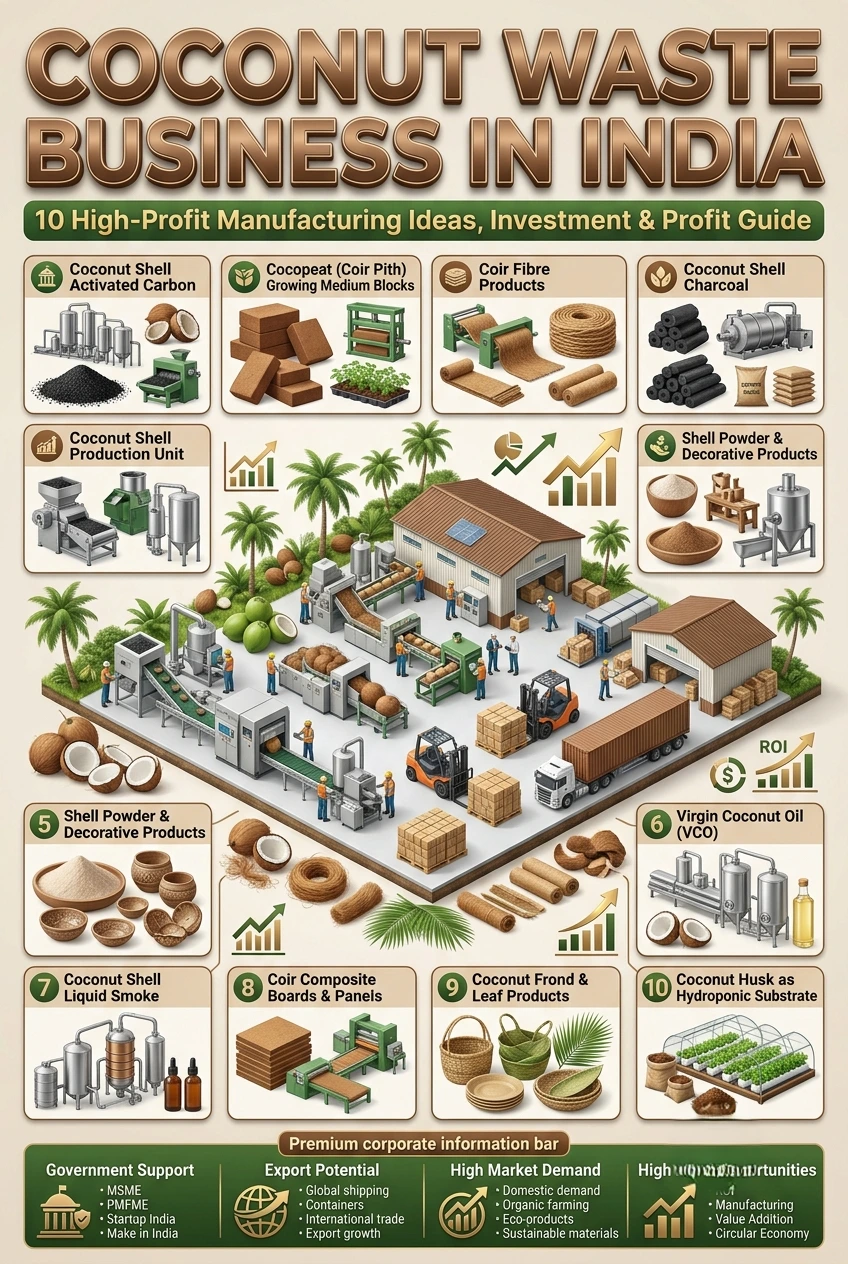
6. Virgin Coconut Oil (VCO)
The virgin coconut oil, which is extracted from fresh coconut kernel without heat or chemicals, fetches Rs. In top health food and cosmetics stores, 300–800 litre which is 3–5 times the price of refined coconut oil. Production of VCOs from fresh coconuts around the growing clusters in Kerala, Tamil Nadu and Coastal Karnataka is a good business opportunity because of the increased demand of the natural, minimally processed food and cosmetic oils in the world. Investment: Rs. 20–60 lakh for a 500–2,000 litres/day cold-press facility.
Access Complete Business Plan: Virgin Coconut Oil Manufacturing Project Report
7. Coconut Shell Liquid Smoke
Liquid smoke is a result of the burning of coconut shell and condensing of the smoke vapour. It has application in food flavours, additives for meats, and in antimicrobial agents for the processed food industry. The condensate is split into two constituents: pyroligneous acid (wood vinegar) and tar, which are both commercially used. A liquid smoke production unit is easily combined with charcoal production. Investment: Rs. 15–35 lakh.
8. Coir Composite Boards and Panels
Coir fibre composites are developed by mixing coir fibre with a polymer matrix or cement binder and are used to manufacture light weight, strong panels for door liners in cars, railway compartment interiors and building insulation. Natural fibre composites are being used in automotive OEMs in India (Maruti, Tata, Mahindra) for interior panel, to save weight of the vehicle. The cost of a coir composite panel is Rs. Establish and serve OEMs’ supply chains with 80-200 lakh.
9. Coconut Frond and Leaf Products
Coconut leaves and fronds used in making broom, leaf plate for pressing (disposable plates which will not pollute the environment), and thatching material. Eco-leaf plates market is witnessing fast growth as alternative to plastic plates and paper plates by utilizing the coconut and palm leaves pressed, stitched or moulded into plates. Investment: Rs. The leaf plate pressing line will cost Rs. 5–25 lakh.
10. Coconut Husk as Hydroponic Substrate
In addition to coconut peat blocks, hydroponic vertical farming, anthurium growing, and orchid growing uses coconut husk chips, which are small pieces of the outer coconut husk, as drainage and aeration substrates. Husk chips are exported to Japan, South Korea and Netherlands at Rs. 15,000–25,000 per tonne. The amount of investment required for husk chipping and washing unit is minimum (Rs. These range from 10–25 lakh and can be used along with cocopeat processing.
Related Article: Unlock Huge Profits With These Coconut Business Opportunities
Investment Overview
| Product | Investment (Rs.) | Export Price Range | Key Market |
| Activated Carbon | 80–180 lakh | USD 1,200–4,000/MT | Global — Water, Gold Mining |
| Cocopeat Blocks | 20–50 lakh | USD 150–250/MT | Netherlands, Japan, Korea |
| Coir Geotextile | 40–100 lakh | Rs. 80–200/m² | Road, Erosion Control |
| Shell Charcoal (BBQ) | 20–50 lakh | USD 350–600/MT | Japan, Europe, Korea |
| Virgin Coconut Oil | 20–60 lakh | Rs. 300–800/litre | Health Food, Cosmetics |
| Coir Composite Panels | 80–200 lakh | Rs. 80–200/panel | Automotive OEMs |
| Husk Chips | 10–25 lakh | USD 200–350/MT | Japan, Korea, Netherlands |
Export Market Development for Coconut Waste Products
Establishing export relationships are the best leverage an entrepreneur of a coconut waste processing business can make. Most buyers of cocopeat in most countries of the world, including Holland, Japan and Australia, will need to make 3 trial shipments before placing standing purchase orders. Each trial shipment must comply with EC (electrical conductivity) level less than 0.5 mS/cm, moisture less than 18% and it must be free of physical debris.
The Coir Board of India assists in introducing buyers and sellers and participation in the Coir Board’s annual meet of buyers and sellers is the shortest process to establish international linkages. In the water treatment industry, a buyer needs to purchase a sample of activated carbon for site-specific performance testing, which can take 3–6 months.
This process should be started 6 months prior to the start of commercial production. APEDA and Export Promotion Council for EOUs and SEZs help in arranging participation in international trade exhibitions where buyers of coconut products from India are actively engaged in sourcing the products. Order books fill up on commissioning earlier, the sooner the market is developed.
Find high-return business ideas based on your budget & ROI
How NPCS Helps Entrepreneurs Enter This Sector
At Niir Project Consultancy Services (NPCS), we provide professional consulting for Market Survey cum Detailed Techno-Economic Feasibility Reports (DPRs) for setting up coconut shell and coir-based product manufacturing businesses. Our report includes details on the entire manufacturing process, market demand analysis, process flow diagrams, plant layout, machinery and raw material procurement, and detailed financial projections with profitability analysis.
If you are an entrepreneur interested in exploring opportunities in waste-to-ware manufacturing, NPCS project reports provide you with the technical and financial background to confidently approach banks, investors and the government. To check our entire library of waste-related project reports visit www.niir.org.
Conclusion: The Business Case for Coconut Waste-Based Manufacturing
In the case of products like coconut shell activated carbon, cocopeat, coir geotextiles and shell charcoal, Indian manufacturers have some definite advantages – they have access to a good raw material base, they have developed a technology that is proven, and they have built relationships with export markets, and their cost structures cannot be duplicated by overseas producers. The agro-waste processing potential on the coconut belt of South India is one of the most fascinating areas in India.
Early movers into waste-based manufacturing establish raw material relationships, buying networks, and regulatory clearance that can be hard to duplicate by later entrants. It is never too late to take action on these business concepts, but before the area gets too saturated… and for most of the waste streams listed here, that time has not yet passed.
Frequently Asked Questions (FAQ)
Q1. Which product of the coconut can yield the maximum return?
Coconut shell activated carbon (CSAC) provide the maximum margin; as raw shell is costing Rs. The price of 2,000–5,000 per tonne and the premium CSAC sells at Rs. 1,50,000–2,50,000 per tonne. The value addition factor is 30-50x which makes it the most profitable coconut waste product for the entrepreneurs with Rs. 80+ lakh capital.
Q2. How much do they need to export for cocopeat?
Usually 20-foot container loads (15-20 tonnes of compressed blocks) are needed for buyers. The consistent specification of salt content (EC < 0.5 mS/cm) and moisture is required by the buyer in Netherlands, Japan and South Korea. For long term export relationships, it is more important for the quality to be consistent than the minimum quantity.
Q3. Are coconut shells available all year?
Yes. Coconut is picked from the tree throughout the year in the states of South India. The supply of Shell from copra mills, coconut oil expellers and coconut desiccation unit is continuous throughout a year, compared to rice husk, that may vary in availability from time to time.
Q4. Which is the government support to coir MSME units?
Capital subsidy, technology upgradation support and export market development support is available exclusively to coir industry units by the Coir Board of India (MSME Ministry). Coir MSME units can be availed of under Mahatma Gandhi Bunkar Bima Yojana and PMEGP.
Q5. Is it possible to produce charcoal and activated carbon from a single unit?
Yes, and it is the best economic model to use. The charcoal production unit (Rs. The activation plant (Rs. 20-50 lakh) is operated as a feedstock for the activation plant. 60–120 lakh). Running both will result in a better margin of control than purchasing commercial charcoal to be used as a feedstock for activation.
Q6. What are the required specifications of coconut shell activated carbon?
Key specifications include iodine number (for water treatment ≥900 mg/g; for premium ≥1050 mg/g), methylene blue adsorption (for water treatment ≥200 mg/g; for premium ≥1050 mg/g), moisture content (<5%), and ash content (<3%). Water treatment applications that are regulated must meet AWWA (American Water Works Association) and IS standards.


