





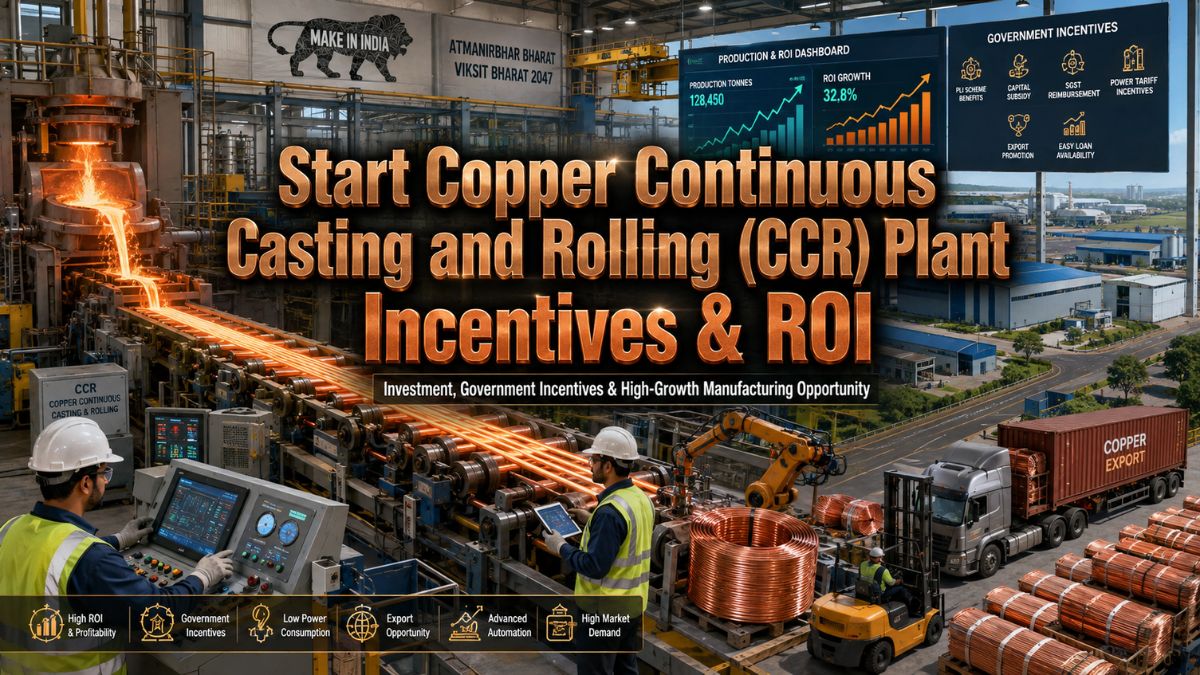
Copper wire rod has permeated nearly all aspects of modern life, from the wiring in a brand-new flat to the electric scooter motor. This constant demand is what makes Copper Continuous Casting and Rolling (CCR) one of the more reliable business ideas for those who want to venture into the metals industry. A CCR plant converts copper cathodes into copper wire rod, the raw material required by cable manufacturers, EV component producers, and electrical equipment manufacturers nationwide to manufacture cables. This isn’t a bet on a trend for a first-generation manufacturer. It is a gamble on infrastructure, electricity, and export demand for which India has already made a commitment for the next decade.
Why the Copper CCR Sector Deserves Serious Attention
India is not only outpacing its own copper production but it’s also a clear sign of this by how much opportunity lies there. Demand for copper wire rod has been increasing year by year due to various power transmission projects, housing constructions, railway electrification and a sudden surge in the number of electric vehicles. Copper is a very efficient conductor and there is really no substitute for it in high-performance wiring, thus limiting the shock resistance of the demand curve when it comes to the other metal categories.
The process of a CCR plant is also simple and straightforward. The copper cathodes are melted and cast into a continuous bar, which is then hot-rolled to a wire rod gauge, usually 8 mm. Running continuously, and not in batches, high output per shift and low labour cost per tonne. This is a combination of a steady demand / process efficiency that makes it profitable to operate even a mid-sized unit.
There is the potential of exports as well. There is limited domestic smelting and rolling capacity of copper wire rod in Middle East, Africa, and South Asia, which is why countries in these areas import Indian Copper wire rod. This also means that a well-managed CCR unit will not be overly reliant on any single buyer or any one state’s demand cycle, which is a significant benefit for a new player looking to get off the ground in the first couple years and reduce risk.
Related Article: Precision Copper Alloy Rod Manufacturing: A High-Growth Manufacturing Opportunity for Indian MSMEs and Industrial Investors
Government Policies and Incentives Supporting New Entrants
The policy landscape for metal processing units has recently become more conducive. In a capital-intensive unit like a CCR plant, the credit-linked capital subsidy schemes and collateral-free loan guarantees launched by the Ministry of MSME are of great significance under CGTMSE.
Priority sector lending is available with public sector banks to entrepreneurs registered as Udyam and term loans for plant and machinery are eligible for interest subvention. This reduces the effective project cost of rolling mill on which the project cost is typically the highest.
On the state level, industrial policies provide added value to central level policies. Capital subsidy, stamp duty exemption on land purchase, reimbursement of SGST on units established in notified industrial areas are provided in some of states. In line with Make in India initiative, the processing of non-ferrous metal has been identified as an important segment and environmental clearance for many such industrial estates has been obtained at a faster pace.
On the other hand, if a startup decides to structure it formally, it can also be registered as a startup with Startup India which will enable the company to avail tax holiday in the first few profitable years as well as avail the easier access to Government tenders which require domestic manufacturing certification. Together with these incentives, the overall investment cost and working capital requirement of a new metal processing unit is lowered, which helps eliminate the strain on working capital.
Multiple Business Ideas Within the Copper CCR Value Chain
A copper CCR plant is not a one-size-fits-all business model. Depending on the amount of capital an entrepreneur has at his disposal and the target market he is considering an entrepreneur can enter at various stages of the value chain with different investment sizes and margin profiles.
1. Standalone Copper Wire Rod Manufacturing Unit
The most direct one would be to establish a separate CCR line to produce 8 mm wire rod from copper cathode and sell it to cable makers, as well as downstream processors. This model is applicable to industrial clusters in the vicinity of existing cable and conductor manufacturing plants—where transport cost rapidly increases with distance on a dense metal product. The first year is typically the limiting factor, not the machinery, so the first thing a founder should plan is a cathode sourcing arrangement.
Get Detailed Project Report (DPR): Enameled Copper Wire Manufacturing Project Report
2. Integrated CCR Plus Fine Wire Drawing Unit
An entrepreneur can add a wire drawing process to the wire rod business where the wire rod is drawn to a smaller gauge that is directly used in cable production. This integration provides the extra margin as the drawn wire sells for more than the rod sold on. It increases the up-front cost, but at the same time it creates a broader base of drawn wire customers, which includes more cable, transformer and motor winding manufacturers.
3. Copper Rod for EV and E-Mobility Components
The amount of copper consumed by an electric vehicle is much higher than that of a traditional vehicle, especially in motor windings, battery cables and charging stations. By specializing in the provision of a specific rod quality, and having its products certified for such tolerances, a CCR unit can develop a long-term supply contract with a market that continues to expand its domestic supplier network. This is one of the more promising business ideas in this area, due to the continued and growing demand curve.
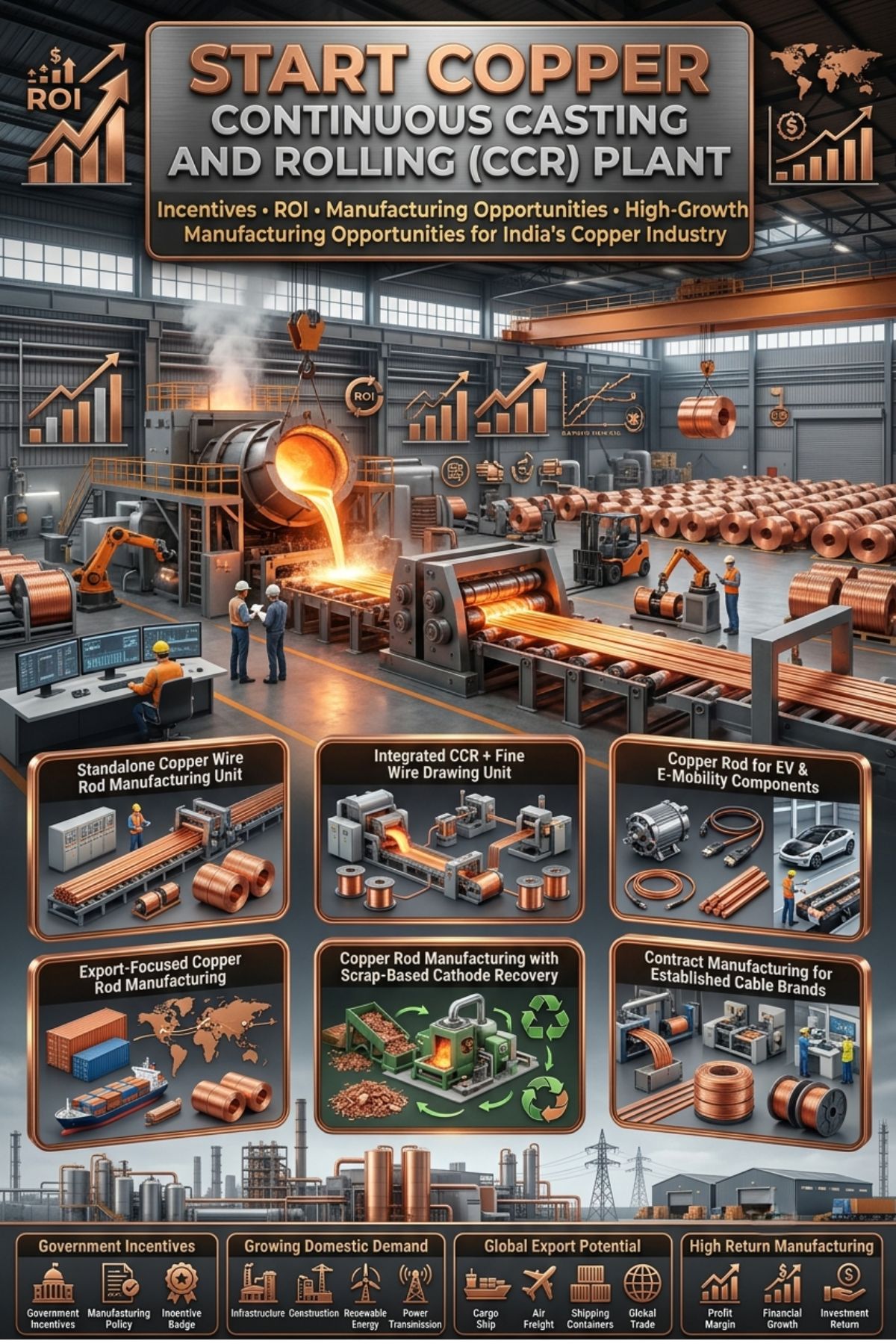
4. Export-Focused Copper Rod Manufacturing
Some businessmen decide to develop capacity with a particular perspective on exporting to markets, especially to countries in the Middle East and Africa where there is no rolling infrastructure. The argument is that this model requires more working capital because payment cycles for exports are longer than domestic cycles, but it also allows the company to buffer itself against a slowdown in the demand for these goods in a single region.
5. Copper Rod Manufacturing with Scrap-Based Cathode Recovery
A slightly different model integrates a small copper scrap smelting and cathode recovery unit ahead of the CCR line. This lowers raw material cost meaningfully because recovered copper cathode is typically cheaper than freshly refined cathode, though it does require additional environmental compliance for the smelting stage. Entrepreneurs with existing scrap trading relationships often find this the most capital-efficient entry point.
6. Contract Manufacturing for Established Cable Brands
Rather than building an independent brand, a new unit can operate as a contract rod supplier to established cable manufacturers who prefer to outsource part of their upstream rolling capacity. This reduces marketing overhead considerably and gives a new entrant predictable offtake, though margins tend to be tighter than in the open market since pricing is usually benchmarked to LME copper rates plus a fixed conversion charge.
Import–Export Opportunity Analysis for New Startups
India still imports a portion of its refined copper cathode requirement, which means a new CCR entrant needs to track LME copper pricing and cathode import trends closely before locking in raw material contracts. At the same time, finished copper wire rod and drawn wire products from India find steady demand in export markets, particularly where local processing capacity has not kept pace with cable and conductor demand. According to trade data compiled by the Directorate General of Foreign Trade, non-ferrous metal exports, copper included, have remained a consistent contributor to India’s engineering goods export basket.
For a new manufacturer, the practical takeaway is to build flexible customer contracts from day one. A plant that can service both a domestic cable manufacturer and an overseas buyer is far better positioned to absorb currency movements and cyclical demand shifts than one locked into a single channel.
Get Detailed Insights from This Book: Books
Indian MSME Success Stories Worth Studying
Sudhir Vasudeva and the Finolex Cables model: built one of India’s most recognised names in copper and cable manufacturing by starting with a modest rolling operation and reinvesting profits into backward integration, eventually controlling everything from cathode processing to finished cable production. Message to new entrant simple – get new profit out of this cycle and throw it at the next piece of the value chain, as is that level on integration you will eventually have.
Havells India’s growth trajectory: Anil Rai Gupta transformed a small to medium business selling electrical components into a broad-based manufacturing group through intense concentration on being ready for the export market and achieving the quality certificate, before rapidly growing domestic sales volume. New CCR entrepreneurs can take a direct cue from this by getting product quality certified to international standards early, rather than treating certification as a later-stage formality.
KEI Industries: started as a modest trading operation before moving into copper and cable manufacturing, and its growth shows how a founder with strong distributor relationships can use that existing network to de-risk a new manufacturing venture. Rather than building demand from scratch, the company leaned on relationships it already had, which is a practical lesson for any first-generation manufacturer entering the copper rod business today.
Getting the Feasibility Numbers Right Before You Invest
Every one of the business ideas above depends on getting the underlying numbers right before construction begins, not after. We at Niir Project Consultancy Services (NPCS) provide professional consulting for the preparation of Market Survey cum Detailed Techno-Economic Feasibility Reports (DPRs) for setting up new industries or businesses. Our reports include detailed manufacturing processes, market research and demand analysis, process flow diagrams, product mix and capacity planning, machinery and raw material details, and complete project financials with profitability analysis. Our objective is to help entrepreneurs evaluate feasibility, profitability, and long-term scalability before investing, so that capital goes into a plant sized correctly for the market it is meant to serve.
Find high-return business ideas based on your budget & ROI
Frequently Asked Questions
Q1. How much land does a copper CCR plant typically need?
A mid-sized unit generally needs between 3,000 and 5,000 square metres, depending on whether wire drawing and scrap recovery sections are added alongside the core casting and rolling line.
Q2. Is copper cathode sourcing difficult for a new manufacturer?
This can be managed with prior planning. Cathode should come from local smelters and or via import channel, the costs follow LME price and a founder should make a firm purchase contract for cathode before the purchase of any machinery is finalised
Q3. What certifications does copper wire rod need before it can be sold to cable manufacturers?
Wire Rod quality is normally compared with various standards published by the Bureau of Indian Standards, and larger cable consumers undertake their own incoming quality assurance tests, therefore conductivity, uniform appearance quality and surface finish becomes extremely important rather than certificates only.
Q4. How long does it take to set up and commission a CCR plant?
It typically takes most units 12 to 18 months from initial site acquisition and land purchasing through to full commercialization and normally the procurement and erection of machinery occupy the single longest period.
Q5. Can a first-generation entrepreneur without a metals background enter this business?
Yes, provided the founder invests in an experienced plant manager for the casting and rolling operations and gets the feasibility study and financial model professionally validated before construction begins.
Q6. What is the typical payback period for a copper CCR investment?
Having steady offtake deals, majorities of mid-scale mines aim at payback of about four to six years, this is however, subject to commodity price cycles and offtake quantity in the early years of operation.
The Bottom Line
Copper CCR production is at a historically promising junction – underpinned by both growing domestic consumption, fuelled by electrification and EV penetration, reliable external demand, and a supportive government policy environment provided through the Ministry of Mines and a suite of MSME schemes which encourages new capacity expansion. But between a winner and a flop for CCR production, the machinery is almost never the differentiator, rather it is sourcing of raw materials, size of capacity and getting the financials right pre-first cut. For an individual seeking entry in this field serious about it, doing this essential techno-economic viability exercise is paramount for both a plant that makes profits right from the first year.


