





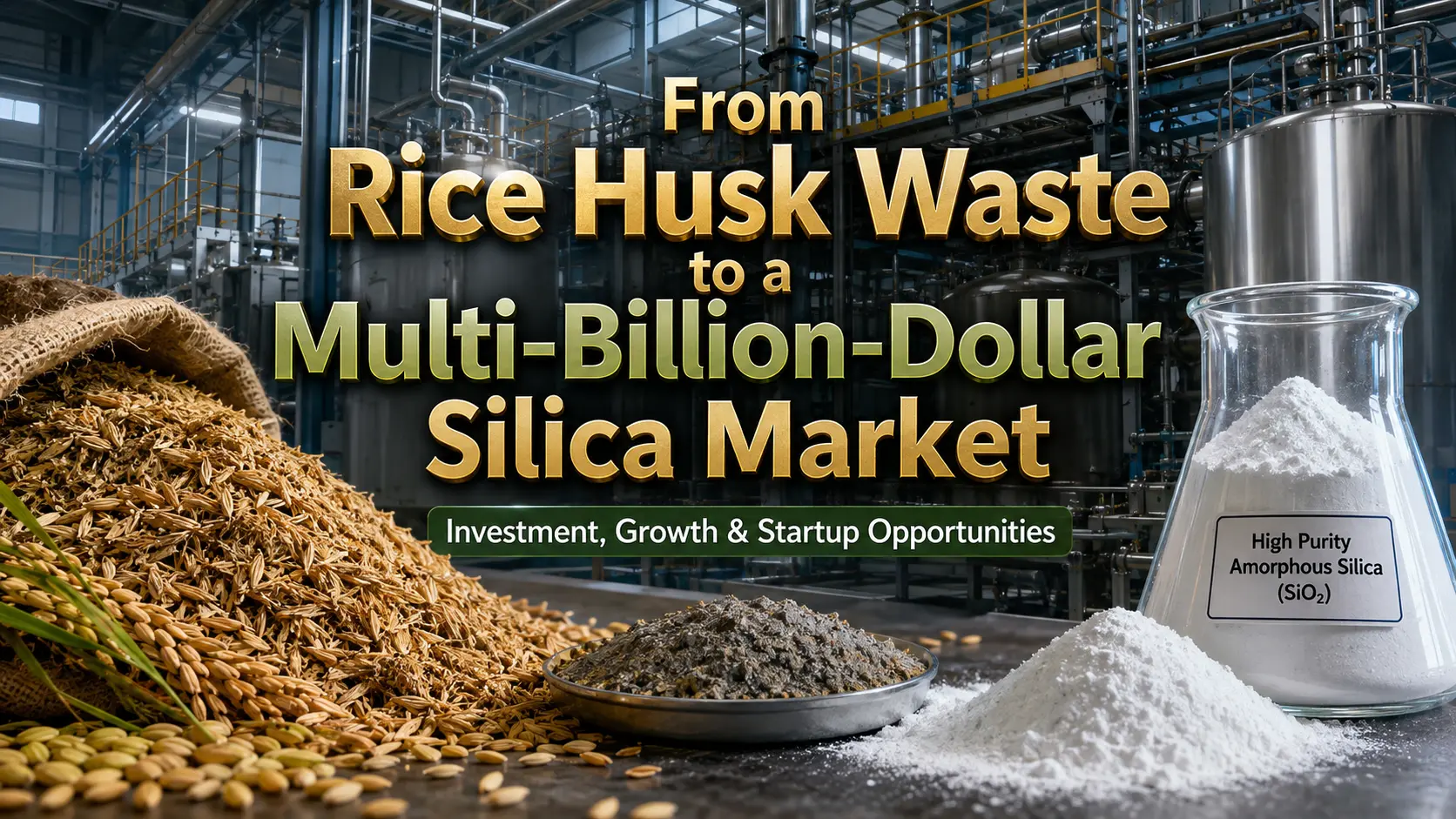
Rice Husk Silica Manufacturing
In India, all the rice mills produce a huge quantity of an unwanted byproduct. An estimated 20% of paddy is removed as husks (hard shell) for every tonne of paddy that is processed, before it reaches your kitchen. That husk was either burned openly in heaps, dumped near mill yards or at best shovelled into boilers as a low-grade fuel for decades. India is able to produce more than 130 million tonnes of rice per year.
The waste product, rice husk, is of approximately 23 million tonnes per year and burning it or dumping it makes another 4–5 million tonnes of ash annually – most of which is treated as waste rather than as an industrial raw material.
That is beginning to change and the answer is almost literary – the stuff that everyone set on fire is one of nature’s best sources of pure silica.
The Chemistry Nobody Expected
Rice husk ash is not all carbon and grit. In the right form, silica makes up 85% to 95% of the material, which is as pure or purer than many of the natural silica sand deposits that are traditionally mined. Research institutes investigating the material have discovered that well-processed RHA can contain 80–90% of recoverable silica, and that it is actually a viable feedstock and not just a novelty substitute.
The extraction process is already known and does not involve special equipment; silica is extracted from the purified rice husk ash as sodium silicate or silicon dioxide, filtered to remove impurities, precipitated, dried and packaged. It’s a process that can be performed by any medium-sized specialty chemicals plant and is not a laboratory trick for research institutes.
Get Detailed Insights from This Book: Manufacture of Value Added Products from Rice Husk (Hull) and Rice Husk Ash (RHA)
Why the Market Actually Wants This
Precipitated silica is by no means a specialty chemical, but a performance critical input for one of the world’s biggest manufacturing sectors. In 2026, the global precipitated silica market value is estimated at approximately USD 4.3 billion which is expected to reach USD 7 billion by 2036 and the major application of precipitated silica is tires. In rubber compound applications, precipitated silica enhances tread wear, wet skid resistance and rolling resistance, all of which become critical as fuel consumption and global emission standards become more stringent. More than 60% of the precipitated silica used globally is in the rubber industry.
In addition to tires, it can be found in oral care products, cosmetics, anti-caking agents for food, coatings, adhesives and water treatment. The fact that that’s a wide swath of products is important to a new manufacturer — it is not dependent upon the ups and downs of any single industry. In fact, Asia Pacific already accounts for more than 50% of the precipitated silica market and rice-husk-ash valorization projects have been successful in reducing raw-material costs by 15–20%, which is exactly what a rice-husk based Indian producer has the advantage of doing.
The Business Case, Stripped to Basics
This is unusual because of the raw materials aspect of the business, as opposed to most specialty chemical-based enterprises.
More than plentiful, and good value for money. Rice husk is locally available from almost all mills and biomass processing units in the country at little or no cost and without any risk of sourcing or lack of seasonal availability to plan around.
More valuable processing pathway than fuel use. Husk can be used as a boiler fuel, but only for its calorific value. The difference here is between a byproduct and an industrial input and converting it to precipitated silica extracts its chemical value.
Having more than one exit from the same fuel.More than one way to get out of one fuel. Depending on the equipment and process used, the same husk can be directed to silica extraction, activated carbon, biochar or construction grade ash products, providing a manufacturer with true flexibility when demand changes.
Policy tailwind. The rice husk and RHA-based projects are in tune with the agenda of circular economy and Atmanirbhar Bharat which has seen pilot projects and subsidies for biomass valorization units being introduced in states such as Tamil Nadu.
Related Article: India Rice Husk Based Products Market
What the Investment Actually Looks Like
| Metric | Detail |
| Typical starting investment | ₹25–75 lakh depending on capacity and process route (wet chemical vs. thermal-chemical extraction) |
| Core raw material | Rice husk / rice husk ash — typically sourced free or at nominal cost from local mills |
| Key inputs | Sodium hydroxide or hydrochloric acid, process water, filtration and drying equipment |
| Primary buyers | Tyre and rubber manufacturers, oral care and cosmetics formulators, construction and coatings industries |
| Key licences | GST registration, MSME/Udyam registration, Pollution Control Board consent (chemical processing), Factory licence |
| Product grades | Precipitated silica (rubber/tire grade), nano-silica (higher value, higher technical bar), construction-grade ash products |
Advanced products downstream include nano-silica for coatings and concrete, or silicon-based polymers for sealants, which offer higher margins, but require more process control and technical learning curve. For most, it’s most advantageous to begin with the more common precipitated silica rubbers, which have established demand and the documentation of specifications, and then add higher-value grades when the initial process is working well.
The Import-Substitution Angle
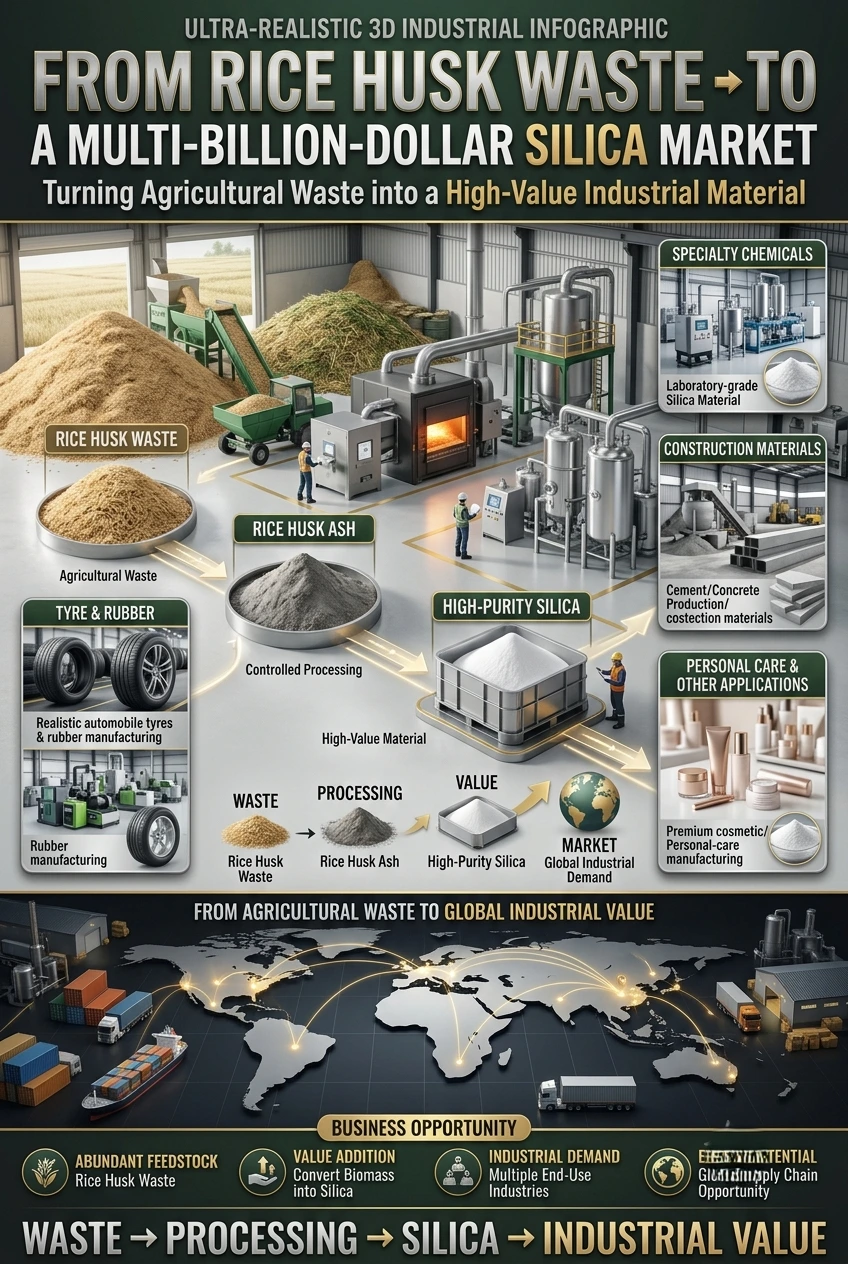
In fact, the real demand for silica in India is from the domestic tyre and rubber industry which is already getting its silica from imported sodium silicate derived silica or imported specialty grade silica. By building a new export market category, a new supply chain is also displacing an existing export market category, one that is already in place at scale in the country — and that makes the sales pitch a lot easier than selling an entirely new export market category.
View Full Project Details: Rice Husk Ash to Precipitated Silica: Complete Guide
Why the Tire Industry Specifically Is Driving Demand
The single biggest reason for the increased demand for precipitated silica is not for use in cosmetics or coatings, it’s for what the industry calls “green tires. The tread compounds are filled with silica and that helps to lower the rolling resistance and directly influence the fuel efficiency of a vehicle; tire-labelling requirements are being tightened in Europe and now, more and more, in Asia, encouraging manufacturers to get closer and closer to these types of compounds.
The report monitoring the silica segment of tyres predicts the sector to reach USD 8.1 billion by 2033, up from approximately USD 5.2 billion in 2024. The Indian tire industry is growing along with the number of automobiles and exports, so the Indian buyer base for silica is not an abstraction, but is real and is in urgent need of a reliable local source of silica that is also cost competitive.
Industry trackers noted a tightening of precipitated silica supply among tire manufacturers in China and India as recently as February 2026, with procurement activity intensifying on the back of green-tire initiatives and automotive expansion — exactly the kind of supply squeeze that rewards a new domestic producer entering with a cost advantage on raw material.
Getting the Process Right Before Scaling
The only technical challenge in this business is consistency, not the discovery of the chemistry, which is well known. For tire and rubber customers to consider a supplier first, second, or at any time, the purity, particle size and surface area of the silica must be within close tolerances, batch by batch. These new entrants eventually get to rubber-grade silica much sooner than those who attempt to sell it for tires right away since they first start their business, since they sell it for lower specification applications during the initial six to twelve months while the quality systems are being developed.
A detailed techno-economic feasibility study, which determines the equipment design for the wet process versus the thermal-chemical process, the design of the effluent treatment and a realistic timeline to meet the quality requirements of initial customers, is typically the difference between a unit that starts off smoothly in its second and third year of operation, and one that continually gets stuck in an endless cycle chasing quality complaints from early customers.
Identify high-growth industries before others do
The Bigger Pattern
Rice husk silica is part of a larger class of opportunity that’s worth watching: agricultural residues which were long considered as waste until someone figured out how to use the chemistry to turn them into an industrial input. This is the same story for sugarcane bagasse, cotton stalks and coconut shell in other regions of India’s biomass economy. That is why it is important that the technologies that are used to convert rice husks to fuel, ash or silica and to activate them to carbon and make pellets are all proven and commercially available today and not experimental processes awaiting a breakthrough.
Rice husk, a by-product of the rice milling process, was not really waste for a country of more than 130 million tonnes of rice production annually. It only took the right company, in this case, the world’s specialty chemicals and tire industry, to notice.
Entrepreneurs evaluating this opportunity should also weigh feedstock logistics carefully. Detailed project analysis of precipitated silica ventures consistently flags that co-locating near a cluster of rice mills — rather than a single supplier — materially de-risks raw material continuity, since husk availability tracks the local paddy harvest calendar and a single-mill dependency can create seasonal supply gaps that a multi-mill sourcing radius avoids entirely.
There is no need to reinvent anything for any of this. The extraction chemistry is ancient, the equipment is commercially available and from many of the factors involved in raw material, it is largely import substitutable and — unusual in a specialty chemicals venture — the most difficult aspect of the raw material issue is that rice mills are actively seeking someone to get rid of their husk. A wider look at the rice husk value chain puts the issue in the context of one of the rare areas of specialty chemicals where the raw material cost remains stable and predictable while the market price proceeds on the global demand and supply of tires and rubber.
How NPCS Can Help You Get Started
NPCS makes Detailed Project Reports & techno-economic feasibility studies for rice husk ash silica projects ranging from process route selection (wet-chemical vs. thermal-chemical extraction), equipment specification, effluent treatment design, capacity-wise project cost, to realistic roadmap to tire-grade quality qualification; the kind of planning that can make or break quality projects in the fist year by the time they reach rubber-grade specification.
Some other business ideas that can be explored are: Making of activated carbon from rice husk, manufacturing of particle board and construction panels using it, production of biochar and soil amendment using it for agricultural purpose, manufacturing of nano-silica for coatings and concrete, it is a downstream use of rice husk with higher technical requirement and manufacturing of rice husk briquetting for industrial fuel, which is a lower technical requirement use.


