





Michael Dell success story
The University of Texas at Austin has given birth to a lot of things: oilmen, football legends, a governor or two. It hasn’t created a lot of college dropouts with a fortune that is in the quarter-trillion dollars. Except for Michael Dell, of course, who rose from the ranks of the very lucky and the story of how he did it has more to do with a teenager who was willing to wager it all on a spreadsheet rather than luck.
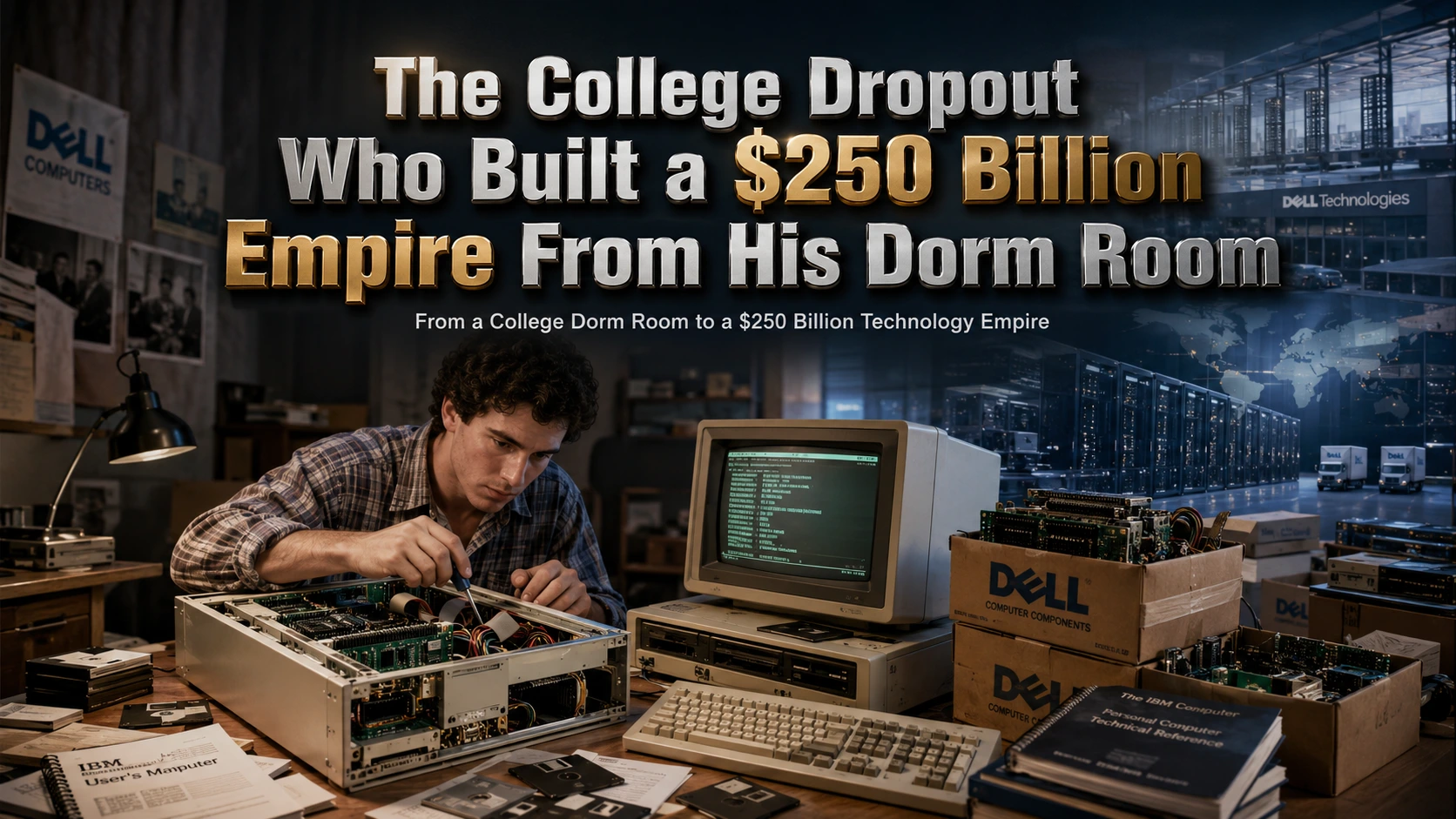
Dell was an 18-year-old freshman in a pre-med program in 1983, mostly because his father, who was an orthodontist and his mother, a stockbroker, were hoping he would become a doctor. He had other plans. Since he was a youth, he has been fascinated with electronics, and even purchased an Apple II computer simply to tear it apart and peer at its workings. While in college he began purchasing surplus IBM PCs, adding more memory and disk drives, and selling the machines to fellow students and local companies for a profit. It wasn’t a hobby. From the first month it was a real business.
Related Article: Top 20 Business Ideas Above 1 Crore Investment
The $1,000 Bet That Became a Company
About $1,000 of his own money, Dell filed a business registration with the state of Texas as PC’s Limited. He was filling orders in his dorm room and a rented condo. After his first year, the figures began to add up: he brought in just about $80,000 in revenue, according to a detailed account of his early years published by A Touch of Business.
His parents were not thrilled. They’d agreed to let him spend the summer testing the business on one condition — if it didn’t work out, he’d go back to school full time and drop the computer stuff for good. Dell didn’t wait for permission twice. In the summer of 1984, he brought his parents a single-page document: PC’s Limited’s first quarterly earnings report. It showed real revenue, real profit, and a business that was, in his words, already working. As Dell later wrote when sharing the original document publicly, that one page “convinced my parents I shouldn’t go back to college.”
Betting on an Idea Nobody Else Wanted
It wasn’t the hardware that was special about Dell’s company, it was the model. During the mid-1980s, the only places to purchase computers were retail stores and dealer networks, and there were significant markups in between. Dell went to great lengths and took the middleman out. Computers were assembled to the customer’s requirements, and were shipped directly to the customer. At the time it seemed obvious. In 1984, it was radical.
That direct-sales, build-to-order model became the engine of everything that followed. Dell also pioneered just-in-time inventory — building computers only after they were ordered, rather than warehousing finished stock — which kept costs low in an industry where component prices dropped constantly. TheStreet’s breakdown of his career credits these early operational bets, plus free customer support, as the foundation of everything that came after.
Dell has been consistent about the philosophy behind it. In a 2017 interview with Fortune, he said the key was refusing to build something ordinary — that a business only gets big if it’s doing something genuinely nobody else is doing. He’s also been candid that he didn’t spend much time asking for permission or validation. As he told Fortune in a piece on his success habits, most people asked about a new idea will tell you it won’t work — so he generally didn’t ask.
After four years in its dorm-room beginnings, the company was renamed Dell Computer Corporation and went public in 1988. By the 1990s it was one of the largest PC makers in the world.
Get Detailed Insights from This Book: Book
The $67 Billion Deal That Rewrote the Company
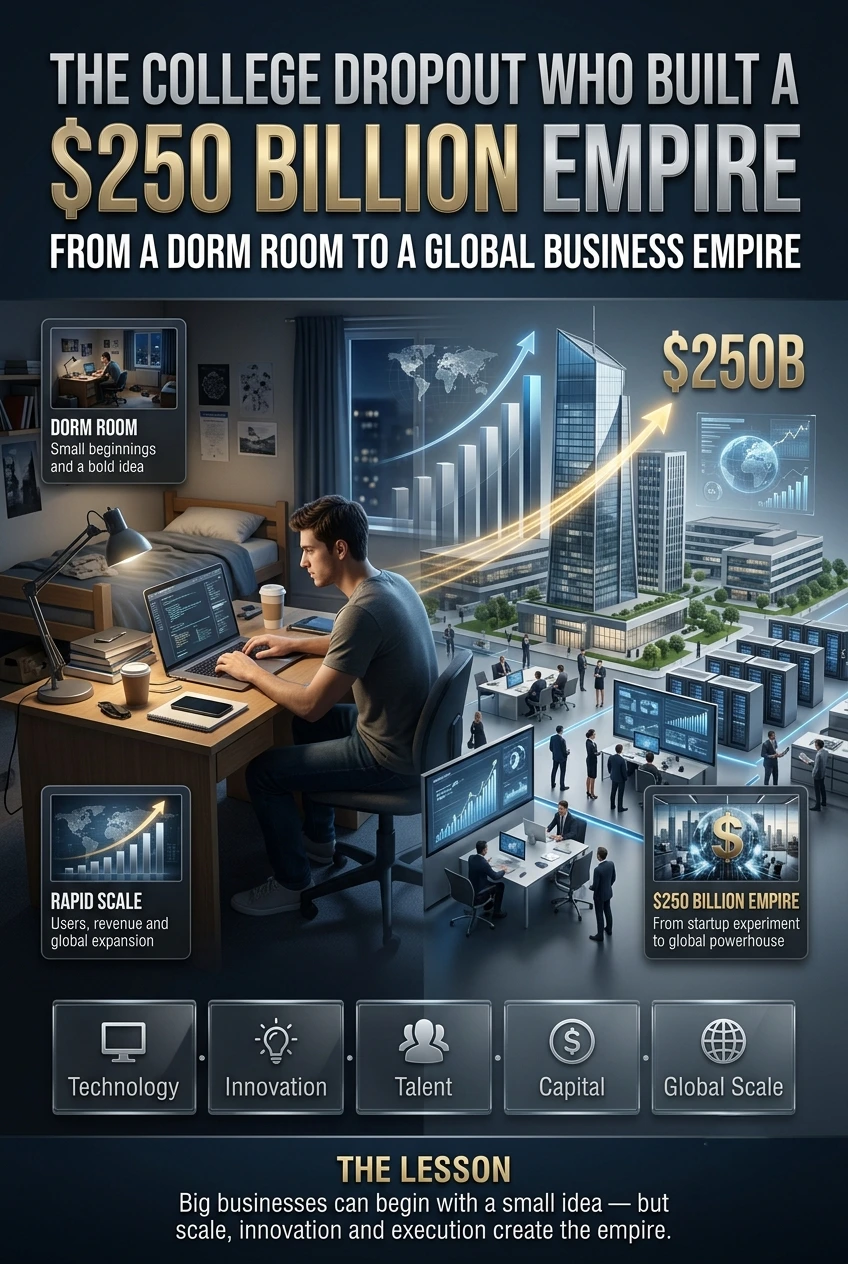
Dell’s tale might have been a history of the founder creating a strong computer company, the PC business eventually growing, and the founder getting paid off. Rather, in 2015 he took the largest gamble of his career: a $67 billion purchase of data-storage giant EMC Corp. It was the biggest tech buy ever at the time. The transaction changed the company’s business from being a computer manufacturer into an enterprise infrastructure firm that now includes servers, storage, and cloud services, and became Dell Technologies. According to BBN Times’ description of the deal, it was the time Dell transitioned to enterprise IT.
The company went public again in 2018 and in 2021 it separated out its controlling interest in VMware, which in turn, along with Dell owning about 40–50% of the parent company, added tens of billions to his own wealth.
From $1,000 to a Quarter-Trillion Dollars
Dell’s wealth has fluctuated greatly over the decades as the stock market has gone up and down; in one day, for instance, he lost $11.7 billion when he announced a lackluster earnings report causing shares to drop 18%. But long-term growth has been more or less continuous, as well as picking up steam recently, thanks to demand for AI infrastructure — the very type of massively parallel computing gear around which Dell has built its business for 40 years.
By mid-2026, reporting from VnExpress put his net worth near $253 billion, driven by a roughly 225% surge in Dell Technologies’ share price over the year, making him briefly the fifth-richest person alive. He still owns around 41% of the company he founded from that dorm room — meaning, unlike most tech billionaires, his fortune isn’t diversified away from the business that made him. When Dell Technologies rises, so does he. When it falls, so does he.
View Full Project Details: DPR Consultant in India – Detailed Project Report Consultants & Consultancy Services
Quick Facts: Michael Dell
| Born | February 23, 1965, Houston, Texas |
| Started business | 1983, University of Texas dorm room |
| Starting capital | ~$1,000 |
| Company | PC’s Limited → Dell Computer Corporation → Dell Technologies |
| Dropped out | 1984, age 19 |
| Landmark deal | $67 billion EMC acquisition (2015/2016) |
| Ownership stake today | ~41% of Dell Technologies |
| Peak net worth (2026) | ~$253 billion |
Why His Story Still Matters
It’s easy to conclude that Michael Dell “started early, got lucky. That doesn’t really back that up. He wasn’t a lunatic; he dropped out with a document that proved that the business was already working and that it was working at a level that made it an irrational decision to stay in school.
He wasn’t the first to invent the personal computer, but he was the one who changed the way it was sold, which proved to be more significant. Then decades later, when his fundamental PC business started to mature and become competitive, he didn’t rest on his laurels either — he re-invested the company in infrastructure and enterprise IT with the EMC deal, which is what ends careers when it backfires.
Forty-two years after that quarterly earnings report changed his life, Dell is still running the company, still holds a huge personal stake in its outcome, and — according to Gazette Direct’s 2025 profile of his finances — is now pushing the business into AI infrastructure, supplying hardware for some of the largest AI data centers in the world. The dorm-room habit of building exactly what the customer needs, nothing more and nothing less, never really went away.
Discover business ideas that actually make money
Four Lessons From Dell’s Rise, for Anyone Starting From Zero
1. Prove it before you leap. Dell didn’t quit on faith; he quit with a document in his hands that revealed that the business was already working. The lesson of the big risk story isn’t the one that’s on everyone’s lips: “quit your safe path! The message from the big risk story isn’t the one we’ve all heard: “quit your safe path!
2. Find the inefficiency everyone else ignores. The personal computer wasn’t Dell’s invention. That the customer didn’t have to have a retail mark-up and a dealer network between them and a computer was his idea. The best thing in an established business is not always a new product; it’s a better way of selling the old one.
3. Stay concentrated on what you understand. Dell still holds about 41% of Dell Technologies, instead of dividing his assets across other unrelated businesses. He has served as chairman and CEO of the company for virtually its entire history, with a few breaks in between, as outlined in Wikipedia’s overview of his career. That focus is a two-edged sword, as it cost him billions in bad quarters, but also has been good for his own bottom line in the AI infrastructure boom.
4. Be willing to re-bet the whole company. For a PC company that already has a value of tens of billions, the EMC acquisition was not a safe bet. This was a risk that could have resulted in disaster for the company. It did not and that’s why Dell Technologies has a bull in the ring when the market is on the move for AI infrastructure, instead of being bogged down in a contracting PC market. The bet paid off and Forbes’ real-time billionaire tracker always names him as one of the world’s wealthiest people, as referenced in The Street’s evaluation of his fortune for 2026.
The Bigger Picture
According to BBN Times’ company overview, Dell Technologies today boasts annual revenues of over $90 billion, ranging from laptops to the servers that are the foundation of large-scale AI systems. To learn the story of how the company changed from PC’s Limited to the company it is today, then it’s best to read it from the corporate history page of Dell Technologies, which outlines the mergers, spin-offs, and public offerings in chronological order.
But the key takeaway in the millions-of-dollars figure is that it was actually quite simple in the beginning: a teenager, $1,000, and the desire to continue upgrading the machines of others until the side business got too big for a dorm room. Michael Dell didn’t get short cut to success. He upgraded them one by one and erected the on-ramp himself.


