





Rice Husk Based Products Business
Market Insight
More than 30 million tonnes of rice husk are produced every year in India, an agricultural residue which is so prolific and underutilised that it has become one of the most promising raw material investments for industrial investors in the country today. Now, the global rice husk ash (RHA) market is estimated to be USD 2.91 billion and is expected to reach USD 4.8 billion by 2035, expanding at an estimated CAGR of 5% during the forecast period. India is in the middle of this market, as the major biomass producer of rice husks in Asia, and has a growing number of applications in the downstream business including precipitated silica, activated carbon, biomass power, particle boards and biodegradable packaging.
Raw material availability and Demand–Supply Gap: India imports considerable amounts of high purity silica, activated carbon and other downstream chemical products which can be produced domestically using rice husk. India’s domestic demand for silica products alone is estimated to be nearly ₹900 crore and a significant amount of the silica used in specialty applications such as tyre manufacturing, toothpaste, pharmaceuticals and electronics is sourced from energy intensive conventional raw materials either imported or produced from the far cheaper and far more sustainable rice husk silica path.
This is the commercial heart of the case for new investments in rice husks value added processing — the difference between supply and demand in commercial rice milling, which accounts for current import of rice husks for processing.
The Raw Material Foundation: Why India’s Position Is Structurally Unrivaled
The first step to understanding the Indian rice husk products market is to comprehend the raw material base. The Department of Agriculture & Farmers’ Welfare (DA&FW), Government of India, shows that India is one of the biggest rice producers where the total paddy production in the crop year 2024–25 stood at 1,490.74 lakh tonnes. This is an impressive 8% gain compared to the previous year and makes India a major supplier for the world’s rice supply. The top 5 states of rice production (Uttar Pradesh, Telangana, West Bengal, Punjab and Odisha) account for more than 52% of the country’s rice production and are natural geographic clusters for industrial investment based on rice husks.
Rice husk is about 20% of the weight of a bundle of paddy. This implies that India annually produces more than 30 million tonnes of rice husk and about 20 million tonnes of rice husk ash (RHA) is generated as a result of the combustion of rice husk in the boilers, power plants and direct burning at the rice mill sites. If combustion is conducted within the temperature range of 500°C to 800°C, then the RHA has a silica composition of 85-95% by weight.
The amorphous silica is just the silica that global industries are looking for to use as an additive to cement, as a rubber compounding additive, as a personal care ingredient, as an agricultural carrier and as an ingredient in advanced battery separators.
However, most of this ash is disposed of on land, making it hazardous to the environment, or incinerated in uncontrolled open burn areas, where the ash is lost in its chemical value. In India, the quantity of RHA commercially used for the production of high value chemicals such as silica, activated carbon or other specialty chemicals is still small compared to the available feedstock. This underutilization is not a market failure; it is a market gap that needs to be filled.
Get Detailed Insights from This Book: Manufacture of Value Added Products from Rice Husk (Hull) and Rice Husk Ash (RHA)
Market Size and Growth Trajectory: 2026–2033
The current market value of the rice husk ash is USD 2.41 billion and is expected to increase to USD 3.54 billion by 2033 with a CAGR of around 4.92%. Asia-Pacific region, comprising India and China, has more than 43% market share in the global market, with India’s consumption base gaining pace due to the growth of its construction, rubber, automotive, and specialty chemicals industry.
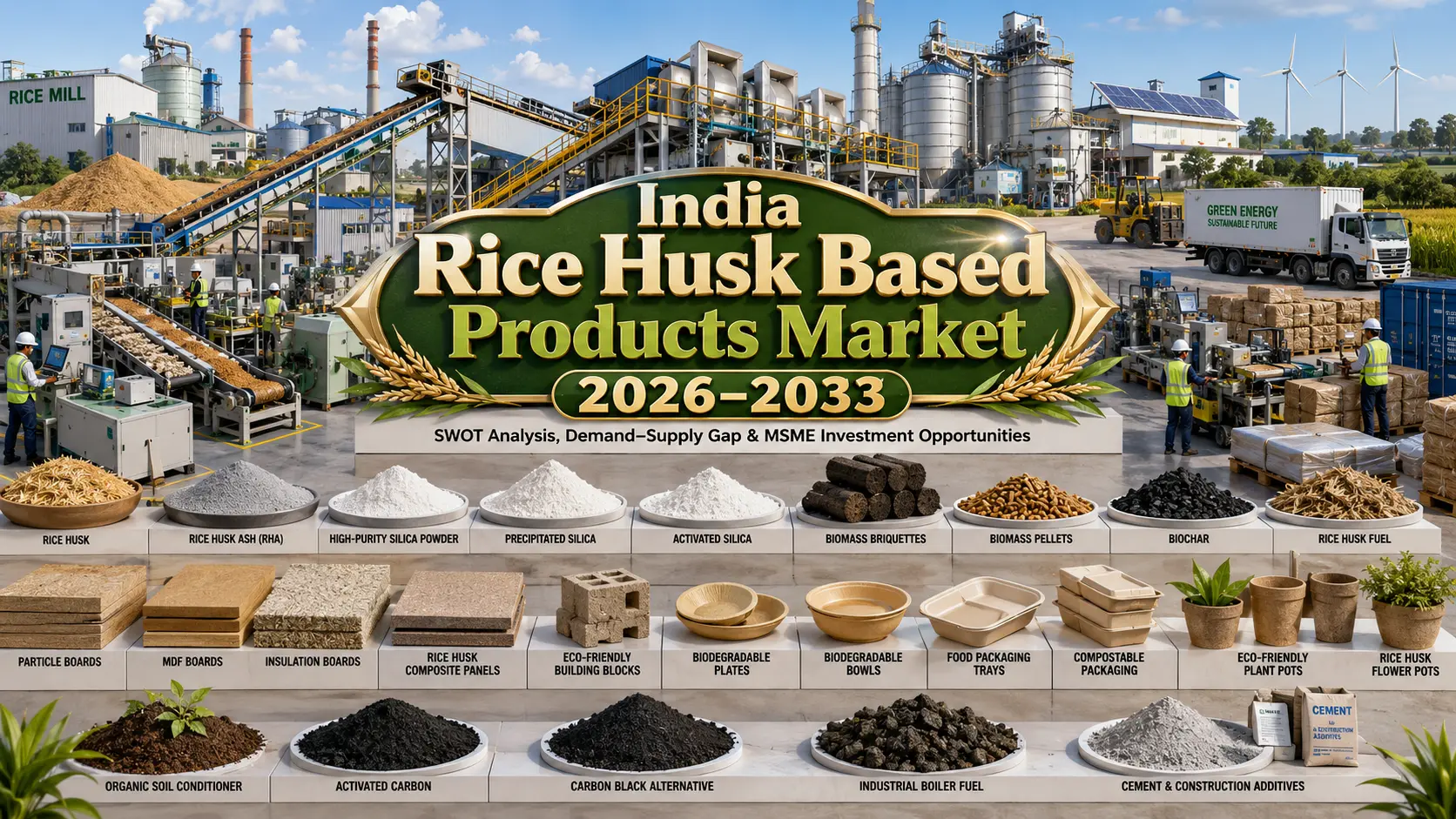
In India, rice husk products industry is multi-faceted. It includes a minimum of 8 marketable product streams, with different market demand, capital investment and market depth:
The biggest use by volume is Rice Husk Ash (RHA) in Construction. RHA is added as a supplementary cementitious material in the manufacturing of concrete, where 10-30% of ordinary Portland cement (OPC) can be substituted with RHA, which helps increase the compressive strength of concrete, decrease permeability, and increase resistance to chemical attack. The construction industry in India is one of the fastest growing in the world and the need for sustainable and economical alternatives to cement is also on the rise due to growing significance of green building certification programs like GRIHA and IGBC.
Precipitated Silica: May be the most valuable commercially available product from RHA. Precipitated silica is used in tyre manufacturing (as a reinforcing filler in green tyres), tooth paste, animal feed, food additives, coatings and pharmaceutical excipients. The precipitated silica market is valued at more than 3.38 million tonnes across the globe during current period and is projected to grow to 4.08 million tonnes by 2031 at an overall CAGR of about 3.86%. The rice husk-based silica production routes reduce the raw material cost by 15-20% than the conventional sodium silicate and sulfuric acid route and provide a true cost advantage to the domestic producers over imported silica.
Activated Carbon: Rice husk can be used as a good feedstock for pyrolysis and then chemical or steam activation to produce activated carbon. It is used in water treatment (RO systems, municipal filtration), air purification, pharmaceuticals production, effluent treatment in industry and recovery of gold in mineral mining. The activated carbon market in India is on a steady growth trajectory, as the regulations against industrial pollution pressure and the swift development of domestic water purification systems drive the market’s expansion.
Bio briquettes and Bio pellets: Biomass briquettes and biomass pellets are compressed fuel briquettes which can be used as an alternative to coal and firewood in brick kilns, small power plants, industrial boilers and food processing industries. Biomass co-firing in thermal power plants is being encouraged by the Ministry of New and Renewable Energy (MNRE) and the manufacturing of briquette/pellets is being facilitated through the National Bioenergy Mission, providing a definite policy push and low capex entry point for the MSME investors for this product category.
Based on studies sponsored by MNRE, surplus biomass is available in the country at 120–150 MMT per annum, which equates to an energy potential of around 18,000MW of which rice husk is one important feedstock.
Particle Boards and Agro-Based Boards: Rice husk can be processed into particle boards for use in doors, wall panelling, furniture, table tops, and modular construction applications. These boards are lighter than wood-based MDF, offer better fire and termite resistance due to their silica content, and are moisture-resistant — making them ideal for tropical climates. India’s particle board and MDF market is projected to grow at over 7.5% CAGR, reaching USD 3.5 billion by 2030, driven by rapid real estate development, the furniture industry’s expansion, and growing consumer preference for wood alternatives that don’t require deforestation.
Sodium Silicate: RHA is an efficient raw material for producing sodium silicate (water glass), which is used in detergents, paper manufacturing, water treatment, and as a binder in foundries. The domestic sodium silicate demand is significant and largely met through conventional routes, but the RHA-based production route offers cost and sustainability advantages that are beginning to attract investor attention.
Biodegradable Tableware and Packaging: An emerging and fast-growing segment. Rice husk combined with natural binders can be molded into single-use tableware — plates, bowls, trays — that are fully biodegradable. With government policies mandating the phaseout of single-use plastics and growing consumer demand for sustainable packaging, biodegradable rice husk tableware is growing at over 9% CAGR and finding ready markets in urban hospitality, QSR chains, airline catering, and export markets in Europe and the Middle East.
Biochar and Soil Amendment Products: Rice husk biochar — produced through slow pyrolysis — is gaining acceptance as a soil conditioner that improves water retention, carbon sequestration, and microbial activity in agricultural soils. This represents both a domestic market opportunity and an emerging export category, particularly as carbon credit mechanisms develop around biochar applications in soil.
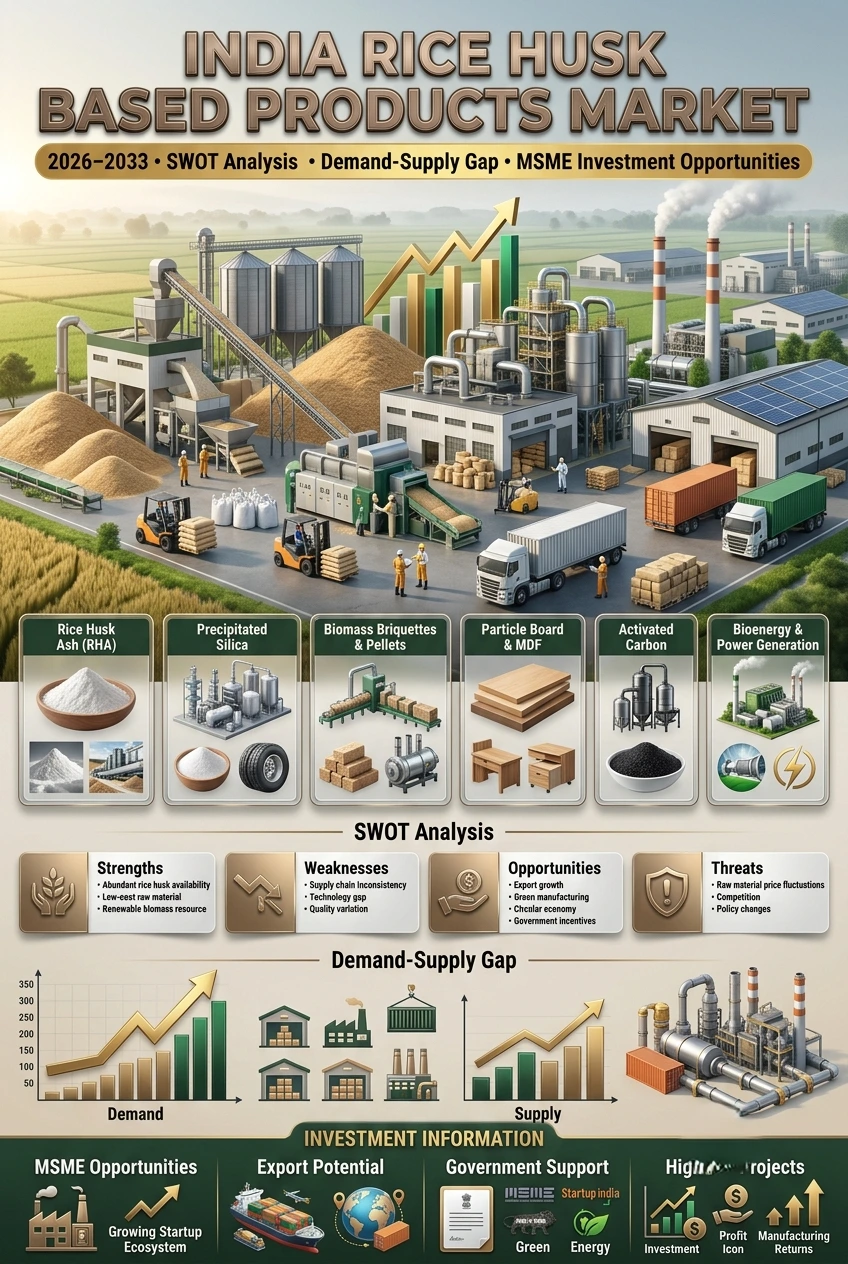
SWOT Analysis: India Rice Husk Based Products Sector
Strengths
The strength of this sector is quite apparent – India has the maximum and most geographically confined supply of rice husk, which is available every agricultural season without any capital investment at the primary level. Rice husk is a renewable by-product at the mill gate with zero cost, as compared to petroleum-based feedstock or mined mineral resources where the entrepreneur has to pay substantial prices for the collection, logistics, and processing.
India has an established milling infrastructure with all the major agricultural states, which facilitates the collection of raw materials in terms of a hub and spoke model. The processing units are within 30–50 km of major rice milling clusters in Punjab, West Bengal, Uttar Pradesh, Andhra Pradesh and Telangana and they can easily get their feedstock without making expensive transportation. There is no disruption of husk availability even in seasonal transitions because rice is a dual season crop in most southern and eastern states.
Another great attribute is the technical versatility of rice husk as a feedstock. The variety of products that can be manufactured from agricultural residues is very limited, ranging from simple energy production (briquettes, electricity generation) to special chemicals (precipitated silica, activated carbon, sodium silicate) to construction materials (boards, cement additives) and consumer products (tableware, packaging). This diversification enables investors and entrepreneurs to select a product vertical that matches their investment capacity, technical expertise, and market reach, ensuring broad accessibility to investment opportunities of varying scales in the sector.
View Full Project Details: Rice Husk, Rice Hull & Rice Husk Ash Based Projects
Weaknesses
The major operational shortcoming is the feedstock quality is inconsistent. Rice husk composition (and hence ash composition) depends on the variety of rice, mineral content of soils, drying process, and the combustion conditions. This variation can complicate processing and lead to yield losses in high-value applications such as manufacturing of pharmaceutical grade silica or battery separator. The technical requirements for small-scale producers are progressively higher as the producers seek to grow the premium market for their products, through the use of controlled combustion technology, consistent temperature control and strict quality testing.
In many areas, the awareness of the market and the commercial infrastructure for the value-added rice husk products are still underdeveloped. The market of specialty products using ash has been relatively nascent in the country as compared to the rice milling companies in Punjab and Haryana which have been selling rice husk for power generation for years. Purity grades in the precipitated silica market range from 98% to 99.99% .
A new supplier needs to go through a series of qualification cycles with customers before gaining traction, and these can take 12–24 months for the market entry of pharma or tyre grade silica.The market segments of precipitated silica include tyres and pharma applications, with the latter requiring 12–24 months of quality demonstration and qualification cycles before new suppliers enter the market.
Another structural challenge is collection and logistics. In eastern India, the rice belt of Bihar, Orissa, and Jharkhand, the milling is more fragmented and it is more difficult and costly to aggregate sufficient feedstock for commercially viable processing volumes, as compared to mill concentrated areas like the Punjab.
Opportunities
The most structurally interesting possibility in this area is the import substitution aspect of specialty silica. India still imports huge quantities of silica-based products which can be produced in the country at a lower cost using the rice husks, for example, by the tyre, pharmaceutical and electronics industry. Market analysts have pointed out that the production of silica through rice husks is 15-20% cheaper than the traditional sodium silicate production method due to the use of lower cost raw material. Also, the EU Carbon Border Adjustment (CBA) mechanism is kicking in and making the sustainability story commercially relevant for export buyers.
The green building materials opportunity is on the rise. Construction is India’s second largest industry and is expanding at a fast pace as a result of government infrastructure initiatives. Sustainable building codes are gaining popularity, like GRIHA, LEED, IGBC, and the demand for supplementary cementitious materials (SCMs) to minimize the embodied carbon in cement-based structures is rising. RHA is identified as one of the most cost-effective such materials and is expected to continue having a multi-decade demand runway as the construction industry grows structurally until 2033.
Substituting single-use plastics is a growth driver stemming from regulations. The phased ban on single-use plastics, as mandated by the Ministry of Environment, Forest and Climate Change (MoEFCC), is shifting the demand to other materials, such as tableware made of rice husk, which is biodegradable. The largest demand segments are urban food service, hospitality and organized retail, with the export market on the rise, especially to the EU, which has enacted its own single-use plastics directive.
The EV revolution is ushering in a new high purity rice husk silica premium application. When properly processed, the grades of silica can meet the incremental demand for grades in battery separator manufacturing, with greater than 90% SiO₂ purity, and the growing lithium-ion battery production ecosystem in India and globally. A high value use, a frontier in the market, challenging but lucrative for producers who are able to produce the required purity specification.
Threats
A competitor to feedstock is a real and growing constraint. Rice husk no longer just gets thrown away. With growing awareness of its biomass fuel potential, the demand for good quality husk has become a source of conflict amongst the power generators, boiler operators, brick kilns and chemical processors especially in Punjab, Haryana and Uttar Pradesh. This isn’t making procurement prices more favourable for the husk-rich states, but is putting upward pressure on them, squeezing margins for processors not having long-term supply contracts with mills.
Compliance to the environment has become stricter. The combustion-based rice husk processing operation is being closely monitored by the state pollution control boards in terms of air quality effects of poorly controlled burning as well as ash disposal. Compliance demands for controlled combustion facilities, effluent treatment and handling of ash can create regulatory risks and shut down plants, which can jeopardize project viability if not taken into account by the entrepreneur.
Competitive headwind in certain segments is the quality substitution pressure of synthetic alternatives. Precipitated silica continues to be technically feasible in some rubber compounding applications and may have a lower production cost in some commodity grade applications. Likewise, within the construction industry, the fly ash from coal fired power plants has become a well-known competing pozzolanic material, that is well entrenched in the manufacture of cement and is often supplied at little or no cost by the power plant.
Identify high-growth industries before others do
Demand–Supply Gap: The Investment Thesis in Granular Detail
India’s position as the world’s largest or second-largest producer of rice creates a raw material base that is vastly larger than the country’s current processing capacity for value-added rice husk derivatives. The numbers illustrate the gap clearly:
| Product | Estimated India Demand | Current Domestic Processing Capacity | Import/Gap Status |
| Precipitated Silica (all grades) | ~₹900 crore annually | Partial — significant imports persist | High import dependency |
| Activated Carbon | Growing — water, pharma, industrial | Limited domestic RH-based capacity | Imported specialty grades |
| Biomass Briquettes/Pellets | Rapidly expanding | Underserved in Tier 2/3 markets | Production-demand mismatch |
| Biodegradable Tableware | Estimated 9%+ CAGR | Nascent capacity | Largely import-substitute opportunity |
| RHA for Construction | Large and growing | Some capacity but under-utilized | Cement plants beginning adoption |
| Sodium Silicate | Established industrial demand | Mostly conventional routes | RHA route significantly underused |
The Food and Agriculture Organization of the United Nations (FAO) reports global rice production (milled basis) at approximately 543 million tonnes in the current season, with India producing around 150 million metric tonnes — the second highest on record. At 20% husk yield, India’s rice husk availability comfortably exceeds 30 million tonnes annually, yet the commercially processed fraction for high-value applications is a fraction of this. The gap between available feedstock and processed output represents one of the most straightforward investment cases in India’s agro-industrial sector.
Regional Analysis: Where Processing Units Make Most Sense
Rice Husk Products Market geography follows the paddy production geography with some interesting variations affecting the location of investments.
Punjab and Haryana: The rice-wheat belt of the north-west accounts for a significant amount of rice husk generated from mechanised milling and the region already has a good pool of biomass power plants that utilise rice husk. Feedstock Price is the challenge in this situation — procurement price of husk is high in Punjab due to high competition. But the region’s roads, industries and markets, along with its close proximity to rubber industries in northern India, allow processors to “make it” by finding supply deals with big rubber mills, and RHA with established industrial infrastructure.
Eastern belt (West Bengal and Odisha): It has world class production capacity of rice in several varieties with access to chemical manufacturing infrastructure and port connectivity in Kolkata for exporting. This is also an ideal place for the production of activated carbon and sodium silicate considering the location near the pharmaceutical and chemical manufacturing belt of West Bengal and the growth happening in the tier-2 cities of eastern India.
Uttar Pradesh and Bihar: The biggest paddy-producing state and its eastern neighbour have the most availability of feedstock in the north, although the state of fragmentation in the milling process in Uttar Pradesh complicates the availability of feedstock. However, for biomass briquette production not requiring high-purity processing and small-scale production, UP and Bihar has good economics as there are a large number of Small/Medium industrial consumers (brick kilns, food processing units, small textile mills) which are eager to replace expensive coal.
Rice production is high, and there is high demand for chemicals, construction, and export products in the southern belt of Andhra Pradesh, Telangana, and Tamil Nadu, especially in the city of Hyderabad, the Krishna-Godavari delta. The location is also close to major ports (Vizag, Chennai, Krishnapatnam) which makes it an ideal choice for export of precipitated silica and activated carbon to the buyers in Europe, Southeast Asia and the Middle East, who can be reachable at a cost-effective manner.
Major Indian Players in the Organized Sector
The rice husk products industry ranges from large and integrated agribusiness firms to specialty chemical producers.
KRBL Limited is one of the leading rice processing and export industries in India for more than 130 years in the industry. KRBL’s biomass power generation and ash recovery systems at the Dhurkot milling plant in Punjab are being expanded to enable the integration of biomass from husk with cement for local construction. The scale of rice milling operations of the company provides it a structural advantage in terms of access to feedstock and ash quantity.
Usher Agro Limited is a major rice husk ash player and has been exposed in various applications such as metallurgy, oil and gas, agriculture etc. The company is engaged in rice husk power plant, silica extraction plant project and has large installed capacity of rice and wheat milling. At the vertical integration model level, Usher Agro’s milling-to-ash-to-specialty application is the one being sought by many smaller companies.
Guru Metachem Private Limited is a manufacturer and exporter of rice husk ash-based products and has a niche in construction and specialty chemical market. The company has established export linkages with regulated markets and is an example of mid-scale players who have proven the commercial viability of manufacture of specialty chemicals based on RHA in India.
Startup and MSME Opportunity: Entry Points Across Investment Scales
The rice husk products industry is truly open to first generation entrepreneurs and MSME investors as the product ladder has various levels of investment ranging from ₹6–10 lakh for the basic briquette unit, up to ₹2–5 crore for a mid-scale activated carbon plant, and up to ₹10–25 crore for a precipitated silica plant equipped with controlled combustion and chemical processing.
Biomass Briquettes and Pellets (Entry Level): Entry point in the sector with lowest capex and fastest payback. If a briquette manufacturing unit operates at a production rate of 1-3 tonnes per day, it is necessary to invest in a pellet mill, drying system and in basic packaging equipment. The target market is spread out and looking to alternatives to coal, consisting of industrial boiler operators, brick kilns, food processing units, and institutional buyers. Capital recovery time for well-placed briquette units varies from 1.5–2.5 years and profits of 15–35% can be realized if feedstock is obtained directly from mills at low cost.
Bio Rhtw (mid-scale): As the single use plastic ban becomes more stringent and institutional buyers in the food service sector seek alternatives to single use plastic, rice husk molded tableware offers an easy-to-manufacture solution. The cost of the equipment for thermoforming or compression molding varies depending on their size and level of automation, ranging from ₹50 lakh to ₹2 crore, sourced from India or China. The export market potential, especially to the EU, Southeast Asia, and the Gulf, provides a new dimension of revenue for the investment case, compared with just domestic sales.
ACTIVATED CARBON FROM RICE HUSK (Mid to Upper Mid-Scale): Rice husk is one of the cheapest sources for the production of activated carbon especially for water treatment applications. The expansion of the domestic market is being supported by compulsory regulations on industrial effluent, rising domestic water purifiers and demand from the pharmaceutical market. The cost of a focused activated carbon unit of carbonization kiln, activation reactor and washing/drying equipment is ₹3-8 crores depending on grades and capacities specifications.
Precipitated Silica from RHA (Upper Scale): The biggest margin and most technically challenging product of rice husk value chain. To make the precipitated silica work commercially, it is necessary to control the combustion of husk (to produce quality ash), to leach the ash with acid, to form precipitators, to filter the precipitated silica and to dry it. The investment range in the unit is in the range of ₹ 10 – 25 crore, which is sufficient to provide silica of tyre grade or pharmaceutical grade.
The market returns are good though — precipitated silica can be sold for much more than the raw material inputs and the import substitution market provides a protected window of opportunity for the early producers to establish market relations and quality certifications.
The Ministry of MSME, Government of India has made entrepreneurship in agro-processing a priority under its various subsidy and credit-linked incentive schemes. The MSME Development Act frameworks, along with capital subsidy under the Credit Linked Capital Subsidy Scheme (CLCSS) and support from state-level agro-industrial parks, provide financial scaffolding that meaningfully reduces the effective capital burden for entrepreneurs entering this sector.
Related Article: Rice Husk to Revenue: Profitable Agricultural Waste Business Ideas in India
Import–Export Dynamics: The Trade Intelligence for Investors
On the import side, India’s dependence on specialty silica — particularly for pharmaceutical, rubber, and electronics applications — creates a demonstrable import substitution opportunity. High-purity precipitated silica for tyre manufacturing is produced by global majors including Evonik, Solvay, and PPG Industries, and Indian tyre manufacturers source significant volumes from these players at prices that domestic RHA-based producers could undercut while maintaining comparable quality.
On the export side, rice husk ash and its derivatives are finding growing demand in markets where local rice husk availability is limited but construction and industrial silica demand is high — particularly the Middle East, parts of Europe, and Southeast Asian countries that are developing their construction sectors faster than their raw material base can support. India’s emergence as a net exporter of value-added RHA products is visible in the 300-kilotonne global export figure for processed RHA recorded in recent years, with India and China as the dominant suppliers.
Biodegradable tableware from rice husk has opened export lanes to the EU, UK, and North American markets where plastic bans are driving institutional procurement of alternatives. This is an export opportunity that MSME manufacturers can access at relatively modest scale, particularly if they obtain required food-safety certifications (FDA compliance for US, LFGB for EU) that validate their products for food-contact applications.
The Agricultural & Processed Food Products Export Development Authority (APEDA) supports agro-industrial exporters in India, and while its primary mandate covers food and agricultural products, the value chain linkages to rice husk-based natural food packaging and organic agricultural inputs (biochar) bring RHA manufacturers within the ambit of exporters who can access its market development and infrastructure support programs.
NPCS: Feasibility Intelligence for Rice Husk Based Manufacturing Projects
Entrepreneurs interested in entering the rice husk products market face a common challenge: the sector’s product diversity means that making the wrong product choice — wrong in terms of local feedstock economics, target market reach, or capital availability — can undermine a project that should have succeeded on fundamentals alone.
Niir Project Consultancy Services (NPCS) — www.niir.org — is India’s leading industrial and manufacturing project consultancy, specializing in the preparation of Market Survey cum Detailed Techno-Economic Feasibility Reports (DPRs) that answer exactly these investment questions. NPCS has prepared feasibility reports specifically for rice husk-based product manufacturing — covering the full range of products from briquettes and particle boards to precipitated silica, activated carbon, sodium silicate, and biomass power — and brings industry-specific process knowledge, market data, and financial modeling expertise to every project evaluation.
A typical NPCS DPR for a rice husk-based project includes:
- Detailed manufacturing process documentation with process flow diagrams (PFD/BFD) specific to the chosen product and technology route
- Market research and demand analysis covering domestic consumption patterns, import data, and export opportunity assessment
- Product mix and capacity planning recommendations calibrated to the investment level and target market
- Machinery and raw material specifications with vendor references and procurement guidance
- Import-export dependency analysis and competitive benchmarking
- Complete project financial modeling: capital cost, operating cost structure, working capital cycle, revenue projections, break-even analysis, IRR and NPV estimation, and sensitivity analysis under varying feedstock price scenarios
For first-generation entrepreneurs without prior experience in chemical or agro-industrial manufacturing, the NPCS DPR provides the technical and financial credibility needed to approach lenders — including SIDBI, NABARD, and state financial corporations — as well as to engage strategically with potential offtake buyers and equipment suppliers. The report transforms an entrepreneurial intent into a bankable project proposal.
Frequently Asked Questions (FAQs)
Q1. How much rice husk does India produce, and is feedstock availability reliable year-round? India generates more than 30 million tonnes of rice husk annually as a byproduct of rice milling, with production concentrated in states including Uttar Pradesh, West Bengal, Telangana, Punjab, and Odisha. Since rice is cultivated in Kharif (summer-monsoon) and Rabi (winter) seasons in different regions, and rice milling operates continuously to serve domestic consumption and exports, husk availability is structurally year-round. Establishing direct procurement agreements with rice mills provides investors with supply security and cost predictability.
Q2. Which rice husk product offers the best return on investment for a first-time entrepreneur? Biomass briquettes and pellets offer the lowest capital requirement and fastest payback (1.5–2.5 years) for entrepreneurs with limited capital. Biodegradable tableware offers strong margins and growing export demand. Precipitated silica carries higher capital but commands the highest value per unit and has the strongest import-substitution story. The ideal product depends on local feedstock price, available capital, target market proximity, and technical capability — a proper feasibility study is essential before committing.
Q3. What is the silica content of rice husk ash, and how does it compare to conventional silica sources? Rice husk ash produced through controlled combustion at 500–800°C contains 85–95% amorphous silica by weight — comparable in purity to conventionally produced silica from sodium silicate routes, but produced at significantly lower raw material cost. The amorphous structure of RHA-derived silica is particularly valued in construction (pozzolanic reactivity), rubber (reinforcing properties), and advanced battery applications.
Q4. What government policies support rice husk-based manufacturing in India? The Ministry of New and Renewable Energy (MNRE) supports biomass briquette and pellet manufacturing through the National Bioenergy Mission and co-firing programs. The Ministry of Environment, Forest and Climate Change enforces plastic ban regulations that drive demand for biodegradable alternatives. The Ministry of MSME provides credit-linked subsidies and enterprise development support for agro-based manufacturing units. The DPIIT (Department for Promotion of Industry and Internal Trade) under the Make in India initiative supports agro-industrial manufacturing investment through policy facilitation and ease-of-doing-business reforms.
Q5. Can rice husk-based products be exported? What are the key markets? Yes. Rice husk ash is already exported from India to construction markets in the Middle East and Southeast Asia. Precipitated silica derived from RHA has potential export markets in Europe, where sustainability credentials in supply chains are increasingly valued. Biodegradable tableware made from rice husk is finding export traction in the EU, UK, and Gulf markets. Activated carbon exports to water treatment and industrial markets in developing countries represent another channel. APEDA and the Export Promotion Councils for relevant industries provide support and market linkage for export-oriented MSME manufacturers.
Q6. What is the minimum capital required to start a rice husk-based manufacturing unit? A rice husk briquette unit can be started with as little as ₹6–15 lakh for basic equipment. A biodegradable tableware unit ranges from ₹50 lakh to ₹2 crore depending on scale and automation. An activated carbon unit requires ₹3–8 crore. A precipitated silica facility needs ₹10–25 crore or more for commercial-scale production. Government subsidies and MSME credit facilities can reduce the effective equity requirement significantly.
Summary Metrics at a Glance
| Parameter | Data |
| India Annual Rice Husk Generation | >30 million tonnes |
| India Paddy Production (2024–25) | 1,490.74 lakh tonnes |
| Global RHA Market Size (current) | ~USD 2.91 billion |
| Global RHA Market Projected (2033–35) | USD 3.5–4.8 billion |
| RHA CAGR (2026–2033) | ~4.9–5.3% |
| Silica Content in Controlled Combustion Ash | 85–95% SiO₂ |
| India Domestic Silica Market | ~₹900 crore (growing) |
| Biodegradable Tableware Segment CAGR | >9% |
| Particle Board Market CAGR (India) | >7.5% |
| Major Production States | UP, Telangana, West Bengal, Punjab, Odisha |
| Key Organized Players | KRBL Ltd, Usher Agro, Guru Metachem |


