






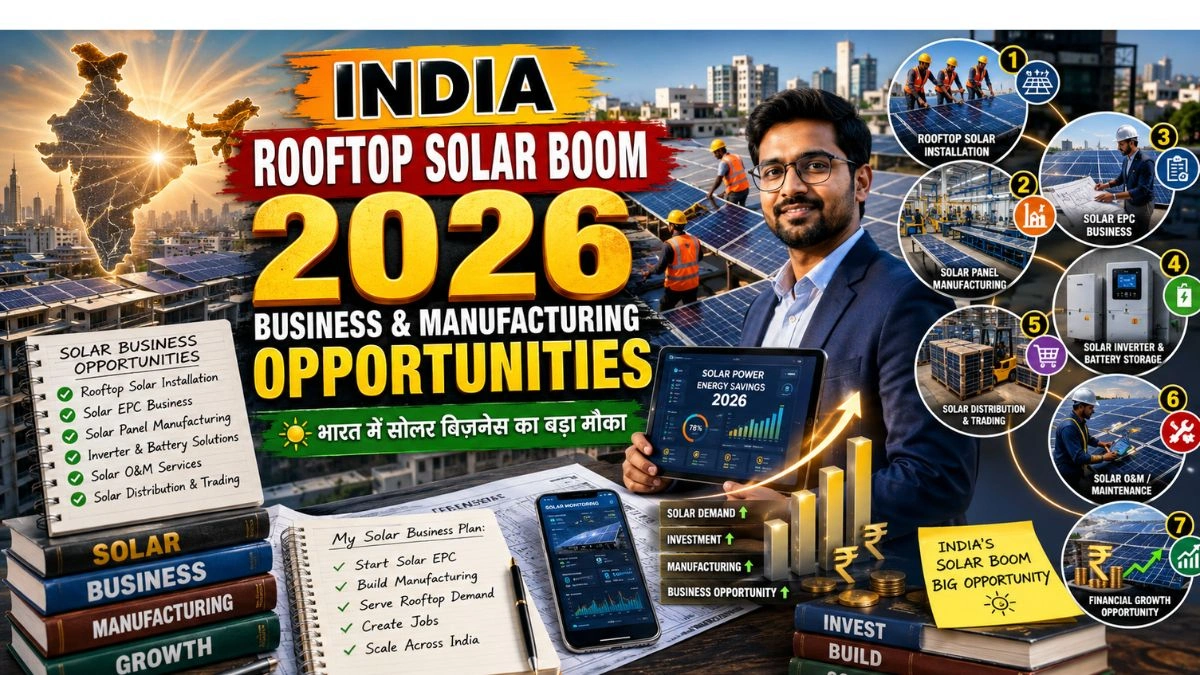
6.6 GW Installed in Just Six Months—Here Is Why Entrepreneurs, MSMEs, and Investors Should Pay Close Attention, Rooftop Solar Business
The landscape of distributed energy has turned a corner in India. In the first half of 2026 the country recorded 6.6 GW of rooftop solar installation, an impressive 136 percent increase from the 2.8 GW achieved in the same timeframe last year. The second quarter saw an additional 3.8 GW, up 41 percent quarter-on-quarter and double the year-over-year, thus accounting for 41 percent of the total 10 GW. The share of rooftop solar has been estimated to be about 33 percent of national solar energy installations, which was farfetched two years ago.
This is not an increase or a one-off initiative. It is a structural shift in India’s electricity generation and consumption. The government’s ambitious residential rooftop programme, PM Surya Ghar Muft Bijli Yojana, has already touched the lives of almost 4.5 lakh households, which is a mere 45% of its planned target of 10 lakh households. Residential additions accounted for 84 percent of rooftop additions and industrial rooftops another 10 percent in Q2 2026.
This momentum is an avenue to vast and clear commercial potential for entrepreneurs, manufacturers, MSMEs, startups, and investors, far more than the solar panels themselves. All parts of the supply chain, installation environment and downstream service sectors are all opening up, and the time to build early leadership is now.
What This Development Means for Indian Businesses
Multiple industries are impacted when rooftop solar is deployed on a large scale. For every 1 GW of rooftop solar installations, the mounting hardware, inverter, wiring, earthing system, monitoring system, junction boxes and battery storage systems are needed. They are in such high demand, they had 6.6 GW installed in only six months.
The implementation of domestic content requirements coupled with ALMM List-II regulation, which will require a 25 percent domestic locally manufactured solar cells requirement from June 2026, is changing the procurement landscape. Any developers and system integrators will no longer be able to use imported modules as freely. This results in immediate localization pressure and thus in a business opportunity for domestic manufacturers who are ready to invest in the production of cells and modules.
In addition to hardware, there is a demand for the installation wave for skilled electrical contractors, project developers, O&M service providers, financing intermediaries and energy monitoring software. Roof top Solar projects are becoming easily available to be bid on for MSMEs in the areas like Electrical works, Civil construction, Mechanical fabrication. The capex model, in which system owners fund their own projects, captured the bulk of Q2 2026 additions and lessened the reliance on complicated leasing models, as well as making projects more accessible for smaller companies.
Policy support, increases in grid tariffs and decreasing panel prices remain attracting project economics for investors. Customers using rooftops for industrial and commercial applications are looking more closely than ever at rooftop systems. This leads to the demand for project development services, EPC services and financing solutions, all of which are areas where MSMEs/startups can be competitive.
Why This Industry Could See Stronger Growth
There are a number of forces at play that are further building momentum and unlikely to change in the short term.
First of all, the PM Surya Ghar programme hasn’t achieved more than 50% of its objective. The residential pipeline is still very large, with 4.5 million homes built and a target of 10 million. State agencies, discoms and channel partners will be on the move to bring the remaining rollouts on track to end March 2027 and beyond.
Second, payback periods for rooftop installations have drastically shortened in several states due to increases in commercial/industrial electricity rates. For industrial electricity consumers who now pay higher electricity tariffs from the grid, rooftop solar PV is no longer a green credential, but a direct cost reduction measure.
Third, the ALMM transition window which would enable eligible net-metering and open access projects to use a wider variety of modules until December 2026, suggests that domestic manufacturing of cells and modules will become a condition for most government–backed projects from 2027. Businesses that start the process of setting up domestic cells manufacturing capacity early will be heading into a required shift with a head start.
Fourth, there is a large lag time in many states for approval of grid connections and metering. Solutions that utilize technology to automate application processing, monitor approvals and communicate with distribution companies are truly underpenetrated market opportunities.
Last, but certainly not least, the amount of storage continues to increase. With more rooftop solar, more of these grid-interactive battery systems, smart inverters, and demand management will add value, and have high margins and export potential – premium segments.
Government Policies and Incentives
The policy backing is favourable for businesses interested in the sector in India. In the following programmes, entrepreneurs should carefully examine their options.
In the middle of the entire downstream supply chain, the flagship PM Surya Ghar Muft Bijli Yojana offers rooftop solar subsidy to the residential consumers resulting in sustained demand. Any manufacturer who provides components listed on ALMM can have their product(s) accepted for subsidized installation.
The Ministry of New and Renewable Energy (MNRE) provides standards, approvals of lists and policy direction throughout the solar industry. Any entrepreneurs who are involved in making solar components and providing installation services, should keep a close eye on MNRE notifications.
Manufacturing capital and technology support for MSMEs is available from the Ministry of MSME, including through the Credit Guarantee Fund Trust for Micro and Small Enterprises which waive collateral requirements for working capital loans.
While technology startups breaking into the energy monitoring, O&M software or smart inverter business segments, the Startup India portal has facilitated access to Government procurement, provided DPIIT recognition and offered tax benefits for three years in a row.
Industrial promotion agencies at the state level, like Gujarat Industrial Development Corporation (GIDC), provide land, infrastructure, and incentives to solar component manufacturers for dedicated production units.
The Solar Energy Corporation of India (SECI) is the nodal agency for large solar tenders and is the one to manage ALMM list. The manufacturers who want to put their products for the Govt. sponsored projects should register with SECI.
The Engineering Export Promotion Council of India (EEPC India) can provide market development assistance and facilitation to export-oriented units/companies engaged in manufacturing of engineering products.
The National Institute of Solar Energy (NISE) Testifies, certifies and supports R&D of solar products. For manufacturers who must have product accreditations for listing in ALMM, accreditation with NISE is required.
Integrated solar manufacturing can also be pursued under the Production Linked Incentive (PLI) Scheme of MNRE, which provides output-linked financial incentives for integrated solar manufacturing. As programmes change over time, there may be opportunities for mid-scale manufacturers.
Manufacturing Business Opportunities Emerging From This Development
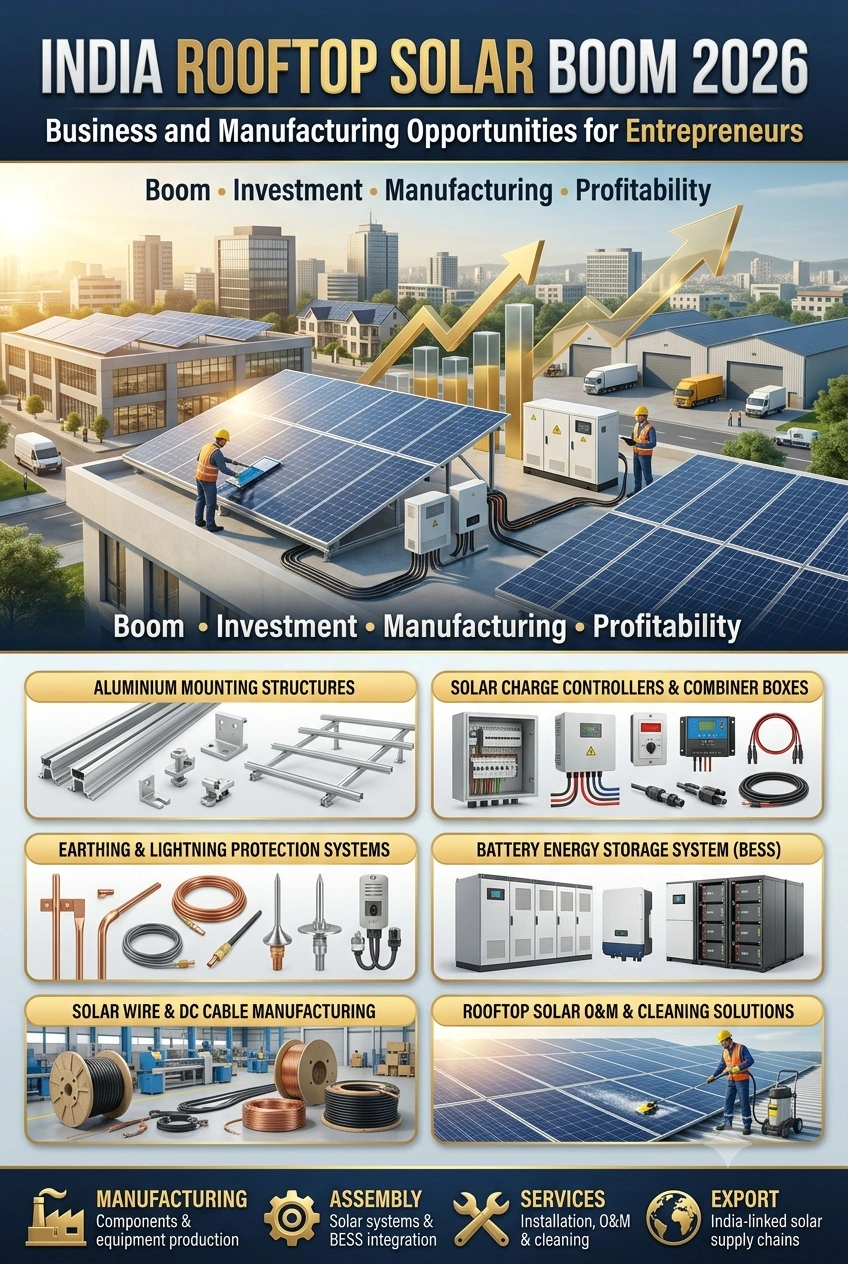
The Solar Rooftop boom generates demand only for a very targeted range of manufacturing segments. Each opportunity below is directly tied to the growth in installation that is under way.
1. Aluminium Mounting Structures and Racking Systems
Each rooftop solar installation needs to have a unique mounting structure, comprising extruded aluminium rails, clamps and brackets that attach the panels to the flat or pitched roof surface. As the volume of installations has increased, so has the demand for these structures. The process of aluminium extrusion is established MSME friendly process with a moderate investment of dies, extrusion press, anodising lines.
The target customers are EPC contractors, solar dealers and direct consumers. The availability of raw material is good in India and so is the domestic production of aluminium. There is export opportunity in SAARC and SE Asian Markets. The investment consideration is moderate, scalability is high and risks are associated with aluminium price volatility.
Get Detailed Project Report (DPR): Aluminium and Aluminium Downstream Projects
2. Solar Charge Controllers and String Combiner Boxes
String combiner boxes can be used to combine the output of a number of solar strings together and supply fusing, monitoring and surge protection to the inverter. Both residential and C&I are growing fast, and both are growing in demand for these electrical safety components. PCB assembly, enclosure fabrication, and sourcing of components are skills that can be found in electronics manufacturing clusters all over India and are all part of manufacturing.
It has real import substitution potential as many combiner boxes and controllers are currently imported from China. Projects using BIS certified components are eligible for government tenders. High suitability for MSMEs, and emerging export potential to Africa and Southeast Asia.
3. Earth Electrodes, Earthing Systems, and Lightning Protection Kits
According to the Indian safety regulations, each rooftop solar system should be properly earthed. The installation surge is a proportional rise in demand for copper-bonded earth rods, earth plates, galvanised earthing strips, and full lightning protection. It is a low-tech manufacturing unit, which has regular and consistent demand and has less competition at MSME level.
The raw materials used – namely copper wire, GI strips and earthing enhancement compounds in cement matrix, are available in the country. There are well-established distribution channels via electrical wholesalers and solar EPC contractors. The export to the countries of Gulf Cooperation Council is a feasible second market as electrical contractors are prevalent in India.
4. Battery Energy Storage System (BESS) Assembly and Integration
With growing residential and commercial rooftop solar use, grid interactive battery storage will become more appealing. A new manufacturing and assembly opportunity is lithium iron phosphate (LFP) battery packs, battery management systems and integration units that incorporate an inverter/charger. Construction of battery cells is largely outsourced to India, but cell assembly, BMS integration, cell enclosure fabrication, and BOS manufacturing can be done in India.
The target areas are rooftop solar installers, housing societies, commercial establishments, and rural electrification projects. The number of government incentives for the manufacture of storage is increasing. The investment is higher than in other categories, but is justified by the strong and growing demand, particularly in the region of Africa and South Asia.
Related Article: Battery Energy Storage Systems Are India’s Next Big Opportunity
5. Solar Wire and DC Cable Manufacturing
Every installation will require large quantities of specialised solar DC cables which are designed to resist UV, temperature extremes and outdoor conditions. India continues to import significant number of solar cables. Technically, it is possible to manufacture with the use of cross-linked polyethylene (XLPE) insulation and tinned copper conductor with investment in the wire drawing and stranding machines and extrusion machines for MSME scale operators.
Margins are uniform, customers are varied and demand varies in direct proportion to installation volumes. Government linked tenders are given a competitive edge through the BIS certification. An opportunity that is sustainable, expandable and exportable.
Check Out This Recommended Book: Manufacture of Electrical Cables, Wire and Wire Products Handbook
6. Rooftop Solar O&M Equipment and Cleaning Solutions
The installed rooftop solar base in India is reaching a critical mass. Soiling with dust, bird droppings and other soilings are significant yield losses especially in northern and western India. The demand for automated and semi-automated panel cleaning systems (robotic cleaners, pressurised spray systems and dry-cleaning brushing units) is growing rapidly, the investments needed are relatively low, and the field is an attractive manufacturing opportunity.
Its target customers are housing societies, commercial and large C&I solar owners. The opportunity for exporting is good in the Middle East, because desert conditions create energy yield being a critical operational requirement in terms of maintaining clean panels.
Explore This Book: Solar PV Power and Solar Products Handbook
Import-Export and International Market Opportunity
Export Opportunity
India’s rooftop solar installation industry is maturing at a very fast pace and producing products, services and technology know-how for export. Rooftop solar products made in India could be competitively priced in Africa, South Asia, Southeast Asia and the Gulf, where the market for rooftop solar is expanding but local manufacturing capacity is limited.
The country’s content policy is also creating quality-ensuring ALMM-approved module manufacturers which will start gaining importance in overseas tendering bids. Solar cable and wiring accessories are already being exported from India, albeit on a small scale, and the scope is huge to grow. EPC expertise and project management can be exported to the neighbouring markets.
Import Substitution
Though the installation boom, India still imports battery cells, some types of modules, advanced inverter components, and solar-grade encapsulants and backsheet materials. These are the areas of priority for domestic manufacturing investment. The ALMM framework aims to gradually decrease the dependency on imports for the modules and will be expanded to other modules in the future.
Currently, the sources for string inverter components, bypass diodes, and solar-grade connectors (MC4 type) are mainly from China. These are difficult components to make domestically but are directly aligned with import substitution policy goals and eligible for government support in a variety of schemes.
Indian MSMEs and Startups in Related Industries
Solar Square Energy
SolarSquare Energy is a rooftop solar company based in Bengaluru, with a robust D2C model for residential solar installations, notably in Tier 1 cities. The company has been working on the end-to-end customer journey—from site assessment to installation and post-install O&M—gaining recognition in a trust-deficit, and historically fragmented market. New players in the residential installation and solar O&M service could make use of SolarSquare’s strategy of customer acquisition and service standardisation.
Servo tech Power Systems
Servotech Power Systems is an EPC company based in Delhi, specializing in solar inverters and charging systems. The company has been engaged in providing inverter solutions for rooftop solar market and scaling up its manufacturing capacity as per domestic content norms. Servotech can be leveraged as a useful reference model for MSMEs interested in developing and certifying inverter/power electronics.
Amplus Solar
Amplus Solar, now part of the PETRONAS Energy group, has built one of the largest commercial and industrial rooftop solar portfolios in India. Their model of long-term power purchase agreements with C&I customers—effectively offering solar energy as a service rather than a capital product—demonstrates how sophisticated financing structures can unlock demand in the commercial segment. Entrepreneurs exploring C&I rooftop development, O&M services, or energy management can find useful commercial lessons in Amplus’s market approach.
Choose the right startup backed by real market demand
What Entrepreneurs Should Evaluate Before Investing
Entering any segment of the rooftop solar supply chain requires careful preparation. The following factors deserve thorough evaluation:
- Market Demand: Confirm whether residential, C&I, or industrial demand is the primary target. Each segment has different procurement behaviour, contract sizes, and decision cycles.
- Raw Materials: Assess domestic availability and price stability for key inputs—aluminium, copper, XLPE insulation, lithium cells. Import dependency in any input adds currency and logistics risk.
- Technology and Machinery: Identify appropriate machinery scale. Over-investment at entry creates cash-flow strain; under-investment limits capacity to meet demand growth.
- Location: States with strong installation pipelines—Rajasthan, Gujarat, Maharashtra, Uttar Pradesh, and Karnataka—are logical base options given proximity to demand, raw materials, and skilled labour.
- Regulatory Requirements: BIS certification, ALMM listing (where relevant), and electrical safety approvals must be factored into product development timelines and budgets.
- Working Capital: Rooftop solar projects often involve extended payment cycles from government-linked customers. Working capital planning must account for receivables management.
- Distribution: Reaching installers and EPC contractors requires either a direct sales team or a wholesale distribution network. Channel development should be planned ahead of production ramp-up.
- Competition: Chinese manufactured products remain a price benchmark in several categories. Domestic manufacturers must differentiate on quality, certification, delivery time, and technical support.
- Break-even and Scalability: Many solar supply businesses are highly scalable once fixed overheads are covered. Model the business at multiple capacity utilisation levels.
- Export Potential: Factor potential export revenues into financial projections from the outset, not as an afterthought.
- Risk Management: Key risks include policy change, raw material price volatility, payment delays from large project customers, and competition from imports.
How NPCS Can Help Entrepreneurs Evaluate the Opportunity
NPCS – Niir Project Consultancy Services has over two decades of experience preparing Detailed Project Reports, feasibility studies, and market intelligence analyses across India’s industrial and manufacturing sectors. For entrepreneurs evaluating entry into rooftop solar component manufacturing, installation services, or related businesses, NPCS provides:
- Detailed Project Reports (DPR) covering manufacturing processes, plant layout, machinery specifications, raw material requirements, and financial projections
- Market Research identifying demand drivers, customer segments, competitive landscape, and pricing benchmarks
- Feasibility Studies assessing technical, commercial, and financial viability of proposed projects
- Technology Consultancy identifying appropriate manufacturing processes and equipment sourcing options
- Plant and Machinery Assessment evaluating machinery suppliers, capacity options, and capital expenditure requirements
- Investment Evaluation analysing IRR, payback periods, and break-even scenarios to inform capital deployment decisions
NPCS project reports are widely used by MSME entrepreneurs, bank loan applicants, project developers, and investment evaluators as a reliable, consultancy-grade reference document for decision-making.
Business Opportunity Snapshot
| Industry | Rooftop Solar and Solar Component Manufacturing |
| Market Driver | PM Surya Ghar programme, rising electricity tariffs, ALMM domestic content mandate |
| Key Development | 6.6 GW rooftop solar installed in H1 2026, up 136% year-on-year |
| MSME Opportunity | Mounting structures, earthing systems, cables, junction boxes, O&M services |
| Manufacturing Potential | High — strong domestic demand with import-substitution incentives |
| Export Potential | Moderate to High — Africa, Southeast Asia, Gulf markets accessible |
| Import Substitution | Battery cells, solar cables, string combiner boxes, encapsulants, connectors |
| Government Support | PM Surya Ghar, ALMM incentives, MSME schemes, PLI for Solar PV |
| Investment Consideration | Variable by segment; entry-level manufacturing from approximately ₹30 lakh upward |
| Risk Level | Moderate — policy transition risk, raw material price volatility |
| Growth Outlook | Strong through 2027 and beyond — residential and C&I pipelines remain large |
Conclusion
India’s rooftop solar market has entered a phase of rapid, policy-driven acceleration that is creating broad and tangible business opportunities across the supply chain. The 6.6 GW installed in the first half of 2026 alone represents a market at genuine scale—not a pilot or a projection. The residential segment is being driven by one of India’s most ambitious energy programmes, which still has more than half its household target ahead of it. Industrial and commercial demand is being independently sustained by rising grid tariff costs, creating durable, non-policy-dependent demand drivers.
For manufacturers, the domestic content push embedded in ALMM regulations is actively favouring local producers of solar components over importers. For service providers, the growing installed base creates durable O&M, monitoring, and financing service demand. For startups, technology gaps in approval management, performance analytics, and grid integration represent genuinely open market positions with strong growth potential.
This is not a market that rewards waiting. Entrepreneurs and investors who conduct thorough market research, prepare credible feasibility studies, and develop detailed project reports now will be positioned to capture the commercial value that this energy transition is generating. The essential first steps are clear: conduct proper Market Research, commission a rigorous Feasibility Study, prepare a comprehensive Detailed Project Report, and develop a disciplined Investment Plan. The opportunity is real, the demand is confirmed, and the policy framework is supportive. The question is simply who moves first.


