





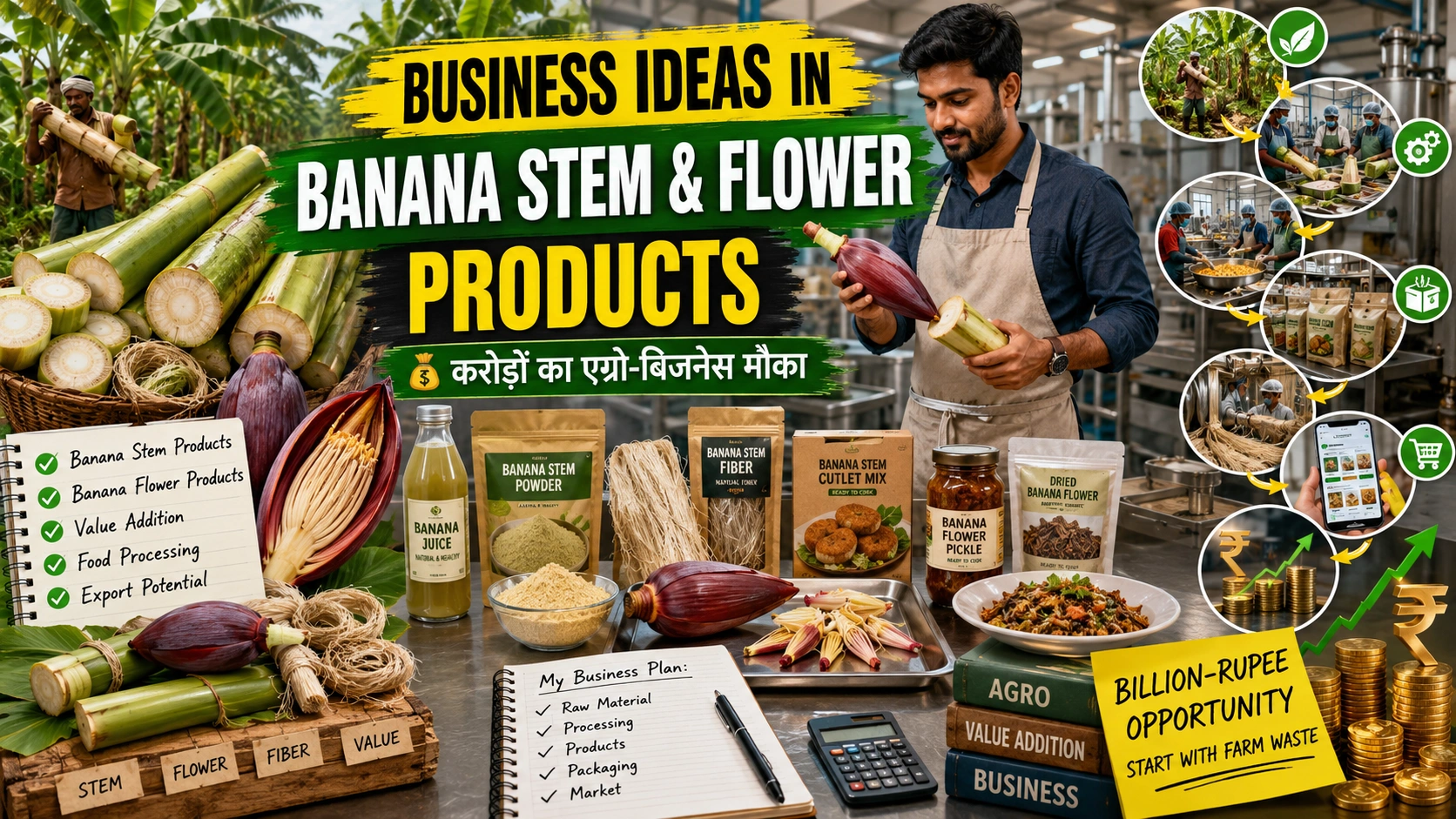
Banana Stem and Flower Business
India is the largest banana producer in the world with an annual production of more than 37 million tonnes. But the significance of this giant agricultural success is camouflaged by a silent wastage problem and in this problem is the one of the most interesting agro-processing opportunities for Indian entrepreneurs, MSMEs, startups and food manufacturers at present.
The banana plant has been discarded of or underutilised for decades, after the fruit harvest, of the most commercially versatile parts: its stem and flower. In all the banana belts of Tamil Nadu, Maharashtra, Gujarat, Kerala, AP and Karnataka, millions of tonnes of pseudo-stems and blossoms are thrown away every year which are rich in nutrients and have great industrial value. But a new revolution is coming to change that calculation.
Consumption of natural, plant-based functional products has picked up significantly in the urban market in India. Food and beverage products that offer nutrition, tradition, and clean label are in demand with health-conscious consumers. Long-established staple ingredients of home cooking in South and West Indian cuisines, banana stem and banana flower are now beginning to appear as raw material sources for a variety of products with commercial potential – ready-to-eat pickles, dietary fibre concentrates, nutraceutical supplements, natural energy drinks and value-added culinary products.
This blend of an abundant agricultural sector, high consumer demand and manufacturing capability is a huge business opportunity that hasn’t been fully exploited by entrepreneurs and investors outside saturated markets.
What This Development Means for Indian Businesses
The realization that banana stem and flower is a valuable raw material is not just a trendy fashion. It represents a structural change in the way agro-food businesses in India can make use of the waste generated at the farm level by transforming it into higher valued food products that can be sold in the market under the umbrella for functional foods, natural foods and traditional foods, which have a higher demand in the markets.
A financial argument is convincing. The main trunk of the plant (the banana pseudo-stems) contain a high amount of dietary fibre, potassium and natural fluids in plants. The blossom or banana flower contains flavonoids, Vitamin C, Vitamin E and iron. Both are ideal as key components in a wide range of natural energy drinks, pickling salts, functional food supplements and for premium retail placement in the food industry.
For Indian enterprises, the chance is played out at different value chain locations. Farmers and farmer producer organisations can provide raw stems and flowers to the processors at a quantity which can significantly cut the present post-harvest losses. Small and medium food processors can set up specific manufacturing facilities for finished consumer food products. FMCG companies and D2C startups can create their own product lines which now occupy a competitive health, wellness beverage and food category.
The special part of this opportunity is that it does not involve new crops, new import requirements and no exotic raw materials. The input base—banana stem and flower—is already at gigantic scale, much of which is going unused. Utilizing this waste stream for commercial output generates economic value and an agro-processing business model that has value and a sustainability story.
View Full Project Details: Banana and Its By-Products Manufacturing
Why This Industry Could See Stronger Growth
There are some structural factors which are coming together in favour of banana value added products expansion in India and abroad.
There is growth in consumer demand for function, plant-based drinks, which is outpacing supply in many categories. The health drinks market in India is estimated to grow to USD 28.45 billion by 2033, with people in urban areas looking for natural, low-sugar, preservative-free drinks as alternatives to carbonated drinks. The banana stem extract is a natural substance that can be used to produce energy drinks, which are a viable product in this niche due to the fact that they provide hydration, natural electrolytes, and dietary fibre, but without any synthetic additives.
As the culinary culture and retail networks in India continue to grow, the pickle market is still thriving. Specialty pickles produced from banana flower and banana stem are gaining ground in the modern retail channels and e-commerce food sites as well as in gourmet food stores, especially in the metro and tier-1 cities where people are looking for authentic regional products with health benefits.
Production of bananas in India is geographically clustered provides cost-effective raw material clusters in Tamil Nadu, Maharashtra, Andhra Pradesh and Gujarat. Food manufacturing processing units built inside or near such clusters can take advantage of the low transport cost for access to raw materials.
The dimension of export markets is further. For the Indian community in the Gulf, the UK, USA, Canada, Australia and Southeast Asia, Indian processed foods, such as pickles and health drinks, have gained traction. Further, the rising demand for plant-based, sustainable, and heritage food products offers opportunities in global specialty, organic retail segments for well-formulated and well-packaged products made from bananas produced in India.
Government Policies and Incentives
For entrepreneurs who wish to venture into the market of processing banana stem and flower, there are a number of support mechanisms provided by the government. Credit linked subsidy of 35% on project cost for micro food processing enterprises is available under the PM Formalisation of Micro Food Processing Enterprises (PM FME) scheme of the Ministry of Food Processing Industries applicable to banana-based food manufacturing project. The scheme provides assistance for upgrading, formalisation and market linkage of micro-enterprises.
The Ministry of Food Processing Industries (MoFPI) also has the Production Linked Incentive (PLI) Scheme for food processing to cater to the interest of medium and larger size food manufacturers who are planning to also scale up their processed food products for the domestic and export market. Drinks and packaged foods based on bananas may be eligible under certain product categories under this scheme.
As for manufacturing enterprises, the Prime Minister’s Employment Generation Programme (PMEGP) is administered by the Ministry of MSME which gives financial assistance up to ₹50 lakh. For entrepreneurs starting food processing units based on bananas under PMEGP, they can avail themselves of capital subsidy which significantly decreases initial cost.
The SFURTI scheme (Scheme of Fund for Regeneration of Traditional Industries) is applicable to the rural clusters of artisans and small manufacturers and it is relevant for creating clusters of banana fibre and banana product-based clusters in the production belts of Kerala, Tamil Nadu and Maharashtra. The scheme supports financial assistance for capacity building, procurement of raw materials and common facility centres.
State-level support is also crucial. In Tamil Nadu, one of the major bananas producing States in India, there is active promotion of agro-processing through the Tamil Nadu Industrial Development corporation (TIDCO) who provide land, infrastructure and investor assistance for food processing projects.
The National Horticulture Board (NHB) provides financial assistance for post-harvest management, cold storage, packaging, and processing infrastructure related to horticultural crops including banana. Entrepreneurs looking to establish value-addition processing for banana stem and flower can explore NHB subsidy programs as part of their project financing.
For startups, Startup India provides tax exemptions for three years, fast-track patent filing, and access to the Fund of Funds for Startups—all accessible to food technology and agro-processing startups developing innovative banana-derived products.
Export-focused entrepreneurs should register with the Agricultural and Processed Food Products Export Development Authority (APEDA), which provides financial assistance for export promotion, market development, and quality certifications for processed food products including banana-derived food and beverages exported from India.
The National Research Centre for Banana (NRCB), ICAR has developed and transferred specific processing technologies for banana flower and stem pickles and value-added products. Entrepreneurs can access proven technology packages, training, and technical guidance from NRCB, significantly reducing the technology development risk for new entrants.
Get Detailed Insights from This Book: Book
Manufacturing Business Opportunities Emerging From This Development
1. Banana Stem Natural Energy Drink Manufacturing
The juice from the inner core of the banana pseudo-stem is a natural source of potassium, dietary fibre and plant-based minerals. Formulated and packaged as a natural energy drink, it can directly challenge energy drinks and packaged fruit juices in the health and wellness category.
Their target customers are health-conscious urban consumers, gym goers, diabetic and wellness market buyers, and institutional buyers like hospitals, wellness centres and corporate cafeterias. The process of manufacturing includes extraction, minimal flavour addition (for palatability), pasteurisation or aseptic processing, and packing in tetra packs, glass bottles or PET containers. With India’s energy drinks market size around INR 6500 crore with an increasing growth, the plant-based energy drink with clean label has the pricing power. There are exporting opportunities in the Gulf, UK, USA and Southeast Asia regions. Moderate capital investment can be made for MSME scale units.
2. Banana Flower and Stem Pickle Manufacturing
Pickle making from banana flower (mocha) and banana stem is a proven and established food processing technology with commercial viability. The product has a shelf life of one year or more, and is attractive to consumers who want authentic, traditional South and West Indian condiments.
Commercial processing includes blanching, mixing of spices, oil treatment and sealing with food-grade packaging. The market includes modern retail, online grocery delivery, supply to south Indian restaurants, and special food export. The raw materials are readily available in the banana growing areas, cheap and provided by farmer organizations. Relatively small investment is required for setting up MSME units. Markets with substantial Indian expatriate populations, such as the UK, UAE, USA, Canada, Malaysia and Singapore, are markets where export demand exists.
3. Banana Stem Dietary Fibre and Nutraceutical Ingredient Processing
Banana stem dietary fibre is a high value industrial product which can be applied in functional foods, nutraceutical supplements and pharmaceutical formulations. Food manufacturers are seeing a surge in demand at the ingredient level due to a growing awareness of the gut health, diabetes management and functional nutrition.
Entrepreneurs can set up extraction and drying facilities to produce banana pseudo-stem in the form of regularised dietary fibre powder or isolates. The product is used by the food manufacturers, nutraceutical companies, and pharmaceutical producers as a B2B ingredient. The price of per kg realisation is much higher than of finished food products in this segment, which makes it attractive for manufacturing units who get a steady supply of raw material. Potential export markets to European, USA and Japanese functional food manufacturers is good as banana dietary fibre is a clean label and plant-based ingredient.
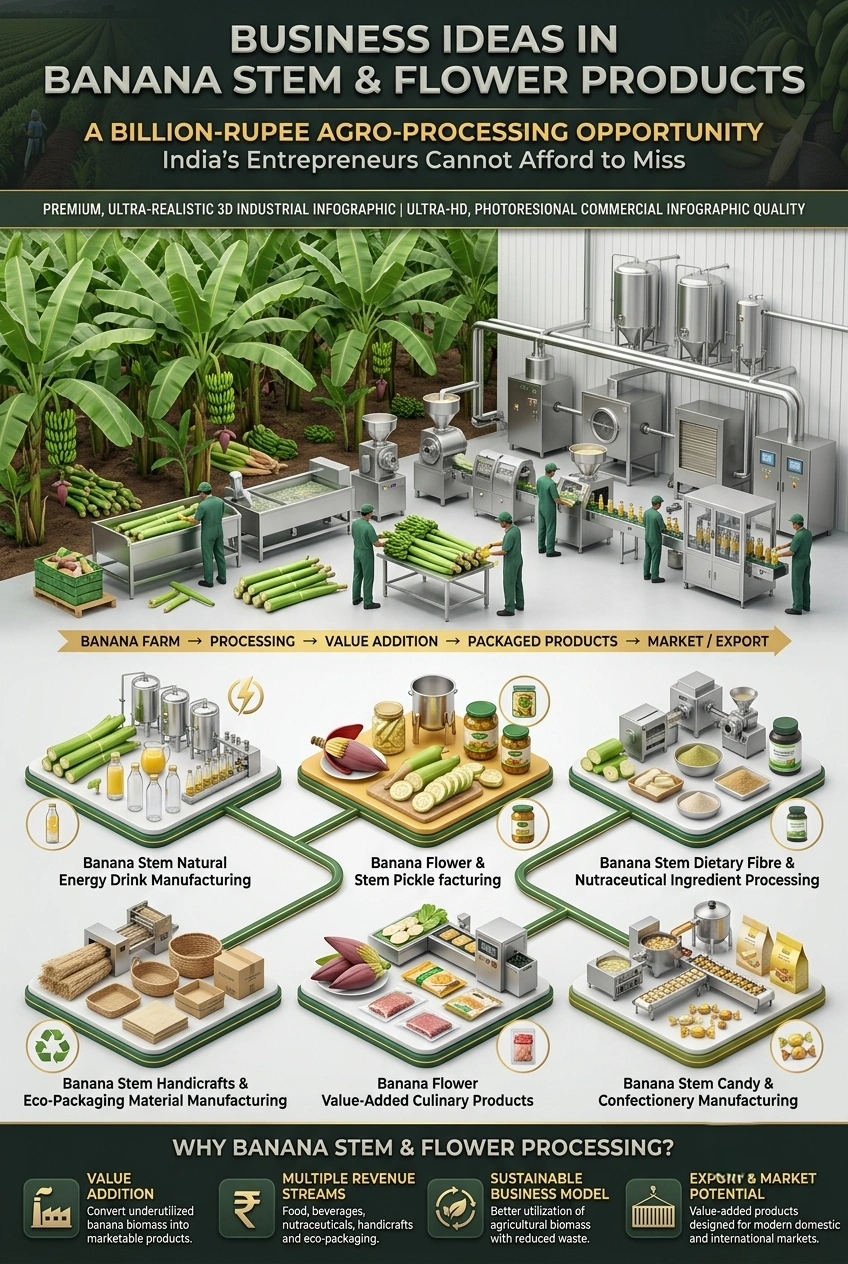
4. Banana Stem Handicrafts and Eco-Packaging Material Manufacturing
Banana pseudo-stem fibre is also well-known for its high tensile natural fiber properties, and has been used in fabrics, ropes, mats, packaging materials and handmade crafted items for long. As a result of the policy shift towards eliminating single-use plastics, the demand for sustainable and biodegradable packaging is growing rapidly within the industry and globally in India.
MSME units are able to set up banana fibre extraction and processing centres with decorticator machines. Finished products such as banana fibre-based bags, paper and packaging material have been able to provide export demand in Europe, Japan and the Gulf. A few Indian start-ups have already proven the feasibility of such a business and some of the international brands in fashion and lifestyle are looking for sustainable inputs for their material.
5. Banana Flower Value-Added Culinary Product Manufacturing
In addition to pickle, banana flower (blossom) can be processed into other types of ready-to-cook and ready-to-eat culinary products: dried banana flower flakes, banana flower powder; curry paste; and banana flower snack products. The products are for urban consumers who want to use traditional cooking ingredients that are easy to use, and healthy snacks too.
The manufacturing process comprises of cleaning, blanching, drying or dehydrating, grinding or packaging. The products can be sold via contemporary retail, quick commerce and online food platforms. Export markets include markets for Indian diaspora and specialty food importers from the USA and UK. This is a sub-segment of the larger specialty food segment for South Asia that is growing.
6. Banana Stem Candy and Confectionery Manufacturing
Banana stem has an inner core with mild flavor and crunchy texture that can be used to make sugar-free or sugar reduced candies and confectionery based on diabetic care, health and children food markets. This niche is in its nascent stage in India and as such, first movers would own the segment by developing brand identity and standardised manufacturing processes.
Procurement of raw materials from the banana belt in Tamil Nadu and Kerala is a simple process. Manufacturing consists of cleaning, standardised boiling, flavour addition and packaging. The product can be sold in Health Food Retail, Pharmacy Retail, and E-Commerce with a focus on wellness.
Related Article: 25 Profitable Banana Business Ideas in India: Complete Guide for Entrepreneurs
Import-Export and International Market Opportunity
Export Opportunity
The banana processing and value addition industry in India has definite export capability in various product segments. Gulf Cooperation Council (GCC) countries, UK, USA, Canada, and Southeast Asia, which have large Indian communities and a surge of interest in plant-based, functional drinks, can serve as potential markets for natural energy drinks made from bananas. There are existing export demand patterns for banana flower and stem pickles as well, as India has already exported to Malaysia and Australia via exporting companies.
Banana fibre-based eco-products are important for export to Europe and Japan, where regulatory and consumer pressure for sustainable packaging and textile materials are driving this. Indian banana fibre producers have proven to be able to receive export orders from Western fashion companies and companies that care about sustainability. Banana stem is an excellent source of dietary fibre and nutraceutical ingredients that have very high value in B2B export markets in Europe, Japan and North America.
Import Substitution Opportunity
India is currently importing some of the dietary fibre ingredient requirements for pharmaceutical and nutraceutical industries, specialty natural fibre-based materials. Domestic processing of banana pseudo-stem into standardised dietary fibre concentrates and natural fibre composites can be a direct substitute to these imports, offering a viable import substitution manufacturing opportunity. Considering the raw material availability and the competitive production costs in India, businesses producing banana fibre and ingredient could be a competitive option to their imported counterparts as long as they maintain the standards of quality in the Indian market.
Indian MSMEs and Startups in Related Industries
KRL Foods, Tamil Nadu
KRL Foods is an established example of a commercially successful banana flower and stem pickle enterprise. The company, which received technology transfer from the National Research Centre for Banana, operates under a dedicated brand and distributes its products across Tamil Nadu and to select markets in Karnataka, Kerala, Gujarat, and Maharashtra. The business also exports to Malaysia and Australia through sub-buyers, demonstrating that a relatively small-scale processing operation can achieve both domestic and international market presence. Entrepreneurs can draw from this example that technology-backed, branded, and well-distributed niche food products built on locally abundant raw materials can achieve sustainable commercial scale.
Malawa Kela Resa Utpadan Laghu Udyog Kendra, Madhya Pradesh
This enterprise, established by Ravi from Madhya Pradesh, upcycles banana stem into fibre-based handicrafts and products sold through market channels including exhibitions at Pragati Maidan, New Delhi. The business demonstrates that banana stem-based enterprises need not be limited to food processing—natural fibre-based crafts and products present a parallel commercial opportunity. For MSME entrepreneurs in banana-growing belts, this model illustrates how farm-level waste can be converted into sellable artisanal products with urban market appeal.
Greenikk, Tamil Nadu and Kerala
Greenikk is a startup co-founded by Fariq Naushad and Previn Jacob, built on the observation that farmers across India burn enormous quantities of banana stems post-harvest. The company established Enablement Centres across Kerala, Tamil Nadu, and Karnataka to create a farmer-to-buyer supply chain for banana fibre. This approach enabled Greenikk to secure a significant international order—15,000 banana fibre bags from France—demonstrating that technology-enabled, farmer-integrated supply chain models can unlock global markets for Indian banana-derived products. For startup founders, the Greenikk example underlines the commercial and reputational value of combining farmer empowerment with sustainability-oriented product positioning.
What Entrepreneurs Should Evaluate Before Investing
A structured feasibility assessment is essential before committing capital to any banana stem or flower processing business. The following parameters deserve careful evaluation:
- Market Demand: Verify target customer segments and their price sensitivity. Conduct retail and online market research to assess product placement feasibility in modern trade, quick commerce, and export channels.
- Raw Material Access: Identify banana-growing clusters within economic transport distance. Establish supply agreements with farmer groups or Farmer Producer Organisations (FPOs) to ensure volume and consistency.
- Technology and Process: Source proven technology from ICAR-NRCB or other credible institutions. Avoid developing processes from scratch without technical validation.
- Machinery and Infrastructure: Capital requirements vary by product. A banana stem pickle unit can be established at relatively modest investment; a dietary fibre extraction unit requires higher processing infrastructure. Obtain detailed machinery quotations before finalising project costs.
- Quality and Regulatory Compliance: Products must meet FSSAI standards. Export-oriented units must additionally meet APEDA-notified quality standards and, where required, international food safety certifications such as HACCP or ISO 22000.
- Distribution and Market Access: A product without distribution is commercially valueless. Develop a realistic distribution plan before investment—modern retail listing, online platform tie-ups, export agent relationships, or direct institutional sales agreements.
- Working Capital: Seasonal availability of raw materials may require planned raw material stocking. Factor working capital for inventory, processing, packaging, and distribution logistics.
- Competitive Landscape: Research existing brands in the target product category. Identify differentiation—whether through taste, packaging, origin story, certification, price point, or channel focus.
- Break-Even and Profitability: Prepare a detailed financial model covering fixed costs, variable costs, pricing, volume projections, and break-even timelines. Engage with a project consultancy or conduct a formal feasibility study before finalising investment decisions.
Identify high-growth industries before others do
How NPCS Can Help Entrepreneurs Evaluate the Opportunity
NPCS – Niir Project Consultancy Services is a specialised industrial and project consultancy with deep experience in agro-processing, food manufacturing, and MSME project development across India. For entrepreneurs evaluating investment in banana stem and flower processing, NPCS provides a structured suite of professional advisory services:
- Detailed Project Reports (DPRs) covering project cost, plant layout, machinery specifications, raw material sourcing, financial projections, and regulatory requirements for banana-based processing businesses.
- Feasibility Studies that assess market demand, competition, pricing, and financial viability before investment commitment.
- Technology Consultancy and Plant & Machinery Assessment to help entrepreneurs identify appropriate processing technology and equipment suppliers.
- Market Research on domestic and export market demand for banana-derived products including beverages, pickles, fibre, and nutraceutical ingredients.
- Manufacturing Project Planning for new units and expansion of existing agro-processing facilities.
A well-prepared project report and feasibility study remain the most cost-effective steps an entrepreneur can take before committing significant capital to any new manufacturing venture.
Business Opportunity Snapshot
| Parameter | Details |
| Industry | Agro-Processing / Food & Beverage / Natural Fibre / Nutraceuticals |
| Market Driver | Health & wellness consumer shift, banana agri-waste valorisation, demand for plant-based functional products |
| Key Development | Rising commercial interest in banana stem energy drinks, banana flower pickles, dietary fibre, and eco-products |
| MSME Opportunity | High — multiple product segments suitable for small and medium processing units |
| Manufacturing Potential | Energy drinks, pickles, fibre extract, dietary fibre powder, handicrafts, confectionery |
| Export Potential | High — Gulf, UK, USA, Malaysia, Australia, Europe for food, fibre, and ingredient products |
| Import Substitution | Dietary fibre and natural fibre materials currently partially imported; domestic production feasible |
| Government Support | PM FME, MoFPI PLI, PMEGP, SFURTI, NHB, NRCB, APEDA, Startup India |
| Investment Consideration | Varies by product; modest to moderate for food units; higher for fibre/ingredient extraction |
| Risk Level | Moderate — raw material seasonality, FSSAI compliance, distribution, and market acceptance are key risk factors |
| Growth Outlook | Positive — supported by consumer trends, export demand, and government agro-processing policy |
Conclusion
India’s position as the world’s largest banana producer creates an extraordinary manufacturing opportunity that remains significantly underexploited. The growing commercial interest in banana stem-based natural energy drinks, banana flower and stem pickles, dietary fibre ingredients, eco-packaging materials, and speciality confectionery products signals a shift in how the agro-food sector views what was previously considered agricultural waste.
For MSMEs, startups, food manufacturers, and agri-entrepreneurs, the banana stem and flower processing space offers a rare combination of raw material abundance, consumer demand growth, government policy support, and export market access—all within a segment that is not yet crowded with established competition.
The window for early movers is open. Entrepreneurs who conduct structured market research, prepare detailed feasibility studies, and develop products with clear consumer positioning and distribution plans are well placed to build commercially meaningful businesses in this space. The combination of India’s agricultural scale and the growing global appetite for plant-based, natural, and traditionally rooted products creates a compelling case for investment in banana stem and flower value-addition.
The time to evaluate this opportunity seriously—through proper market research, feasibility assessment, Detailed Project Report preparation, and investment planning—is now.


