





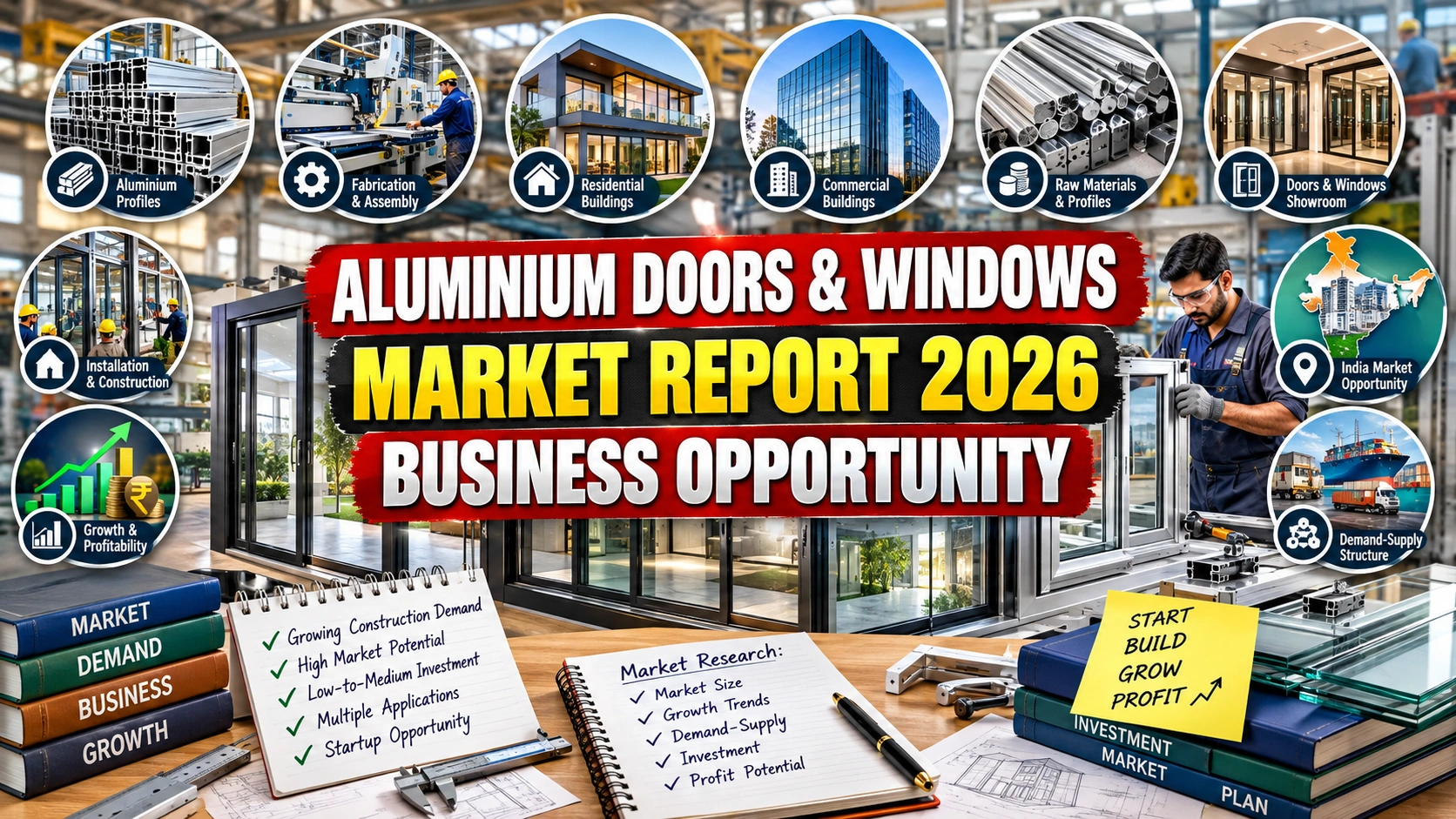
Go anywhere in urban India and you will find that today’s window frames are very probably aluminium, rather than wood or steel from a generation past. The aluminium door and window market in India is worth more than USD 6 billion and expanding at over 7% per year, not only in terms of the number of units being sold, but also due to a real material change as homebuyers and developers switch to materials like Aluminium that are durable, easy to maintain and design.
This is a sizable, structurally expanding market with a unique layer of competition that needs to be understood: a high-quality, technically advanced market, driven more and more by energy-efficiency codes, over a much larger and more diffuse mass-market fabrication layer.
What Are Aluminium Doors & Windows?
Aluminium doors and windows are products of fenestration (window and door systems) created from extruded aluminium alloy profiles and known for their strength-to-weight ratio, corrosion resistance, slim sight lines (which enable greater glass area), and long lifespan compared to their wood and steel counterparts. The category covers a variety of technical sophistication:
- Standard aluminium sliding/casement systems: Traditional, affordable aluminium window and door systems for bulk residential and commercial applications.
- Thermally broken aluminium systems: Must include a thermal break (usually polyamide) in the aluminium system to minimise heat transfer, which is important for meeting energy efficiency requirements for building codes.
- Awnings & balustrades – steel, iron and aluminium large-span balcony systems
- Premium/engineered systems – systems designed with advanced features, such as magnetic sliding tracks, multi-point locking, Wind, Water, Air performance certification and connection to smart home systems.
The fabrication process is quite a bit more easily undertaken by a regional fabricator than producing primary aluminium; this includes: extrusion or sourcing extruded profiles, cutting, machining, surface finishes (powder coating or anodising), hardware fitting and assembly.
Read the Complete Book Here: The Complete Technology Book on Aluminium and Aluminium Products
Global and India Aluminium Doors & Windows Market Size and Growth
The aluminium door and window market is worth about USD 78.6 billion in 2026 and will reach USD 142.09 billion by 2035 with a CAGR of approximately 6.8% and the demand in this market is expected to focus mainly on China, India and the United States where urbanisation is gaining momentum. A similar but more focused projection for the aluminium alloy windows market values the market to be worth USD 11.51 billion by 2026, and USD 16.38 billion by 2035.
The aluminium door and window market in India is estimated to be around USD 6.16 billion in 2025, to rise to USD 9.39 billion by 2031 at around 7.1-7.8% CAGR, making India one of the fastest growing national markets in the world as it experiences construction boom and a strong material shift from wood and steel to aluminium and UPVC. The India’s wider doors and windows market (all materials) has already crossed USD 6.8 billion and in some narrower definitions, the aluminium fenestration market is expected to cross USD 1.5 billion by 2027.
Note on figures: Market size estimates are subject to significant variation, depending on the study which refers to finished doors/windows, aluminium profile/extrusion volume or the total fenestration market (which includes UPVC and other materials). NPCS can also provide a project-specific techno-economic feasibility study for the numbers for investor that are suitable for the specific product tier (standard, thermally broken, premium) and specific target segment.
A Two-Tier Market: Premium International Brands Above a Fragmented Fabrication Base
The structure of the aluminium fenestration industry in India is unique and needs to be understood before venturing in the business. On top of that is a rising tier of technically advanced and high-end brands many of which are tied to international systems houses (such as Schüco, Reynaers Aluminium, Technal, AluK, Alumil, Tostem/Lixil, Asian Paints/Weatherseal) and strong home-grown premium players (ALCOI India, Fenesta, Eternia by Hindalco, Weatherseal by Asian Paints) which are competing on engineering precision, thermal performance, certification (WiWA, IGBC, GRIHA compliance), and design.
The base of regional and local aluminium fabricators who produce for the mass residential and commercial market is much larger, and more fragmented, and typically use standard (not thermally-broken) profile systems with less formalised quality certification.
This makes it nearly impossible for a new player to break into the premium tier, but the mass-fabrication tier, though more competitive, is also large, regionally scattered and open to a well-managed MSME-sized fabricator.
Policy Tailwinds
- Energy Conservation Building Code & its upcoming revised code 2026: Encouraged by forthcoming Energy Conservation & Sustainable Building Code guidelines mentioned in the Economic Survey 2024-25, thermal-performance criteria of building envelopes components are increasingly mandated by these codes, favouring the thermally broken aluminium systems over simple, non-insulated aluminium systems.
- Buoys up: New construction permits in Mumbai, Delhi and Bangalore now stipulate compliance with Bureau of Indian Standards (BIS) for aluminium profile energy efficiency, driving import substitution to certified domestic fabricators and increasing the level of compliance for the market.
- PM Surya Ghar Yojana and PMAY-Urban 2.0: With PM Surya Ghar Yojana backed by ₹75,021 crore, and Pradhan Mantri Awas Yojana-Urban 2.0 driving fenestration demand into Tier-2 and Tier-3 cities, government housing and energy schemes are unlocking large-scale retrofit and new-construction demand for energy-efficient fenestration.
- India’s USD 1 trillion construction pipeline target by 2030: The overall scale of India’s construction sector growth provides the structural demand base underpinning fenestration market expansion across all material types.
- Green building certification growth: IGBC and GRIHA certification frameworks increasingly reward energy-efficient glazing and thermal-break aluminium systems, creating specifier-driven demand for certified premium product.
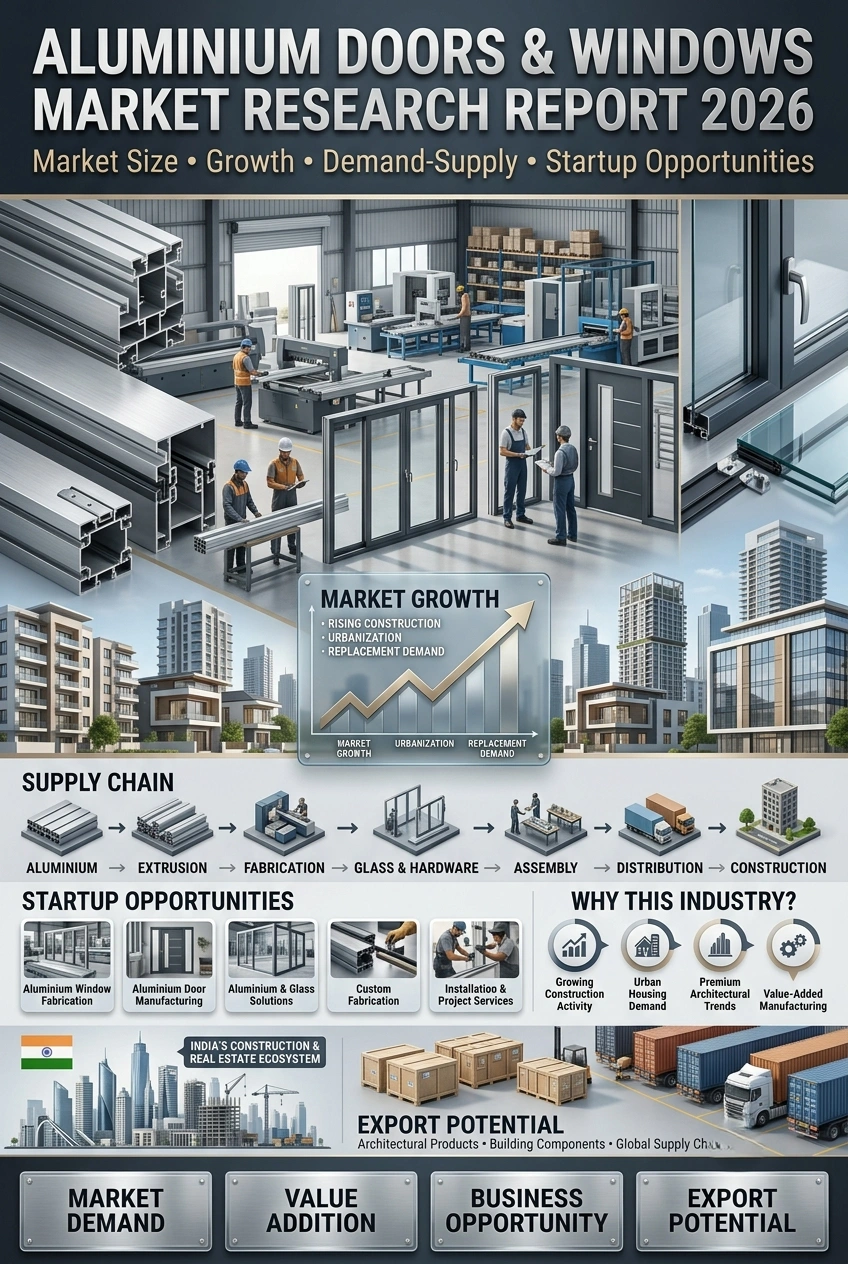
India Market Structure: Aluminium Doors & Windows
| Parameter | Current Position |
| Market size (2025) | ~USD 6.16 billion, growing at 7.1-7.8% CAGR |
| Market structure | A distinct two-tier structure: an organized premium tier (international systems brands plus strong homegrown players) and a much larger, fragmented regional/local fabrication base |
| Import dependency | Present but concentrated at the high-value end — premium engineered systems, polyamide thermal-break components, and some hardware remain import-dependent; standard aluminium profile fabrication is largely domestic |
| Regulatory driver | New BIS certification mandates for aluminium profile energy efficiency in major cities are actively reshaping the competitive landscape, favouring certified domestic fabricators |
| Nature of the opportunity | Not a clean import-substitution gap, but a regulatory-driven quality upgrade opportunity — as ECBC-style codes and BIS certification requirements tighten, fabricators who invest ahead of the curve in thermally broken systems and proper certification are positioned to capture share from both the uncertified informal segment and from imported premium systems |
| Regional demand shift | Real estate development beyond Tier-1 metros, supported by PMAY-Urban 2.0, is extending fenestration demand into Tier-2/3 cities historically underserved by premium national brands |
Reading the market: This category resembles construction chemicals in structure — a large, genuinely fragmented market where no single player dominates, layered with a premium segment increasingly shaped by energy-efficiency regulation. The opportunity for a new entrant sits less in overcoming an import gap and more in positioning correctly relative to the coming regulatory shift: fabricators who invest early in thermally broken, BIS-certified, ECBC-compliant systems are well placed to capture share as codes tighten and informal/uncertified competitors face rising compliance pressure.
Related Article: Aluminium Value-Added Manufacturing in India: A High-Growth Startup Opportunity
Major Indian Aluminium Doors & Windows Manufacturers
| Company | Base/Region | Notes |
| Hindalco Industries Ltd. (Eternia brand) | Multiple locations (Aditya Birla Group) | India’s largest aluminium producer; Eternia is its fenestration brand, using “Duranium” — described as the world’s first patented aluminium alloy developed specifically for windows; India’s first WiWA-tested and certified window brand |
| Fenesta Building Systems (DCM Shriram) | Multiple locations, pan-India | Among India’s most recognised organised fenestration brands, with strong retail presence in both UPVC and aluminium systems, particularly for mass residential projects |
| Jindal Aluminium Limited | Bengaluru, Karnataka | Major Indian aluminium extrusion company with a significant presence in the aluminium doors and windows market |
| ALCOI India | Pan-India (25+ cities) | Founded 2006; premium engineered fenestration systems combining European-grade design with Indian climate-tailored performance; 500+ completed projects |
| AluPure | India | Premium aluminium systems brand with European design influences, often specified for high-end residential projects |
| Weatherseal (Asian Paints) | India | Fenestration brand under Asian Paints, among the recognised premium aluminium window brands in India |
| AIS Windows | India | Recognised Indian premium aluminium and glazing systems brand |
| FabFrame (Atul Glass) | Chandigarh (pan-India execution) | Performance-driven brand known for customisation-focused fabrication and pan-India project execution |
| Lingel Windows | India | Combines German technology with localised fabrication for residential and commercial applications |
Major International Aluminium Fenestration Players (India-Active)
| Company | Country | Notes |
| Schüco | Germany | Global leader in high-performance facade and window systems, leveraging European engineering heritage; active in the Indian premium/commercial segment, supported through the Indo-German Chamber of Commerce network |
| Reynaers Aluminium | Belgium | European-grade design and insulation solutions provider, active in India’s contemporary architecture segment |
| Technal | France | Known for large-span architectural systems and curtain walls with a strong structural reliability focus |
| AluK | United Kingdom/Italy | Global aluminium systems house active in the Indian market, known for innovative designs |
| Alumil | Greece | Offers a broad selection of European aluminium solutions for Indian developers and commercial contractors; introduced SUPREME S500 PHOS thermally insulated system with magnetic levitation track technology in June 2025 |
| Tostem (Lixil Group) | Japan | Japanese-engineered aluminium systems known for precision manufacturing, targeting India’s mid-to-premium segment |
Market Segmentation
By Product Type
- Windows (sliding, casement, tilt-and-turn) — largest volume segment
- Doors (sliding, hinged, folding)
- Curtain walls and structural glazing — commercial/high-rise segment
By Technology
- Standard (non-thermally-broken) aluminium systems — dominant in mass-market/value segment
- Thermally broken systems — growing rapidly, driven by ECBC and green building code compliance
- Premium engineered systems (magnetic levitation tracks, multi-point locking, WiWA-certified) — smallest but fastest-growing, highest-margin segment
By Application
- Residential (new construction and retrofit) — largest segment, driven by urbanisation and rising disposable incomes
- Commercial (offices, hotels, hospitals, educational institutions) — driven by thermal/acoustic insulation, safety, and fire-rating specifications
- Institutional and public infrastructure
By End-Use Building Type
- High-rise residential and commercial towers (above 12-15 floors) — aluminium’s structural rigidity and wind resistance make it especially favoured here, with over 60% of high-rise fenestration demand globally using aluminium systems
- Low-rise residential — increasingly shifting from wood/steel to aluminium and UPVC
- Retrofit/renovation of existing buildings — a growing segment as energy-efficiency retrofit programmes expand
View Full Project Details: Aluminium Printing Plate Manufacturing Project Report
Key Growth Drivers
- Shift in structural material away from wood and steel. Traditional wooden and steel doors/windows are losing their popularity, and the demand for aluminium and UPVC is taking its place, especially in the construction of multi-storey apartments in Tier-2 and Tier-3 cities.
- Tightening energy-efficiency building codes. Thermally broken aluminium systems are being directly specified in commercial and more recently residential building for ECBC and its successor codes.
- Government housing and energy schemes. The PM Surya Ghar Yojana and PMAY-Urban 2.0 are creating new retrofit and new construction fenestration demand in the Tier-2/3 market which was previously untouched.
- Growing premium and luxury housing market. The high-margin premium segment is growing due to increased demand for larger glass areas, few frames and smart-home-integrated systems by homebuyers.
- The increase in high-rise commercial and residential building. The increasing heights of the urban skyline in India are directly impacting the demand for aluminium, owing to its structural performance and advantages.
- BIS certification and green building specification. The rise in certification requirements and IGBC/GRIHA green building recognition is professionalising the market and is promoting those fabricators who are certified and produce quality consistent products over those who are not certified and informal.
Challenges and Restraints
- Volatility of raw material prices. Aluminium is a commodity traded world-wide, and in some years, LME price fluctuations have been more than 15%, putting downward pressure on fabricator margins and offsetting fixed priced commercial contracts.
- High level of fragmentation and competition at mass market segment. A large unorganised sector exists with fierce price competition and differentiation is necessary for sustainable margins, in terms of quality and certification.
- Import reliance on special components. Some high-quality hardware products still rely heavily on imports, however, and polyamide thermal-break materials are heavily reliant on specialty polymer producers in Europe and China that certify thermal-break products.
- Investment in certification and compliance. Properly meeting BIS, WiWA and green building certification standards requires true testing and quality investment, and that is something that smaller fabricators may not be able to absorb.
- High fabrication skill labour demand. There is a need for skilled labour for precision cutting, machining and glazing, and skill availability may differ from region to region.
Competitive Landscape
The India aluminium fenestration market can be segmented into two categories: the organised premium segment, represented by domestic players such as Fenesta, Eternia (Hindalco), Alcoi India, Weatherseal (Asian Paints) and international systems houses such as Schüco, Reynaers, Technal, AluK, Alumil, and Tostem, and a larger, more heterogeneous mass segment, consisting of regional fabricators supplying the mass market of residential and commercial buildings.
Unlike construction chemicals, no single company controls the entire market, but unlike most other products in this series, the premium part of the market is more clearly defined by brand, certification and technical performance, making it a true strategic choice for new market entrants between competing in the value segment or investing in certified systems that are thermally broken, and enjoy a higher share of the market.
Identify high-growth industries before others do
Aluminium Doors & Windows Manufacturing: Business Opportunity for Startups and MSMEs
- Regional factory for mass residential and commercial market. Likewise, a good aluminium fabrication facility with standard systems to local builders and homeowners is a big, wide-open market especially in Tier-2/3 cities where national brand products have a limited distribution.
- Making ECBC compliant thermally broken systems. The early adoption of thermal-break technology and BIS certification gives a fabricator a head starts in the race for an even larger market when energy-efficiency codes become more stringent — not just a first-mover advantage over the large uncertified informal sector.
- High Quality/engineered systems for large homes and commercial buildings. Meaningful higher margins than standard fabrication is provided by building technical capability for the luxury residential segment and Grade-A commercial segment, which is aligned to the IGBC/GRIHA specification and WiWA testing.
- Retrofit and renovation-based fabrication. A fenestration retrofit fabrication and installation service is a unique and different revenue stream than the less new construction cycle dependent energy-efficiency retrofit programmes, as they grow and aging building stock necessitates fenestration replacement.
- Fabrication ecosystem component/hardware supply. The domestic production of thermal-break materials and specialty hardware supports the overall fabrication industry and do not directly compete as a fenestration brand because they are essential to the production of other fenestration products.
Investment and margin for aluminium fenestration fabrication is significantly different between each technology level from standard through thermally broken and premium engineered and between the two options of extruding their own profiles or buying extruded stock. NPCS develops Project Reports to outline the detailed bankable project and provides technology specific machinery list, guidance for certification pathway, and regional market assessment specific to your target technology and capacity.
How NPCS Supports Entrepreneurs Entering This Space
The initial step for any business person considering starting an aluminium doors and windows manufacturing business is to prepare a well framed Detailed Project Report (DPR) with regard to plant capacity, technology level (standard or thermally broken), compliance pathway with BIS/ECBC, raw material sources, manpower planning, project cost and financial viability with respect to the selected market segment.
About NPCS (Niir Project Consultancy Services)
NPCS, founded in 1994, is an ISO 9001:2015 certified New Delhi based Industrial Consultancy having more than 30 years of experience in Techno-economic and Project Consultancy. NPCS has provided over 150,000 project reports and profiles in 85 countries over the past 30 years and has covered most manufacturing and process industries including building materials, aluminium fabrication and architectural/construction products.
The following is a list of the key outputs of NPCS that would be relevant for an aluminium doors and windows business:
- Detailed Project Reports (DPRs) with plant capacity, machinery specifications and layout
- Techno-economic feasibility studies, such as BIS/ECBC compliance guidance
- Financial modelling – project cost, profitability analysis, ROI, break even calculation
- Specificity of raw material assessment, and evaluation of market in Indian regional construction market.
- Support Documentation for MSME loan applications, subsidy schemes and bank funding requirements.
Government and Institutional Reference Links
Entrepreneurs can also connect with the Indo-German Chamber of Commerce for technology partnerships with European systems houses, and the Confederation of Indian Industry (CII) Green Building Council for green building certification guidance relevant to thermally broken and energy-efficient fenestration systems.
- Ministry of Housing & Urban Affairs (PMAY-Urban 2.0)
- Ministry of Power — PM Surya Ghar Yojana
- Bureau of Indian Standards (BIS)
- Ministry of Micro, Small and Medium Enterprises (MSME)
- Development Commissioner, MSME (DCMSME)
- Ministry of Mines (Aluminium sector)
- Press Information Bureau (PIB), Government of India
- Startup India
- Invest India (National Investment Promotion and Facilitation Agency)
Entrepreneurs are advised to verify the latest ECBC/energy code updates, BIS certification requirements, and MSME subsidy guidelines directly on these portals, as regulatory provisions are periodically revised.
Conclusion
Aluminium doors and windows is a huge market that continues to expand in India and is seeing a material preference shift from wood and steel, in addition to a new regulatory focus as energy-efficiency codes and BIS certification requirements become stricter. Whereas in an import substitution gap the opportunity is to make the right move in a two-tier market, whether that is the low cost/high volume mass-fabrication world or the high margin, technically advanced premium market, here the opportunity is to create a legitimate quality footprint and certification credentials to claim share as the market becomes more professionalised.
Aluminium doors and windows present a big and steadily expanding market, and for entrepreneurs and MSMEs, it’s a clear business decision about going with the larger accessible value market or the smaller, but faster growing certified high-quality market.


